
Hops in Beer Brewing: Santiam
Gepubliseer:
Laas opgedateer: 25 Maart 2026 om 19:02:32 UTC
Santiam, an American aroma hop, emerged in 1997. It's celebrated for its soft, herbal, and floral notes. These characteristics are ideal for India Pale Ales and American Pale Ales. In the United States, brewers also employ it to enhance the aroma in lagers and other European-style beers, seeking a gentle noble-like quality.
Hops in Beer Brewing: Santiam
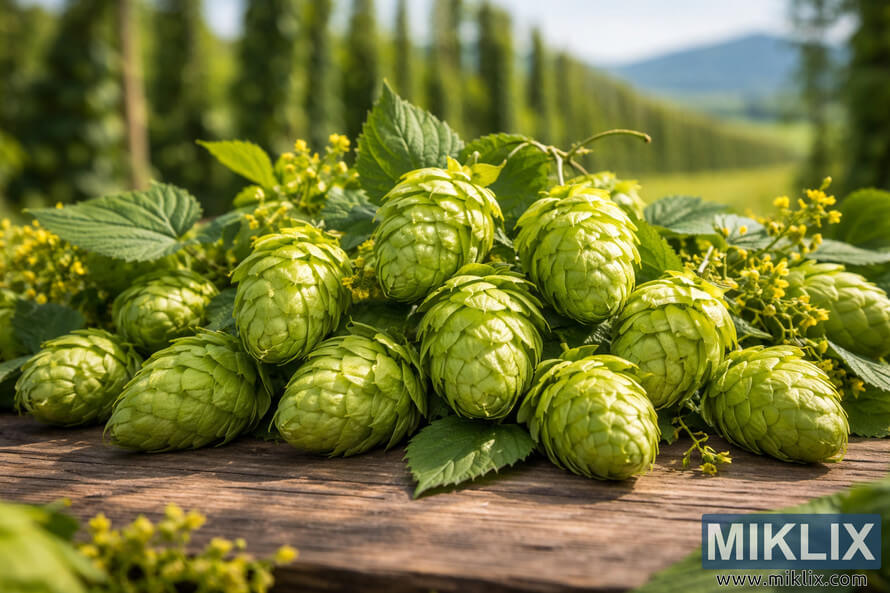
Klik of tik op die beeld vir meer inligting en hoër resolusies.
The Santiam hop boasts fruity highlights with subtle black pepper and spice accents. It excels in late-boil additions, whirlpool hops, and dry hopping. Its oil profile, rich in myrcene, humulene, caryophyllene, and farnesene, mirrors Tettnanger, making it a European-style option grown in Santiam USA hop yards.
Key Takeaways
- Santiam hops are an American aroma variety released in 1997, used mainly for finishing and dry-hop additions.
- The Santiam hop offers soft, herbal, floral aromas with fruity and spicy accents.
- Best applied late in the boil, in whirlpool, or as a dry hop to preserve volatile oils.
- Santiam brewing suits APA, IPA, and European-style lagers that need a mild noble-like aroma.
- Oil composition and storage traits make Santiam a close match to Tettnanger-style hops for many recipes.
Origins and breeding of Santiam hops
Santiam hops were developed to meet the Pacific Northwest's unique conditions. This effort began in the late 1980s at Oregon State University and the U.S. Department of Agriculture. The goal was to create a European-style aroma hop. Field trials were conducted to refine the selection, focusing on stable aroma and agronomic traits.
- Development at Corvallis, Oregon
- In Corvallis, a collaborative effort between academia and the USDA-ARS was underway. Researchers at Oregon State and the USDA-ARS conducted extensive trials. These trials aimed to assess aroma, yield, and disease resistance. The focus was on achieving consistent oil profiles for brewers.
- Parent varietals
- The breeding process involved Swiss Tettnanger and German Hallertauer Mittelfrüher as primary parents. A U.S. cultivar, derived from Cascade, contributed genetically. This blend aimed to merge noble floral and herbal notes with American hop characteristics.
- Release history and USDA involvement
- The USDA's formal release of Santiam hops marked the end of nearly a decade of breeding. The process began in 1988, with public notices issued after the final registration. The USDA worked with the Oregon Agricultural Experiment Station and stations in Washington and Idaho. Official reports detailed oil and acid compositions for growers and brewers.
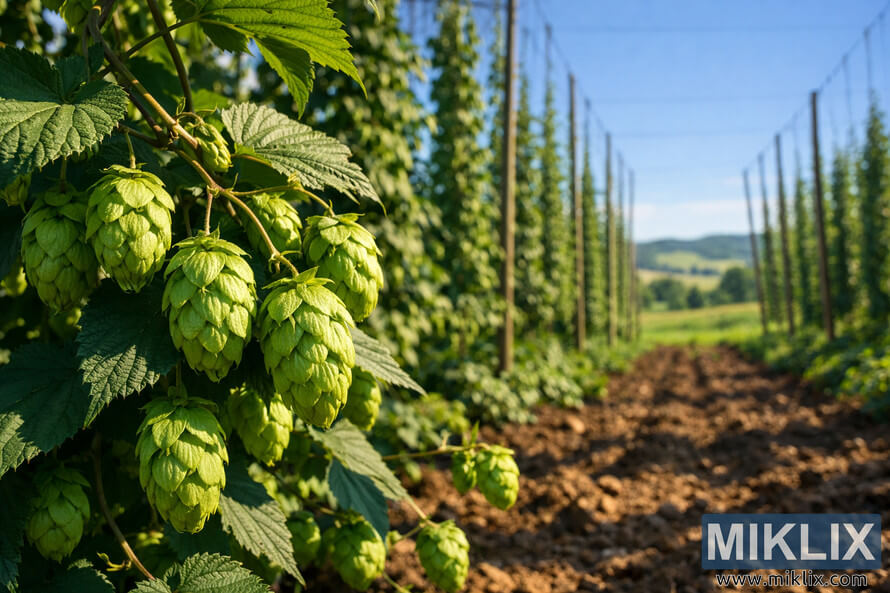
Klik of tik op die beeld vir meer inligting en hoër resolusies.
Santiam hops
Santiam is a standout among American-bred aroma hops, known for its European character and practical field traits. It was bred to offer brewers a mild, noble-like aroma. At the same time, it provides growers with sound agronomy across the Pacific Northwest. The cultivar's pedigree and field performance influence how brewers and farmers use it in modern recipes.
Triploid genetics and near-seedless cones
As a triploid, Santiam produces mostly near-seedless cones, even with male pollen present. This genetic makeup reduces viable seed formation. It improves cone quality for brewers and lowers the risk of seeded beer faults. The triploid status also ensures consistent aroma and visual quality in harvested hops.
Adaptation to Pacific Northwest growing regions
Trials in Oregon and Washington have shown Santiam's good adaptation to common PNW conditions. It exhibits moderate-to-high vigor, mid-season maturity, and reliable yields. Growers in some third-party trials have reported yields up to about 2,400 kg/ha. This makes Santiam a practical choice for those seeking European-style aroma with solid field performance.
Alternative names and code (SNT)
- SNT hop code is the standard identifier in many catalogs and trial reports.
- Growers and brewers often describe Santiam as Tettnanger-like or a European-type American aroma hop.
- Use of the SNT hop code simplifies ordering, trial tracking, and lab record keeping for procurement and research.
Santiam genetics, triploid Santiam, SNT hop code, and Santiam adaptation are mentioned in grower notes and brewery specs. This ensures clear communication across the supply chain. The blend of breeding, field behavior, and labeling makes the hop a staple among craft brewers. They seek a subtle noble profile with dependable agronomy.
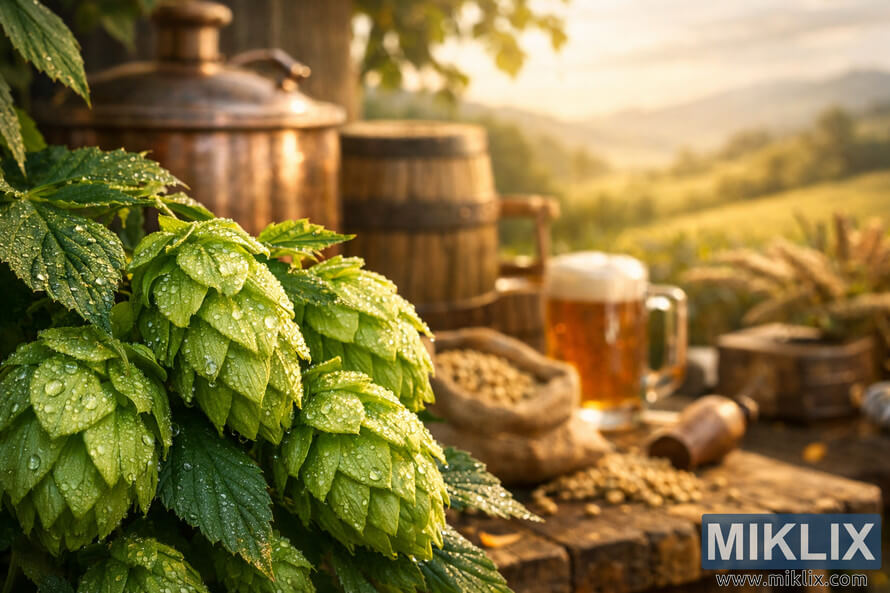
Klik of tik op die beeld vir meer inligting en hoër resolusies.
Flavor and aroma profile useful to brewers
Santiam offers a delicate blend of soft herbal and floral notes, appealing to brewers who value subtlety. Its flavor profile is reminiscent of noble hops, making it ideal for lighter lagers and restrained ales. Brewers often prefer late additions to maintain these delicate qualities.
The primary impressions include gentle floral lifts and fresh-green herbal tones. Santiam's aroma features fruity top notes, reminiscent of pear, light citrus, or stone-fruit hints. These fruity accents come from volatile oils like myrcene.
Peppery and spicy elements add complexity without overpowering the base. The Santiam spicy floral fruity character manifests as black pepper or warm spice, linked to caryophyllene and some sesquiterpenes. Small whirlpool doses or measured dry hops accentuate this spice, providing a savory contrast.
The translation of these oils into the finished beer depends on timing and style. Early-boil additions primarily increase bitterness and lose many aromatics. Late-kettle, whirlpool, and dry-hop uses, however, retain the Santiam aroma and softer herbal notes. In IPAs and APAs, it works best as an embellishing hop, layered under brighter, fruit-forward varieties.
- Use late additions to preserve floral and fruity top notes.
- Choose lighter-bodied recipes to showcase the soft herbal character.
- Combine with fruitier hops when you want a bolder aromatic profile.
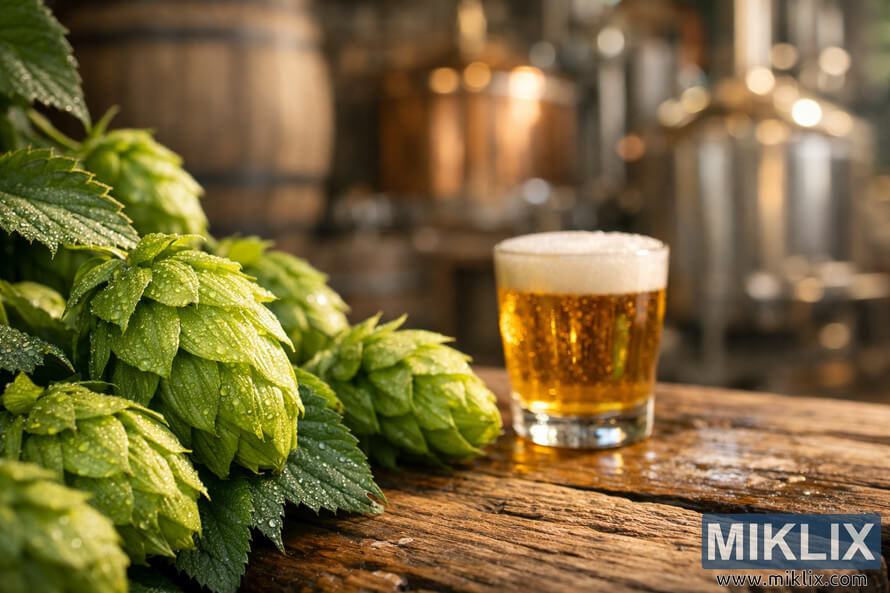
Klik of tik op die beeld vir meer inligting en hoër resolusies.
Brewing uses and addition timing
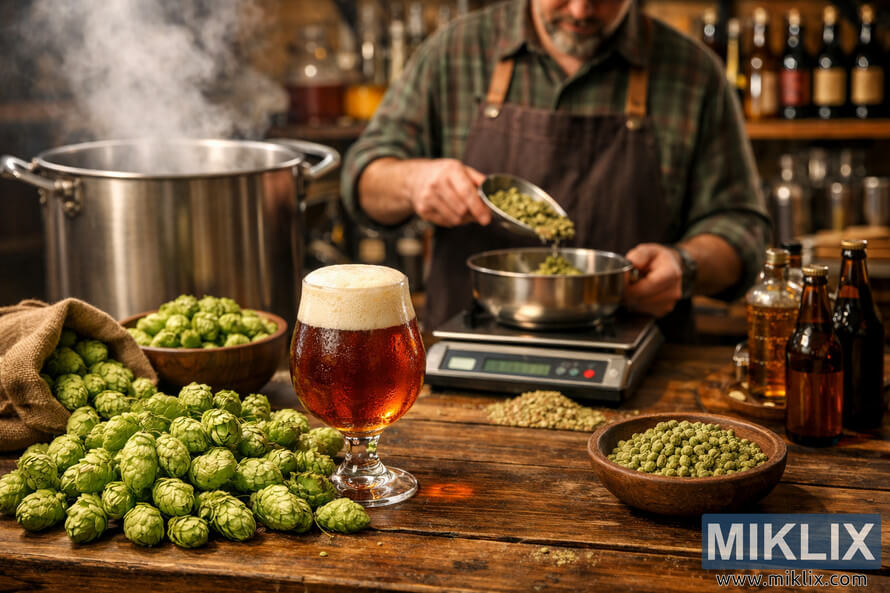
Santiam is best used to enhance aroma, not to add bitterness. It's favored by brewers seeking a delicate herbal and floral touch. They add it late in the boil, during whirlpool rests, or as a dry-hop. This approach preserves volatile oils like myrcene, humulene, and farnesene, showcasing the hop's noble character.
For aroma, Santiam is added in small amounts late in the boil (5–10 minutes), or in a cool whirlpool at 170–180°F. It's also used as a dry-hop during fermentation or conditioning. Use it sparingly, especially when paired with high-oil American hops, to achieve a subtle floral layer. When combined with fruit-forward hops, Santiam enhances the midnote without overpowering the fruit.
Recommended beer styles include American Pale Ale and India Pale Ale, where Santiam adds a gentle herbal-floral contrast. It's also suitable for American Blonde Ale, American Lager, Pilsner, Kölsch, Bock, and Helles. In lagers and pilsners, a light addition provides a faint noble lift while maintaining a clean malt profile.
- For APA/IPA: blend Santiam with Citra or Mosaic to add herbal depth behind bright fruit.
- For lagers and pilsners: choose clean lager yeasts like Wyeast 2001 or White Labs WLP830 and use neutral Pils malts to let Santiam aroma come forward.
- For Kölsch and Blonde styles: modest whirlpool and brief dry-hop contact produce delicate floral notes.
Balance is key with Santiam's moderate alpha acids. Keep the malt bill light and neutral to avoid covering floral nuances. Avoid heavy specialty grains when aiming for aroma preservation. Select yeast strains that ferment clean and minimize esters to keep the hop's herbal character distinct.
When planning Santiam brewing, consider it a supporting aroma hop. Small, well-timed additions provide complexity and a subtle noble profile without overwhelming the beer's base flavors.
Klik of tik op die beeld vir meer inligting en hoër resolusies.
Chemical profile and brewing values
Santiam exhibits a balanced acid and oil profile, ideal for enhancing aromas. Brewers leverage this chemical makeup for precise bittering, aroma enhancement, and aging predictions. The data below represents typical ranges from various crop reports and lab analyses.
Alpha acids in Santiam typically range from 5.0% to 8.5%, averaging around 6.8%. Early boil additions of Santiam contribute a subtle bitterness, complementing malt without overpowering it. This mild bitterness makes it a versatile hop for small additions in dual-purpose brewing.
- Alpha acid role: primary contributor to isomerized bitterness during the boil.
- Typical alpha range: 5.0–8.5% (average ~6.8%).
Beta acids in Santiam span from 5.3% to 8.5%, averaging about 6.9%. Unlike alpha acids, beta acids do not isomerize to create bitterness. Instead, they contribute to the hop resin matrix and can oxidize over time, influencing the beer's aged aroma.
- Oxidation pathway: Santiam beta acids can create tertiary aromas as beer ages.
- Typical beta range: ~5.3–8.5% (average near 6.9%).
Co-humulone levels in Santiam typically fall between 18% and 24%, averaging around 21%. This places Santiam in a moderate cohumulone category. Higher co-humulone levels can impart a sharper bitterness, but the hop's aroma use mitigates this effect in most recipes.
- Co-humulone impact: subtle edge to bitterness when used for early bittering.
- Typical co-humulone: 18–24% (average ~21%).
Alpha:beta ratios for Santiam can range from near 1:1 to 2:1, influenced by season and lot. Hop Storage Index values of 0.40–0.50 indicate potential acid and oil loss at room temperature. Proper cold, low-oxygen storage is crucial for preserving Santiam's alpha and beta acids, ensuring better shelf life and consistent brewing performance.
When planning recipes, it's essential to rely on average figures and adjust based on batch testing. Monitoring Santiam cohumulone alongside alpha and beta acids helps predict bitterness perception and aroma evolution during aging.
Klik of tik op die beeld vir meer inligting en hoër resolusies.
Essential oils and sensory drivers
Santiam hops are a blend of essential compounds that influence beer's aroma and flavor. Brewers delve into Santiam essential oils to understand how volatile and stable components create floral, spicy, and fruity notes. They use practical techniques during the boil, whirlpool, and dry-hop to preserve these characteristics.
Myrcene is often the most volatile oil in Santiam myrcene humulene blends. Its presence is usually around 20–30%. This oil contributes citrusy, resinous, and fruity top notes. To capture this fruitiness, hops should be added late in the kettle or during the whirlpool and through dry-hopping.
Humulene, on the other hand, is less volatile and adds woody, noble, and herbal tones. It typically makes up about the mid-20s of Santiam. This steady presence gives the classic floral-herbal signature of Santiam aroma oils. To retain humulene, brewers should use shorter boil times and moderate whirlpool temperatures, protecting delicate terpenes.
Caryophyllene and farnesene contribute spicy and green-floral depth. Caryophyllene, present at around 5–8%, offers peppery and woody accents. Farnesene, found in the lower teens, adds fresh, green floral complexity. Their presence enriches the hop bouquet and enhances the beer's aroma.
- Late additions and whirlpool: preserve myrcene-driven fruitiness and some humulene.
- Dry-hop: maximize Santiam aroma oils that are heat-sensitive, especially myrcene.
- Long early boils: extract bitterness but sacrifice volatile aromatics from Santiam.
The humulene-to-caryophyllene ratio in Santiam aligns with noble hop character, ideal for European-style aromas. Small adjustments in timing and temperature can significantly alter the beer's citrus, floral, spicy, or pepper notes. Thoughtful application of Santiam essential oils enhances the final sensory experience without overwhelming malt and yeast flavors.
Physical hop characteristics and cultivation
Santiam exhibits consistent field traits that are crucial for growers and brewers. Observations on cone form, growth habit, seasonal timing, and harvest practicality guide planting and processing. These insights are derived from trial reports and grower experiences.
Cone form and density
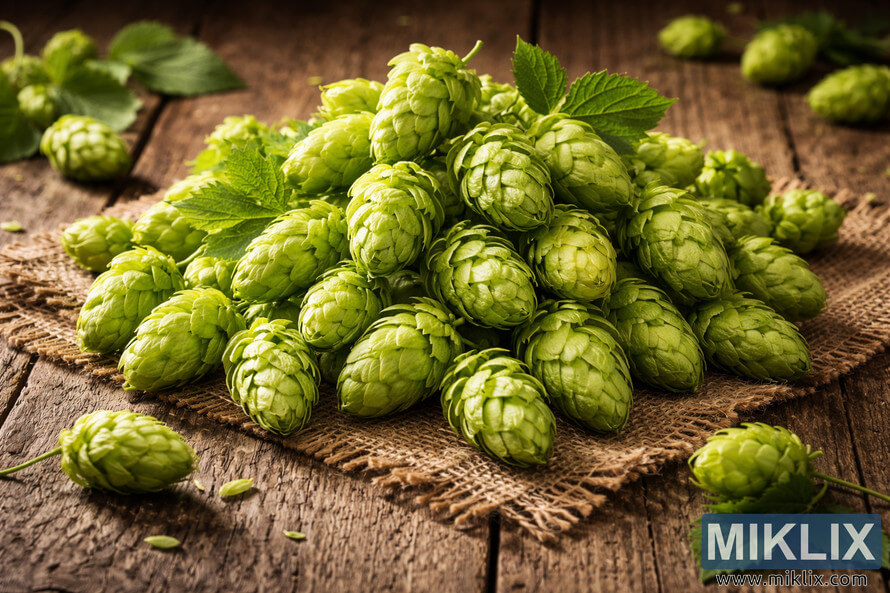
Santiam cones are typically small to medium in size. They have a loose density, appearing open and feeling light. This characteristic can complicate mechanical handling during harvest and processing.
Field yield ranges
- Trials often report Santiam yields between 1,430 and 1,780 kg/ha (1,280–1,580 lb/acre).
- Some trials indicate yields up to roughly 2,400 kg/ha (about 2,000 lb/acre), surpassing Tettnanger levels.
Vigor and growth rate
In the Pacific Northwest, Santiam plants show moderate-to-high vegetative vigor. They grow rapidly in spring, developing a robust canopy. This vigor supports full trellis coverage and steady cone production throughout the season.
Seasonal maturity and timing
Santiam matures mid-season, aligning with many aroma varieties. In the U.S. Pacific Northwest, aroma hop harvest typically starts in mid-to-late August. Growers must monitor cone feel and HSI to pick at the peak of aroma and oil retention.
Harvest considerations
- Loose cone density complicates mechanical harvest; careful combine settings and gentle handling reduce cone damage.
- Adjust sorting and drying parameters to preserve volatile oils and minimize loss during processing.
Effective Santiam cultivation planning must consider cone structure, seasonal timing, and yield ranges. These factors influence labor, equipment, and post-harvest handling to safeguard aroma and quality.
Disease resistance and cultivation challenges
Santiam presents a complex scenario for growers, with both advantages and drawbacks. Reports highlight its robust disease resistance against downy mildew. This trait significantly reduces crop loss in wet springs and minimizes the need for frequent spraying on many farms.
However, growers must remain vigilant against powdery mildew during dry, warm periods. The mildew resistance in Santiam is not consistent across all sites, with some experiencing sensitivity under intense fungal pressure. Proactive scouting and timely fungicide applications are crucial to maintain canopy health and preserve cone quality.
Harvesting Santiam poses its own set of challenges. The cones are often loose, making them susceptible to damage from mechanical harvesters. Growers generally rate Santiam's harvest difficulty as moderate to high. They advocate for gentle handling and adjusting harvester settings to minimize loss and bruising.
- Monitor canopy microclimate to lower powdery mildew risk.
- Adjust harvester speed and pickup belts to protect fragile cones.
- Plan harvest timing to avoid overly wet or dusty conditions.
Storage performance of Santiam falls in the middle range. Its HSI values, around 0.4–0.5, indicate moderate storability. Tests reveal about 40–50% alpha-acid retention after six months at 68°F (20°C). Thus, cold storage and minimizing oxygen can enhance aroma and bittering stability.
Practical steps are essential to maintain quality. Rapid cooling after harvest, vacuum-sealed packaging, and refrigerated storage in warehouses are key. These measures help extend the usable life and protect the hop oils that define Santiam’s aromatic profile.
Comparisons and suitable substitutions
Santiam serves as a reliable American-grown substitute for several noble-style aroma hops. It's favored by brewers seeking floral, herbal, and mildly spicy notes. This is especially true when European varieties are in short supply.
Common alternatives to Santiam include Tettnanger, Spalt, Spalter Select, Hallertau, and Liberty. These hops offer a delicate, noble-like profile that many recipes demand. Opt for a Tettnanger substitute if you desire the classic soft herbal and floral character reminiscent of German originals.
Here's a guide for swapping hops:
- For late additions and dry hopping, prioritize flavor and aroma. The subtle herbal and floral traits are key to the beer's aroma, more than exact alpha values.
- For bittering substitutions, match alpha-acid percentage and recalculate quantities. This ensures bitterness remains balanced.
- If you need greater crop availability or yield while maintaining a European profile, Santiam can replace German aroma hops in many recipes. It preserves the intended character.
Some brewers opt for Citra or other fruit-forward varieties as alternatives in specific contexts. Choose Citra for prominent citrus and tropical top notes, rather than delicate noble spice. This choice alters the beer's aromatic direction, so adjust malt and yeast choices accordingly.
When comparing flavor match versus alpha-acid match, consider the addition's role. Aroma-focused additions benefit from prioritizing sensory match. Bittering additions require alpha matching and precise math. Use Santiam alternatives thoughtfully to ensure the final beer retains its intended balance and aroma.
Practical recipe examples featuring Santiam
Santiam is best used as an aroma hop. Below, you'll find outlines for an American pale ale and a light lager or pilsner. There's also guidance on whirlpool and dry-hop additions. Scale all weights to your batch size and adjust for crop alpha and total oil numbers.
American Pale Ale outline (target OG ~1.050, FG ~1.010):
- Grain bill: U.S. two-row base, 5–8% crystal 5–10L for color and light caramel.
- Yeast: Chico/US-05 or Wyeast 1056 for clean ester profile.
- Bittering: neutral high-alpha hop early to reach target IBUs.
- Late kettle: add Santiam at 10–15 minutes, suggested 0.5–1.0 oz/gal (adjust by alpha).
- Whirlpool: 30–60 minutes at 170–185°F with 0.5–1.0 oz/gal of Santiam for floral lift.
- Dry-hop: 0.5 oz/gal for 3–7 days to showcase herbal and floral notes.
Light lager / Pilsner profile:
- Grain bill: Pilsner malt with minimal specialty malts to keep brightness.
- Yeast: clean lager strain with low ester production and proper lagering.
- Late addition: use Santiam in whirlpool or very late kettle at 0.25–0.5 oz/gal to add a noble-like floral lift without masking malt.
- Post-fermentation: consider a brief low-dosage dry aroma addition (0.25–0.5 oz/gal) after lagering for delicate perfume.
Dry-hop and whirlpool dosage guidance:
- For most ales aim 0.5–1.0 oz/gal in whirlpool or dry hop for pronounced aroma. This guidance covers common Santiam recipes and balances intensity with delicacy.
- For lighter styles reduce to 0.25–0.5 oz/gal to avoid overwhelming malt and yeast character.
- Adjust based on batch size, desired intensity, and measured alpha or oil levels from your supplier.
Practical notes for technique:
- Prioritize late additions. Santiam’s oils are fragile and long hot-side contact will reduce fruitiness and soft floral character.
- When whirlpooling, hold 30–60 minutes at 170–185°F to extract aroma without driving off volatiles.
- Record your Santiam dry hop rates and outcomes so you can refine future Santiam APA recipe choices and match aroma expectations.
Availability, purchasing and formats
Securing Santiam for your brew involves a swift check of suppliers, formats, and harvest year. Retailers offer whole cones and pellets, with stock levels fluctuating seasonally. Always verify the packaging date and storage conditions before placing your order.
When searching for where to buy, consider regional hop farms, established distributors, and major online platforms. Compare prices and formats by exploring listings from hop farms, craft brewing suppliers, and Amazon in the USA. Prioritize sellers who clearly state the harvest year and use vacuum-sealed packaging when purchasing Santiam hops.
Freshness is crucial for maintaining aroma and flavor. Opt for hops from the current harvest year for superior oil intensity. Ensure the product is either pelletized or whole-cone, vacuum-sealed, and shipped with cold-chain handling if available. Review the alpha range and packaging dates from suppliers to align with your recipe requirements.
The available formats are straightforward. Whole cones are ideal for small-scale dry hopping, preserving cone integrity. Pelletized Santiam, on the other hand, offers consistent dosing and easier storage, a preference for many brewers. Currently, no cryogenic lupulin powders are available for this variety.
- Common purchase points: hop farms, craft hop distributors, online marketplaces like Amazon (USA).
- Formats: whole cones and pelletized hops; pellet form often preferred for storage and consistency.
- Freshness checks: harvest year, packaging date, vacuum-seal, cold-chain shipping.
Market notes suggest Santiam availability can vary by season and vendor. For commercial batches or limited releases, contact Santiam suppliers early to secure quantities and confirm the harvest year. Hobbyists can quickly acquire small-quantity packs from reputable retailers.
Storage and shelf life for preserving aroma
Proper handling is key to maintaining hop character for late-boil and dry-hop work. Decisions on Santiam storage impact both bittering and aroma. Small variations in temperature and oxygen exposure can significantly alter performance, more than brewers anticipate.
Santiam's shelf life at room temperature is short. Studies indicate that Santiam retains about 40–50% of its alpha acids after six months at 68°F (20°C). This level of loss means older, unrefrigerated hops will have less bittering power and a muted aroma when used for whirlpool or dry-hop additions.
Adopting best practices can slow degradation and protect essential oils. Cold storage in a refrigerator or freezer is the most effective step. Use vacuum-sealed bags or nitrogen-flushed packaging to reduce oxygen contact and extend shelf life.
- Vacuum-sealed or nitrogen-flushed packages minimize oxidation.
- Freezer storage maintains hop oils and alpha acids for months to years.
- Limit light and temperature swings during transport and handling.
Santiam HSI storage values typically range from 0.4–0.5. This range indicates measurable oil and acid breakdown unless hops are kept cold and oxygen-free. Track HSI and crop year on each batch to make informed recipe choices.
Practical recipe planning must account for hop age and HSI. Older Santiam cones with higher HSI often need larger late additions for aroma impact or can be shifted to bittering roles. Reserve current-year Santiam for delicate late-boil and dry-hop work to preserve floral and herbal notes.
When purchasing, verify provenance and inquire about storage conditions. Accurate labeling of harvest year and HSI helps predict remaining shelf life and adjust hop quantities for consistent beer character.
Santiam in commercial brewing and craft trends
Santiam quietly holds its ground in American brewing. It's chosen for its soft floral top note, which complements hop-forward bases without overpowering them. Its balanced oils are ideal for styles where subtlety is key.
In craft brewing, Santiam is often used to enhance the aroma of APAs and IPAs. It's blended with bold hops to add herbal and spicy notes, enriching the beer's complexity. This approach enhances the beer's depth without obscuring its clarity.
For lagers and pilsners, Santiam brings a European noble-hop character to American brews. Its Tettnanger-like profile offers subtle floral, herbal, and noble spice notes. These are perfect for beers with clean yeast profiles and crisp fermentation.
- Uses in lighter beers: provides delicate aroma without overwhelming the base.
- Blend strategy: paired late or in whirlpool for fragrant lift.
- Target styles: APA, IPA, lager, pilsner and hybrid craft recipes.
Despite its brewing merits, Santiam's commercial appeal is limited. Marketing and the fame of other varieties like Citra, Cascade, and Centennial play a role. Santiam remains in a niche, overshadowed by more popular hops.
The lack of high-profile adoption and no common lupulin powder variant hinders Santiam's visibility. Yet, brewers who value subtlety still choose it. However, its widespread use is hindered by the allure of more aromatic hops.
For those aiming to create a restrained noble aroma in modern American beers, Santiam is a reliable choice. It offers consistent results, making it a dependable option for brewers seeking balance over boldness.
Laboratory data and research references
Santiam research and lab data are crucial for brewers and growers. They offer detailed chemistry ranges, field trial yields, and agronomic performance records. These documents are essential for those interested in the triploid genetics of Santiam.
Chemical composition in breeding reports and supplier summaries indicates alpha acids between 5–8.5%. Beta acids are similarly reported, with a narrower range of 5–7%. Total oil values are around 1.3–2.2 mL per 100 g of hops.
Essential oil breakdown in Santiam lab data shows myrcene ranging from 15% to 50%, often between 20–36%. Humulene is typically between 18–30%, with a central value of 23–26%. Caryophyllene is reported at roughly 4.8–9%. Farnesene, contributing to the varietal's floral-spicy notes, is near 8–16%.
Yield and field trial data from Oregon and Washington are promising. Some trials recorded 1,430–1,780 kg/ha. Others reached near 2,400 kg/ha, showing Santiam can outperform Tettnanger under optimal conditions.
- Trial yield ranges: 1,430–2,400 kg/ha (approximate figures).
- Near-seedless cone production tied to triploid genetics; documented in agronomy summaries.
- Field observations note consistent adaptation across Pacific Northwest sites.
The USDA release notice and cooperating experiment station publications formalized the cultivar. The Henning and Haunold release notice from March 1998 marks the official announcement. Alfred Haunold’s 1998 article in The New Brewer outlines flavor work for new hop varieties, including Santiam.
Industry databases and supplier pages like HopUnion, BeerMaverick, and BeerLegends compile the chemistry, use cases, and practical notes. These resources draw from the original Santiam release notice and subsequent trial reports. Brewers can cross-check these entries against primary lab reports for recipe planning.
Use the numerical ranges above as starting points. For precise formulation, request batch-specific Santiam lab data from your supplier. Compare it to local field trial outcomes before scaling production.
Conclusion
Santiam conclusion: Santiam is an American-bred aroma hop, code SNT, developed at Corvallis, Oregon, and released in 1997. It boasts a soft, herbal-floral-fruity profile with peppery spice accents. Its balanced oil mix makes it ideal for late-boil, whirlpool, and dry-hop use. With alpha acids roughly 5–8.5% and total oils around 1.3–2.2 mL/100g, it's perfect for APA, IPA, and lighter lagers where delicate aroma is desired.
Santiam summary: Agronomically, Santiam is triploid with near-seedless cones, showing good vigor and mid-season maturity. It's well-suited to Pacific Northwest farms. Field trials reported yields competitive with Tettnanger and solid disease resistance in many blocks. However, careful harvest and cold, oxygen-minimized storage are crucial to preserve its aromatic character and manage HSI losses.
Santiam hops overview: For brewers, use current-year Santiam for aroma work, favoring late additions and dry hopping. When unavailable, Tettnanger, Spalt, or Hallertau serve as close flavor substitutes. Overall, Santiam offers a practical, noble-like American option for brewers seeking soft herbal and floral notes with subtle fruity and spicy depth.
FAQ
What is Santiam and where was it developed?
Santiam is an American aroma hop developed by the U.S. Department of Agriculture's Agricultural Research Service in Corvallis, Oregon. The breeding started in 1988, with a formal release in the late 1990s. It was made available to growers in 1997, thanks to USDA and cooperating experiment stations.
What are the parent varieties of Santiam?
Santiam's parents are Swiss Tettnanger and German Hallertauer Mittelfrüher. A Cascade-derived U.S. cultivar also contributed to its genetics. The goal was to create a European-type aroma hop suitable for American brewing.
Is Santiam triploid and does that affect cone quality?
Yes, Santiam is triploid. This trait leads to nearly seedless cones, even with male pollinators. Triploidy enhances cone quality, ensuring cleaner flavors without seed-derived off-notes.
How does Santiam perform agronomically in the Pacific Northwest?
Santiam thrives in Oregon and Washington's growing regions. It exhibits moderate-to-high vegetative vigor and mid-season maturity. Yields range from 1,430 to 2,400 kg/ha, often surpassing Tettnanger's productivity.
What are the main sensory descriptors for Santiam?
Santiam is known for its soft, herbal, and floral aroma with fruity top notes and subtle black pepper or spicy accents. It offers a noble-like delicacy, making it ideal as a supporting aroma hop.
Which essential oils drive Santiam’s aroma?
Myrcene, humulene, caryophyllene, and farnesene are the primary oils in Santiam. Myrcene adds fruity resin and citrusy notes, while humulene contributes woody, floral, and noble characteristics. Caryophyllene provides peppery, spicy accents, and farnesene adds fresh-green and floral complexity.
What are Santiam’s typical alpha and beta acid ranges?
Alpha acids typically range from 5.0 to 8.5%, averaging around 6.8%. Beta acids are roughly 5.3–8.5%, averaging near 6.9%. As an aroma hop, Santiam is primarily used for its volatile oils, not bittering.
What is Santiam’s co-humulone percentage and why does it matter?
Co-humulone usually ranges around 18–24%, averaging about 21%. It can influence bitterness sharpness, but Santiam's late use for aroma minimizes its impact on beer bitterness.
How much total oil does Santiam contain?
Santiam contains about 1.3–2.2 mL of total oil per 100 g, with averages around 1.6 mL/100 g. Oil composition and freshness determine its aromatic impact.
When should I add Santiam in the brew to maximize aroma?
Add Santiam late, such as in late kettle additions, whirlpool/whirlpool-rest at lower temperatures, or dry hopping. This preserves its floral, herbal, and fruity notes, as myrcene and other volatile oils are lost during long boils.
What beer styles suit Santiam best?
Santiam is well-suited for American Pale Ale and India Pale Ale as a supporting aroma hop. It also complements lighter styles like American Blonde Ale, American Lager, Pilsner, Kölsch, Helles, and Bock.
How should I balance malt and yeast to showcase Santiam?
Use clean, neutral malts like 2-row or Pilsner malt. Choose clean-fermenting yeast strains, such as lager yeasts (Wyeast 2001 or White Labs WLP830), to preserve the hop's delicate aroma. Avoid heavy specialty malts when aiming for aroma preservation.
What substitution hops are recommended if Santiam is unavailable?
Tettnanger, Spalt, Spalter Select, Hallertau, and Liberty are good substitutes. They share a noble-like floral and herbal character. Citra can be used for pronounced fruity/citrus notes, but it alters the profile to tropical fruit.
What harvest and cone physicals are typical for Santiam?
Santiam's cones are small to medium with loose density, making mechanical harvest challenging. It matures mid-season, with U.S. Pacific Northwest harvests starting in mid-to-late August.
What disease pressures and harvest challenges should growers expect?
Santiam shows good resistance to downy mildew but can be susceptible to powdery mildew. Its loose cone density complicates harvest, requiring careful handling to avoid mechanical loss and cone degradation.
How well does Santiam store and what is its HSI?
Santiam has moderate storability. Its Hop Storage Index (HSI) is around 0.4–0.5. Studies indicate 40–50% retention of alpha acids after six months at 68°F (20°C). Cold, oxygen-minimized storage slows oil and acid degradation.
What formats is Santiam sold in and are cryo/lupulin products available?
Santiam is available as whole cones and pelletized hops. There are no widely available cryogenic lupulin or commercial "cryo" powder forms from major processors. Pellet form is preferred for storage and consistent dosing.
How should I adjust dosages for whirlpool and dry hopping?
For aroma in ales, use about 0.5–1.0 oz per gallon in whirlpool or dry hop. For lighter lagers or pilsners, reduce to 0.25–0.5 oz per gallon. Adjust according to batch size and hop quality. Increase amounts for older or oxidized hops.
Does Santiam contribute much bitterness if used early?
Santiam's moderate alpha acids can contribute mild bitterness early in the boil. However, early additions lose most volatile oils. For aroma, use late additions; for bittering, choose higher-alpha neutral hops or adjust Santiam quantity.
How do Santiam’s oil proportions compare to Tettnanger?
Santiam's oil profile, including myrcene, humulene, caryophyllene, and farnesene, is similar to Tettnanger. The humulene-to-caryophyllene ratio is around 3.2–3.6, supporting a noble-like floral and herbal character with peppery accents.
Where can I buy Santiam and what freshness checks should I perform?
Buy from regional hop farms, specialty hop suppliers, and online retailers that list harvest year and packaging date. Pacific Northwest hop suppliers and general marketplaces are good sources. Opt for current-year harvest, vacuum-sealed or nitrogen-flushed packaging, and cold-chain storage when possible.
Are there published laboratory data and references for Santiam?
Yes. Key references include USDA release notices, cooperating experiment station publications, Alfred Haunold's notes on new hop varieties, and supplier/hop database entries (HopUnion, BeerMaverick, BeerLegends) that compile chemistry, oil breakdown, and yield data.
Why hasn’t Santiam become more widely used despite favorable traits?
Santiam's limited adoption stems from market dynamics rather than poor brewing performance. Factors include limited marketing, the dominance of high-profile modern varieties (Citra, Mosaic), and the absence of cryo/lupulin derivatives. Despite this, brewers seeking a noble-like supporting aroma find Santiam valuable.
Verdere Leeswerk
As jy hierdie plasing geniet het, sal jy dalk ook van hierdie voorstelle hou: