
Image: Hop Essential Oils in Glass Vials on a Laboratory Table
Published: September 15, 2026 at 5:17:05 PM UTC
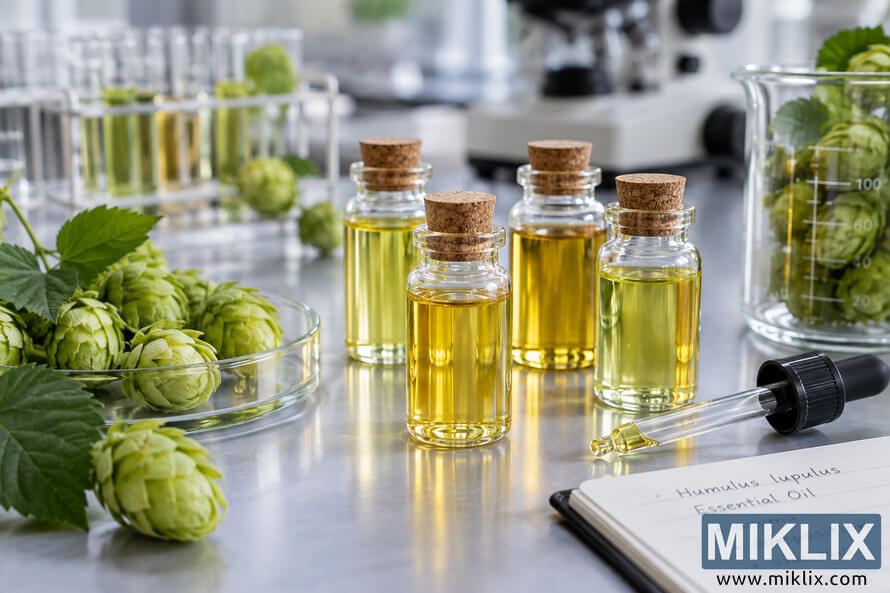
High-resolution laboratory still life of golden hop essential oils in small glass vials with fresh hop cones, scientific glassware, a dropper, and research equipment.
Available versions of this image
The image files available for download below are less compressed and higher resolution - and as a result of that, higher quality - than the images embedded in articles and pages on this website, which are more optimized for file size in order to reduce bandwidth consumption.
Regular size (1,536 x 1,024)
Large size (3,072 x 2,048)
Very large size (4,608 x 3,072)
Extra large size (6,144 x 4,096)
Comically large size (1,048,576 x 699,051)
- Still uploading... ;-)
Image description
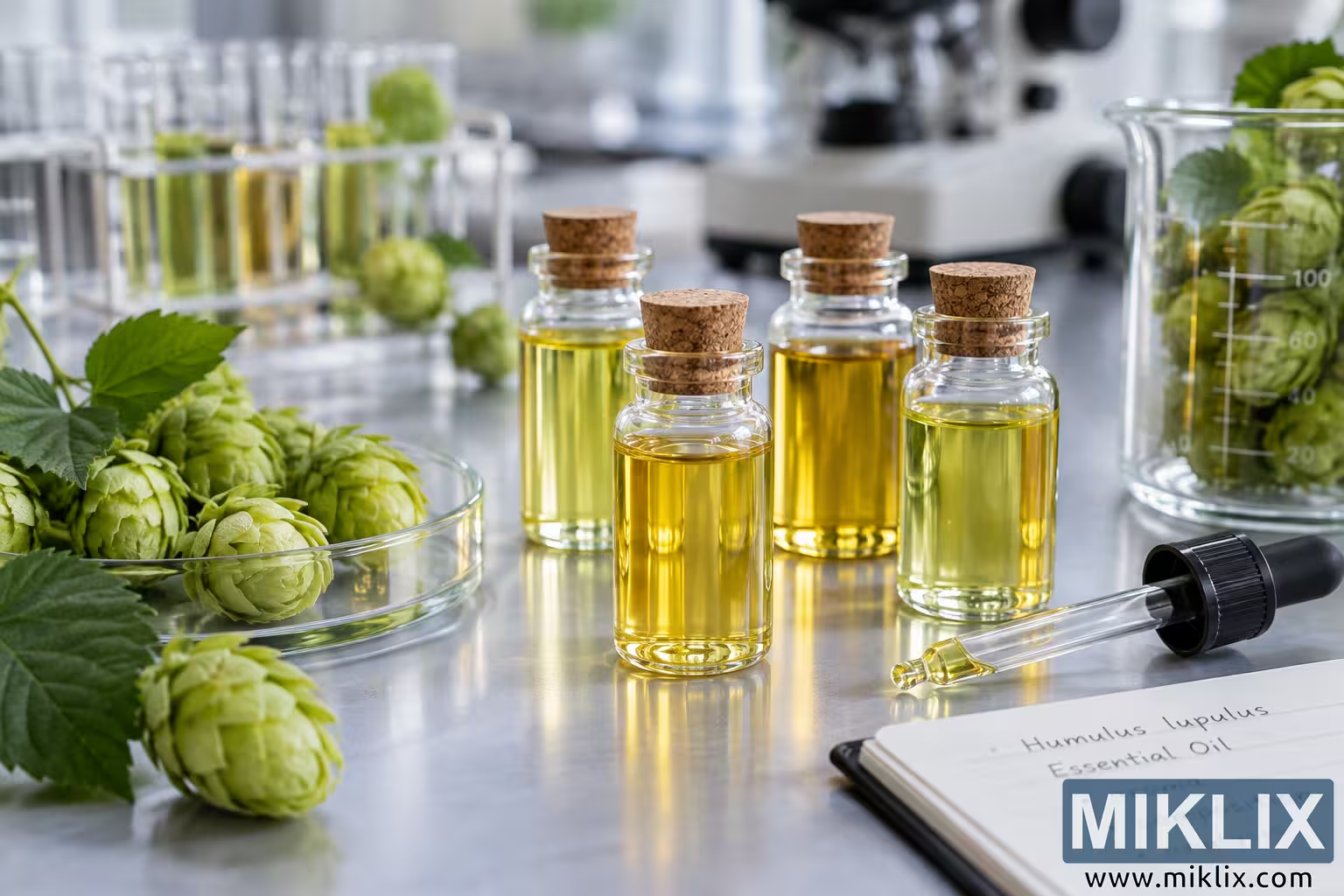
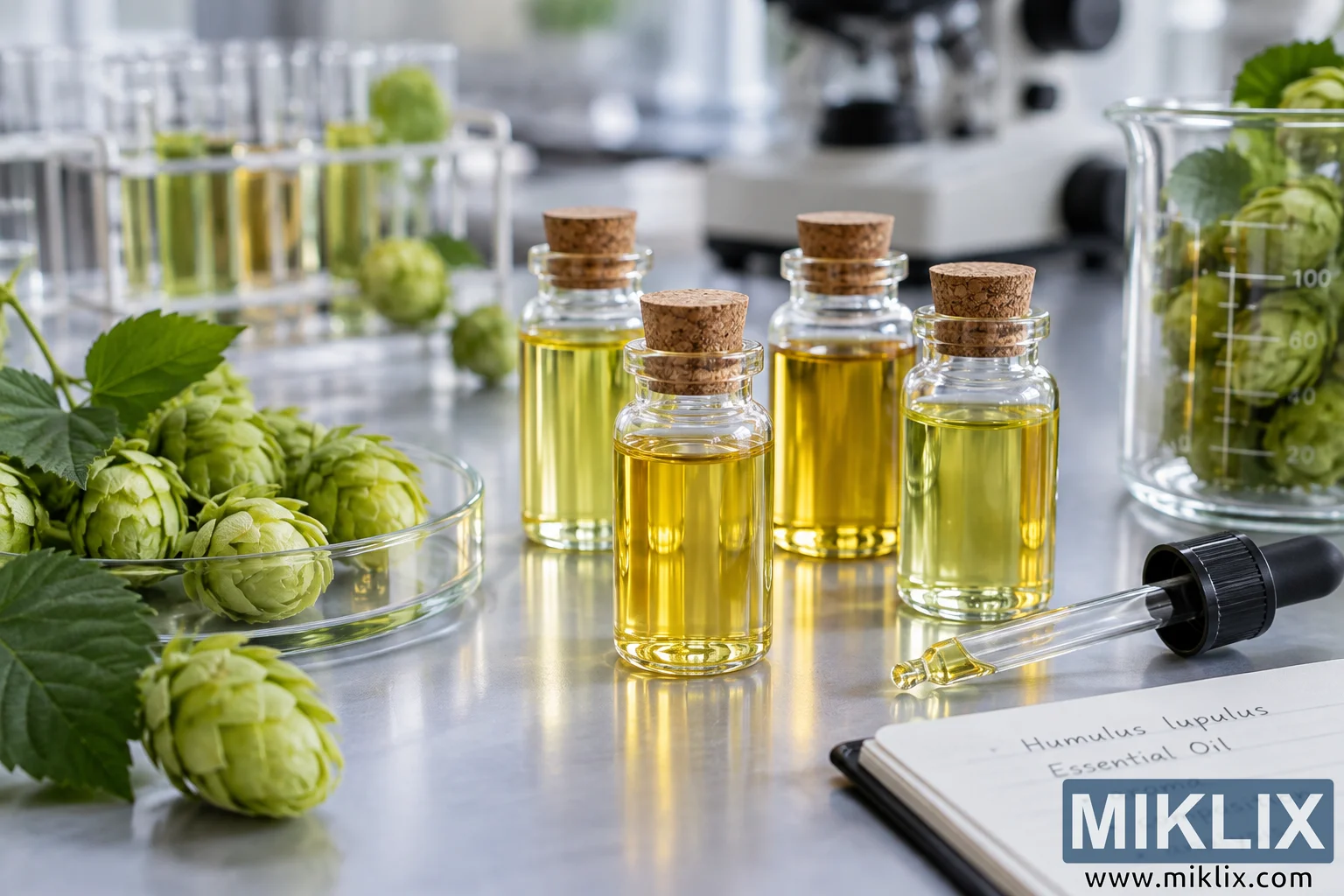
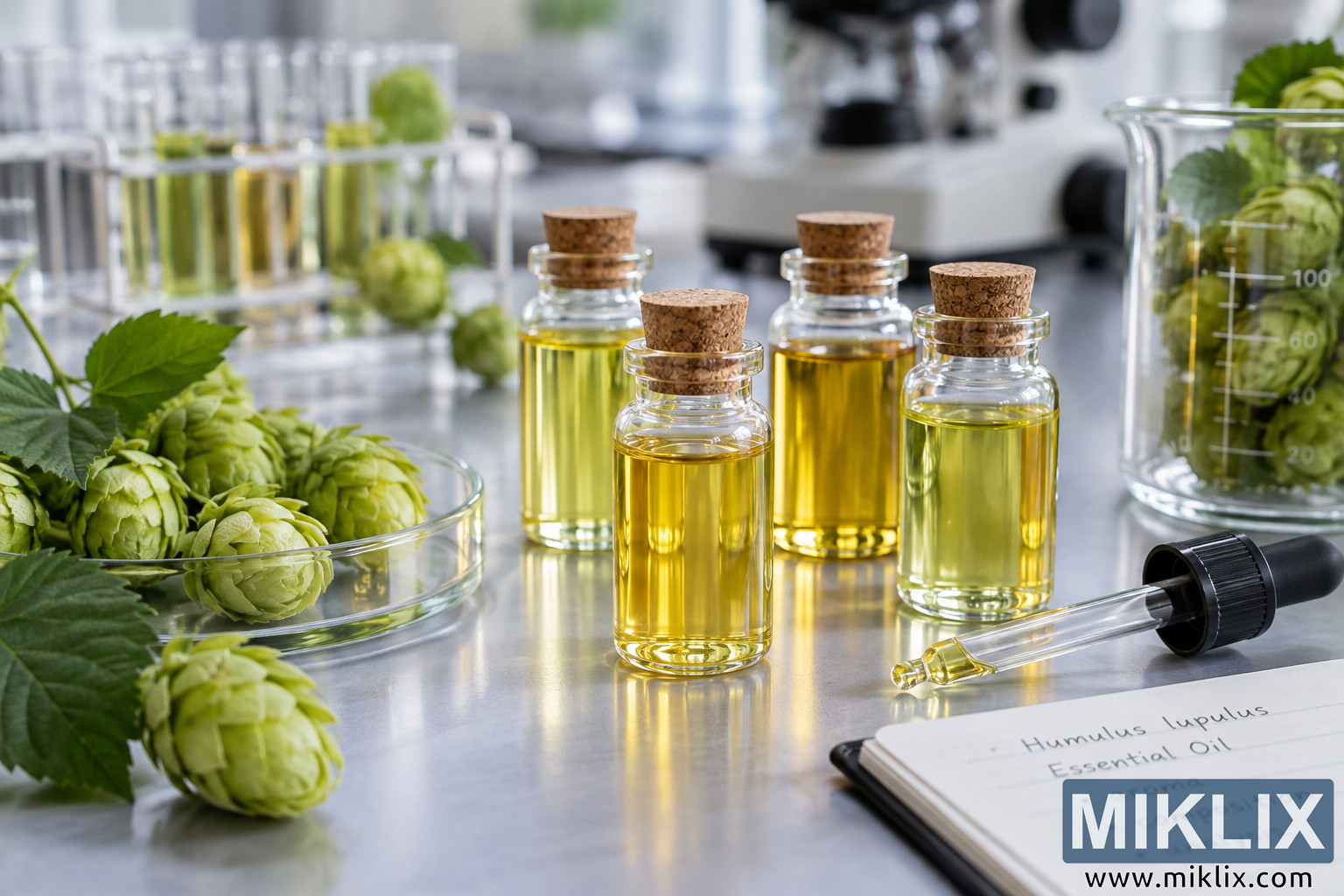
A crisp, photorealistic laboratory still life presents hop essential oils as the central subject, arranged carefully across a clean, reflective stainless-steel work surface. The composition is photographed in landscape orientation with a professional commercial and scientific aesthetic. Four small transparent glass vials occupy the center of the scene. Each vial is sealed with a natural cork stopper and contains a clear, golden-yellow to pale yellow-green liquid representing essential oil extracted from hops. The varying shades of the liquids create subtle visual differences between the samples, ranging from bright straw yellow to a warmer amber-gold. Light passing through the transparent oils produces luminous highlights and warm reflections on the polished laboratory table beneath them.
The foremost vial stands near the center of the image and acts as the primary focal point. Its cylindrical glass body, rounded shoulder, thick transparent base, and cork closure are rendered in sharp detail. The golden liquid inside catches the surrounding light, emphasizing its clarity and rich color. Three additional vials are positioned slightly farther behind and to either side, creating depth while maintaining a balanced arrangement. Although these background containers remain clearly recognizable, the shallow depth of field gradually softens elements farther from the camera, giving the photograph a polished macro-product-photography quality.
Fresh green hop cones and leaves provide an immediate botanical connection to the essential oils. On the left side of the laboratory table, several hop cones are gathered inside and around a shallow transparent glass dish. Their overlapping pale green bracts are highly detailed, showing the layered, papery structure characteristic of mature hop flowers. Broad, serrated green leaves and sections of hop stems extend outward from the cluster, adding organic shapes and natural texture to the otherwise precise laboratory environment. One additional hop cone lies prominently in the lower-left foreground, partially surrounded by leaves, while several smaller cones appear farther back near the glassware. The vivid greens contrast strongly with the warm golden tones of the oils and the neutral silver-gray laboratory surface.
On the right side of the composition, a large transparent laboratory beaker contains several fresh hop cones and leaves. White measurement markings are visible on the side of the beaker, reinforcing the scientific context without introducing any commercial branding. The botanical material inside the glass vessel appears fresh and naturally colored, and the curved surface of the beaker produces realistic reflections and optical distortions. In front of the beaker, a glass dropper rests diagonally across the metal table. The dropper has a black rubber bulb and dark screw-style collar, while a small quantity of golden liquid remains visible inside its transparent glass pipette. A tiny droplet-like concentration of oil near the tip helps suggest laboratory sampling, formulation, or analytical work.
Additional laboratory equipment appears in the softly blurred background. On the left, a rack holds multiple clear test tubes containing pale yellow and greenish liquids. Their repetition creates a recognizable analytical laboratory motif while remaining secondary to the central oil vials. Toward the upper middle and right background, the dark and light shapes of a laboratory microscope are visible but intentionally out of focus. Other indistinct glassware and equipment contribute to the impression of a clean, active research environment. None of the equipment displays recognizable commercial logos, manufacturer names, trademarks, or other brand identifiers.
A laboratory notebook occupies part of the lower-right foreground. Its white page is angled into the frame and contains handwritten-style scientific notes identifying the subject as Humulus lupulus essential oil, accompanied by brief references to aroma, composition, and analysis. The notebook gives the scene a research-oriented narrative, suggesting that the oils are being examined for their aromatic profile or chemical properties. Its placement opposite the fresh hops on the left helps visually frame the central group of vials. The black edge of the notebook provides a subtle dark accent that echoes the black dropper bulb nearby.
The lighting is bright, soft, and naturalistic, resembling diffused daylight entering a modern laboratory. Highlights on the glass containers are controlled and realistic, clearly defining their shapes without overwhelming glare. The stainless-steel tabletop reflects the vials, hops, and golden liquids in a subdued manner, adding depth and visual richness. The overall palette combines clean whites, cool silver-gray laboratory tones, fresh botanical greens, transparent glass, warm cork brown, and luminous golden-yellow oil. This restrained palette reinforces the connection between natural plant material and scientific extraction or analysis.
The image uses a shallow depth of field to establish a clear visual hierarchy. The central essential-oil vials, nearby hop cones, dropper, and portions of the foreground glassware are sharply rendered, while the test tubes, microscope, and distant laboratory environment gradually become softer. This selective focus creates a realistic photographic sense of depth and prevents the scientific background from competing with the main subject. Fine details such as the porous texture of the cork stoppers, layered hop bracts, serrated leaf edges, thickness of the glass, refraction through the oils, and reflections on the metal surface contribute to the high-resolution appearance.
The scene communicates a combination of botanical science, natural-product research, essential-oil extraction, aroma analysis, and laboratory quality control. Rather than depicting an industrial production facility, it presents an intimate research setting in which small samples of hop-derived oil are being studied alongside the original plant material. The careful organization of the vials and scientific tools gives the photograph a precise and credible laboratory atmosphere, while the abundance of fresh hops keeps the image visually organic and approachable. No actual product packaging or recognizable brands appear anywhere in the composition. Overall, the photograph presents hop essential oil as a natural botanical substance undergoing professional laboratory examination, combining the freshness and texture of green Humulus lupulus cones with the clean glassware, analytical equipment, and controlled visual language of modern scientific research.
The image is related to: Hops in Beer Brewing: Belma