
Hops in Beer Brewing: Fantasia
Published: July 16, 2026 at 8:39:23 PM UTC
Discover the unique flavor profile and benefits of using Fantasia hops in your brewing process for exceptional beers that stand out in taste and aroma.

Click or tap the image for more information and higher resolutions.
Key Takeaways
- Fantasia hops offer a distinct aromatic profile useful in pale ales, IPAs, lagers, and Belgian styles.
- Brewing with Fantasia requires attention to late additions, dry hop timing, and cold storage to protect volatile oils.
- The Fantasia hop variety pairs well with clean-fermenting yeast strains and light to medium malt bills.
- Proper IBU calculations and alpha-acid checks help preserve the hop’s aromatic character without excessive bitterness.
- U.S. homebrewers can source Fantasia hops from specialty suppliers and should plan for seasonal availability and formats.
What are Fantasia hops and their origin
Fantasia is a modern aroma hop bred for its bright floral and tropical notes. It's designed to be practical for growers and brewers. Its reputation is built on a targeted origin and a focus on aromatic oil balance. This supports late additions and dry hopping in various beer styles.
Breeding programs aim to combine intense scent with solid field performance. Fantasia breeding followed this path, developed through recognized programs. These include collaborative work from institutions like Hop Breeding Company and European nurseries such as Hüll. The goals were to create aroma-rich oil profiles and agronomic traits like disease resistance and consistent yield.
Documented hop parentage sets expectations for oil composition and sensory character. Fantasia's parentage often includes floral backbones from Hallertauer- or Perle-like noble traits and New World varieties that push citrus and tropical characters. This mix clarifies volatile oil ratios, including higher myrcene for aroma, balanced humulene and caryophyllene for spice, and monoterpenes for floral lift.
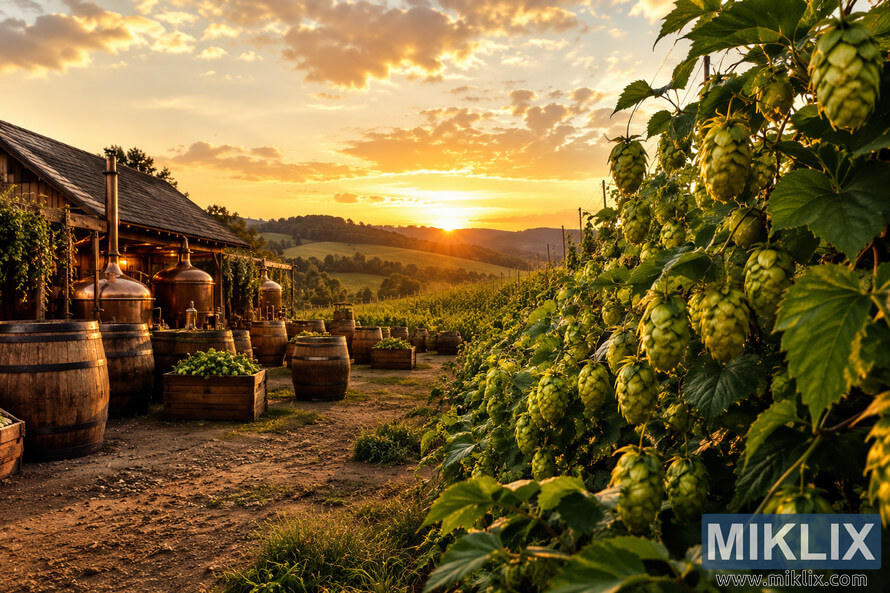
Where Fantasia hops are grown influences their final character. Commercial growers in the United States test new aroma varieties in the Pacific Northwest, notably Washington and Oregon, plus parts of Idaho. Experimental blocks also appear in New York and Michigan as growers test local terroir effects. The preferred climate is temperate continental with dry summers, cool nights, well-drained soils, and reliable irrigation.
Terroir and microclimate change oil concentrations. Warmer sites can raise alpha acids and push some oil volatility, emphasizing citrus and resinous facets. Cooler mountain or Finger Lakes sites tend to preserve floral and delicate citrus esters, prized for late-hop additions.
Availability follows acreage and release plans. New varieties often appear in small lots at first, with limited runs of whole-cone and T90 pellets. Grower adoption expands supply over several seasons, so hop seasonality matters for purchasing and recipe planning. Harvest occurs once per year in the Northern Hemisphere, typically late summer into early fall, and early orders or contracts with suppliers are common for fresh lots while production ramps up.
- Formats: whole-cone and T90 pellets are standard for Fantasia, with pelletization aiding storage and shipping.
- Inventory patterns: limited early batches, then broader availability as acreage increases.
- Lead times: contract grower commitments or pre-orders can secure supply in first years after release.
Click or tap the image for more information and higher resolutions.
Sensory profile of Fantasia hops
Fantasia hops provide a complex aroma experience, ideal for contemporary craft beers. The aroma profile is celebrated for its vibrant, accessible nature. It excels in short contact times and dry hopping. Brewers must carefully manage dosage and technique to highlight its best qualities.
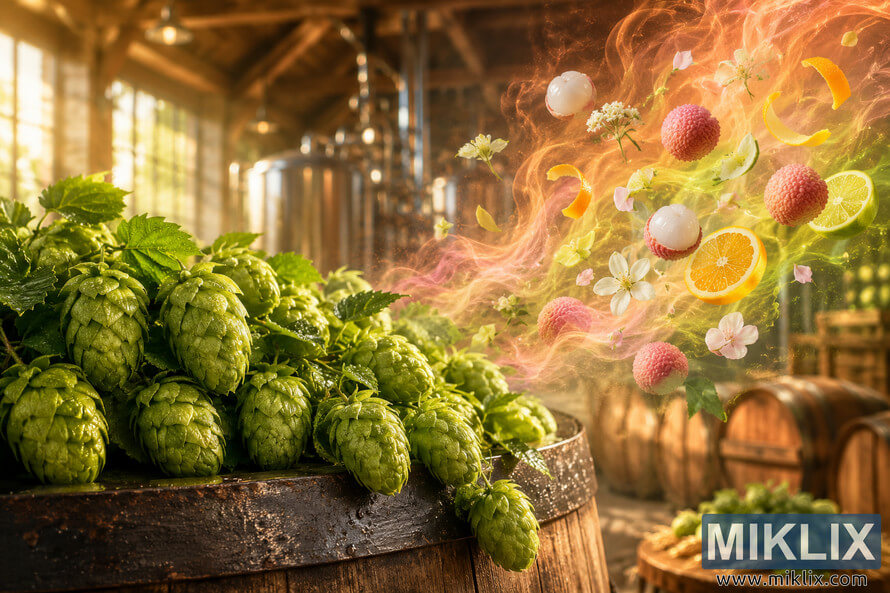
Aroma descriptors: floral, citrus, tropical notes
The initial impression is floral, with notes of jasmine, soft lavender, and light honeysuckle. This delicate perfume is clean and inviting.
Citrus notes follow, featuring tangerine, sweet orange, and bergamot. These add a zesty lift without the heaviness of pith. They shine in whirlpool additions and late-boil dosing.
Tropical fruit completes the profile, with passionfruit, guava, and ripe pineapple. These fruits emerge with dry hopping and warmer fermentation esters. Secondary hints may include stone fruit or melon, along with a subtle herbal or tea-like undertone, adding complexity to the aroma.
Flavor characteristics on the palate
The flavor on the palate is clean, with citrus zest and juicy tropical fruit. Late additions deliver a crisp, bright taste, rather than dense resin.
Higher rates of use can enhance perceived juiciness and fullness due to the hop's oil content. In moderation, it adds aromatic lift and brightness, preserving malt character.
Fresh, well-handled Fantasia shows minimal vegetal or resinous bite. A touch of pithy bitterness from late additions provides balance without obscuring fruit notes.
Typical bitterness and alpha acid range
Fantasia is primarily an aroma variety with a modest bittering profile. Expect alpha acids in a moderate to low range, roughly 4–7% AA for typical lots. The breeder may specify otherwise.
Brewers often prefer late boil or whirlpool additions and dry hopping to capture the floral, citrus, and tropical hops. While it can add gentle backbone bitterness if used earlier or in larger amounts, its primary intent is not bittering.
- Best aromatic gains: dry hop and whirlpool additions.
- Palate role: bright zest and juicy tropical notes with light pith.
- Bittering use: possible, but not the primary intent; check Fantasia alpha acids for formulation.
Click or tap the image for more information and higher resolutions.
How Fantasia hops compare to other aroma hops
We compare Fantasia to several well-known aroma varieties. This comparison aims to help brewers choose the right hop for their recipe. It's about finding the perfect aroma profile for their beer.
Fantasia's fruity intensity rivals that of Citra, Mosaic, Galaxy, and El Dorado. These hops all bring strong tropical and citrus notes to the table. They are ideal for late additions and dry hopping, making them perfect for New England IPAs and fruit-forward ales.
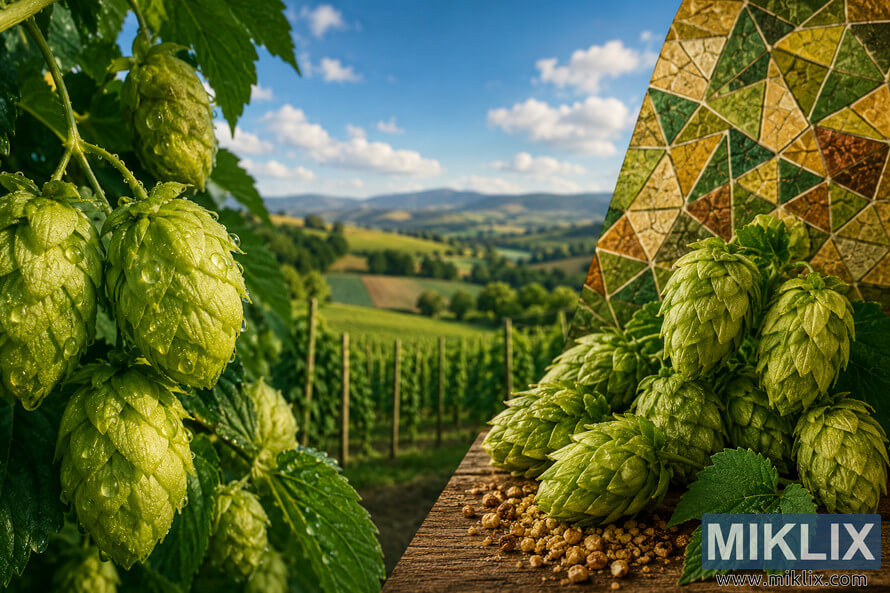
Fantasia also mirrors some delicate floral qualities found in noble and floral varieties. When blended carefully, these floral facets enhance the tropical core. They do so without adding heavy bitterness or harshness.
Similarities with classic aromatic varieties
- High aromatic intensity suited to late additions and dry hopping.
- Tropical fruit and citrus elements common to Citra and Mosaic.
- Versatility across pale ales, IPAs, and lighter styles.
Distinctive traits that set Fantasia apart
- Pronounced floral top-notes from higher linalool and geraniol-like character, creating a perfumey lift.
- Clean tropical-fruit core with bright citrus brightness rather than resinous pine.
- Balance of fruity sweetness and floral lift without dank or heavy resin, giving a softer mouthfeel.
When to choose Fantasia over alternatives
- Pick Fantasia when you want floral complexity layered with tropical citrus in beers focused on drinkability.
- Prefer Fantasia vs Mosaic or Fantasia vs Citra when avoiding dank, resinous tones and seeking a less aggressive hop presence.
- Use Fantasia in NEIPAs for floral lift, in saisons for citrus flourish, and in delicate lagers to add subtle aroma without overpowering the base.
Click or tap the image for more information and higher resolutions.
Using Fantasia hops in pale ales and IPAs
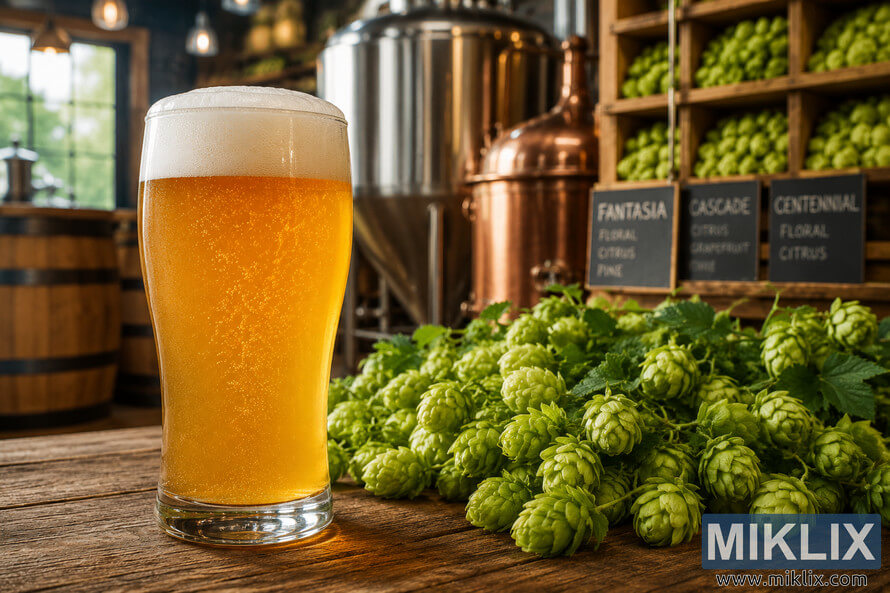
Fantasia hops add bright citrus and tropical flavors, enhancing pale ales and IPAs. A well-planned hopping schedule is key to highlight its floral notes while maintaining balance. Below, we provide a practical guide for a 5-gallon batch, suitable for both American pale ales and hop-forward IPAs.
- 60-minute bittering: 0.5–1 oz to reach target IBUs. This preserves hop aroma by minimizing early additions.
- 10–5 minutes late boil: 0.5–1.5 oz for citrus lift and lively top notes.
- Whirlpool/flameout at ~170–180°F: 1–2 oz to extract floral and delicate oils without harshness.
- Dry hop: 2–4 oz split across charges for tropical intensity and aroma persistence.
Late addition and dry hopping strategies
- Split dry-hop approach: add half near high krausen to lock in volatile oils, add the rest after primary fermentation to boost aroma. This reduces grassy off-notes while preserving freshness.
- Contact times: 3–7 days for active fermentation additions, 3–10 days for post-fermentation. Check aroma regularly to avoid vegetal character.
- NEIPA guidance: use heavy late and dry-hop rates, control oxygen exposure, and use gentle rousing only if needed to suspend hop particles and create a fuller aroma presence.
Recipe examples and target profiles
- American Pale Ale template (5 gal): OG 1.048–1.055; FG 1.010–1.012; IBUs 35–40. Malt bill: Maris Otter or domestic 2-row with 4–6% light crystal. Yeast: Wyeast 1056 or White Labs WLP001 for a clean ferment that highlights hops. Use Fantasia in IPA-style late additions and a balanced dry hop to keep citrus and floral notes front and center.
- IPA template (5 gal): OG 1.060–1.070; FG ~1.012; IBUs 50–60. Build bitterness early if needed, then load late additions and whirlpool charges. Dry-hop aggressively with Fantasia to emphasize tropical top-notes and juicy character.
- Hopping times and quantities above are flexible. Adjust Fantasia hopping times based on target aroma and batch scale while watching for vegetal extraction with extended contact.
Click or tap the image for more information and higher resolutions.
Fantasia hops in lagers and lighter styles
Fantasia shines in clean, restrained lagers, where its floral and citrus notes can fully express themselves. Light-bodied beers require careful handling to preserve the crisp profile and volatile oils. This ensures the delicate hop aroma remains intact.
Employ a clean lager yeast like Wyeast 2206 or White Labs WLP830 for fermentation and conditioning. An extended cold fermentation and conditioning period is crucial. This approach minimizes yeast ester production, allowing the hop aroma to dominate the beer's character.
Late hopping in the whirlpool at 160–180°F is essential. It captures volatile aromatics without losing them. Post-fermentation dry hopping for 2–4 days enhances freshness while maintaining clarity and crispness.
For light lagers and pilsners, aim for modest IBUs, around 18–25. This balance ensures malt simplicity isn't overshadowed. Use minimal bittering additions early and focus on Fantasia additions at whirlpool and brief dry-hop. This preserves the floral and citrus notes.
Cold conditioning can mute hop perception in clarity-focused styles. To counter this, slightly increase late-hop rates or use a short, targeted dry hop. This revives the aroma without clouding the beer.
Base the grist on Pilsner malt or a light two-row to emphasize hop character. Small amounts of Vienna or Carapils add body without obscuring brightness.
- Flaked rice or corn: increase dryness and enhance drinkability in light lagers.
- Touch of Munich: gives subtle breadiness that pairs with Fantasia's floral lift.
- Minimal specialty malts: avoid heavy caramel or roasted malts that compete with hops.
When crafting Fantasia pilsner recipes, balance minimal bitterness with concentrated late-hop aroma additions. Consider pairing Fantasia light beers with seafood, salads, and mild cheeses. This complements the hop's gentle floral and citrus profile.
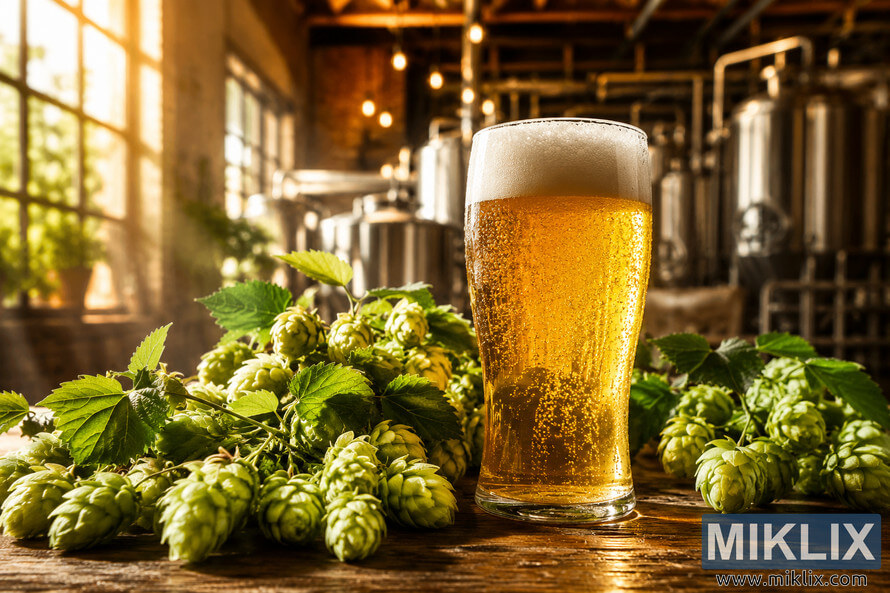
Click or tap the image for more information and higher resolutions.
Integrating Fantasia hops into Belgian and saison ales
Fantasia hops introduce floral, citrus, and tropical flavors, complementing the boldness of Belgian and saison yeasts. A light to medium grain bill allows these hop aromas to shine. The art of yeast selection, timing of adjuncts, and temperature control is crucial. It's about creating a harmony where floral hops and yeast esters blend seamlessly.
Opt for yeast strains that offer mild phenolics and esters to achieve a balanced Fantasia Belgian ale. Wyeast 3724 Belgian Saison, White Labs WLP565 Trappist, and Wyeast 3711 French Saison are excellent choices. Each strain brings its unique character: Trappist strains add fruity esters, while saison strains introduce peppery phenolics. Selecting the right strain ensures that Fantasia yeast pairing enhances the floral hop notes, rather than overpowering them.
Spices and fruits can enhance Fantasia hops without dominating them. Consider fresh orange peel, coriander, or elderflower for subtle citrus and floral notes. Grated ginger adds a warm, spicy kick when used judiciously. Stone-fruit purees, such as peach or apricot, complement tropical hop flavors. Add these adjuncts late in fermentation or post-fermentation to preserve their delicate aromas.
Fermentation temperature is key in controlling ester and phenol production. For Belgian ales, aim for a mid-range temperature of 64–74°F to highlight esters that complement the Fantasia saison's character. Saisons, on the other hand, benefit from warmer temperatures, 72–85°F, to develop spicy phenolics and a dry finish. Keep a close eye on fermentation temperatures to prevent them from overpowering the floral hop aroma.
After fermentation, cool the beer for a brief maturation period. This allows hop aromatics to settle and flavors to clarify. Consider dry hopping lightly or adding late whirlpool additions to preserve the floral essence. These steps are essential for showcasing the bright hop expression and balanced yeast profile in a Fantasia Belgian ale or saison.
Fantasia hops for experimental and hybrid brews
Fantasia invites brewers to explore new horizons with experimental recipes. It combines hop clarity with innovative fermentation techniques. Its bright, floral notes enhance hybrid styles without overpowering the base beer. Plan hop additions and contact times to maintain a lively hop profile, even during souring or aging.
Fruit-forward and sour beer pairings
- Pair Fantasia with passionfruit, mango, or peach for fruited sours. The tropical and citrus notes complement these fruits well.
- For kettle sours, add Fantasia late in the whirlpool or post-fermentation as a dry-hop. Souring often involves heat or long kettle holds that can strip delicate oils.
- When using fruit purée, stagger additions: fruit early for integration, Fantasia late to preserve aroma.
Barrel aging with hop-forward beers
- Long barrel aging usually reduces hop aromatics. Use light hop rates during the barrel phase to avoid clashes with oak and Brettanomyces funk.
- Dry-hop after barrels or add hop tinctures or cryo-hop doses just before packaging to restore hop lift.
- Test small additions of Fantasia to add a fresh floral top note that complements barrel character without overwhelming it.
Tips for small-batch experimentation
- Split a batch into 1–2 gallon test portions to trial different hop rates and schedules. small-batch Fantasia trials speed learning and save ingredients.
- Run a control with a standard schedule alongside variations that change contact time or combine fruit and yeast strains.
- Keep detailed tasting notes and aroma flasks. Repeat promising experimental Fantasia recipes at larger scale once results are consistent.
Hopping techniques to maximize Fantasia hops aroma
To get the most from Fantasia, handle it gently and with care. Small adjustments in temperature, timing, and contact can enhance its floral and citrus notes. These practical tips help preserve volatile oils and shape the aroma, avoiding grassy or vegetal traits.
Whirlpool temperature and time are crucial, more than many brewers realize. Aim for a whirlpool between 160–180°F (71–82°C) for 10–30 minutes. This helps extract floral and citrus oils without losing too much. Lower temperatures in this range preserve the most delicate top notes. Ensure gentle circulation to improve hop contact and help trub settle quickly.
Rapid cooling after the whirlpool is key to locking in aroma. Move the wort to cold side quickly to limit hot-side exposure. Use cryo or T90 pellets when possible to retain hop oils during handling and transfers.
Split dry hopping offers both biotransformation and fresh aroma. Add one Fantasia dry hopping addition during high krausen or just after primary attenuation begins. This enables yeast-hop interactions. Add a second dose after active fermentation for bright, volatile character.
Keep dry-hop contact short and controlled. Target 3–7 days per addition, with total hop contact time rarely exceeding 10–14 days to avoid grassy flavors. For cold-conditioning or lager-style beers, 2–4 days per addition is often sufficient and keeps the profile clean.
Protect volatile oils by minimizing oxygen exposure at every stage. Use closed transfers, purge vessels with CO2 when possible, and avoid splashing when racking. These steps help retain hop oils and extend fresh hop character in the finished beer.
- Choose pellet type: cryo or dense T90 pellets give higher oil retention than low-density products.
- Decide on form: loose additions maximize surface area, hop bags make removal easier; pick based on ease of handling and desired extraction.
- Avoid long, vigorous kettle boils for aroma hops; reserve Fantasia for whirlpool and hop-back roles when aroma is the priority.
- Monitor hop contact time closely and taste before packaging to prevent over-extraction of vegetal notes.
Calculating bitterness and alpha acid for Fantasia
Accurate bitterness estimates and precise alpha acid numbers are crucial for brewers aiming to balance their beers with Fantasia hops. This guide will cover basic estimation for boil additions, the difference between lab values and catalog ranges, and practical tools for speeding up recipe work. Follow these steps to ensure consistent and predictable Fantasia IBUs.
Estimating IBUs for different boil additions
IBU estimates depend on the hop's alpha acid percentage, the weight used, wort volume, and boil time. Utilization formulas like Tinseth, Rager, or Morey convert these inputs into IBU contributions. Longer boils, lasting 60–90 minutes, contribute most to bitterness. Short additions, lasting 5–10 minutes, add aroma with minimal bitterness.
For Fantasia as an aroma-forward choice, late additions should be primarily aromatic. Early additions should be calculated for bittering using a chosen utilization model. This allows for adjustments in early bittering hops. Small AA variations significantly impact the hop weight needed for a target IBU in homebrew scale.
Using laboratory vs. catalog alpha acid values
Catalog alpha acid ranges are averages for a cultivar lot. Laboratory COA values report the measured AA% for a specific harvest or pellet lot. Use COA values when available to avoid batch-to-batch swings.
For example, a recipe targeting 40 IBUs with 6% AA will need less Fantasia than one with 4% AA. This 2% difference can change the required hop weight by about one-third for the same bittering target. Always log the AA% from supplier lot sheets to reproduce results later.
Tools and calculators to streamline formulations
IBU calculators and brewing tools speed up iterations and reduce math errors. Reliable options include BeerSmith and Brewer’s Friend IBU calculators, as well as portable spreadsheets for switching between Tinseth and Rager formulas. Bru’n Water is also useful for water profile work that affects perceived bitterness.
- Keep a recipe spreadsheet noting lot-specific AA% for each hop.
- Use calculators with selectable utilization formulas to compare outcomes.
- Record measured gravities and boil volumes to refine hop utilization Fantasia in your system.
Consistent record-keeping, use of lab values when available, and regular checks with trusted IBU calculators will make Fantasia IBUs predictable. This approach keeps Fantasia alpha acid calculation grounded in real batch data. It helps preserve the variety's aromatic strengths while hitting your bitterness goals.
Storage, handling, and freshness of Fantasia hops
Ensuring Fantasia hops remain in top condition involves storing them in cold, dark environments. It's crucial to exclude oxygen tightly. This method helps maintain the hop's freshness and the delicate floral and citrus notes that brewers cherish.
Best practices for cold storage and vacuum sealing
- Freeze hops at 0–40°F (-18–4°C) for long-term storage. Use vacuum seal hops or nitrogen-flushed mylar bags to block oxygen and light.
- For short-term storage, refrigerate at 34–40°F. This is suitable when batches are used within weeks.
- Label packages with harvest and pack dates plus alpha acid percentages. This helps track the decline in potency over time.
- Only open packages when you're ready to use them. Reseal unused portions in fresh vacuum-seal bags or transfer to inert-gas flushed containers.
How to recognize degraded hops
- Visual cues: cones or pellets turning brown or past their normal green indicate oxidation.
- Aroma cues: a loss of bright top-notes, replaced by wet-paper, cheesy, or soapy off-aromas, signals deterioration.
- Flavor cues: increased harsh resinous bitterness and muted floral/citrus character indicate reduced hop freshness.
- When unsure, steep a small sample in boiling water or a quick wort test. Reduced alpha acid potency will show as softer bitterness.
Effect of pellet vs. whole-cone on aroma preservation
- Pellets, especially T90 and cryo formats, compact plant material for consistent utilization. They can expose more surface area at each cut point, yet perform well when vacuum packed and frozen.
- Whole-cone Fantasia keeps cone structure intact and may show slightly different aging profiles. Whole cones need more storage space and careful packing to avoid air pockets.
- For Fantasia’s delicate floral notes, high-quality vacuum-sealed pellets or cryo-pellets stored cold often preserve aroma most reliably.
- Choose packaging and format based on your usage rate. Smaller brewers who use hops slowly should prioritize vacuum seal hops and strict cold storage to protect hop freshness.
Sourcing Fantasia hops in the United States
Securing Fantasia hops for brewing involves both retail searches and direct communication with industry sellers. Homebrewers and small breweries often turn to established hop houses and specialty retailers. They seek new varieties, confirm formats, and plan around harvest windows.
Yakima Valley Hops, Hops Direct, and Great Western Malting are key sources for trade buyers. Homebrew shops like Northern Brewer and MoreBeer are also valuable resources. Reaching out to sales representatives can confirm inventory and upcoming Fantasia hop releases.
Trade distributors provide lead times for new varieties. Early contact can help avoid unexpected delays. This is crucial for planning your brewing schedule.
When buying for homebrewing, consider the quantity and format. For trial batches, start with 1–4 oz (28–113 g). Small commercial batches usually require 1–5 lb (0.45–2.3 kg).
Choose between whole-cone, T-90 pellet, or cryo formats based on your needs. Whole-cone offers a fresher character for single batches. Pellets and cryo formats are more space-efficient and ensure consistent dosing.
New varieties can sell out fast. Pre-ordering or securing a purchase agreement with distributors ensures supply for your brews. Inquire about packaging, harvest dates, and vacuum sealing to assess freshness.
Supporting local growers enhances regional supply and freshness. Look for trial acreage reports and farm sales in Yakima Valley and Willamette Valley. While farmers’ markets rarely have fresh cones, harvest festivals and hop yards may offer small quantities directly to brewers.
- Contact multiple Fantasia hop suppliers to compare lead times and prices.
- Match order size to batch plan to avoid waste and preserve freshness.
- Consider local growers for short lead times and better Fantasia seasonal availability.
Pairing Fantasia hops with malts and yeast strains
A clean grain and a thoughtful yeast choice let Fantasia hops lead. Use a restrained malt bill Fantasia to keep the canvas neutral and bright. Small changes to body and sweetness can push the hop aromas forward without masking them.
Grain bill ideas to showcase hop character
- Simple base: American 2-row or Maris Otter as the majority malt gives a crisp, grainy backbone that lets Fantasia shine.
- Light crystal (5–10L): Add 3–6% to round the finish and support hop sweetness without heavy caramel flavors.
- Body for haze: For NEIPA-style beers, include 6–12% flaked oats and 5–8% wheat to increase mouthfeel and make juicy hop notes pop.
- Specialty balance: 1–3% Carapils helps head retention and perceived fullness when you want a lighter malt bill Fantasia that still drinks smooth.
Yeast strains that complement Fantasia aromas
- Clean American ales: Wyeast 1056, Safale US-05, or White Labs WLP001 keep esters low and boost hop clarity for Fantasia yeast pairing.
- British strains: English ale yeasts add a soft fruity backbone that can lend complexity without hiding hop details.
- Saison yeasts: For spicy-ester interplay try Saison strains to create lively aromatics that play off Fantasia’s tropical notes.
- NEIPA approach: London Ale III or similar English-derived strains with lower attenuation and moderate ester production help showcase Fantasia hops in haze beers.
Adjuncts and flavor enhancers that work well
- Fruit purees: Mango, passionfruit, and peach pair naturally with Fantasia’s tropical profile and lift perceived juiciness.
- Citrus peel: A touch of orange or tangerine zest brightens aromatics and aligns with the hop’s citrus facets.
- Lactose and milk sugars: Use in milkshake-style beers to add sweetness and body that magnifies hop-forward flavors.
- Floral enhancers: Light honey or elderflower complements floral notes while preserving the main hop voice when used sparingly as adjuncts Fantasia hops.
Combine these elements in small test batches. Keep the malt bill Fantasia restrained, pick yeast for the character you want, and add adjuncts to highlight specific tropical or floral notes. That approach will showcase Fantasia hops with balance and clarity.
Common problems and troubleshooting with Fantasia hops
Even seasoned brewers encounter challenges with Fantasia hops. Small adjustments in process and storage can introduce vegetal notes, diminish aroma, or result in stale hop flavors. These steps aid in identifying and resolving issues, ensuring the hop character is preserved without overcomplicating the brewing process.
Mitigating vegetal or grassy off-notes
Vegetal flavors often stem from extended hot-side contact, high whirlpool temperatures, or the use of unripe cones. Shorten the time hops spend in hot wort and lower whirlpool temperatures to under 160°F. This minimizes chlorophyll and plant compound extraction.
Limit dry-hop duration to 3–7 days to avoid excessive extraction of green compounds. Store hops in airtight, cold environments and verify pellet quality before use. When dry-hopping, use cooler temperatures or hop bags to reduce particulate contact and grassy hop extraction.
Fixes for muted hop aroma in finished beer
A muted Fantasia aroma can result from oxidation, prolonged conditioning, yeast masking, or excessive attenuation. Begin by verifying fermentation and aging parameters. If the aroma is lacking, a short re-dry-hop with fresh Fantasia hops can enhance the bouquet.
For a controlled boost, add small, fresh late-stage hop additions or employ a hop tincture made with neutral spirit for bottled beer. This method revives aroma without altering bitterness. Commercial breweries can blend hop-forward tanks or apply post-fermentation aroma additions to restore hop clarity before packaging.
Addressing oxidation and stale-hop flavors
Oxidation manifests as cardboard, loss of brightness, or muted fruit notes. Stale hop flavors may smell cheesy or like wet paper. Prevent these by minimizing oxygen pick-up during transfers and using CO2 purging at packaging.
Keep hops and beer cold, rotate inventory with FEFO, and vacuum-seal or store hops in nitrogen-flushed bags. If oxidation is already present, blending with fresh-hopped beer can mask defects. Prevention remains the best remedy when trying to avoid stale hop flavors in your final product.
Recipe templates featuring Fantasia hops
Below are practical templates for brewing with Fantasia hops. They serve as starting points, allowing you to tweak to taste. You'll find examples for an all-grain pale ale, an extract/partial-mash version for beginners, and guidance on scaling recipe quantities for different batch sizes and kegging.
All-grain American Pale Ale (5 gallons)
- Grain bill: 9.5 lb (4.3 kg) US 2-row, 1.0 lb (0.45 kg) crystal 10L, 0.5 lb (0.23 kg) Carapils.
- Mash: 152°F (67°C) for 60 minutes, sparge to collect ~6.5 gallons.
- Hops (example AA 5%): 0.5 oz Fantasia at 60 min (bittering), 1.0 oz at 10 min, 1.5 oz whirlpool at 170°F for 20 min, 3.0 oz split dry-hop (2.0 oz after primary fermentation, 1.0 oz late). Target IBUs ≈ 35.
- Yeast: Safale US-05 or Wyeast 1056. Target OG 1.050, FG 1.010.
- Fermentation: 68°F primary until stable gravity, then dry-hop for 3–5 days before cold crash.
The Fantasia pale ale recipe showcases late additions and dry hopping. This highlights floral and citrus notes. Adjust whirlpool and dry-hop contact times to fine-tune aroma intensity.
Extract / Partial-Mash Version (6.5 gallons)
- Extract: 6.6 lb (3.0 kg) liquid pale malt extract or 7–8 lb DME light.
- Specialty grains: 1.0 lb crystal 10L, steep at 155°F for 20–30 minutes; optional 0.5 lb Carapils for head retention.
- Hops: Keep same schedule as all-grain but increase late and dry-hop amounts by 10–20% to compensate for lighter malt complexity. Example: 0.6 oz at 60, 1.2 oz at 10, 1.8 oz whirlpool, 3.6 oz total dry-hop split.
- Yeast and fermentation: Use US-05 or 1056 with the same target gravities; ferment at 68°F.
For simpler equipment needs, use the Fantasia extract recipe. Steeping specialty grains adds body and color. Bigger late additions preserve hop character.
How to scale Fantasia recipe for different batch sizes and kegging
- Linear scaling: Multiply all grain and hop weights by the batch size ratio. For example, to move from 5 to 10 gallons multiply by 2.
- Caveat: Hop utilization changes with kettle geometry and wort gravity. Use software like BeerSmith or Brewer’s Friend to refine IBUs when you scale.
- Kegging tips: Cold-crash to drop yeast and trub for 24–48 hours, then transfer under CO2 to avoid oxygen pickup. Carbonate to style level; for an American pale ale aim for 2.2–2.6 volumes CO2.
Scaling Fantasia recipes requires adjusting whirlpool volume and hop contact time. Larger kettles can lower effective utilization for late additions, so small adjustments may be needed.
These templates ensure consistent results across all-grain, extract, and scaled brews. Use them to create your own Fantasia recipes and refine hopping schedules for the desired aroma and flavor.
Cost considerations and yield when using Fantasia
Fantasia adds a vibrant aroma and complex flavors to beer. Its higher cost per ounce reflects its premium status among aroma hops. This price is justified when used for flavor enhancement, not just bitterness.
Comparing cost per ounce and per IBU
To calculate hop cost per IBU, divide the cost by the IBUs it contributes. Use alpha values from catalogs or tests for precise calculations. Fantasia's high cost per IBU is due to its minimal bitterness contribution. Its true value lies in its sensory impact.
Supplier formats like pellets, cryo lupulin, and whole cone vary in yield and price. Cryo products, with their concentrated oils and resins, may cost more per ounce but require less weight for the same aroma.
Maximizing value with targeted additions
Target late kettle additions, whirlpool hops at 170–180°F, and dry hopping for maximum aroma. Use small, precise amounts to extract oils effectively, avoiding vegetal flavors.
- Use high-alpha, inexpensive hops for early boil bittering to lower overall hop spend.
- Split late additions to layer aroma and stretch ounces across batches.
- Reuse small leftover amounts for pilot brews or aroma trials to save money and test profiles.
Budget-friendly substitution strategies
For cost or supply concerns, blend alternatives to mimic Fantasia's floral-citrus-tropical profile. Try Hallertau Blanc, Ella, Citra, or Cascade in different ratios. Adjust amounts on small batches to find the perfect balance.
Consider cryo or concentrated lupulin products as a Fantasia substitute. They reduce handled weight and may lower costs per aroma. Keep notes on substitution ratios for scaling and deciding when to splurge on the original hop.
Shop around to save on Fantasia hops. Compare wholesale lots, buy in bulk, and consider pellet versus cryo formats. Thoughtful planning of additions maximizes aroma per dollar.
Conclusion
Fantasia hops summary: Fantasia is a hop variety known for its floral, citrus, and tropical aromas. It excels with late-boil additions, whirlpool hops, and dry hopping. This hop adds a bright top-end character to pale ales, IPAs, saisons, and experimental fruit or hybrid beers. When used fresh, its volatile oils provide a clear aromatic lift without needing heavy bittering additions.
Practical Fantasia brewing takeaways include trialing small batches and prioritizing cold storage and vacuum-sealed pellets to preserve aroma. Calculate IBUs using the actual alpha-acid percentage printed on the lot. Favor targeted late additions to maximize aroma per ounce. Pair Fantasia with clean ale yeasts for modern pale ales or with Belgian/saison strains for a spicy, phenolic backdrop.
For sourcing and cost control, buy from reputable U.S. suppliers or local growers. Compare cost per ounce versus cost per IBU when planning batches. Use substitutions thoughtfully and focus on late-stage additions to get the most value from each hop measure. Finally, document hop weights, contact times, and tasting notes for every trial to refine recipes and fully realize Fantasia’s aromatic potential.
FAQ
What are Fantasia hops and where did they originate?
Fantasia hops are a modern aroma variety, developed through targeted breeding. They combine floral top-notes with bright citrus and tropical fruit character. Breeders aim to balance intense essential oils with good agronomic traits. This includes disease resistance and yield.
While specific parentage may vary, expect lineage that blends noble-type floral traits with New World citrus/tropical lines.
In which U.S. regions are Fantasia hops grown and how does terroir affect them?
Fantasia is grown in the Pacific Northwest (Yakima Valley, Washington; Willamette Valley, Oregon) and Idaho. Trial plots are also found in New York and Michigan. Warmer sites tend to raise alpha acids and mute delicate florals.
Cooler, high-elevation sites preserve perfumey top-notes. Soil drainage, irrigation, and diurnal temperature swings all influence final oil intensity and aromatic balance.
What does Fantasia smell and taste like?
Fantasia presents a layered sensory profile. It has primary floral impressions (blossom, jasmine, light lavender), bright citrus (tangerine, sweet orange, bergamot), and ripe tropical fruit (passionfruit, guava, pineapple).
On the palate, it delivers clean citrus zest and juicy tropical notes with low vegetal or resinous character. In restrained doses, it brightens a beer; in heavy late additions, it increases perceived juiciness and fullness.
What is the typical alpha acid range and bitterness role for Fantasia?
As an aroma-focused variety, Fantasia’s alpha acids are modest—commonly expected in the roughly 4–7% AA range for aroma hops. It’s primarily used for late-boil, whirlpool, and dry-hop additions to deliver aroma rather than boil bittering.
If used early in the boil, it will contribute gentle backbone bitterness but is not the most efficient bittering choice compared with high-AA varieties.
How does Fantasia compare to hops like Citra, Mosaic, or Galaxy?
Fantasia shares tropical and citrus elements with Citra, Mosaic, and Galaxy but leans more toward a floral-citrus hybrid. Compared with resinous/dank varieties, Fantasia emphasizes perfumey floral lift—often due to higher linalool/geraniol relative to piney terpenes.
Choose Fantasia when you want bright floral complexity layered over tropical citrus without heavy resinous notes.
What hopping schedule works best for pale ales and IPAs using Fantasia?
For a 5-gallon batch, aim for a small bittering charge at 60 minutes (0.5–1 oz), a late addition at 10–5 minutes (0.5–1.5 oz), a whirlpool at 170–180°F for 10–30 minutes (1–2 oz), and split dry-hop charges totaling 2–4 oz. Adjust weights to OG and AA%.
Use heavy late and dry-hop rates for New England–style IPAs to maximize tropical intensity while controlling oxygen exposure.
How should Fantasia be used in lagers and lighter styles?
Preserve delicate aromas by fermenting clean with lager yeasts (e.g., Wyeast 2206, White Labs WLP830) and using late whirlpool and brief dry hops post-fermentation. Keep IBUs modest (18–25) so bitterness doesn’t overwhelm malt simplicity.
Use Pilsner or light 2‑row bases and minimal specialty malts; a short cold-side dry-hop (2–4 days) can add floral/citrus lift without masking clarity.
Can Fantasia be used in Belgian ales and saisons?
Yes. Pair Fantasia with Belgian or saison yeasts to create interplay between floral hop lift and yeast-derived esters/phenolics. Choose yeast strains and fermentation temperatures to complement rather than compete—moderate temperatures for Belgian ales (64–74°F) or warmer saison ranges (72–85°F) depending on desired spice.
Add delicate adjuncts like orange peel, coriander, or stone fruits late to preserve aroma.
What are good experimental applications for Fantasia (sours, barrel-aging)?
Fantasia pairs well with fruit-forward sours—passionfruit, mango, and peach accent its tropical notes. For barrel-aged beers, avoid relying on long barrel time to preserve hop aromatics; dry-hop after aging or use hop tinctures/cryos just before packaging.
Small-batch split-tests (1–2 gallon trials) help dial contact times and combinations with fruit or Brett.
What whirlpool temperatures and dry-hop contact times maximize Fantasia’s aroma?
Whirlpool between 160–180°F (71–82°C) for 10–30 minutes to extract floral and citrus oils while minimizing volatilization. Dry-hop with a split schedule—one at high krausen or early fermentation for biotransformation and one post-fermentation for fresh aroma.
Keep each dry-hop contact to about 3–7 days and total contact under roughly 10–14 days to avoid grassy off-notes.
How should I calculate IBUs when using Fantasia?
Use the hop’s actual AA% (from lot COA when possible) and common utilization formulas (Tinseth, Rager) to estimate IBUs. Treat Fantasia as primarily a late-addition hop; short 5–10 minute boils contribute little bitterness.
When precise bitterness is important, use lab AA values instead of catalog ranges to avoid significant formulation errors.
What are best practices for storing and handling Fantasia hops?
Store hops vacuum-sealed or nitrogen-flushed in mylar at freezer temperatures (0–40°F, ideally around -18°C) for maximum life. Minimize oxygen and light exposure and label packs with harvest/pack dates and AA%. T90 pellets or cryo products in vacuum packs provide consistent storage life; whole cones preserve cone integrity but take more space.
How can I spot degraded or stale Fantasia hops?
Degraded hops show brown color, weak or off aromas (wet-paper, soapy, cheesy), and loss of bright floral/citrus notes. In beer they yield dullness or harsh resinous flavors. If unsure, smell a small sample and boil a pinch to assess aroma.
Prevent degradation through cold, oxygen-free storage and FEFO rotation.
Where can U.S. brewers source Fantasia hops?
Trusted suppliers include Yakima Valley Hops, Hops Direct, and homebrew retailers like Northern Brewer and MoreBeer; industry buyers also work with distributors such as Great Western. New varieties may require pre-orders or contacting grower sales reps.
Buy sample ounces for trials and larger 1–5 lb lots for commercial needs, choosing pellet or whole-cone formats based on use.
What grain bills and yeasts best showcase Fantasia?
Use neutral bases to highlight Fantasia: American 2‑row or Maris Otter, a touch of light crystal (5–10L), and carapils for body where needed. For hazy beers, add flaked oats and wheat. Yeasts: clean American ale strains (Wyeast 1056, White Labs WLP001) to showcase hop aromatics; British or saison strains when wanting fruity or spicy interplay.
Adjuncts like mango, passionfruit, orange peel, or elderflower enhance the hop’s tropical and floral profile.
What common problems arise with Fantasia and how do I troubleshoot them?
Vegetal or grassy off-notes typically come from long hot contact, excessive dry-hop time, or stale hops—shorten hot-side contact, lower whirlpool temps, and limit dry‑hop duration. Muted hop aroma often results from oxidation, over-conditioning, or yeast masking—consider a small post-fermentation dry-hop or hop tincture.
Prevent stale-hop flavors by minimizing oxygen pickup and maintaining cold storage.
Can you provide a basic all-grain recipe template using Fantasia?
Example 5-gallon all-grain American Pale Ale: 9.5 lb US 2‑row, 1 lb light crystal 10L, 0.5 lb Carapils. Mash 152°F for 60 min. Hops (AA 5% example): 0.5 oz Fantasia at 60 min, 1 oz at 10 min, 1.5 oz whirlpool at 170°F for 20 min, 3 oz split dry-hop (2 oz post-fermentation, 1 oz late). Yeast: US‑05 or Wyeast 1056. Target OG 1.050, FG 1.010, IBUs ~35.
How do cost and yield factor into using Fantasia hops?
New proprietary aroma hops often cost more per ounce and per IBU than established bittering varieties. Maximize value by reserving Fantasia for late and dry additions where aroma impact per ounce is highest, and use cheaper high-AA hops for early bittering.
Consider cryo products or blending with Hallertau Blanc, Ella, Citra, or Cascade if budget requires substitution.
Any final tips for brewers experimenting with Fantasia?
Run small split batches to test hop rates, contact times, and yeast pairings. Track AA% per lot, document sensory notes, and practice tight cold-side handling to preserve delicate floral and citrus oils. When scaling up, confirm availability with suppliers and consider pre-orders to secure consistent supply.
Further Reading
If you enjoyed this post, you may also like these suggestions: