
Hops in Beer Brewing: Herald
Published: July 19, 2026 at 11:18:02 AM UTC
Herald has become a staple in American craft brewing. Its clean citrus and floral notes, steady alpha acid profile, and reliable yields make it a favorite. It's ideal for single-hop experiments and complex blends.
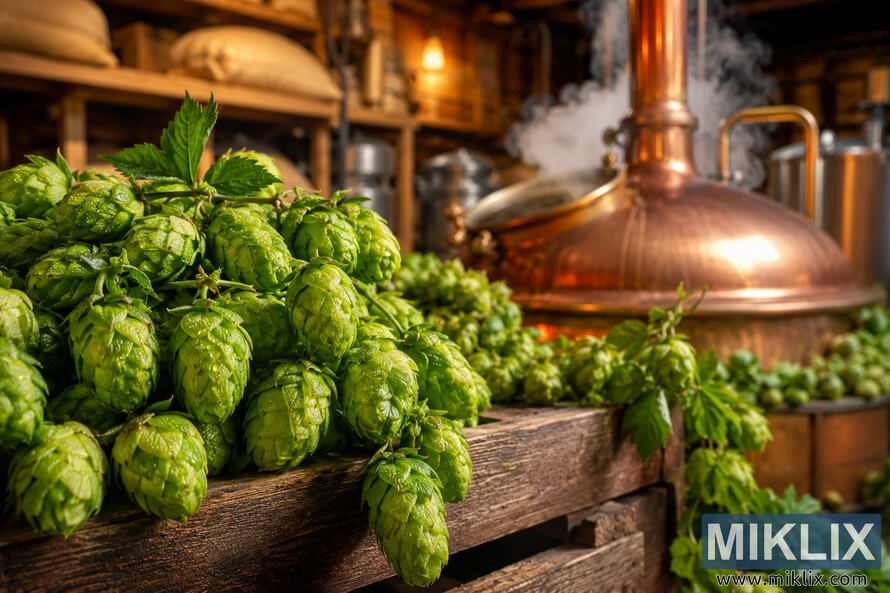
Click or tap the image for more information and higher resolutions.
Key Takeaways
- Herald hops bring a unique flavor profile, enhancing both IPAs and malt-focused beers.
- This Herald hops brewing guide is tailored for U.S. homebrewers and craft brewers, offering practical techniques.
- Sections are organized progressively: profile → sourcing → technique → recipes → packaging and troubleshooting.
- Expect evidence-based tips for bittering, aroma additions, and dry hopping with Herald.
- Practical notes are provided for scaling recipes and maintaining Herald hops flavor through fermentation and packaging.
Introduction to Herald hops and their role in brewing
Herald has become a staple in American craft brewing. Its clean citrus and floral notes, steady alpha acid profile, and reliable yields make it a favorite. It's ideal for single-hop experiments and complex blends.
Here's a brief overview of Herald's journey into commercial use, its significance to modern brewers, and its suitability for various beer styles.
Brief history of the variety
Herald emerged from formal breeding programs, including those at regional universities and by industry leaders like Yakima Chief Hops. It's a result of deliberate crosses aiming to merge aromatic intensity with agricultural stability. Grower adoption started in the 2010s, with commercial planting expanding after positive trial feedback and supply agreements.
Why this hop matters to craft brewers
Brewers value Herald for its clear aroma and flavor. It offers citrus peel, light floral, and stone-fruit notes, especially in late additions and dry hopping. Its stable alpha acids simplify bittering and reduce batch variation.
For production breweries, Herald's consistent yields and disease resistance are crucial. This reliability supports the U.S. craft brewing trend towards single-hop showcases, small-batch collaborations, and innovative hop-forward styles.
Overview of common beer styles using Herald
Herald suits a broad spectrum of styles where hop aroma and balance are key. It's commonly used in:
- American IPA — as a primary aroma hop for bright citrus and floral top notes.
- New England IPA (NEIPA) — for its soft fruit tones that complement fruity yeast esters and high-protein malts.
- Pale ale — adds a citrus lift without overpowering malt character.
- Saison — brings a clean, floral edge that complements peppery yeast strains.
- Amber ale and English-influenced ales — used sparingly to enhance malt complexity while adding a fresh finish.
Brewers can showcase Herald as a single-hop feature or blend it to enhance complexity. In malt-forward beers, it supports the malt. In hop-forward recipes, it dominates the aroma.
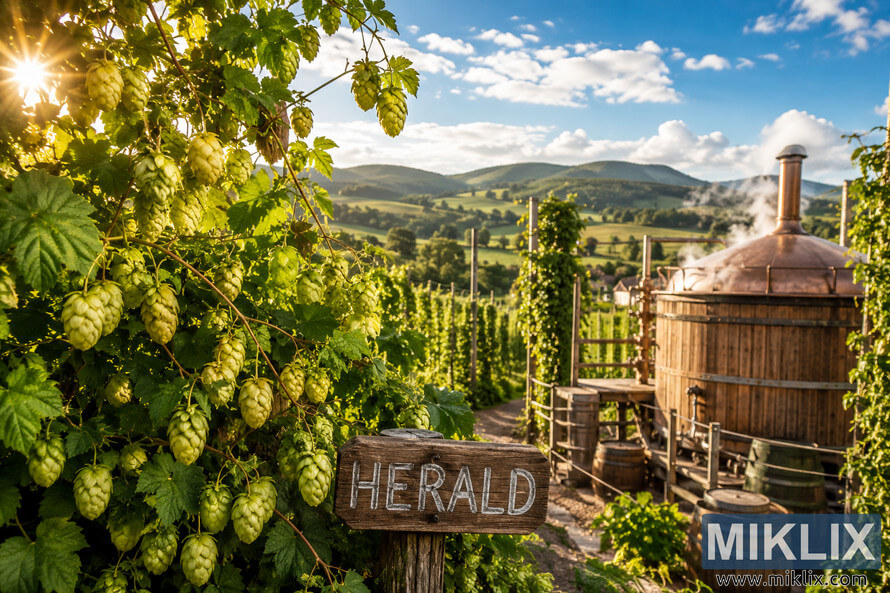
Click or tap the image for more information and higher resolutions.
Herald hops flavor and aroma profile
The Herald hop profile is known for its clear, approachable aroma. It's favored for its balance and versatility in brewing. It offers bright citrus and floral notes without the harshness of pine or heavy resin. This makes Herald ideal for creating clean, expressive hop flavors in pale ales and malt-forward beers.
Key aroma descriptors
Herald's hop tasting notes include bright citrus like grapefruit and orange zest. It also features lighter tropical stone-fruit notes, such as peach and apricot. Floral accents add a touch of blossom and a faint tea-like quality. Herbal and spice undertones provide depth without overpowering the scent. The aromatics are moderately volatile, making late additions and dry hops crucial for capturing the delicate facets.
Taste characteristics in finished beer
The flavor of Herald hops in beer is clean and citrusy on the palate. It adds a soft, rounded fruitiness when used late in the boil or as a dry hop. Early additions contribute moderate bitterness without harshness, enhancing malt sweetness. In hazy IPAs, Herald creates a juicy mouthfeel. In pale ales, it provides a crisper finish while maintaining aromatic clarity.
Comparisons to similar hop varieties
Compared to Citra, Herald has less tropical and pungent notes, focusing on citrus and floral balance. Mosaic offers more complex berry and dank layers, while Amarillo is known for its orange and floral dominance. Herald falls between classic U.S. citrus hops and modern, punchy varieties, offering a milder, more rounded profile.
- Substitute guidance: swapping Herald for Citra will reduce tropical punch and increase citrus subtlety.
- Blending tip: pairing Herald with a resinous hop can add backbone while keeping Herald's floral-citrus clarity.
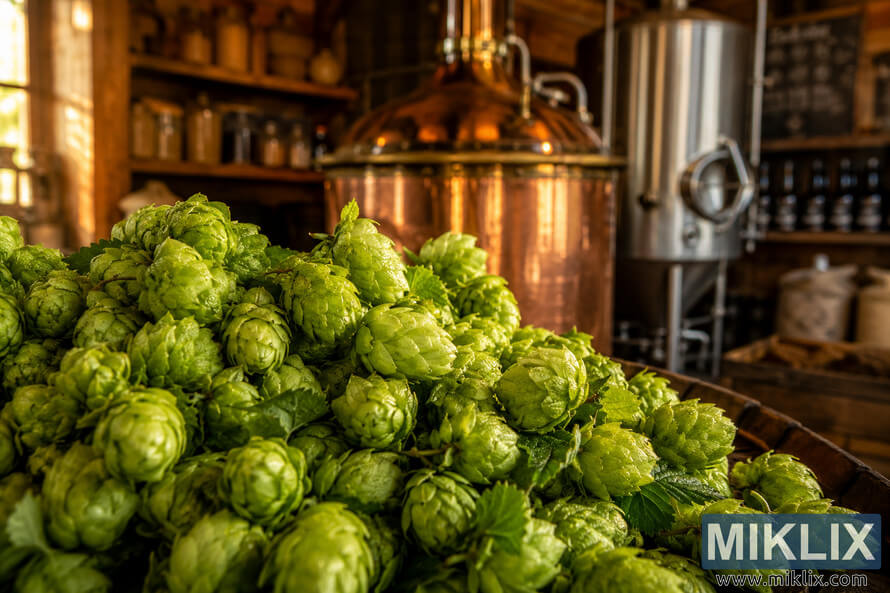
Click or tap the image for more information and higher resolutions.
Growing and sourcing Herald hops in the United States
The Herald hop has found a reliable home across several U.S. growing regions. Brewers and growers should know where the variety thrives, what buying options exist, and how to work with reputable hop farms and suppliers. This ensures fresh, testable crop lots.
Regions and climates where Herald thrives
Herald performs best in the Pacific Northwest. Yakima Valley and the Willamette Valley offer the chill hours and cool nights that bring out floral and citrus aromatics. Parts of Oregon and Idaho produce good crops where irrigation and heat management are available.
Growers aim for consistent irrigation to avoid stress during hot spells. Typical harvest windows fall in late August through September. Microclimates within valleys can shift aromatic expression, yielding brighter citrus in cooler sites and riper stone-fruit notes in warmer pockets.
Buying options: pellet, whole-cone, and cryo hops
Buyers can choose whole-cone, pelletized, or concentrated lupulin products. Whole-cone Herald suits dry hopping and small-batch kegging because it contains less processed material and preserves hop structure.
Pellet Herald is the go-to for most commercial brewers and homebrewers. Pellets compress hops for easier storage, more consistent utilization, and predictable bitterness contributions.
Cryo and lupulin concentrates deliver intense aroma with less vegetal matter. These products raise extract per ounce while changing handling and dosing. When comparing pellet vs whole-cone Herald, consider storage stability, ease of use, and aroma yield.
Working with local hop farms and suppliers
Sourcing through established channels helps maintain freshness. National vendors like Yakima Chief Hops, Brewers Supply Group, and Hops Direct supply bulk and packaged lots. Regional hop farms and cooperatives offer small-batch purchases and direct contact with growers.
- Ask hop suppliers for harvest date and alpha acid testing to confirm potency.
- Prioritize vacuum-sealed foil bags and cold storage to preserve volatile oils.
- Discuss contract hops or small-batch runs if you want consistent crop-year lots.
Building a relationship with Herald hop farms encourages transparency on crop practices. This helps you secure targeted lots. When you plan to buy Herald hops, clear communication about desired form, storage needs, and testing will improve consistency in your brews.
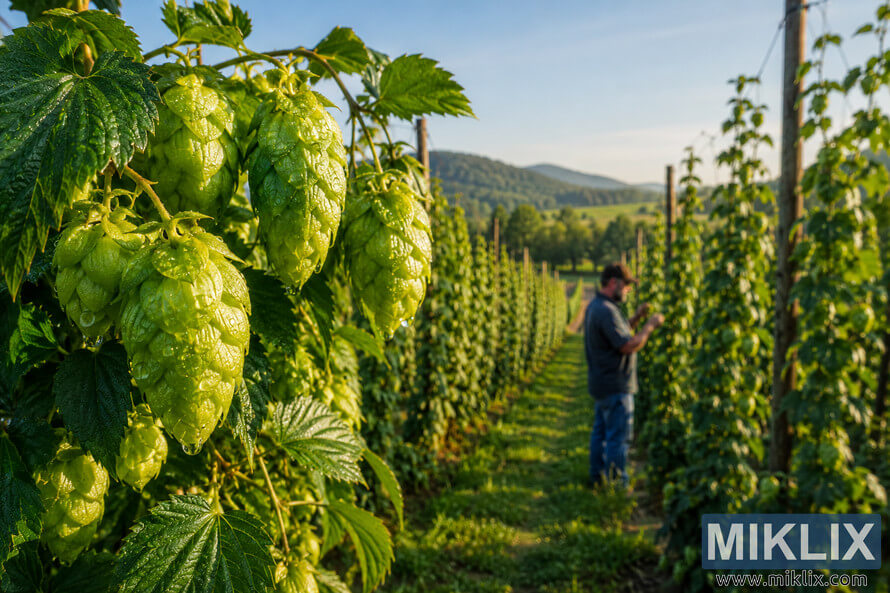
Click or tap the image for more information and higher resolutions.
Understanding alpha acids and bittering with Herald hops
Herald hops offer brewers a range of bittering options. Understanding typical alpha numbers and their IBU translation is key to achieving balance. Always check the latest Certificates of Analysis from suppliers like Yakima Chief or Hops Direct before brewing.
The alpha acid range for Herald hops varies by crop and lab analysis. Suppliers like Yakima Chief or Hops Direct provide lab sheets showing a range from 5% to 12%. Crop variability can significantly impact the alpha acid content, so it's crucial to use the COA for the specific lot you purchase.
Calculating IBUs with Herald hops involves standard formulas like Tinseth or Rager. The calculation depends on boil time, wort gravity, and hop form. For instance, a 60-minute addition of 28 grams (1 ounce) of 8% alpha Herald in 19 liters (5 gallons) of wort yields roughly 18–20 IBUs. Lower alpha acids result in fewer IBUs, while higher boil gravity reduces utilization and bitterness.
Here is a simple calculation flow to follow:
- Record the alpha acid percent from the lot's COA.
- Choose a formula (Tinseth for homebrewers is common).
- Enter hop weight, boil time, wort volume, and starting gravity.
- Adjust for utilization and recalc if you change gravity or batch size.
Strategies for achieving balance and drinkability start with style targets. For American Pale Ales, aim for 25–40 IBU. For American IPAs, target 40–70 IBU, depending on malt bill and bitterness goals. If the alpha acid range of Herald hops is lower, use a high-alpha bittering hop for the 60-minute addition and save Herald for flavor and late additions.
When bittering with Herald, try these approaches:
- Use Herald as the sole bittering hop when lab numbers are 8–12% and you want a clean, slightly floral base bitterness.
- Combine a 60-minute addition of a high-alpha hop, such as Magnum, with late Herald additions to preserve aroma and add complexity.
- Target perceived balance by adjusting malt sweetness, not just raising IBUs. A slightly higher malt backbone reduces the need to push IBUs very high.
Regularly update your Herald IBU calculations with every new hop lot. Small changes in alpha acids can significantly shift final bitterness and drinkability. Using precise weights, current COAs, and consistent formulas ensures batches remain consistent and taste as intended.
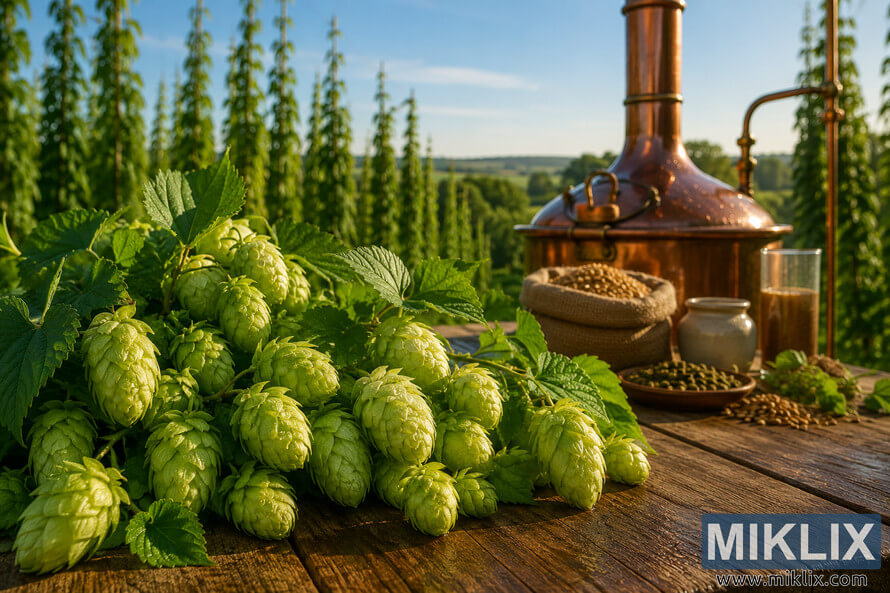
Click or tap the image for more information and higher resolutions.
Using Herald hops for aroma and flavor additions
Herald hops bring bright citrus and floral notes to the table. They require careful handling to showcase their best qualities. Here are some practical tips for late additions, whirlpool work, and dosage planning. These methods help maximize Herald's aroma and flavor without introducing harsh bitterness.
Late boil additions to preserve aroma
Introduce Herald hops in the last 5–15 minutes of the boil to preserve volatile oils. A 5-minute addition captures the freshest citrus and floral notes. A 10-minute addition strikes a balance between aroma and light flavor. A 15-minute addition adds more flavor and a bit of isomerization, still maintaining its character.
For delicate top notes, add hops with 5 minutes left and avoid vigorous boiling afterward. Use hop pellets for even extraction or whole-cone for a softer profile.
Whirlpool and hop stand techniques
Cool the wort to 170–180°F (77–82°C) before adding Herald for whirlpool or hop stand. This temperature range optimizes essential oil extraction without excessive bitterness.
Generate a gentle vortex to keep hops suspended and enhance contact. Steep for 10–30 minutes, depending on the desired intensity. Longer steeping increases aroma but risks polyphenol extraction if the temperature rises.
Employ a hop bag or false bottom for easy removal. Bags contain trub, simplifying transfer. A false bottom ensures maximum surface contact and less absorption. Keep a close eye on temperatures to avoid vegetal or astringent flavors.
Typical dosage ranges for flavor impact
- Homebrew, 5-gallon: 0.5–1.5 oz for subtle aroma.
- Homebrew, 5-gallon: 1.5–4 oz for clear flavor presence in pale ales and amber ales.
- IPAs and heavy hop-forward beers: 4–8+ oz in whirlpool or hop stand for concentrated aroma and flavor.
Scale dosages for commercial batches by weight and batch size. Adjust according to hop form: cryo lupulin often requires less than pellets. Monitor results and adjust Herald hop dosages across batches to align with style goals.
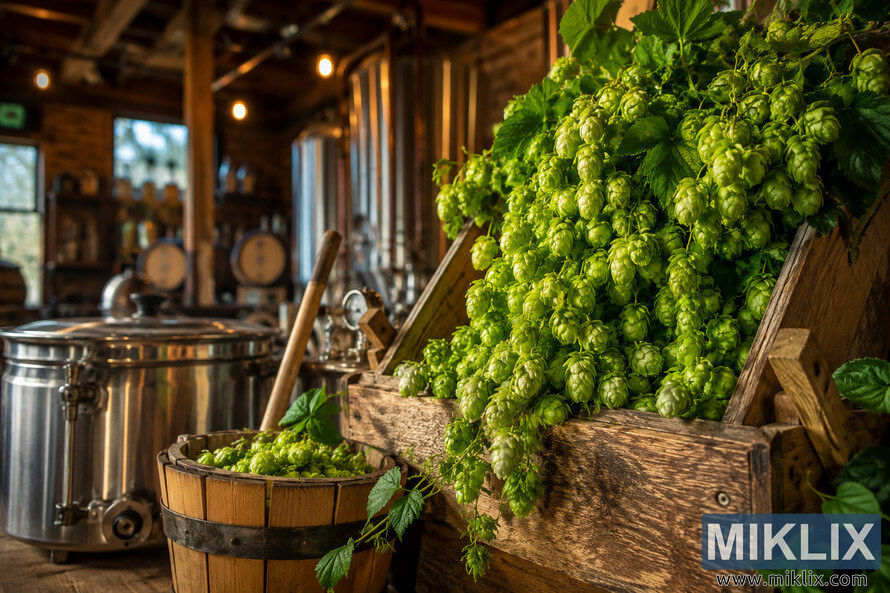
Click or tap the image for more information and higher resolutions.
Dry hopping techniques specific to Herald hops
Dry hopping is where Herald hops truly excel, bringing forth bright citrus and floral oils. These oils enhance aroma without introducing harsh bitterness. Brewers aim for a clean, fresh character, which Herald hops deliver with precision. A well-planned approach to timing, contact, and dosage is essential.
Timing is crucial. Begin dry hopping after primary fermentation slows or during conditioning. Herald's dry hop schedule typically involves additions 3–7 days before packaging. Maintain fermenter temperatures between 50–68°F (10–20°C) to facilitate the movement of oils into the beer. This helps avoid unwanted biotransformation.
For New England–style beers, warm dry hops at 65–72°F are recommended. This encourages biotransformation, resulting in juicier fruit notes.
Timing and temperatures for dry hopping
Start dry hopping once gravity stabilizes and active krausen is absent. Short contact times help prevent vegetal extraction. Aim for 3–7 days at 50–68°F for general styles. For NEIPAs, use 65–72°F to achieve more enzymatic change and softer hop esters.
Dry hop quantities for different beer styles
Adjust the dose based on the beer style. For subtle amber and brown ales, use 0.25–0.75 oz/gal (2–6 g/L). Standard IPAs and hop-forward ales require 0.5–1.5 oz/gal (4–12 g/L). For hazy and New England IPAs, aim for 1–2+ oz/gal (8–16+ g/L) to achieve the desired intensity.
- Split additions across multiple days to layer aroma and complexity.
- Adjust dry hop quantities Herald based on batch size and malt backbone to avoid imbalance.
Avoiding vegetal or green flavors
To prevent grassy notes, use clean hops and handle them carefully. Opt for fresh pelletized or cryo hops to minimize plant matter. Short contact times and cold crashing before packaging can help drop solids.
- Minimize agitation when adding hops to avoid extracting chlorophyll.
- Use hop bags or stainless mesh when needed to simplify removal and lower trub pickup.
- Follow a disciplined sanitation routine to keep microbial risks low during the Herald dry hopping process.
Herald hops in IPA and other hop-forward styles
Herald hops are perfect for brewers who prefer simple grists and bold hopping. They offer a framework for showcasing Herald in single-hop brews, blending it with other varieties, and selecting malt and yeast. This approach highlights the hop's fruit and floral notes.
Single-hop IPA recipe concepts
For a single-hop Herald IPA, start with a light malt base. This lets the hop's aromatics shine. Use 90–95% two-row pale or Pilsner malt, with 5–10% dextrin malt like Carapils. This adds body without sweetness.
- Target OG 1.060–1.066 and FG 1.010–1.014 for a balanced, drinkable strength.
- IBU range 45–65 focuses on late bittering and whirlpool additions for flavor over harsh bitterness.
- Choose clean American ale yeast like Wyeast 1056 or Safale US-05 for neutral esters.
- Adjust water with a higher chloride-to-sulfate ratio for juicier mouthfeel.
Blending Herald with other hops for complexity
Lead with Herald hops, adding supporters at 20–40% of the total hop weight. This maintains Herald's identity while adding depth.
- Citra enhances citrus and tropical notes when paired with Herald.
- Amarillo adds orange and floral lift, complementing Herald's fruit tones.
- Simcoe or Mosaic adds resinous, berry, and pine facets for depth.
Build complexity through staging: late-boil and whirlpool Herald-forward additions, followed by a two- to three-stage dry hop. Use a smaller portion of supporting hops to preserve bright top notes.
Adjusting malt and yeast to showcase Herald
Malt and yeast choices should not overshadow Herald's flavor. Stick to simple pale malt bills. Add small amounts of Vienna or Munich for extra backbone.
- Avoid heavy crystal or roasted malts that mute hop aromatics.
- Neutral American ale strains deliver clarity, allowing Herald to express citrus and floral characters.
- For a twist, try an ester-forward English strain or a saison yeast. This creates complementary fruit esters that enhance Herald's profile.
Plan fermentation temperatures to minimize unwanted esters for neutral strains or to encourage specific esters for stylistic variation. These choices complete the recipe frameworks that make Herald IPA recipes and single-hop Herald IPA trials shine. They allow for blending Herald hops and careful malt and yeast selection, ensuring harmony.
Using Herald hops in balanced and malt-forward beers
Herald hops can enhance malt-forward beers without overpowering them. By using them judiciously and at the right time, you can add a touch of brightness to amber ales, brown ales, saisons, and farmhouse styles. This approach ensures that the malt remains the star of the show.
In amber ales and brown ales, subtlety is key. A small amount added during the late boil and a gentle whirlpool dose can elevate the caramel and toasty malts. Consider adding 0.25–0.5 oz per gallon at ten minutes left in the boil, and another 0.1–0.25 oz per gallon in the whirlpool. A minimal dry hop of 0.05–0.1 oz per gallon can enhance the aroma without overpowering the roast and caramel notes. This strategy allows Herald's subtle hop presence to complement the malt without overshadowing it.
For saisons and farmhouse beers, Herald pairs well with yeast strains that impart pepper and spice. Strains like Wyeast 3711 or Belle Saison provide an excellent base for Herald in saison. Aim for moderate hopping rates, around 0.3–0.6 oz per gallon, with a focus on late additions and a brief dry hop for floral notes. This method ensures the beer remains dry, allowing the yeast and hops to harmonize.
To preserve the hop character in malt-forward recipes, focus on the mash and water profile. Consider mashing a touch lower to retain more body, or lower for a drier finish if you prefer a more defined hop presence. Opt for a lower sulfate-to-chloride ratio to emphasize maltiness and reduce bitterness perception. Keep hop rates gentle to showcase delicate aromatics without clashing with the malt.
- Dosage guide for malt-forward ales: late boil 0.25–0.5 oz/gal, whirlpool 0.1–0.25 oz/gal, dry hop 0.05–0.1 oz/gal.
- Saison pairing: use Saison strains (Wyeast 3711, Belle Saison), moderate total hops, late dry hop for floral lift.
- Brewhouse tips: adjust mash temp and water chemistry to balance malt and hop expression.
Recipe development: example with Herald hops
This section provides two practical recipes and a detailed hop and yeast plan. Brewers can showcase Herald hops with these guidelines. Follow the Herald malt bill, adhere to the Herald hop schedule, and select a Herald yeast that aligns with your style.
5-gallon Single-Hop Herald IPA (target: 6.5% ABV)
- Herald malt bill: 11 lb (5 kg) US 2-row (90%), 0.75 lb (340 g) CaraPils (6%), 0.5 lb (225 g) Munich 10L (4%)
- Adjuncts: 8 oz (225 g) flaked oats for mouthfeel
- Total grain: ~12.25 lb (5.55 kg)
- Target OG: 1.064, FG: 1.014
5-gallon Malt-forward Amber with Herald (target: 5.8% ABV)
- Herald malt bill: 10.5 lb (4.76 kg) Maris Otter (85%), 1 lb (454 g) Crystal 60L (8%), 0.5 lb (225 g) Munich 20L (4%), 0.25 lb (115 g) Carapils (3%)
- Adjuncts: none required, consider 4 oz (115 g) flaked wheat for head retention
- Target OG: 1.056, FG: 1.012–1.014
Herald hop schedule for homebrewers (5-gallon batches)
- 60 min: 0.5 oz (14 g) Herald for bittering. Use less if alpha acids are high.
- 15 min: 1 oz (28 g) Herald for late flavor.
- 10 min: 1 oz (28 g) Herald for aroma support.
- 5 min: 1 oz (28 g) Herald for bright top-note aroma.
- Whirlpool/stand (20–30 min at 170–180°F / 77–82°C): 2–3 oz (56–85 g) Herald. Add when heat is off and wort sits in range.
- Dry hop: Day 4–7 of fermentation or after high krausen subsides. Use 3–4 oz (85–113 g) Herald for 5 gallons. For extended conditioning, split dose: half at day 4, half at day 7.
Scale notes for commercial brewhouses: multiply hop weights by batch size ratio and reduce late-boil additions slightly for kettle volume differences. Adjust whirlpool grams per liter to keep similar ppms of oil extraction.
Herald yeast selection and fermentation profile
- Clean American ale profile: Safale US-05, Wyeast 1056, or White Labs WLP001. Ferment 64–68°F (18–20°C) for a clean canvas that highlights Herald hop aromatics.
- Farmhouse variant: Saison strains such as Wyeast 3711 or White Labs WLP565 to add peppery, fruity esters that play with Herald.
- Pitching: 0.75–1.0 million cells/ml/°P for ales. Use a well-made starter for liquid yeast to hit target pitch rate.
- Oxygenation: 8–10 ppm dissolved oxygen for healthy fermentation. For lagered styles, lower temps and adapted strains are required.
- Conditioning: Allow a diacetyl rest near 68–70°F (20–21°C) for 24–48 hours if fermenting cooler. Place dry hops after primary activity slows to avoid excessive vegetal extraction.
Follow the Herald recipe example above, match the Herald hop schedule to your equipment, and pick a Herald yeast selection that fits the beer's intent. Small tweaks to mash temp and water will further tune body and hop perception.
Brewhouse adjustments when using Herald hops
To incorporate Herald hops into your recipe, you'll need to make some adjustments. These tweaks are essential to preserve the hops' citrus and floral notes. They also ensure the beer has the right balance. Adjusting water chemistry, selecting a suitable mash profile, and managing boil additions are key steps. These actions help showcase Herald's unique qualities without overwhelming the base beer.
Water chemistry tweaks to complement hop flavors
Adjusting water chemistry can enhance the perception of Herald's hop flavors. For a juicier hop profile, aim for a chloride-to-sulfate ratio of 1:1 or higher. Conversely, a drier, more bitter beer can be achieved by increasing sulfate levels relative to chloride.
- Baseline ion targets: Ca 50–150 ppm, Mg 5–20 ppm, Na 5–30 ppm, SO4 50–200 ppm, Cl 50–150 ppm.
- Additions: gypsum (calcium sulfate) raises sulfate and accentuates bitterness. Calcium chloride raises chloride and rounds malt and hop flavors.
- Keep mash pH in the 5.2–5.5 range using phosphoric or lactic acid as needed for hop clarity.
Following these water chemistry guidelines allows brewers to fine-tune the mouthfeel and hop presence in their recipes. This is particularly important when working with Herald hops.
Mash profile considerations for hop-forward beers
When brewing hop-forward beers, the mash temperature is crucial. Lower temperatures favor higher attenuation, resulting in a leaner malt profile. This allows the hops to take center stage.
- 148–152°F yields a drier, more attenuated beer that highlights hop aroma and snap.
- 154–156°F produces fuller body and sweetness when you want malt to support hop flavor.
- Mash thickness around 1.25–2.0 qt/lb balances enzyme activity and extract. Decoction is optional with traditional malts but can deepen malt character if needed.
By adjusting the mash profile, you can decide whether Herald should be the star or complement a richer malt base. This flexibility is key to creating a balanced beer.
Boil time and hop utilization impacts
The length of the boil and the timing of hop additions significantly affect the beer's bitterness and aroma. Longer boils increase alpha acid utilization, leading to higher IBUs. This can overpower the delicate aromatics of Herald hops.
- For aroma-forward beers, reduce early Herald additions and focus on late boil, whirlpool, and dry hop additions.
- To hit a target bitterness without losing aroma, shift some early bitterness to neutral bittering hops or use a higher-alpha bittering hop in small amounts.
- When using boil time Herald strategies, shorten contact time for late additions and drop temperature quickly after whirlpool to preserve volatile oils.
By carefully managing boil time and hop additions, you can maintain the right balance of bitterness. This ensures that the beer's delicate citrus and floral notes from Herald are preserved.
Fermentation and conditioning to highlight Herald hops
To maximize Herald hops' impact, focus on fermentation and conditioning. Stable fermentation, proper rest periods, and the right carbonation levels are crucial. These factors determine how the hop's aroma and flavor are showcased in the final beer.
Temperature control is key for clean hop expression
- For ales, maintain temperatures between 64–68°F. This helps avoid fusel and phenolic compounds that can obscure hop nuances.
- For strains like Nottingham, Wyeast 1056, or White Labs WLP001, aim for 64–68°F. For Vermont or New England–style beers, increase the temperature to 68–72°F late in primary fermentation. This enhances esters and hop-derived thiols.
- Keep an eye on temperature swings. Sudden changes can stress the yeast, leading to harsh flavors that overshadow Herald hop characteristics.
Conditioning times are critical for aromatic clarity
- After dry hopping, allow 3–14 days for integration, depending on the beer style and hop load. Shorter periods emphasize bright, punchy flavors. Longer periods smooth out green notes and blend esters with hop oils.
- Bottle-conditioned beers require more time. At least two to four weeks at warm temperatures are needed to mellow out early vegetal tones. This allows CO2 and yeast interaction to round out the flavor profile.
- Cold conditioning, especially for lagers or hazy-filtered ales, enhances aroma clarity. A week at near-freezing temperatures helps precipitate unwanted solids without stripping hop volatiles.
Carbonation levels that suit Herald-forward beers
- Adjust CO2 volumes to enhance desired traits. IPAs and pale ales benefit from 2.2–2.8 vols, which improves brightness and head retention, enhancing aroma.
- Saisons and farmhouse ales thrive with higher carbonation, 3.0–3.5 vols. This increases perceived lift and accentuates spicy or phenolic notes alongside hops.
- Higher CO2 levels in carbonation can sharpen the beer's bite and boost volatile release. Lower CO2 levels, on the other hand, can smooth out the mouthfeel and make hop aroma seem less pronounced.
Practical checklist for brewers
- Plan your fermentation schedule according to yeast strain and style before dry hopping.
- Set clear timelines for conditioning Herald beers. Shorter periods are ideal for immediate brightness, while longer periods allow for better integration.
- Adjust carbonation levels to match your style goals and packaging method.
Packaging and shelf-life considerations with Herald hops
The choice of packaging and handling at the brewery greatly impacts how Herald hops are experienced. Controlling oxygen, light, and temperature is crucial. This ensures the citrus and floral notes of Herald remain vibrant. Brewers can take several steps to maintain hop freshness from tank to tap.
Oxidation management to retain hop freshness
To prevent oxidation, minimize oxygen exposure during transfers and packaging. Use closed transfers and instrumented keg fills to keep dissolved oxygen levels low. Also, purge can and keg headspaces with CO2 before filling.
Consider using oxygen scavengers in crown caps and low-oxygen bottling techniques for glass. Look out for oxidation signs: muted citrus, dull floral notes, and a stale cardboard or paper aroma. These symptoms can dull Herald’s bright profile.
Choosing cans vs bottles for hop stability
Cans offer a stronger barrier against light and oxygen. Many craft brewers choose aluminum cans for hop-forward beers. This limits oxygen ingress and lightstruck reactions.
Bottles, especially clear or green glass, can cause skunky off-flavors. Brown bottles are better, but glass still allows more oxygen exchange than sealed cans.
Best-by recommendations for maximum aroma
For intense dry-hopped IPAs, aim for the freshest consumption window. Consume within 2–8 weeks when cold stored and properly packaged for peak hop intensity. With strict cold-chain handling, expect usable freshness up to 3 months for average drinkability.
- Storage temperature: 32–40°F (0–4°C) to slow aroma loss.
- Labeling: include packaged-on dates and clear best-by guidance.
- Rotation: use first-in, first-out systems in taprooms and distribution.
Packaging Herald beers with low oxygen and cool temperatures maximizes shelf life. Whether choosing cans or bottles, thoughtful packaging reduces aroma fade. This ensures each pour remains true to the brewer’s intent.
Troubleshooting common issues when using Herald hops
Herald hops add a punchy aroma and flavor to beer, but they can pose challenges if not handled with care. Here are some tips to spot problems early and maintain beer quality while preserving the hop character you desire.
Detecting and correcting off-flavors
Off-flavors from misusing Herald hops include vegetal, green, or grassy notes from prolonged dry-hopping. Oxidation manifests as papery or cardboard flavors. Solvent-like harshness can result from excessive hot-side hop additions. Lightstruck character appears when beer is exposed to UV light.
- Shorten dry-hop contact times to two to five days for most ales to limit vegetal off-notes.
- Improve oxygen control during transfer, packaging, and kegging to reduce oxidation risk.
- Avoid massive late boiling of hops; add aroma hops after flameout or in the whirlpool to cut harsh solvent tones.
- Protect beer from light with brown glass, cans, or covered vessels to prevent lightstruck faults.
- Use cold-crash and fine filtration to remove suspended hop particulates that can carry green or vegetal flavors.
Managing hop creep and refermentation risks
Hop creep happens when fresh hops introduce active enzymes that break dextrins into fermentable sugars. This can lead to unexpected gravity drops and refermentation in bottles or kegs.
- Plan extended conditioning times. Allow beer to sit on yeast longer after dry-hopping so any new sugars are fermented and yeast can clean up byproducts.
- Consider sterile filtration or flash pasteurization before packaging to stop refermentation when packaging stability is critical.
- Choose stable yeast strains with predictable attenuation. Avoid overly flocculent strains if you expect residual activity from hops.
- Where legal and appropriate, use preservatives like dimethyl dicarbonate (DMDC) to arrest microbial or enzymatic activity prior to packaging.
Mitigating haze and chill haze linked to hop use
Haze with Herald hops often results from polyphenol-protein interactions and excess particulate from dry-hopping. Some haze is desirable in New England–style beers, but it can reduce shelf stability.
- Include a protein rest during the mash to reduce chill haze precursors in malt-forward beers.
- Add kettle finings such as Irish moss or Whirlfloc to drop proteins out during the boil.
- Cold-crash after fermentation to help flocculate hop solids and yeast. Follow with silica gel or Polyclar treatments if extra clearing is needed.
- Use filtration for clear styles. For hazy styles, time the dry-hop late in conditioning and balance particle load against shelf-life measures like lowered pH or stabilized haze systems.
Cost and availability considerations for homebrewers and pros
When planning hop-forward beers, it's crucial to consider both cost and availability. The price of Herald hops can fluctuate based on form and market conditions. Pellet hops generally cost less per ounce than whole-cone varieties. Meanwhile, cryo extracts are pricier due to their concentrated oil content.
Factors such as weather, crop yields, export limits, and demand from the craft industry can influence prices. These elements can either increase or decrease the cost of hops.
When designing an IPA or hazy ale, it's wise to budget for hops first. A hop-forward batch can account for 30–50% of ingredient costs. In the U.S., prices for pellets range from $1.50 to $4 per ounce, whole-cone from $2 to $5 per ounce, and cryo extracts from $6 to $12 per ounce. These prices can vary based on the harvest year and supplier.
It's important to monitor Herald hop availability during harvest seasons. Planning your purchases early can help you secure the best deals.
- Price trends and budgeting: allocate more funds to late-boil and dry-hop charges for strong hop character.
- Factor in freight and cold-chain fees when ordering from established brands like Yakima Chief or Hopsteiner.
For production breweries, buying in bulk can significantly reduce costs. However, it requires careful inventory management. Commercial buyers should opt for sealed, nitrogen-flushed sacks. Homebrewers can benefit from vacuum-sealed foil packs that match their usage.
- Storage tips: keep hops in the freezer at about -10 to 40°F (-23 to 4°C) with oxygen absorbers.
- Rotate stock by harvest or COA date to preserve alpha acids and volatile oils.
Inventory management is key. Track lot numbers and alpha acid tests. Use older lots for bittering and reserve fresher hops for late additions and dry hopping. Small brewers might split purchases with nearby breweries to meet minimum order sizes while limiting storage needs.
When Herald is scarce, consider alternatives. Amarillo can offer similar citrus notes, while a Citra blend can enhance tropical character. Proprietary varieties can also match floral or stone-fruit facets. Use substitution ratios of 1:1 for general aroma swaps, 0.8–1.2 when adjusting to alpha acid differences, and increase dry-hop rates by 10–20% to approach original intensity.
- Test substitutes in pilot batches or single-vessel dry-hop trials before scaling up.
- Document aroma and flavor shifts so you can refine recipe balance with malt and yeast.
Keep a purchasing calendar tied to hop harvests and market reports. This approach reduces surprises in Herald hop availability and helps you decide when to buy in bulk or secure smaller, fresh lots. Smart planning can save money and preserve the aroma profile you aim to deliver.
Conclusion
Herald hops summary: Herald offers a balanced blend of citrus, floral, and stony-fruit notes. It's perfect for both hop-forward IPAs and malt-driven ales. The key to success lies in freshness and the form of the hops—pellet, whole-cone, or cryo. Timing is crucial, with targeted late-boil, whirlpool, and dry-hop additions to preserve delicate aromatics. Ensuring fresh lots and checking alpha acid COAs is essential for consistent results.
Practical steps to use Herald hops include tailoring water chemistry and mash profiles. This supports the bright hop character. Controlling fermentation is also vital to avoid yeast-derived haze. Conditioning for a sufficient time is necessary for aroma clarity. Proper packaging in cans or amber glass protects volatile oils, extending shelf life for the best sensory impact.
For brewers eager to experiment, single-hop beers can help you understand Herald's unique characteristics. Blending with Citra, Mosaic, or Strata adds complexity. Document each batch and adjust dosages based on taste. Repeat tests to refine your approach. This brewing with Herald hops conclusion encourages systematic trials. It helps you confidently use Herald hops in various recipes and brewing contexts.
FAQ
What is Herald hop and why is it useful for brewing?
Herald is a modern hop variety known for its balanced citrus and floral character. It also has light stone-fruit notes. Brewers value it for its versatile aroma contributions and consistent alpha-acid ranges. It works well in IPAs, pale ales, saisons, and malt-forward beers.
Who should consider using Herald hops?
Homebrewers and professional craft brewers in the United States will benefit from Herald. It's ideal for those aiming to highlight delicate citrus and floral aromatics. It's also great for late additions, whirlpool work, and dry hopping across various styles.
What aroma and flavor can I expect from Herald in finished beer?
Expect bright citrus, floral blossom, and tea-like notes, along with light tropical stone-fruit. The mouthfeel is rounded or slightly juicy in hazy beers. The finish is cleaner and less resinous than many West Coast varieties.
How does Herald compare to Citra, Mosaic, or Amarillo?
Herald is less pungent than Citra and more balanced between citrus and floral tones. Compared to Mosaic, it's cleaner and less berry- or dank-forward. Against Amarillo, it shares orange and floral traits but is softer and less resinous.
Where in the U.S. is Herald grown and how does terroir affect it?
Herald grows well in Pacific Northwest regions like Yakima Valley and Willamette Valley. It also performs well in parts of Idaho and Oregon. Climate, irrigation, and microclimate affect oil composition and aromatic intensity.
What hop formats are available and which should I pick?
Herald is available as whole-cone, pelletized, and cryo/lupulin concentrates. Whole cones are best for traditional dry hopping and keg applications. Pellets are predictable for utilization. Cryo gives concentrated aroma with less vegetal matter.
What is the typical alpha-acid range for Herald and how does that impact bittering?
Alpha acids commonly fall in a moderate range that can vary by crop year. Consult the supplier COA for the exact percent. Use standard IBU formulas and adjust utilization by boil gravity and wort volume.
How should I schedule Herald additions for aroma and flavor?
Use short late-boil additions (5–15 minutes) to retain volatile aromatics. Apply whirlpool/hop-stand at 170–180°F for 10–30 minutes. Typical homebrew dosages: 0.5–1.5 oz for subtle aroma, 1.5–4 oz for prominent flavor.
What are best practices for dry hopping with Herald?
Dry hop after primary fermentation has slowed or during conditioning, usually 3–7 days before packaging. Quantities vary by style: subtle beers 0.25–0.75 oz/gal, standard IPAs 0.5–1.5 oz/gal.
How can I avoid vegetal or grassy off-flavors when dry hopping?
Use pellet or cryo hops to reduce plant matter. Shorten contact time (3–7 days) and cold crash before packaging. Avoid excessive agitation and ensure hop freshness.
What recipe framework highlights Herald in a single-hop IPA?
Start with a light pale malt backbone (2-row or Maris Otter). Add small dextrin malt for balance. Use a clean American ale yeast and a water profile leaning slightly toward chloride for juiciness.
Which hops blend well with Herald for complexity?
Citra can amplify citrus and tropical notes. Amarillo adds orange and floral lift. Mosaic or Simcoe can add berry, dank, or resinous depth. Use Herald as the dominant character and support it with 20–40% complementary hops.
How should I tweak water chemistry and mash to let Herald shine?
For juicier hop expression, increase chloride relative to sulfate. For drier beers to showcase hops, mash lower. Adjust gypsum or calcium chloride to reach target ions and avoid masking delicate hop aromatics.
What fermentation and conditioning practices enhance Herald’s character?
Maintain stable fermentation temps for the chosen yeast. For clean hop expression, use 64–68°F with neutral strains. Allow 3–14 days after dry hopping for integration. Carbonation targets: 2.2–2.8 vols for IPAs/pale ales; higher for saisons.
How should I package and store Herald-forward beers to preserve aroma?
Minimize oxygen pickup during transfer and packaging. Use CO2 purge and low headspace. Prefer cans for light and oxygen protection. Store at roughly 32–40°F (0–4°C) and consume within 2–8 weeks.
What common problems occur when using Herald and how do I troubleshoot?
Common issues include vegetal/grassy off-flavors from overlong dry-hop contact, oxidation leading to papery notes, and excessive bitterness from hot-side late hopping. Corrective steps: shorten dry-hop time, improve oxygen control, cold-crash to remove particulates, and adjust hop timing and quantities in future brews.
What is hop creep and can Herald cause refermentation?
Hop creep is enzymatic activity from fresh hops that can convert dextrins into fermentable sugars. Fresh whole-cone or minimally processed hops increase risk. Mitigate by extended conditioning, sterile filtration, pasteurization, or controlled packaging practices when necessary.
What are practical cost and availability considerations for Herald?
Prices vary by form—pellet, whole-cone, and cryo—with cryo most expensive per aroma unit. Market demand and crop yields affect price. Buy in bulk when feasible, store in vacuum-sealed, cold conditions, rotate stock using harvest/COA dates, and plan budgets accordingly for hop-forward batches.
What are suitable substitutes if Herald is unavailable?
Close substitutes include Amarillo for orange/floral lift, or blends using Citra for amplified citrus and tropical notes. Substitution ratios depend on alpha-acid and desired aroma—test small pilot batches or dry-hop trials first.
How do I scale Herald usage from a 5-gallon homebrew to a commercial brewhouse?
Maintain the same weight-per-volume ratios when scaling up and adjust for hop form—cry0 requires less mass per aroma impact than pellets. Consult utilization differences for larger kettles, account for whirlpool/stand contact times, and use supplier COAs to adjust for alpha-acid and oil content across batches.
Where can I source Herald hops and who are reputable suppliers?
Purchase through reputable vendors such as Yakima Chief Hops, Hops Direct, Brewers Supply Group, or regional hop farms and cooperatives. Request Certificates of Analysis, harvest dates, and storage recommendations. Building relationships with local growers helps secure consistent crop-year supplies.
Further Reading
If you enjoyed this post, you may also like these suggestions: