
Hops in Beer Brewing: Pocket Talisman
Published: July 30, 2026 at 6:33:41 PM UTC
Brewers appreciate Pocket Talisman for its unique aromatics and practical agronomics. Craft breweries and recipe developers commend its high field yields, disease resistance, and consistent cone chemistry.
Click or tap the image for more information and higher resolutions.
Key Takeaways
- Pocket Talisman hops bring citrus, tropical, and herbal tones that suit hop-forward brewing.
- Practical tips on brewing with Pocket Talisman include boil timing, whirlpool, and dry-hop strategies.
- Lab numbers and oil composition guide bitterness and aroma balance for IPAs and pale ales.
- Pair neutral or slightly fruity yeasts and a clean malt backbone to showcase the hop variety.
- Proper storage, oxygen control, and cold packaging extend aroma life in finished beer.
Introduction to Pocket Talisman hops and their brewing appeal
Pocket Talisman hops originate from a U.S. breeding project by a renowned hop breeding program. The first trials were released in the mid-2020s. Commercial availability grew as Washington and Oregon growers included it in their production. Industry reports confirm its origin in public hop breeding programs, aiming to enhance craft brewers' aromatic options.
Brewers appreciate Pocket Talisman for its unique aromatics and practical agronomics. Craft breweries and recipe developers commend its high field yields, disease resistance, and consistent cone chemistry. Growers benefit from its practicality, while brewers see it as a valuable addition to their arsenal, filling gaps left by older varieties.
The hop's core flavors include citrus and tropical fruit, with subtle herbal or resinous undertones. Its aroma profile changes based on brewing methods. Late additions and dry hopping emphasize bright fruit notes, while whirlpool treatments reveal richer, more complex layers. Industry experts describe its sensory profile as lively, versatile, and ideal for IPAs, pale ales, and crisp lagers.
Here are key points for recipe planning:
- Breeder and release context: developed through established hop breeding programs in the U.S.
- Why it matters: offers novel aromatics plus grower-friendly traits that appeal to commercial and small-scale producers.
- Flavor snapshot: pronounced citrus and tropical notes with a supporting herbal backbone adaptable to multiple hop treatments.
Click or tap the image for more information and higher resolutions.
Flavor characteristics of Pocket Talisman hops
Pocket Talisman hops offer a complex flavor profile, making them versatile for various beer styles. They are known for their bright citrus notes, bold tropical flavors, and a subtle herbal-green undertone. The flavor shifts based on when the hops are added, so understanding each component is crucial for achieving the desired taste.
Citrus breakdown: The hops exhibit a tart grapefruit taste, orange zest, and lime freshness. Alone, they present a clean, zesty quality that cuts through malt sweetness. In blends, they enhance the midpalate and add a crisp finish.
Tropical fruit spectrum: Mango, passionfruit, and pineapple are evident in the tropical notes. These fruits range from sweet mango to sharp passionfruit acidity. Dry-hopped beers showcase these juicy traits, offering aromatic intensity without bitterness.
Herbal and green details: Pocket Talisman has a faint mint, basil, and light pine character, adding a green edge. These herbal notes balance the fruitiness, preventing the profile from becoming one-dimensional. In moderation, they add complexity; in excess, they create a grassy backbone.
How the elements combine: Citrus and tropical notes intertwine, creating a bright, fruity bouquet with a leafy undertone. The taste starts with citrus, followed by tropical sweetness, and ends with herbal notes. Layering late additions and dry hops enhances these interactions.
Aroma intensity and timing: Late-boil additions lose delicate volatiles, reducing topnotes. Whirlpool and hop stands preserve more oils, keeping citrus and tropical notes vibrant. Dry hopping offers the freshest, most intense fruit and topnote expression, with aromas lasting through tasting.
Persistence and loss factors: Heat and oxidation diminish fragile esters and terpenes. A hot hop stand retains more aroma than a long boil. Proper packaging and cold storage maintain hop aroma changes over weeks in finished beer.
Hop comparisons: Pocket Talisman shares vibrant citrus and tropical traits with Citra, Mosaic, and Simcoe. It leans more herbal and green than Citra. Compared to Mosaic, it has cleaner citrus and less dankness. Simcoe is more resinous, while Galaxy is intense in passionfruit. Pocket Talisman balances fruit and herb, sitting between these profiles.
When to choose it: Use Pocket Talisman for bright citrus and juicy tropical notes with a modest herbal lift. In single-hop trials, it reveals its unique oil balance, guiding future recipe tweaks. These comparisons help brewers determine when Pocket Talisman is the best choice for a recipe.
Click or tap the image for more information and higher resolutions.
Alpha acids, beta acids, and oil composition for brewing calculations
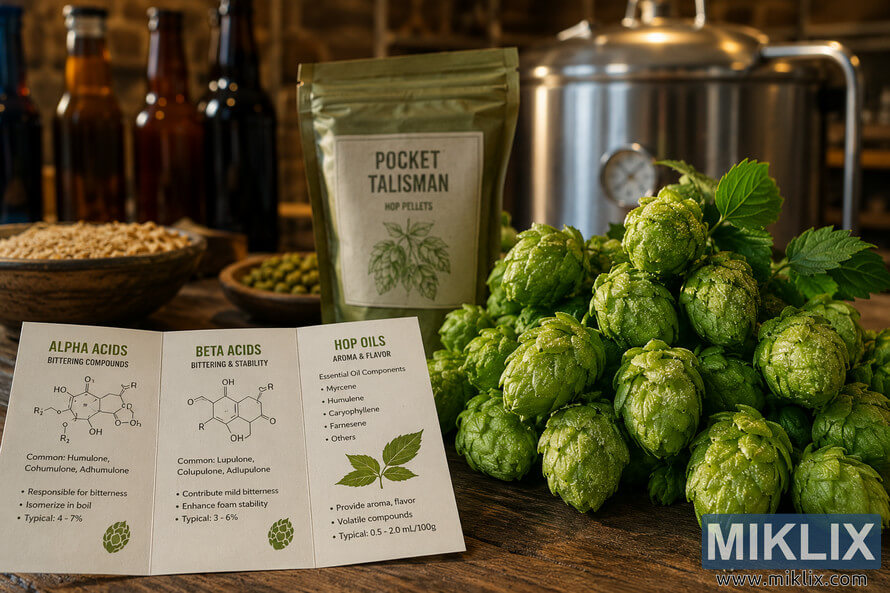
Understanding laboratory numbers is key for brewers to predict hop chemistry results. Pocket Talisman alpha acids and hop oil composition provide insights into bitterness and aroma. Use recent hop lab data to ensure recipe consistency from batch to batch.
Typical alpha acid range and implications for bitterness
Packaged analyses from reputable suppliers show Pocket Talisman alpha acids ranging from 5% to 9%. This range indicates that bitterness can vary significantly between lots. Higher alpha percentages require less hop weight for the same bitterness. Conversely, lower alpha percentages necessitate larger additions or earlier boil timing to achieve the desired IBUs.
Before scaling a recipe, always check the Certificate of Analysis. Use the listed alpha % for hop bitterness calculation, rather than relying on outdated values. This approach prevents inconsistent bitterness in beers brewed with Pocket Talisman alpha acids that vary by harvest.
Essential oils and their contribution to flavor
Pocket Talisman hop oil composition typically includes myrcene, humulene, caryophyllene, linalool, geraniol, and minor farnesene. Myrcene dominates, imparting citrus and resin notes. Linalool and geraniol add floral and tropical top notes. Humulene and caryophyllene contribute herbal, woody, and spicy accents.
The oil percentage and ppm of each compound determine the flavors that emerge. Hot-side additions reduce volatile oils, while late kettle, whirlpool, and dry hop additions preserve delicate linalool and geraniol. Adjust timing based on recent hop lab data to achieve the desired aroma.
Using lab numbers to adjust IBUs
Employ Tinseth or Rager formulas with the alpha % from your COA for hop bitterness calculation. Input boil time, wort gravity, and measured alpha acids for the tinseth utilization curve. For Rager, factor in the boil gravity correction and hop utilization constants. Both methods require accurate Pocket Talisman alpha acids from hop lab data for reliable IBUs adjustment.
- Step 1: Enter the actual alpha % from the COA into your IBU tool.
- Step 2: Choose the formula (Tinseth for aroma-focused beers, Rager for traditional bitterness math).
- Step 3: Adjust addition time and hop weight to hit target IBUs while keeping late additions for aroma.
To account for batch-to-batch variability, maintain a small reserve of hops and retest a new COA at the start of each season. This practice reduces surprises and allows for precise IBUs adjustment without compromising the hop character expected from Pocket Talisman.
Click or tap the image for more information and higher resolutions.
Picking the right beer styles to showcase Pocket Talisman hops
Pocket Talisman beer styles shine when recipes highlight the hop's fruit and herbal notes. Opt for malt bills and yeast that enhance the hop's brightness without obscuring it. Below, explore practical style paths with measured hopping and simple grain backbones.
Single-hop pale ales and hoppy lagers are ideal for initial explorations. Employ a clean two-row or pilsner base with a light specialty malt for color and body. Target a moderate IBU range of 25–35 for pale ales to emphasize aroma and flavor. For a hoppy lager, ferment clean at lager temperatures and aim for IBUs around 20–30 to reveal delicate citrus and herbal nuances.
- Grain suggestion: US two-row or Pilsner malt, 5–10% Vienna or Munich for slight malt complexity.
- Hopping approach: split additions with a larger late hop and a finishing dry hop to highlight hop oils.
IPAs offer a canvas to shape how Pocket Talisman presents in the glass. For a New England IPA, focus on late and hot-side additions, low boil time for hops, and a soft water profile. Target low IBUs, roughly 10–20, with heavy late hopping and whirlpool charges to build intense aroma while keeping bitterness gentle.
West Coast IPA demands cleaner fermentation and higher bitterness to accentuate resin and citrus. Aim for IBUs to 50–70 depending on balance goals. Use fewer late additions but larger whirlpool and dry-hop doses to maintain hop clarity and a crisp finish.
- Session IPA: scale ABV down to 3.5–4.5% while concentrating late hopping. Keep IBUs around 30–40 and maintain vigorous late hop schedules for punchy aroma without heavy alcohol.
Adjunct styles invite creativity. Saison and farmhouse ale hops benefit from the interplay between fruity esters and the hop's tropical facets. Choose saison yeasts like Dupont-like strains and keep malt simple to let yeast and hops converse.
Experimental ales pair Pocket Talisman with fruit adjuncts or mixed-culture fermentation. Consider kettle souring or Brettanomyces blends to add complexity and lift hop-derived tropical notes. Small-batch trials help dial dosage and timing when using nontraditional fermentations.
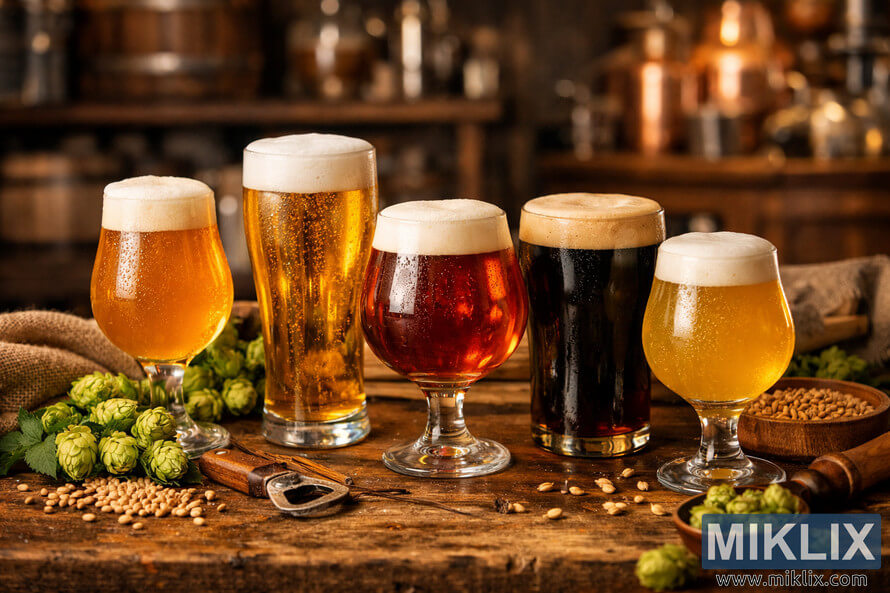
Click or tap the image for more information and higher resolutions.
Recipe formulation strategies with Pocket Talisman hops
Pocket Talisman hops introduce vibrant tropical and citrus flavors. They shine when the grain bill and yeast allow them to express fully. Begin with a pale base to preserve the hop's essence. Then, incorporate light specialty malts to enhance the body without obscuring the aromas.
Malt backbone and yeast choices that complement the hops
Opt for pale two-row malts like Rahr 2-Row or Weyermann Pils for clarity. Include 2–6% light caramel or dextrin malts to enrich the mouthfeel in IPAs and pale ales. This approach supports the hop's dominance while maintaining a clean palate.
For yeast, select neutral strains like SafAle US-05, Wyeast 1056, or White Labs WLP001 to highlight hop characteristics. Fruit-forward strains, such as London Ale III or Wyeast 1318, enhance tropical esters for New England–style beers. Consider the balance between clean expression and ester contribution in your recipe.
Balancing bitterness and hop-forward aromatics
Set OG ranges by style: 1.046–1.055 for session IPAs, 1.060–1.075 for full-strength IPAs. Target IBUs to achieve the desired balance. Use early boil additions sparingly for bitterness and focus on flavor through whirlpool and late additions.
Highlight late kettle and dry hop timing to preserve volatile oils. Typical hops dosing ranges from 2–4 g/L total for aromatic impact in IPAs. Adjust late additions and dry-hop dosages to achieve the right intensity without harshness.
Creating signature recipes and clone experiments
Begin with single-hop test batches to isolate Pocket Talisman characteristics. Employ a clean malt bill and US-05 to discern the hop's unique traits. Record hop timing, dry-hop weight, and yeast strain for consistent results.
For clone beer experiments, analyze commercial examples and replicate fermentables and yeast choices. Increase late additions and step up dry hopping to match the bold aroma profiles. Keep detailed records on hop-forward recipe formulation and refine until the clone matches the target beer.
These strategies enable brewers to create both expressive and controllable Pocket Talisman recipes. Thoughtful malt and yeast pairing, combined with precise late-hop work, ensures a clear presentation of tropical and citrus flavors in the finished beer.
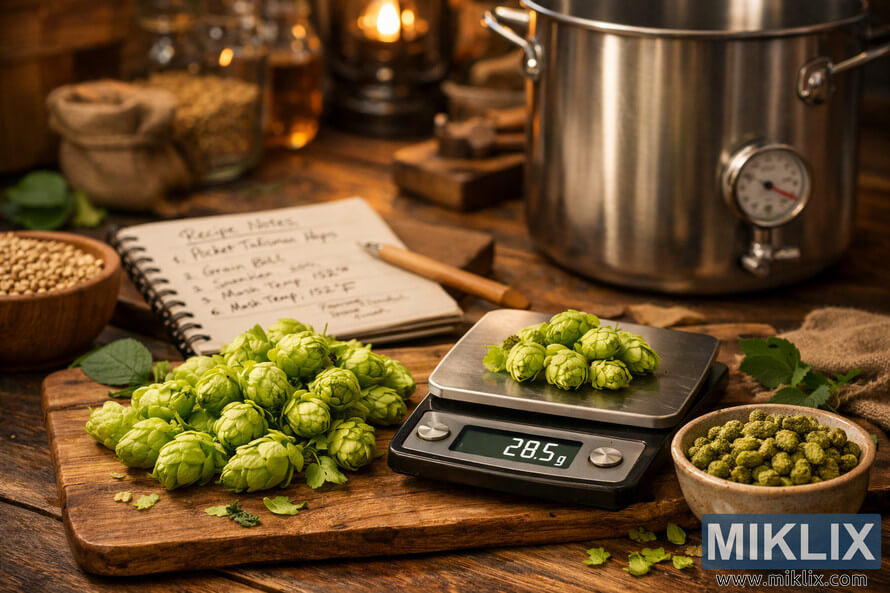
Click or tap the image for more information and higher resolutions.
Hop schedule recommendations: boil, whirlpool, and dry hop uses
Opting for the right hop timing is crucial for preserving the essence of Pocket Talisman hops while managing bitterness. A conservative early-boil approach is advisable if aroma is your main focus. Reserve larger quantities for post-boil stages to capture volatile oils and enhance bright aromatics.
Early boil additions (60–90 minutes) establish the base bitterness. For a 5-gallon batch, add early hops at 60–90 minutes to achieve predictable utilization rates. Expect 20–30% utilization at 90 minutes and 25–35% at 60 minutes, based on wort gravity. Adjust hop weights for alpha acid variability by calculating IBUs from the lab-provided alpha percentage, rather than volume alone.
Here's a starting guide for bittering:
- 90 min: conservative bittering, lower utilization; ideal when preserving aroma is key.
- 60 min: slightly higher utilization; useful for style-balanced bitterness.
- Adjust based on alpha acid: if alpha is higher than target, reduce grams or ounces proportionally.
Whirlpool hops perform best at temperatures between 170–180°F or immediately after flameout. This temperature range extracts flavor compounds while limiting loss of volatile oils. For a 5-gallon batch, try 0.5–2.0 oz of whirlpool hops depending on desired intensity. Commercial scales use approximate weights per barrel: 1–4 lb per barrel covers light to assertive aroma levels.
When planning whirlpool additions, consider contact time and hop form. A 15–30 minute rest at 170–180°F gives solid flavor pickup without harsh vegetal notes. Pellet hops and cryo products will extract differently; reduce pellet weight slightly when using concentrated lupulin or cryo powders.
Dry hopping delivers the most direct aroma impact. For bright, clean notes with Pocket Talisman, aim for a moderate dry hop dosage: 3–5 g/L (about 1–2 oz per 5 gal) for a subtle lift, 6–12 g/L (2–4 oz per 5 gal) for an assertive profile. Higher doses approach overblown or grassy territory, especially with long contact times.
- Timing options: add hops late in active fermentation for biotransformation benefits, or post-fermentation for a purer aroma.
- Contact time: 3–7 days is typical; 5 days often balances extraction and freshness.
- Extended contact beyond 10 days risks vegetal or muted notes unless you want pronounced biotransformation effects.
Match your hop schedule recommendations to the recipe goals. For hop-forward pale ales, pair smaller early-boil amounts with generous whirlpool hops and a measured dry hop dosage. For balanced beers, shift more weight to the boil and trim late additions. Track alpha acid values, use consistent weights, and taste iteratively to refine the Pocket Talisman hop schedule for each recipe.
Special techniques to maximize Pocket Talisman hops impact
Pocket Talisman hops shine when brewers align their techniques with their goals. Opt for cryo hops or lupulin powder for a strong aroma with less vegetal taste. Whole-pellet additions and gentle hop stands are best for clarity and a fuller mouthfeel. Here are some practical tips for each method.
Cryo and lupulin products concentrate oils and resins, removing much of the leafy material. Cryo hops, made by companies like Yakima Chief Hops and Hops Direct, preserve resin and aroma. Lupulin powder, a fine, oil-rich option, comes from U.S. pellet processors and craft suppliers. Both reduce vegetal matter, which can cloud beers and mute delicate esters.
Choose pellets for economical, consistent bitterness and good shelf stability. Cryo hops are ideal for intense aromatic impact with cleaner trub. Lupulin powder is best for rapid extraction and minimal plant tannins in kegged hazy IPAs.
Hop bursting involves swapping heavy early additions for large late additions to enhance flavor and aroma. Use 70–90% of total hopping in the last 10–20 minutes of the boil or in the whirlpool at sub-boil temperatures. For Pocket Talisman, aim for a 3:1 late-to-early weight ratio to highlight citrus and tropical top notes without harsh bitterness.
High-velocity dry hop techniques increase contact between beer and hops to boost volatile oil uptake. Use CO2 recirculation, pump-over, or a gentle agitator for short, intense exposures. Start with 0.5–1.0 lb per barrel for test runs, or 1–3 g/L for single-batch trials. Limit exposure to 24–72 hours at active temperatures to avoid grassy or vegetal extraction.
Avoid over-extraction by lowering temperature and cutting contact time when using cryo hops or lupulin powder. These concentrated forms extract quickly. Reduce dosage by 20–40% compared with pellets for balanced aroma without a heavy oily finish.
A controlled hop stand at sub-boil temperatures pulls volatile aromatics without driving bitterness. Bring wort to a rolling boil, chill to 160–170°F (71–77°C), add late hops or cryo, and hold for 15–30 minutes with gentle stirring. This extracts thiols and monoterpenes that define the Pocket Talisman profile while keeping alpha-acid isomerization low.
Cold conditioning after dry hopping helps settle particles and stabilize hop aroma. After a high-velocity dry hop or heavy lupulin addition, drop temperature to 34–38°F (1–3°C) for 3–7 days. This clarifies beer and tames any green notes, yielding a brighter, cleaner hop character when poured.
For delicate beers, pair shorter dry-hop contact with a brief cold crash. For hazy, soft-mouthed IPAs, allow slightly longer maturation at cellar temps to let oils integrate. Keep notes on dosage and time to refine the balance between intensity and freshness in future batches.
Pairing malts and yeast strains with Pocket Talisman hops
Choosing the right malt and yeast is crucial for showcasing Pocket Talisman hops. Select fermentables and yeast strains that complement the beer style and the hop's unique flavors. For aroma dominance, keep it simple. Add specialty malts for more body or complexity.
Neutral yeasts versus fruity-estery strains
For hop-forward beers, opt for neutral yeasts like Safale US-05 or White Labs WLP001. These yeasts minimize esters, allowing hop aromas to take center stage. Ideal for clean pale ales or crisp West Coast IPAs.
On the other hand, fruity-estery strains such as London Ale III or Wyeast 1318 enhance tropical and stone-fruit notes. This pairing amplifies the fruitiness in New England–style ales, making it a great choice.
Base malt choices to support hop character
Begin with a clean base malt. American two-row or Pilsner malt offers a neutral background, allowing Pocket Talisman's characteristics to shine. For New England IPAs, add adjuncts like flaked oats or wheat to enhance mouthfeel and juiciness.
Consider how base malts impact clarity and bitterness balance. Pilsner malt adds brightness, while two-row provides a fuller grain backbone that still highlights hop flavors.
Specialty malts that enhance hop perception
Specialty malts should be used sparingly. Light Munich, Vienna, or Carafoam at 5–10% add subtle sweetness, toast, or body without overpowering hop aromas. These malts improve head retention and enhance hop presence on the palate.
Experiment with small batches to fine-tune the impact of specialty malts on hop perception. Adjust their percentages to maintain Pocket Talisman's prominence.
Water chemistry and mash adjustments for hop-forward beers
Adjusting water chemistry significantly impacts hop character. Optimal water conditions for hoppy beers enhance hop clarity and ensure a clean finish. It's crucial to focus on simple, consistent changes and test your water before making mineral adjustments.
The sulfate chloride ratio is key in shaping bitterness and mouthfeel. Higher sulfate levels emphasize hop bitterness and dryness. Conversely, higher chloride levels contribute to malt roundness and a fuller body. These ratios are effective across various beer styles.
- 2:1–4:1 sulfate:chloride — drier West Coast and crisp pale ales.
- About 1:1 or lower sulfate:chloride — fuller New England IPA and hop-forward hazy ales.
- Adjust gradually and taste; large jumps change balance quickly.
Setting the right mash pH is essential for hop brightness and extraction. Aim for a mash pH of 5.2–5.4 at mash temperature. This range optimizes enzyme activity and enhances hop brightness.
- Measure pH with a calibrated meter after dough-in.
- Use lactic acid or phosphoric acid to lower pH precisely.
- Raise mash pH with bicarbonate or slaked lime only if needed; avoid overcorrecting.
The final beer pH typically ranges from 4.2 to 4.6, influenced by yeast and fermentation. Monitoring both mash pH and final pH is vital for maintaining stability and flavor.
Mineral additions should enhance clarity, mouthfeel, and hop perception. Calcium sulfate (gypsum) adds sulfate without overpowering, while calcium chloride contributes to fullness. Magnesium or Epsom salt, used in small amounts, can tweak bitterness and yeast performance.
- Gypsum — increases sulfate and enhances perceived dryness and hop snap.
- Calcium chloride — raises chloride and gives roundness and mouthfeel.
- Magnesium or Epsom salt — use sparingly; can tweak bitterness and yeast health.
Before fine-tuning recipes, test your source water. Utilize tools like Bru'n Water or EZ Water Profile Calculator to plan mineral additions. This approach minimizes guesswork and ensures predictable adjustments.
Keep a record of each modification and compare single-batch trials. This method helps understand how sulfate chloride ratio, mash pH, and mineral adjustments impact aroma and flavor. Small, controlled adjustments lead to the cleanest hop-forward results.
Fermentation tips and temperature control to preserve hop aroma
Mastering fermentation is crucial for maintaining hop character in hoppy ales. Adjust fermentation temperature according to yeast type to prevent fruity esters from overpowering citrus and resin notes. Strive for a temperature range that keeps yeast activity in check.
Opt for a clean American ale yeast or a London ale strain. Set a consistent temperature. For Saccharomyces cerevisiae, aim for mid-60s°F during primary fermentation for clean esters. For English strains, slightly lower the temperature to reduce phenolic notes.
Implement gradual temperature changes instead of sudden ones. Elevate the beer 2–4°F towards the end of fermentation to consume remaining sugars and clear diacetyl. A brief diacetyl rest at 68–70°F, followed by cooling, minimizes off-flavors while preserving hop aromas.
Timing dry hops relative to fermentation activity impacts aroma and haze. Add hops during active fermentation for biotransformation and deeper flavor. Expect better integration when dosing 24–48 hours before activity slows.
Post-fermentation dry hopping offers immediate aromatics with less yeast interaction. Add hops after reaching near-final gravity for maximum volatile preservation. However, this method carries a higher risk of haze and requires careful oxygen management.
- Early dry hop: 24–48 hours into fermentation for biotransformation benefits.
- Late dry hop: after final gravity is reached for peak aroma.
- Hybrid approach: small early charge plus a short late top-up for intensity.
To minimize hop oxidation, limit oxygen exposure during transfers and dry hop handling. Use CO2 to purge vessels, opt for closed transfers, and minimize contact time after dry hopping to reduce loss of fragile oils.
Control storage and packaging temperatures to preserve hop aroma. Cold conditioning at near-freezing temperatures aids in settling hop solids while preserving volatiles. Employ inert gas blanketing and reduced-oxygen packaging to safeguard aroma through shelf life.
Follow these steps to protect hop character: steady fermentation temperature control, deliberate dry hop timing, and rigorous oxygen management. These practices ensure the preservation of hop aroma, resulting in a brighter, fresher hop profile in the finished beer.
Packaging and shelf life considerations for hop-forward brews
Packaging hop-forward beer is a meticulous process to preserve its vibrant hop aromas. Brewers aim to minimize oxygen intake, maintain cold temperatures, and choose the optimal container for long-term freshness. These steps are crucial for achieving the best hop character.
Oxygen control during transfer and packaging is more critical than many acknowledge. It's essential to keep dissolved oxygen below 50 ppb. Closed transfer systems and counter-pressure canning help limit exposure. Additionally, purging kegs, bottles, or cans with CO2 before filling significantly reduces oxygen pickup.
- Use oxygen-scavenging caps or headspace blanketing for bottled runs.
- Closed-loop pumps and sanitary hoses reduce splashing and air ingress.
- Inline oxygen monitors let a brewery verify oxygen control packaging targets in real time.
Keeping beer cold is key to preserving hop aroma. Store finished stock at 35–45°F when possible. Cooler temperatures slow down the loss of volatile terpenes, helping to maintain perceived freshness.
The shelf life of hop aroma varies based on hop intensity and packaging. Most hop-forward beers are best consumed within weeks to a few months. Double IPAs with heavy dry hopping may peak earliest, while milder pale ales can retain their character longer.
- Short-term: peak freshness is often 2–8 weeks for aggressively hopped beers.
- Medium-term: 2–4 months for balanced IPAs stored cold.
- Long-term: aromatic decline accelerates after 4 months, especially with higher dissolved oxygen.
Choosing between cans and bottles for packaging is a practical decision for preserving quality. Cans offer a superior oxygen barrier and block light completely. This advantage helps extend hop aroma stability compared to most bottles.
Brown bottles are better than clear and green glass at limiting light-struck flavors. However, they cannot match the oxygen protection of aluminum. For breweries selling hop-forward seasonal releases, cans often provide the best consumer experience.
- For best hop shelf life, pair tight oxygen control packaging with cold chain storage.
- If you must bottle, use brown glass and oxygen-scavenging caps when possible.
- Label storage temperature and a recommended peak-drink window to guide retailers and drinkers.
Small changes in packaging protocol can significantly improve perceived freshness. By combining rigorous oxygen control, steady refrigeration, and the right package choice, you can protect hop character and extend beer shelf life.
Cost considerations and substitution options for recipe flexibility
Pocket Talisman cost can vary widely. Limited-release runs, low production yields, and extra processing such as pelletizing push per-pound prices up. High market demand for new varieties creates spikes during the first season. Homebrewers should expect premium per-ounce pricing. Commercial brewers must factor hop cost into COGS and menu pricing when scaling recipes.
Budgeting helps avoid surprises. Track price per pound, then convert to per-batch ounces for accurate estimates. For contract or production brewing, calculate wholesale tiers and seasonal variability. Small adjustments in hop rates save money without wrecking aroma when recipes are scaled.
- Compare per-pound quotes from Yakima Chief, Hops Direct, and local suppliers before buying.
- Buy pellets in larger quantities to reduce unit cost if storage and turnover allow.
- Use vacuum and freezer storage to protect investment in specialty hops.
Hop substitutions let brewers keep character while lowering cost. When Pocket Talisman is out of budget, consider Citra for bright citrus, Mosaic for complex fruit and resin, Galaxy for tropical punch, or Amarillo for orange and floral notes. Talus can work where piney, herbal accents are desired. Match the dominant trait—citrus, tropical, or herbal—and tweak schedules to mimic the original profile.
- Boost late additions or dry hop to emphasize aroma if substituting a more bitter variety.
- Raise or lower use rates: a more potent hop like Citra may need a 10–20% cut in dose compared with a milder bag.
- Combine two substitutions—one for citrus, one for tropical—to better emulate Pocket Talisman complexity.
Budget brewing hops can keep both hobbyists and pros brewing without large outlays. Blend cheaper noble or high-yield varieties with small amounts of premium hops to stretch impact. Use hop extracts or cryo products judiciously to concentrate aroma where weight is expensive.
Single-hop batch considerations affect when to splurge. Spend on single-hop trials for R&D, flagship beers, or limited releases where the variety is the selling point. For taproom staples and high-volume core beers, mixing hops or choosing economical alternatives preserves margins while maintaining drinkability.
Plan purchases around release windows and contract offers from suppliers. That reduces surprise expenses and lets brewers decide when the unique character of a single-hop Pocket Talisman brew justifies the premium.
Brewing experiments and sensory evaluation with Pocket Talisman hops
Controlled trials allow brewers to pinpoint the unique contributions of Pocket Talisman hops. Begin with a consistent base beer, then split batches for different hop treatments. Ensure identical fermentation conditions to isolate hop effects. This method enhances hop sensory evaluation and refines recipes.
Designing controlled single-hop trials
- Opt for a neutral base beer and a manageable batch size: 1–5 gal is ideal for homebrewers and pilot systems.
- Ensure at least two replicates per condition to detect batch-to-batch variability.
- Keep yeast strain, mash schedule, water profile, and fermentation temperatures consistent across all splits.
- Vary one factor at a time: early boil, whirlpool, or dry hop additions. Track hop weights, timing, and form—cones, pellets, or cryo.
Blind tasting protocols and scoring sheets
- Randomize pours and code samples to remove bias during a blind taste test beer session.
- Serve at consistent temperatures and provide plain crackers or water as palate cleansers.
- Use simple scoring categories: aroma intensity, flavor accuracy, perceived bitterness, balance, and overall impression.
- Adopt a 1–5 or 1–10 scale for each category. Include space for hop-specific descriptors such as citrus, tropical, pine, resin, or herbal notes.
Documenting results to refine future recipes
- Record COAs, hop lot numbers, alpha acids, oil composition, and exact hop weights and timings for every trial.
- Keep fermentation logs with OG, FG, temperatures, and any deviations. Attach sensory notes from blind sessions and numeric scores.
- Summarize findings and list actionable changes for the next round. Use brewing experiment documentation tools or brewing software to centralize records and compare trials over time.
Follow this outline to make iterative improvements. Clear single-hop trials, disciplined hop sensory evaluation, consistent blind taste test beer methods, and thorough brewing experiment documentation form a cycle that turns observations into repeatable recipes.
Conclusion
Pocket Talisman hops bring a burst of citrus and tropical scents, backed by a robust herbal note. They are ideal for pale ales, IPAs, and experimental brews. This summary emphasizes their best application: late additions, whirlpool hops, and dry hopping. This method ensures the preservation of volatile oils, highlighting their clean, fruity essence.
For successful brewing, pair these hops with neutral or complementary yeast strains. Choose a malt bill that enhances the hop character without overpowering it. Ensure balanced water chemistry, control fermentation temperature, and limit oxygen exposure. These steps help maintain freshness during packaging.
When planning your brews, source fresh hops with certificates of analysis and store them in a cold environment. Conduct single-hop trials, keep detailed sensory notes, and consider cost and availability before scaling your recipes. These tips will help you refine your technique and maximize the unique aroma and flavor of Pocket Talisman hops.
FAQ
What is the focus of this guide on Pocket Talisman hops?
This guide delves into Pocket Talisman hops, essential for craft and home brewers in the United States. It covers flavor profiles, best uses, and recipe strategies. It also discusses hop schedules, handling, and storage. Additionally, it provides advice on fermentation, packaging, and sourcing. The goal is to offer actionable guidance for brewers and sensory evaluators.
Where did Pocket Talisman hops originate and who bred them?
Pocket Talisman was developed through a commercial breeding program. It was released by a registered breeder and hop nursery. Availability and breeder details are documented by hop brokers and regional farms. Check supplier COAs for exact breeder attribution and crop-year details.
What are the primary flavor and aroma characteristics of Pocket Talisman?
Pocket Talisman boasts dominant citrus notes like grapefruit, orange, and lime. It also features tropical fruit tones such as mango, passionfruit, and pineapple. A subtle herbal or green edge, including mint, basil, and light pine, balances the fruit. The intensity varies by application, with dry hopping emphasizing fresh fruit and topnotes.
How intense is Pocket Talisman’s aroma and how does heat affect it?
The aroma intensity of Pocket Talisman is highest with dry hopping. Volatile monoterpenes and linalool/geraniol remain intact. Whirlpool or hop-stand additions at sub-boil temperatures preserve much of the flavor. Early boil additions reduce topnote volatiles, leaving more resinous and bitter compounds. Heat and oxidation diminish delicate fruit esters over time.
How does Pocket Talisman compare to Citra, Mosaic, or Galaxy?
Pocket Talisman shares tropical and citrus traits with Citra and Mosaic. It overlaps with Galaxy’s fruit-forward profile but has a distinct herbal/resinous edge. Compared to Citra, it may present less single-note punch and more layered herbal complexity. Use side-by-side single-hop trials to perceive nuances.
What is the typical alpha acid range and what does that mean for bitterness?
The typical alpha acids for Pocket Talisman fall in a realistic mid-range reported by suppliers. This range gives brewers flexibility. Conservative early additions limit bitterness, while larger hop burdens in late additions maximize aroma. Use the COA for each shipment to calculate IBUs and adjust hop weights accordingly.
Which essential oils in Pocket Talisman drive its aroma?
Key oils include myrcene (citrus/resin), humulene and caryophyllene (spice and herbal character), and oxygenated terpenes like linalool and geraniol (floral and tropical notes). Relative percentages determine aroma expression; higher myrcene supports bright citrus, while linalool/geraniol enhance juicy and floral aspects, especially in dry-hop treatments.
How should I use lab numbers to adjust IBUs and hopping schedules?
Use the batch COA alpha percentage with an IBU formula such as Tinseth or Rager to calculate boil additions. Factor utilization based on boil time (60–90 minutes for bittering). For aroma, reduce boil additions and emphasize whirlpool and dry hop weights. Recalculate for each lot given alpha variability and adjust ounce-per-gallon or grams-per-liter to hit target bitterness and aroma goals.
Which beer styles best showcase Pocket Talisman hops?
Single-hop pale ales and hoppy lagers highlight its character. In IPAs, it works well across New England (late additions, hazy mouthfeel), West Coast (clean fermentation, higher bitterness), and session IPAs (lower ABV with intense late hopping). It also complements saisons, farmhouse ales, and experimental ales where yeast esters and mixed fermentation interact with hop-derived tropical notes.
What malt and yeast choices complement Pocket Talisman?
Use a clean base such as American 2-row (e.g., Rahr 2-Row) or Pilsner malt to showcase hop aromatics. For NEIPA styles, adjuncts like flaked oats or wheat improve mouthfeel and perceived hop intensity. Neutral yeasts (SafAle US-05, Wyeast 1056, White Labs WLP001) let the hop shine. Ester-producing strains (London Ale III, Wyeast 1318) can enhance tropical perception when desired.
How do I balance bitterness with hop-forward aromatics?
Keep early-boil additions conservative if aroma is the priority. Target IBUs according to style—lower for NEIPAs (20–40 IBU perceived), higher for West Coast IPAs (40–70 IBU). Shift mass to whirlpool and dry-hop additions to preserve volatile aromatics while meeting bitterness targets with precise early additions calculated from current alpha values.
What hop schedules work best—boil, whirlpool, dry hop?
For aroma-forward beers, minimize 60–90 minute additions and maximize whirlpool at 170–180°F or hop-stand times for flavor extraction. Dry hop aggressively but carefully: typical dosages range from modest 0.5–1 oz per 5 gal up to heavy 2–6 oz per 5 gal for intense aromatics depending on style. Contact time of 3–7 days usually balances aroma gain and vegetal risk.
Should I use cryo or lupulin products with Pocket Talisman?
Cryo and lupulin powders concentrate oils and reduce vegetal matter, increasing perceived intensity and clarity. They work well when you want strong aroma without adding trub. Consider pelletized or cryo options based on desired clarity and potency; many U.S. vendors supply both formats for commercial and homebrewers.
What are hop-bursting and high-velocity dry hop methods for this variety?
Hop-bursting places most hop mass late in the whirlpool and late boil to maximize flavor while minimizing early bitterness. High-velocity dry hopping uses agitation or CO2 to improve contact between hops and beer for faster and fuller aroma extraction. Use measured dosages and monitor for grassy extraction—shorter contact times often reduce vegetal pickup.
How should I adjust water chemistry for hop-forward beers with Pocket Talisman?
Adjust sulfate-to-chloride ratios to match style goals: higher sulfate (2:1–4:1) for drier, crisper West Coast beers; lower ratios (1:1 or less) for rounder NEIPAs. Aim for mash pH 5.2–5.4. Use minerals like gypsum, calcium chloride, and small amounts of magnesium or Epsom to fine-tune perception, and run profiles through calculators such as Bru'n Water.
When should I dry hop—during active fermentation or after?
Dry hopping during active fermentation can yield beneficial biotransformation, creating new aromatic compounds, but it can also increase haze and transform some volatiles. Post-fermentation dry hop maximizes immediate aroma with lower biotransformation. Time dry hops relative to when the beer reaches near-final gravity to balance these effects.
What practices minimize hop oxidation and off-flavors?
Minimize oxygen exposure at transfers, use closed transfers and CO2 purging, limit post-dry-hop contact time, and keep cold temperatures during conditioning and packaging. Target very low dissolved oxygen for packaging (ideally
How should I package and store hop-forward beers for best shelf life?
Cans offer superior oxygen and light protection and are preferred for preserving hop aroma. Store at cold temperatures (35–45°F) and use the beer within weeks to a few months for peak hop expression. Brown bottles are an option but provide less barrier than cans; avoid clear or green glass. Cold, dark storage slows aroma degradation.
Where can I source Pocket Talisman hops in the U.S. and what should I check?
Purchase from reputable U.S. distributors, regional hop farms, and online hop retailers. Ask for Certificates of Analysis, crop-year and lot numbers, and storage/processing details. Reputable suppliers will provide alpha/beta acid data, oil analysis, and freshness notes to help with recipe planning.
Should I buy cones or pellets, and how should I store them?
Cones are preferred for wet-hop or fresh-hop character; pellets are more stable and convenient for dosing and cryo/lupulin processing. Store hops vacuum-sealed in oxygen-barrier bags and freeze at 0°F or below for long-term storage. For opened packages, refrigerate short-term and use FIFO rotation. Freshness signs include bright green color and strong resinous aroma.
How should I budget for Pocket Talisman and what are good substitutes?
Specialty hops can be pricier due to limited release and processing. Budget per-pound costs when scaling recipes and consider blends to reduce cost while preserving character. Substitutes with overlapping profiles include Citra, Mosaic, Galaxy, or Amarillo depending on whether you want more citrus, tropical, or herbal notes. Adjust rates and timing to approximate Pocket Talisman’s balance.
When is it worth splurging on single-hop Pocket Talisman batches?
Splurge for R&D, flagship beer releases, or small limited-run taps where unique hop character is the selling point. For larger-scale production where cost is critical, blend Pocket Talisman with more economical hops to maintain signature notes while controlling COGS.
How can I design controlled single-hop trials to evaluate Pocket Talisman?
Use a consistent base recipe, split into small replicates (1–5 gal), and vary only hop timing or dose. Keep fermentation conditions identical and log COAs, lot numbers, and exact additions. This isolates how boil, whirlpool, and dry-hop treatments affect aroma and flavor.
What blind tasting protocols and scoring methods work for hop evaluation?
Randomize pours, keep serving temperatures consistent, and use palate cleansers between samples. Score aroma intensity, accuracy to expected descriptors, flavor balance, bitterness, and overall impression on a numeric scale. Record qualitative descriptors (citrus, tropical, herbal, resin) to correlate sensory outcomes with treatments.
How should I document experiments to improve future recipes?
Maintain detailed logs: COAs, hop lot numbers, alpha and oil data, weights and timings, mash and fermentation parameters, yeast strain and pitch details, and tasting notes. Use brewing software or spreadsheets to track iterations and outcomes, then adjust hopping schedules, dosages, or yeast choices based on results.
Further Reading
If you enjoyed this post, you may also like these suggestions: