
Hops in Beer Brewing: Universal
Published: August 4, 2026 at 1:54:39 PM UTC
Universal hops are becoming increasingly popular among homebrewers and small breweries. They offer a unique balance of bittering power and aromatic versatility.
Click or tap the image for more information and higher resolutions.
Key Takeaways
- Universal hops suit both bittering and aroma roles, making them useful for hop-forward brewing and balanced ales.
- Understanding alpha acids and IBUs helps control bitterness when brewing with Universal hops.
- Additions at different times—bittering, flavor, whirlpool, and dry hop—unlock distinct characteristics.
- Pair Universal hops with clean, expressive yeast strains and malts that let hop character shine.
- Proper storage, cold-chain management, and dosage scaling preserve potency across batch sizes.
Introduction to Universal hops and why brewers choose them
The Universal hop variety has become a favorite among commercial and home brewers. It's chosen for its steady performance, clear sensory character, and cost-effectiveness. This overview covers its origins, key traits, and the beer styles that benefit most from it.
Brief history and development of the variety
Universal hop development started in formal breeding programs. These programs aimed to create cultivars for broad use. Breeders crossed well-known parents to achieve balanced alpha acids and broad-spectrum aromatics. The variety was officially released in the late 20th or early 21st century.
It first gained traction in Pacific Northwest and Midwestern hop yards. Growers favored it for predictable yields and manageable disease resistance. These attributes helped its adoption across craft breweries and regional malt houses.
This background frames the Universal hop history most brewers reference when choosing new varieties.
Key attributes that make Universal hops versatile
- Balanced alpha acid range suitable for both bittering and late additions.
- Pronounced yet controlled aromatics: citrus, floral, light tropical fruit, and herbal notes.
- Good storage stability for pellets and hop extracts.
- Consistent crop yields and resilience to common pests and mildews.
- Compatibility with dry hopping, extract use, and pellet processing.
These traits make Universal hops versatile. They simplify recipe design and reduce variability during production. Brewmasters choose Universal hops for blending ease and predictable sensory outcomes.
Click or tap the image for more information and higher resolutions.
Common beer styles that benefit from Universal hops
Universal hops adapt well to a range of beers. Session IPA and American Pale Ale showcase its balanced bitterness and bright aromatics.
Full-strength IPA and Hazy/New England IPA benefit from juicy mid-palate notes without harsh bitterness. Crisp lagers and pilsners gain subtle floral lift when used lightly. Belgian-style ales can use Universal to complement esters without masking yeast character.
- Session IPA
- American Pale Ale
- IPA and Hazy/New England IPA
- Pilsner and clean lager styles
- Belgian-style ales and hybrid experiments
These examples show why hop selection often points to Universal. It offers consistent performance, cost-effectiveness, and broad utility across various beer styles.
Flavor and aroma profile of Universal hops
Universal hops offer a versatile option for brewers. They are ideal for achieving a clear fruit presence without any single note dominating. The flavor and aroma of Universal hops vary based on timing, dosage, and form.
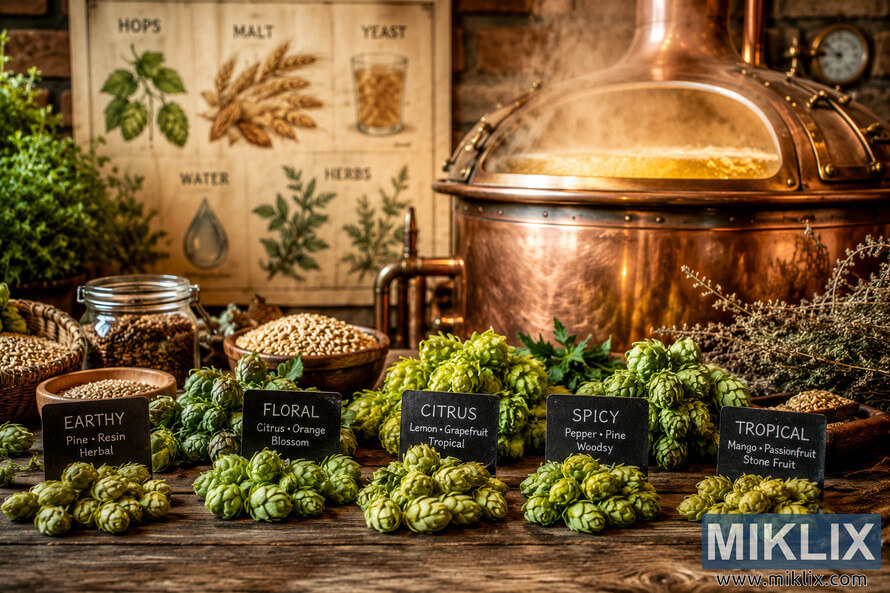
The hop tasting notes include citrus flavors like grapefruit, lemon, and orange peel. Stone fruits such as peach and apricot are also present. Late additions and dry hopping enhance tropical fruit notes, including mango and pineapple. Light floral and herbal undertones complement the profile, while bittering roles keep pine or resin in check.
The intensity of hop flavors changes with the timing of their addition. Early boil additions result in subdued fruit and a more bitter backbone. Whirlpool and dry hop additions, however, amplify tropical and stone fruit notes. Pellet hops may release aroma faster than whole cones, offering a fresher and more subtle experience.
Key hop aroma compounds determine the smell and taste. Myrcene contributes herbal, resinous, and dank tones, quickly disappearing in a boil. Humulene provides woody and spicy facets that resist heat. Caryophyllene adds a peppery bite, while farnesene leans floral. Linalool and geraniol contribute citrusy and floral fruitiness, potentially changing during fermentation.
Oxidation and heat impact these compounds. Boil time reduces volatile myrcene. Oxidation can mute bright fruity esters, shifting them towards musty notes. Yeast interactions can create new hop-derived aromas, altering what you smell in the glass.
When comparing hops like Citra, Cascade, Mosaic to Universal, the differences are significant. Citra offers bold, single-note tropical fruit. Cascade is herbal and grapefruit-forward with floral hints. Mosaic is pungent and complex. Universal balances fruitiness and floral hints, supporting malt and yeast without overpowering them.
Opt for Universal hops when you desire noticeable fruit but prefer a balanced flavor. Terroir, harvest year, and form (pellet versus whole cone) will influence specific hop tasting notes. Plan small test batches to fine-tune your recipe with a new hop source.
Click or tap the image for more information and higher resolutions.
Understanding alpha acids and bitterness contribution
Universal hops alpha acids are key to a beer's bitter profile. They influence hop selection at each boil stage. Knowing the alpha acid range is crucial for brewers to plan additions, predict IBUs, and control bitterness across batches.
The typical alpha acid range for Universal hops is around 6–10% AA. Factors like grower, harvest year, and supplier can alter this range. This makes the variety suitable for late additions and ensures predictable bitterness.
Typical alpha acid range for Universal hops
The alpha acid range for Universal hops is generally 6% to 10%. Suppliers like Yakima Chief or Hopsteiner provide precise batch values. These values are essential for maintaining tight bitterness control.
How to calculate IBU contributions
Calculating IBUs involves four key inputs: hop weight, alpha acid percentage, hop utilization, and batch volume. The Tinseth formula, used by homebrewers, is built into tools like BeerSmith and Brewfather.
- Weight: measured in ounces or grams.
- Alpha acid: percent AA from the spec sheet.
- Utilization: a factor based on boil time and wort gravity.
- Volume: batch size in gallons or liters.
Hop utilization increases with longer boil times and decreases with higher wort gravity. Measuring pre-boil gravity helps refine utilization estimates and improves IBU calculation accuracy.
Practical examples for bitterness control
Example 1: For a 5-gallon (19 L) batch, 1 oz (28 g) of Universal hops at 60 minutes with 8% AA gives roughly 26–30 IBUs. This uses Tinseth typical utilization values. Calculate by converting ounces to grams, applying the alpha acid percentage, multiplying by utilization (about 22–25% at 60 minutes in average gravity), then dividing by volume.
Example 2: A late addition of 0.5 oz (14 g) at 15 minutes with 8% AA yields roughly 3–6 IBUs. Utilization at 15 minutes is much lower, so those IBUs mainly add perceived bitterness and some flavor.
- To reach a Session IPA target (25–35 IBU), reduce 60-minute hop weight or choose later additions to keep bitterness moderate.
- For American IPA targets (40–60+ IBU), increase 60-minute hops or select higher alpha acid lots while monitoring the alpha acid range on the spec sheet.
- Pale Ale goals (30–40 IBU) fall between these approaches by balancing early bittering with mid-boil flavor additions.
Always account for alpha acid variability by updating recipes when you receive new batch specs. Track hop utilization over time in your brewing log to tighten bitterness control and reproduce results reliably.
Click or tap the image for more information and higher resolutions.
Using Universal hops in bittering additions
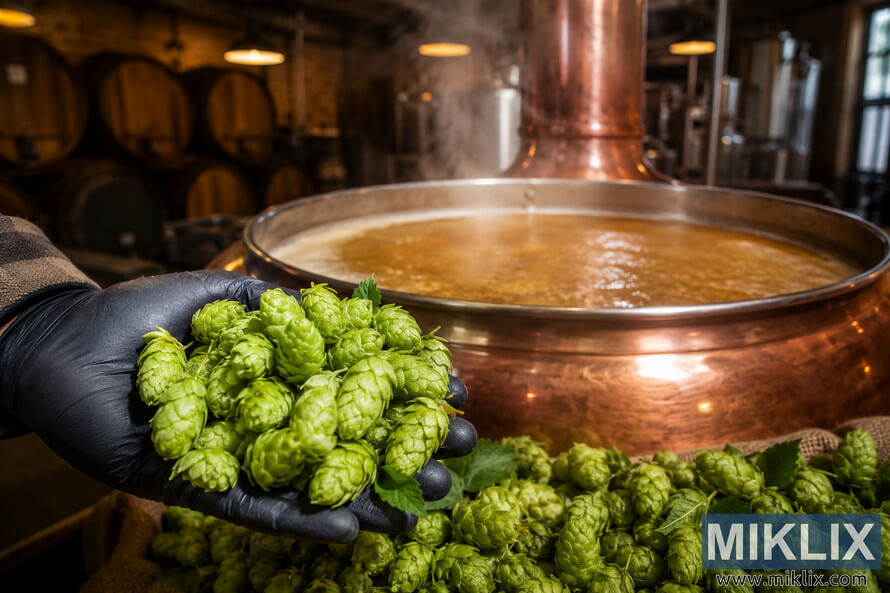
Universal hops are known for their mid-range alpha acid content, making them a reliable choice for bittering. Brewers achieve consistent bitterness by aligning timing and weight with their recipe goals. This guide covers timing, dosages, and combining bittering hops for balance and cost-effectiveness.
When to add for consistent bitterness
Adding hops at the 60-minute mark is the simplest method for achieving stable IBUs. The long boil time ensures alpha acids isomerize consistently. This results in a steady base bitterness for most ales when using Universal hops at 60 minutes.
First wort hopping can soften bitterness perception. Adding hops during lautering extracts early and produces a smoother profile. It maintains IBUs similar to a 60-minute addition. This method is ideal for achieving smoother bittering without sacrificing control.
Recommended dosages for different batch sizes
- 5-gallon (19 L) batch: 0.5–1.5 oz (14–42 g) at 60 minutes, depending on target IBUs and the current alpha acid on the certificate.
- 10-gallon (38 L) batch: double the 5-gallon amounts to 1.0–3.0 oz (28–84 g) for the same bitterness range.
- 1-barrel (31 L) commercial scale: scale proportionally from the 19 L example and account for lower utilization on larger systems by increasing hop dosages slightly.
For style targets use these bittering totals as a guide
- Session IPA: 20–35 IBUs of total bittering; adjust hop dosages toward the lower end of the ranges above.
- Pale Ale: 25–40 IBUs; aim mid-range with Universal hops bittering for character and backbone.
- IPA: 40–70 IBUs; use higher hop dosages and precise alpha acid math to hit the upper range.
Combining Universal with other bittering hops
For a near-neutral main bittering hop, choose a high-alpha, clean variety like Magnum or Polaris. Use that as the main bittering hop at 60 minutes. Then, add Universal later in the boil for flavor and integration.
To combine bittering hops while keeping character, use a 60-minute dose of Universal for integrated bitterness. Add a neutral high-AA hop when cost or alpha consistency becomes a priority. Blending helps manage expense and aroma profile without sacrificing control.
Practical tips
- Check the alpha acid certificate before calculating hop dosages. Freshness affects effective bittering.
- Weigh hops accurately. Pellet hops typically give slightly higher utilization than whole-cone hops, so adjust dosages for form.
- Track your system’s utilization by brewing test batches. Real-world numbers beat theoretical values when scaling up to commercial volumes.
Click or tap the image for more information and higher resolutions.
Using Universal hops for flavor additions
Universal hops provide brewers with a versatile tool for enhancing flavor without dominating the beer. By carefully timing hop additions and using split additions, brewers can preserve delicate oils. This approach also extracts the sweeter, fruitier compounds that define Universal hops.
The timing for flavor extraction varies based on desired outcomes. For a balanced flavor, add 10–20 minutes before the boil ends. This method preserves more volatile oils, resulting in lighter extraction of some compounds. Alternatively, adding hops at 5–15 minutes before the end can yield brighter, fresher notes.
Utilizing a hopstand or whirlpool at 160–180°F (71–82°C) for 10–30 minutes is another effective method. It gently extracts soluble oils without the harshness of boiling.
- 10–20 minute boil: balanced flavor with moderate oil retention.
- 5–15 minute boil: brighter, fresher notes; less extraction of heavier compounds.
- Hopstand/whirlpool 160–180°F for 10–30 minutes: gentle oil extraction and strong aroma retention.
Blending Universal hops with other varieties can reveal new dimensions in flavor. It acts as a bridge between fruity, assertive hops and classic, herbal ones. Pairing Universal with Citra or Mosaic enhances tropical and citrus notes. For a spicy, earthy backnote, combine it with Saaz or Styrian Golding, ideal for Belgian or hybrid styles.
- Bright fruit blend: Universal + Citra for tropical lift.
- Complex hybrid: Universal + Mosaic + a touch of Saaz for spice and balance.
- Traditional meet modern: Universal with Styrian Golding in Belgian-IPA hybrids.
When creating hop blends, maintain a balanced ratio. For late additions, split the dose between flameout and whirlpool. This approach ensures both extraction and aromatic intensity. A common split is 50% at flameout and 50% in a 10–20 minute whirlpool at 170°F.
Creating flavor-focused recipes with Universal hops is straightforward. Below are templates for a 5-gallon batch, illustrating hop timing and blend choices.
- Pale Ale: 0.75 oz Universal @ 15 min + 0.5 oz Citra @ 10 min. Split 0.5 oz Universal between flameout and whirlpool for extra aroma.
- Belgian-IPA hybrid: 0.5 oz Universal @ 20 min to lay a fruity base; dry-hop lightly after fermentation to preserve yeast-driven spice from Belgian strains.
- Lager with subtle lift: 0.5–0.75 oz Universal @ 15 min for a restrained, clean aroma that supports malt balance.
These recipes demonstrate how hop timing and blends influence the beer's character. Small adjustments to timing or ratios can significantly alter the beer's flavor, from delicate to bold, without changing the grain bill.
Click or tap the image for more information and higher resolutions.
Using Universal hops for aroma additions
Universal hops offer a wide range of floral, citrus, and resinous flavors. These are best showcased through low-heat and post-fermentation techniques. The intensity of these aromas depends on several factors, including the beer's matrix, yeast interactions, malt bill, and alcohol level. It's crucial to handle the hops gently to preserve the volatile oils' integrity.
Late boil and whirlpool techniques
To achieve the best aroma, incorporate small flameout additions and use a whirlpool. Aim for whirlpool hops contact at 160–180°F for 15–30 minutes. This method extracts essential oils effectively while minimizing volatilization.
Utilizing multiple small late hop additions can create a layered scent profile. Staggering these additions at 5–10 minute intervals during the final boil enhances citrus and floral notes without increasing bitterness.
Dry hopping strategies to maximize aroma
To enhance complexity, split dry hop additions into two or three stages. This approach helps avoid vegetal flavors. Homebrewers typically use 0.5–2.0 oz per 5 gallons, depending on the style and desired aroma intensity.
- Stage 1: Add during the tail-end of primary fermentation to promote biotransformation.
- Stage 2: Add post-fermentation for fresh, bright topnotes.
- Stage 3 (optional): Brief finishing dose before packaging for maximum impact.
Ensure sanitary transfers and limit oxygen exposure during dry hop handling. Proper sanitation and gentle racking are key to preserving aroma and minimizing oxidation risks.
Cold soak and hopstand considerations
Cold soak and hopstand are low-heat methods that draw out volatiles with minimal isomerization. A hopstand at near-boil cooldown temperatures or a cold soak after fermentation can highlight delicate oils.
Be cautious of chill haze and microbial contamination risks. Use sanitary vessels, chilled wort or beer, and control oxygen tightly during contact. Short contact times help reduce haze while maintaining vibrant aromas.
Integrate late hop additions, whirlpool hops, hopstand, cold soak, and staged dry hop strategies. This combination will enhance Universal hops' aroma without introducing harsh bitterness or vegetal notes.
Dry hopping best practices with Universal hops
Universal hops dry hopping can elevate aroma and flavor with careful handling. Below are practical ranges, risks to watch for, and timing tips for common homebrew and small brewery workflows.
Starting with proven dry hop rates for a 5-gallon (19 L) batch is a good starting point. Scale by weight per liter for larger volumes. Use measured additions to control intensity and balance.
- Session beers: 0.25–0.75 oz (7–21 g) per 5-gallon batch — about 0.37–1.10 g/L (0.00037–0.00110 g/mL).
- Pale Ales: 0.5–1.5 oz (14–42 g) per 5-gallon batch — about 0.74–2.20 g/L.
- IPAs and Hazy IPAs: 1.5–6.0 oz (42–170 g) per 5-gallon batch — about 2.20–8.90 g/L depending on desired punch.
When setting dry hop rates, start with a conservative approach for delicate styles. For high-rate hazy ales, staged additions can better retain aroma than a single large dose.
Proven dry hop rates by style
Match dry hop rates to beer type and drinkability. Session beers require a light touch for a subtle lift. Pale ales benefit from moderate additions. IPAs can handle large quantities but require careful monitoring for off-notes.
Convert the listed 5-gallon recommendations to g/kg per liter when scaling. Keep records of each batch to refine dry hop rates over time.
Managing polyphenols and hop creep
Managing polyphenols is crucial in dry hopping. Excessive hopping can extract tannins, adding haze and astringency. Use moderate contact time and clean hop material to limit over-extraction.
Hop creep occurs when enzymes in hops reactivate fermentation. Heavy dry hopping increases this risk. Monitor gravity after dry hop and allow time for stabilization before packaging.
- Use pasteurized hop products or fresh cold-stored hops to reduce enzymatic activity.
- Consider sequential, smaller additions to limit polyphenol extraction while keeping aroma intensity.
- Measure gravity 24–48 hours after dry hopping and again before packaging to catch hop creep-related changes.
Timing and duration for optimal aroma retention
Contact time impacts aroma retention and clarity. Most beers benefit from 2–7 days of dry hop contact. Shorter times offer cleaner aromatic lift.
Hazy IPAs often sit at 4–7 days with higher dry hop rates but watch for vegetal notes and increased haze from managing polyphenols. Lagers and delicate styles merit 24–48 hours for a subtle, crisp aroma.
Use hop bags or stainless mesh when appropriate to ease removal and reduce trub. Avoid over-agitation to limit oxygen pickup. Sequential additions can maintain aroma while reducing polyphenol load and the chance of hop creep.
Pairing Universal hops with yeast strains and malt bills
Creating a harmonious balance between hops, yeast, and grain is crucial for a hop-forward beer. The first step in Universal hops yeast pairing is selecting a yeast that enhances the variety's fruity and floral notes without overpowering them. Maintaining a consistent fermentation temperature is key to controlling ester production and preserving the volatile hop aromas.
Yeast phenotypes that complement hop character
- Clean American ale strains such as Wyeast 1056, White Labs WLP001, or Safale US-05 provide a neutral background, allowing Universal hop aromas to dominate.
- English ale yeasts introduce mild malt complexity and gentle esters, creating a balanced dialogue between malt and hops in ales.
- Estery Belgian or English strains can enhance stone-fruit or tropical notes, ideal for fruity synergy with late additions or dry hops.
- Kveik and some high-flocculation strains are perfect for Hazy IPA styles, amplifying fruity perception and supporting turbidity when desired.
Malt choices to support hop-driven beers
- Opt for clean base malts like American two-row or Pilsner to give Universal hops ample space to showcase their aroma and flavor.
- Introduce light crystal malts sparingly to avoid dulling hop brightness while adding subtle caramel notes and body.
- For hazy, juicy beers, include higher-protein adjuncts such as flaked oats and wheat to boost mouthfeel and perceived juiciness, complementing Universal's fruity profile.
- Design a malt bill for hop-forward beers that minimizes roasty or dark malts; keep the spectrum light to mid-range to protect hop clarity.
Adjuncts and additions that enhance complexity
- Lactose or dextrin malts create a creamy mouthfeel in New England–style ales while keeping hop character prominent.
- Small amounts of fresh citrus zest can lift and amplify citrus notes from the hops without overshadowing them.
- Delicate spices such as coriander can complement floral aspects when brewing Belgian-hybrid beers with Universal hops.
- Always test adjuncts in small pilot batches to confirm they enhance rather than compete with hop aromatics.
Use yeast phenotypes intentionally and tailor the malt bill for hop-forward beers to match the beer’s target style. Fine-tune fermentation temperature and adjunct levels to preserve hop aroma and achieve the desired complexity.
Recipe templates using Universal hops
Below are tested templates and notes to help brewers use Universal hops in three common builds. Each template targets a 5-gallon (19 L) batch. It includes mash, fermentation, and sensory guidance. Keep a brewing log and adjust hop quantities to taste.
Session IPA template for a light, crushable pour. Target OG ~1.040, FG ~1.008, ABV ~4.0–4.5%. Malt bill: 90% US two‑row, 5% Munich, 5% CaraPils. Mash 152°F (67°C) for 60 minutes to keep body moderate. Ferment at 64–68°F (18–20°C) with Safale US‑05 or Wyeast 1056/WLP001. Water: moderate sulfate to chloride ratio to accentuate hop dryness.
- Hop schedule: 0.75 oz Universal @ 60 min (bittering); 0.5 oz Universal @ 15 min (flavor); 1.5 oz Universal split between 5 min and flameout (aroma); dry hop 1.0 oz for 3 days.
- IBU target: 25–30. Expect a crisp bitterness with bright citrus and mild resin notes.
- Fermentation: active 7–10 days, diacetyl check, then cold crash if clarity desired.
Pale ale template focused on drinkability and balance. Target OG ~1.048, FG ~1.012, ABV ~4.5–5.5%. Malt bill: 85% two‑row, 8% Vienna, 5% Crystal 10L, 2% Carapils. Mash 154°F (68°C) for a slightly drier finish. Use English ale strain S‑04 for malt character or US‑05 for a cleaner profile.
- Hop schedule: 1.0 oz Universal @ 60 min; 0.5 oz Universal @ 20 min; 0.75 oz Universal @ 5 min; small dry hop 0.5 oz for 3 days.
- IBU target: 30–35. This Pale Ale Universal hops build emphasizes drinkability with a balanced bitterness and soft hop aroma.
- Fermentation: 7–10 days primary, finish warm to attenuate fully, condition 7–14 days before packaging.
Experimental aroma-forward template for hazy or juicy interpretations. Target OG ~1.065 for a fuller body. Use 20–30% combined oats and wheat to boost mouthfeel. Mash at 152°F (67°C) for a creamy profile. Yeast choices: Vermont Ale strain or a kveik for fruity esters and rapid fermentation.
- Kettle additions: late hopstand at 170°F (77°C) with 3–5 oz Universal plus complementary varietals such as Mosaic and Citra to layer complexity.
- Dry hop: large program totaling 4–6 oz, split into two additions (e.g., day 3 and day 6 of conditioning) to preserve volatile aromatics.
- Handling: minimal cold crash to retain haze and volatile aroma. Expect bold tropical, stone fruit, and floral notes from these aroma-forward hop recipes.
Mash profile and fermentation schedule notes for all templates. Use single infusion mashes unless a step mash is preferred. Aim for mash pH 5.2–5.4 to support hop perception. Ferment temperature control greatly affects ester profile; keep records of pitch rate, oxygenation, and temperature.
- Record sensory outcomes: aroma intensity, perceived bitterness, and balance.
- Adjust hop amounts in future brews based on tasting notes; Universal hops recipes respond well to small tweaks in late additions.
- When experimenting with fruit, lactose, or adjuncts, add after primary fermentation to protect hop character.
Expected sensory outcomes: Session IPA Universal hops builds yield a light, citrus‑forward beer with clean bitterness. Pale Ale Universal hops templates deliver a balanced, malt‑backed sip with approachable hop aroma. Aroma-forward hop recipes emphasize juicy, layered hop notes and soft mouthfeel.
Keep concise records for each brew. Track grain bill, hop timing, yeast strain, and water profile. These templates provide a solid starting point for dialing in Universal hops across styles.
Water profile adjustments for hop-forward beers
Water profoundly influences how hops are perceived in beer. Even slight mineral adjustments can enhance hop aroma, sharpen bitterness, or soften malt character. Utilize a water test and brewing calculator to plan the necessary additions for your recipe and tap chemistry.
Ideal chloride-to-sulfate ratios
Sulfate accentuates hop bitterness and dryness. Conversely, chloride contributes to malt fullness and sweetness. For hop-forward, dry styles, aim for a sulfate:chloride ratio between 2:1 and 4:1. For malt-forward beers, target a chloride:sulfate ratio of roughly 1:1 to 2:1.
Guideline ranges suggest sulfate levels of 150–350 ppm for assertive hop character, and chloride levels of 50–150 ppm for roundness. Make adjustments in small increments and taste frequently; large changes can disrupt the beer's balance.
Adjusting mash pH for hop perception
Strive to maintain a mash pH of 5.2–5.5 at room temperature to optimize enzyme activity and balance. A lower mash pH can slightly brighten hop perception and reduce harsh bitterness.
To increase sulfate without affecting pH, use calcium sulfate (gypsum). For chloride and a small calcium boost, employ calcium chloride. To lower mash pH, consider food-grade lactic or phosphoric acid, or acidulated malt if preferred.
Practical examples for common water types
- Hard, sulfate-rich water (Burton-like analog): Likely already favors hops. Test before adding gypsum; you may only need small chloride additions to round malt character.
- Soft coastal water (Seattle, Portland analogs): Often low in both ions. For hop-forward beers add gypsum to reach target sulfate and a touch of calcium chloride for balance.
- Mixed Midwest water: Varies by city. Use your local water report to decide whether to raise sulfate for IPAs or to add chloride for malty ales.
Practical steps for homebrewers
- Obtain a water report or send a sample to Ward Labs or similar for analysis.
- Enter numbers into a tool like Bru'n Water or a calculator to plan gypsum and calcium chloride additions.
- Choose food-grade salts and add in small increments. Consider starting with distilled or bottled water and then build a profile if your tap is extreme.
Safety note: use food-grade salts and follow recommended dosages. Regular testing and small adjustments allow for fine-tuning water profile hops and mash pH hop perception for consistent, hop-forward results across varied US water profiles.
Harvesting, storing, and handling Universal hops
Proper handling begins at harvest and extends through your cooler or warehouse. Small decisions at purchase and storage impact aroma, alpha acids, and the final beer. Before buying Universal hops or moving inventory, familiarize yourself with these practical steps.
Buying whole cone vs. pellet
Homebrewers and breweries face choices when purchasing Universal hops. Whole cone hops preserve volatile oils better. They offer brighter aroma in short-term dry hopping and cold soaks.
Pellet hops, on the other hand, provide higher utilization in the boil and consistent dosing. Pellets are often vacuum-sealed in foil packs for predictable shelf life and easier storage. Consider hop extracts and CO2 oils for concentrated aroma with repeatable results.
Proper cold storage and oxygen management
Store hops cold immediately after receiving them. Refrigeration at 32–40°F (0–4°C) works for a few weeks. For longer storage, freeze at -10 to 0°F (-23 to -18°C).
Use vacuum-sealed packaging or oxygen scavenger packets to limit exposure. Minimize headspace and avoid repeated thaw cycles. Commercial operations should maintain a continuous cold chain and use nitrogen blanketing for bulk bales.
Estimating hop freshness and potency over time
Alpha acids and essential oils degrade with age. Request a certificate of analysis from the supplier to establish a baseline AA% and harvest date. Track days since harvest to estimate potency loss.
Palletized pellets stored frozen can remain usable 9–18 months with acceptable hop freshness. Whole cones, however, lose aroma faster and should be used sooner. Use a simple smell test before heavy late additions: cardboard or papery notes indicate stale hops, while bright citrus or tropical scents signal good aroma.
- Look for supplier COAs and harvest dates when you buy Universal hops.
- Adopt hop O2 management: vacuum packs, scavengers, and minimal headspace.
- Rotate stock so older lots are used first, especially for whole cones.
Scaling recipes with Universal hops from homebrew to commercial batches
Scaling a recipe from 5 gallons to 5 barrels or more demands precise calculations and a deep understanding of brewing processes. Brewers must consider unit conversions, hop utilization changes, and equipment effects on extraction and aroma. Systematic scaling helps maintain the recipe's profile, with pilot runs crucial for planning.
Unit conversions and hop quantity scaling
Begin with basic conversions: 1 ounce equals 28.35 grams, 1 pound is 0.4536 kilograms, and 1 gallon is 3.785 liters. For scaling hops, apply a volume ratio: scaled hop weight = recipe hop weight × (target volume ÷ original volume).
However, this ratio needs adjustment for utilization differences. Larger kettles may have varied boil vigor and surface-area-to-volume ratios. Use utilization correction factors or brewing software to adjust bittering hops. Small pilot brews are essential for validating conversions before scaling up to commercial batches.
Maintaining flavor balance at larger volumes
Hop intensity rarely scales linearly. Late additions and dry hops can see changes in impact due to oxygen pickup and contact time. Treat late hop additions as a percentage of wort volume, not absolute weight.
Scale dry hop rates proportionally. For instance, if a 5-gallon dry hop uses 2 ounces, scale by volume to find grams per liter for the commercial target. Sensory panels on pilot batches are vital for confirming hop balance across volumes.
Process adjustments for commercial equipment
Commercial brewhouses come with practical constraints. Kettle BTU density, whirlpool geometry, and hop settling impact hop utilization. Consider hop dosing systems, hopbacks, and hop torpedoes to control extraction and maintain aroma consistency during commercial batch conversion.
Implement precise metering for hop delivery and monitor hop dissolution in whirlpool steps. Clean-in-place routines can affect hop residues and sanitation. Collaborate with suppliers to obtain COAs for consistent alpha acid values and plan inventory considering cost and shelf life.
- Use software or lab data to refine hop scaling estimates.
- Run pilot-scale trials and sensory panels before wide release.
- Document boil vigor, kettle geometry, and hop contact times for repeatability.
- Request certificates of analysis to stabilize alpha acid expectations.
Common issues and troubleshooting when using Universal hops
Universal hops add flavor and aroma to beer. Brewers often encounter problems. This guide helps identify and fix common issues.
Start by matching symptoms to possible causes. Check if hops are fresh, stored properly, and handled correctly. Also, ensure sanitation and limit oxygen exposure. A consistent process helps avoid repeat issues.
Off-flavors linked to hop handling and solutions
- Vegetal or grassy notes from long dry-hop contact: shorten contact time to 24–72 hours for delicate beers.
- Grassy or papery flavors from stale hops: use recent harvests and rotate stock; buy vacuum-sealed pellets from reputable suppliers like Yakima Chief or Hopsteiner.
- Cardboard or oxidation notes from poor storage: keep hops frozen or refrigerated, limit oxygen during transfer, and purge containers with CO2 or nitrogen.
- Sanitation-related taints: sanitize all dry-hop equipment and avoid handling hops with bare hands.
Managing haze and clarity in hop-forward beers
- Hop-related haze often comes from polyphenols in hops binding with grain proteins. High dry-hop rates and late additions raise the risk.
- Temporary haze from suspended yeast can clear with time; cold crash for 24–72 hours to speed settling.
- Kettle fining like Irish moss or Whirlfloc helps during the boil. Post-fermentation finings such as polyclar or gelatin improve clarity for clearer styles.
- Enzymatic treatments such as amyloglucosidase suit specific styles only. Use sparingly in beers where residual sweetness must remain.
Addressing yeast-hop interactions and fermentation problems
- Hop creep results from enzymes in hops that break complex sugars, causing renewed fermentation after dry hopping. Monitor gravity for several days following any heavy late hop or dry-hop addition.
- Over-attenuation and overcarbonation follow unchecked hop creep. Hold beer until gravity stabilizes for at least three readings over 48 hours before packaging.
- Hop oils can stress yeast and stall fermentation. Use correct pitching rates and choose robust strains like Wyeast 1056 or Safale US-05 when planning heavy late hopping.
- Proper aeration and nutrient addition at pitch reduce yeast stress. Re-pitching healthy starter yeast can rescue sluggish fermentations.
Stepwise troubleshooting flow
- Identify the symptom: off flavor, haze, stalled fermentation, or overcarbonation.
- Check hop freshness and storage: inspect harvest date, packaging, and aroma.
- Verify sanitation and oxygen exposure during handling and dry hopping.
- Monitor gravity and CO2 development after dry hopping to detect hop creep early.
- Adjust process for the next batch: shorten contact time, change hop source, or modify yeast and oxygen practices.
Use Universal hops troubleshooting as a routine checklist. This keeps hop off-flavors low, manages hop-related haze, and prevents negative yeast hop interactions in future brews.
Innovations and experimental techniques with Universal hops
Brewers are now exploring new horizons by combining Universal hop varieties with cutting-edge tools and methods. They are experimenting with new delivery formats, targeted yeast interactions, and cold-side handling. This allows for more precise control over aroma and mouthfeel. It's crucial to start with small batches and keep detailed tasting notes to refine recipes before scaling up.
CO2 extracts, cryo lupulin concentrates, and advanced pellet formats are reducing vegetal matter while delivering potent hop oils. These innovations, such as Universal hop extracts and novel hop products, simplify storage and ensure consistent aroma across batches. Brewers should follow supplier guidelines and test solubility in wort or beer to avoid clumping issues.
Commercial brewers must also consider labeling and regulatory rules. Some areas require disclosure of concentrated hop forms on labels. Opting for T-90 pellets or hop oils can streamline inventory, reduce trub loss, and expedite packaging processes.
Biotransformation occurs when yeast enzymes convert bound hop precursors into free aromatics like linalool or geraniol. Selecting yeasts known for ester activity and timing hop contact early in fermentation can enhance these effects. It's important to monitor gravity and watch for hop creep to avoid overattenuation.
Practical examples include using a Saccharomyces cerevisiae strain with known ester production and adding a portion of lupulin early in fermentation. Brewers often combine this with later aroma additions to balance transformed and free volatiles.
Cold dry hopping favors the extraction of fragile volatiles while limiting grassy extracts. This method, along with cold-side hopstands, pulls more delicate hop oils into beer without extracting excess polyphenols. Maintaining sanitation and controlling contact time is crucial to prevent microbial risks.
- Multi-stage dry hopping: staged additions to shape aroma over days.
- Hopback and torpedo infusions: pass hot wort or beer through packed hops for controlled extraction.
- Hop oils and concentrated lupulin: precise dosing for large-scale aroma consistency.
Each technique has its trade-offs. Cold methods preserve delicate notes but may require longer contact times. Concentrates offer consistency but can alter mouthfeel and require legal labeling. Hopback systems can strip oxygen but need cleaning and validation.
Keeping detailed records of doses, timing, yeast strain, temperature, and sensory results is essential. Use small experimental batches, blind tastings, and incremental changes. This approach ensures the integration of Universal hop extracts, biotransformation hops, cold dry hopping, novel hop products, and hop oils into recipes with predictable outcomes.
Conclusion
This Universal hops summary highlights the key points for brewers. The variety is both balanced and versatile. It offers adaptable alpha acids and a fruity, floral, and herbal aroma. This makes it suitable for various beer styles, from bittering to aroma additions.
For brewing, use its middle-ground bitterness for consistent IBUs. Emphasize late-boil, whirlpool, and hopstand additions. This showcases its aromatic layers effectively.
Practical guidance is straightforward. Measure alpha acids from the certificate of analysis. Adjust hop quantities to achieve target IBUs. Use recommended dry hop rates and manage polyphenols.
Store hops cold and oxygen-free to preserve aroma. Pair the variety with yeast strains like SafAle US-05 or Wyeast 1056 for clean fermentation. Select malt bills and water profiles that highlight the hop character.
Encouragement to experiment is key. Start with provided recipe templates and small pilot batches. Keep detailed logs and scale recipes carefully. Monitor freshness and supplier analytics.
For U.S. brewers, confirm COA values at purchase. Test Universal hops in a pilot brew. Follow labeling and regulatory guidance when selling commercially. Thoughtful measurement, storage, and technique unlock the variety’s full potential.
FAQ
What are Universal hops and why are they popular with U.S. brewers?
Universal hops are a versatile variety bred for balanced alpha acids and broad aromatic appeal. They offer citrus, stone fruit, tropical notes, and light floral and herbal facets. U.S. brewers favor them for their consistent performance, cost-effectiveness, and reliable storage stability. They are also adept at serving in various roles across styles, from Session IPAs to lagers.
What is the typical alpha acid range for Universal hops and how does that affect IBU planning?
Universal hops typically have alpha acids in the lower-mid to mid range, around 6–10% AA. This flexibility allows brewers to use them for bittering or later additions for flavor/aroma. IBUs can be calculated using the Tinseth formula or software like Beersmith or Brewfather. Always check the supplier COA and adjust amounts to account for seasonal AA variance.
How should I use Universal hops for bittering in a 5-gallon batch?
For a 5-gallon batch targeting moderate bitterness, use 0.5–1.5 oz of Universal hops at 60 minutes. This depends on the AA% and desired IBUs. For example, with 8% AA, 1 oz at 60 minutes yields approximately mid-IBU contributions. Adjust according to style: Session IPAs aim for 25–35 IBUs, Pale Ales for 30–40 IBUs, and American IPAs for 40–60+ IBUs.
What timing works best for extracting flavor from Universal hops?
For flavor, add Universal hops at 10–20 minutes left in the boil. Shorter late additions preserve more volatile oils but yield less thermal extraction. Whirlpool or hopstand at 160–180°F for 10–30 minutes captures aroma and flavor. Splitting late additions between flameout and whirlpool gives layered complexity.
How much should I dry hop with Universal hops for different styles?
Typical 5-gallon dry-hop ranges vary by style: Session beers 0.25–0.75 oz, Pale Ales 0.5–1.5 oz, and IPAs/Hazy IPAs 1.5–6.0 oz. For delicate lagers, keep contact to 24–48 hours; for Hazy IPAs, 4–7 days is common. Consider sequential additions to layer aroma and reduce polyphenol extraction.
What risks come with heavy dry hopping and how do I manage them?
Heavy dry hopping can increase polyphenol extraction, leading to astringency and haze. It can also trigger hop creep—enzymatic sugars that cause continued fermentation and overcarbonation. Mitigate by monitoring gravity after dry hop, allowing time for stabilization before packaging. Use cleaner hop lots or pasteurized products, limit contact time for delicate beers, and minimize oxygen pickup during transfers.
Which yeast strains pair best with Universal hops?
Clean American ale strains like Wyeast 1056, White Labs WLP001, or Safale US-05 highlight Universal’s fruit and citrus notes. For more ester-driven synergy, use Belgian or English strains to accent stone-fruit characters. For Hazy IPAs, Vermont Ale strains or select kveik strains can enhance perceived juiciness. Adjust fermentation temperature to control ester levels and preserve hop aromatics.
What malt bills complement Universal hops for drinkability?
For hop-forward clarity, use 2-row or Pilsner base malts. For more body and juiciness in Hazy styles, add oats and wheat (10–30% combined). Light crystal malts (5–8%) can add balance without masking hop character. Adjust mash profile and chloride-to-sulfate ratio to favor malt roundness or hop dryness.
How should I adjust water chemistry for Universal hop-forward beers?
Target higher sulfate-to-chloride ratios for hop bite (roughly 2:1 to 4:1 sulfate:chloride) and moderate chloride for malt roundness when desired. Example ranges: sulfate 150–350 ppm for assertive hop profiles, chloride 50–150 ppm. Keep mash pH around 5.2–5.5. Use gypsum and calcium chloride to tune ions and lactic or phosphoric acid to lower pH if needed.
Should I buy whole-cone or pellet Universal hops?
Pellets offer higher utilization, longer shelf life, and more consistent dosing, making them common for most brewers. Whole cones can preserve some volatile aromatics favored in certain dry-hop applications. For large-scale consistency, pellets and concentrated lupulin or CO2 extracts are practical. Store either format cold and oxygen-free to maximize freshness.
What are best storage practices to preserve Universal hop potency?
Store hops cold and oxygen-minimized. Short-term refrigeration (32–40°F / 0–4°C) is fine; for long-term storage, freeze at -10 to 0°F (-23 to -18°C). Use vacuum-sealed foil packs, oxygen scavengers, or nitrogen blanketing for bulk. Avoid repeated thaw cycles and check supplier COAs for harvest date and AA% to plan usage.
How do I scale a Universal hop recipe from homebrew to commercial batches?
Scale by volume and convert units accurately (oz↔g, gallons↔liters, lbs↔kg). Account for utilization changes in larger kettles—boil vigor, kettle geometry, and hop contact time alter IBU outcomes. Keep late addition and dry-hop levels proportional to wort volume, pilot-scale test when possible, and request COAs to maintain AA consistency across lots.
What troubleshooting steps should I take if my beer shows vegetal or cardboard off-flavors?
Check hop freshness and storage—papery or cardboard notes indicate oxidation. Reduce dry-hop contact time and oxygen exposure during dosing to avoid vegetal extraction. Use fresher hops or hop extracts to eliminate musty flavors. For cardboard off-notes, verify packaging oxygen ingress and improve cold chain handling for future batches.
Can I use hop extracts or cryo lupulin instead of whole pellets for Universal hops?
Yes. CO2 extracts, cryo lupulin, and concentrated products give concentrated aroma without vegetal matter and increase consistency while reducing storage footprint. They work well for aroma control and sanitation-sensitive processes. Adjust dosing as extracts are far more potent than pellets and verify solubility and labeling requirements for commercial beers.
Are there regulatory labeling rules I should know when listing Universal hops on my beer label in the U.S.?
The TTB requires truthful, non-misleading labeling. Stating hop variety or origin is common but should be substantiated with supplier documentation and COAs. Keep purchase records and chain-of-custody info in case of audit. For organic or sustainability claims, maintain certification paperwork (USDA Organic, third-party sustainability programs) to support marketing statements.
What modern or experimental techniques work well with Universal hops?
Techniques include whirlpool hopstands (160–180°F), multi-stage dry hopping, biotransformation (adding hops during active fermentation to let yeast enzymes modify hop precursors), cold dry hopping, and using lupulin or extracts for concentrated aroma. Test innovations on small batches, monitor for hop creep, and keep detailed records to replicate successful results.
Further Reading
If you enjoyed this post, you may also like these suggestions:
- Hops in Beer Brewing: Smooth Cone
- Hops in Beer Brewing: Yakima Gold
- Hops in Beer Brewing: Eastwell Golding