
Image: HAVAL-128/4 Hash Algorithm Visualization
Published: January 9, 2026 at 7:26:53 PM UTC
Last updated: January 9, 2026 at 7:27:30 PM UTC
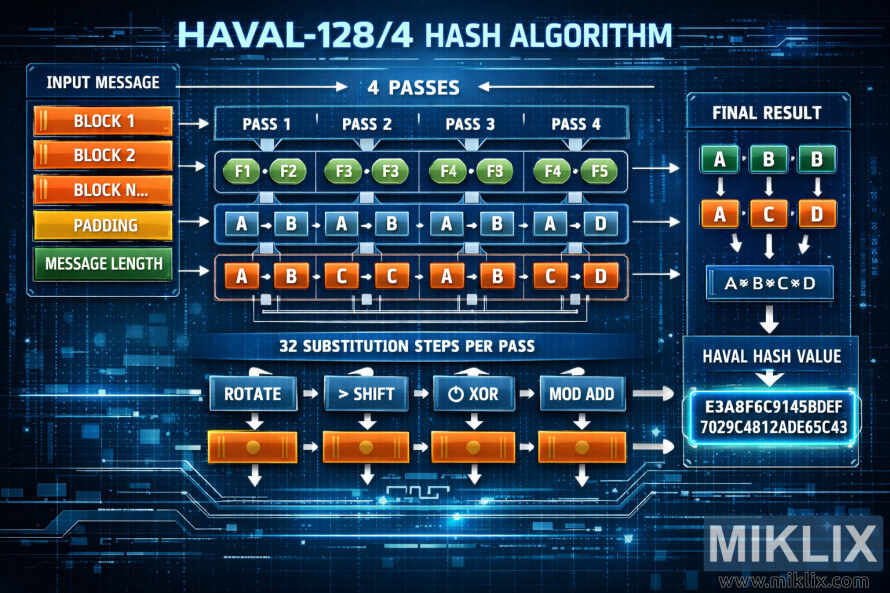
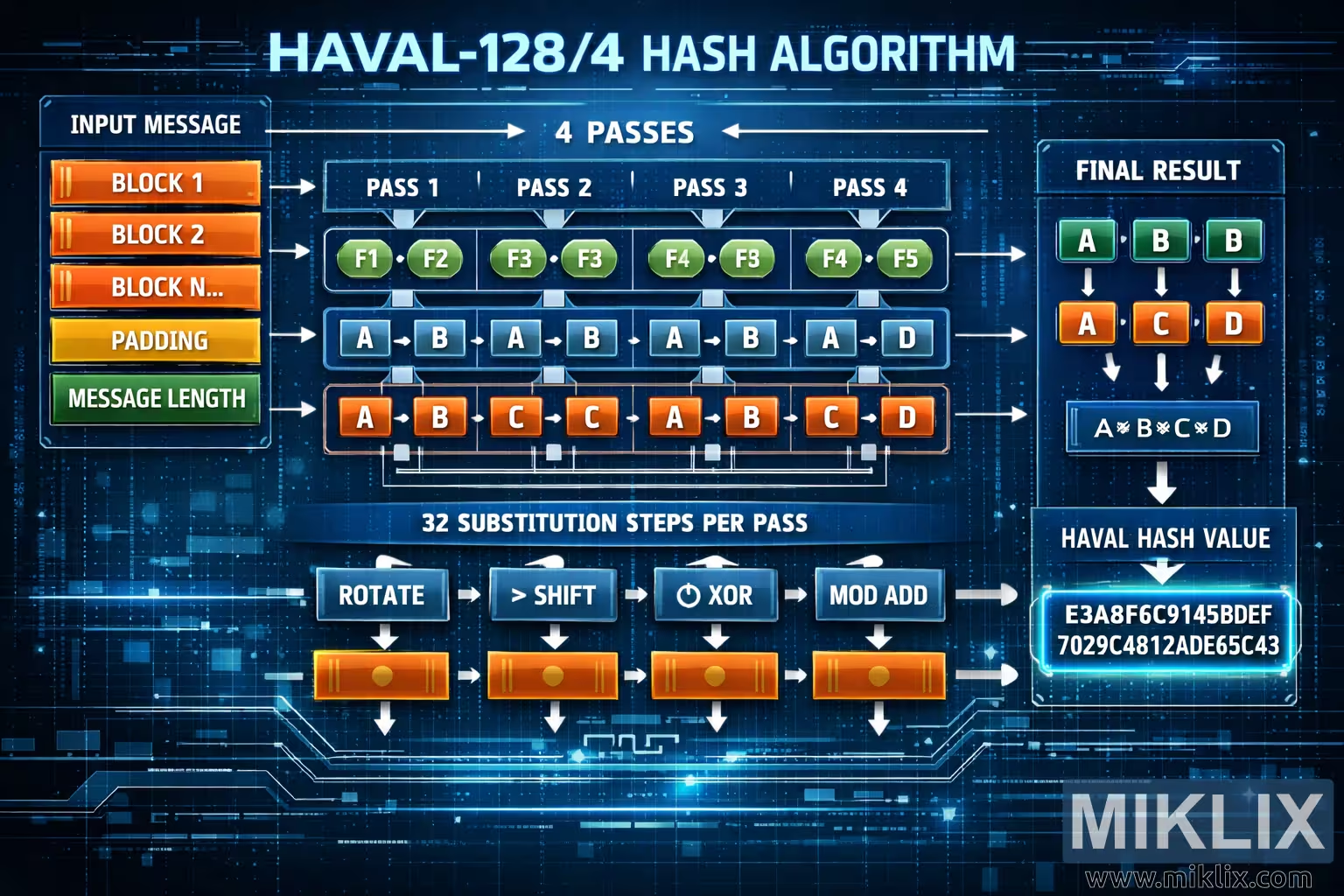
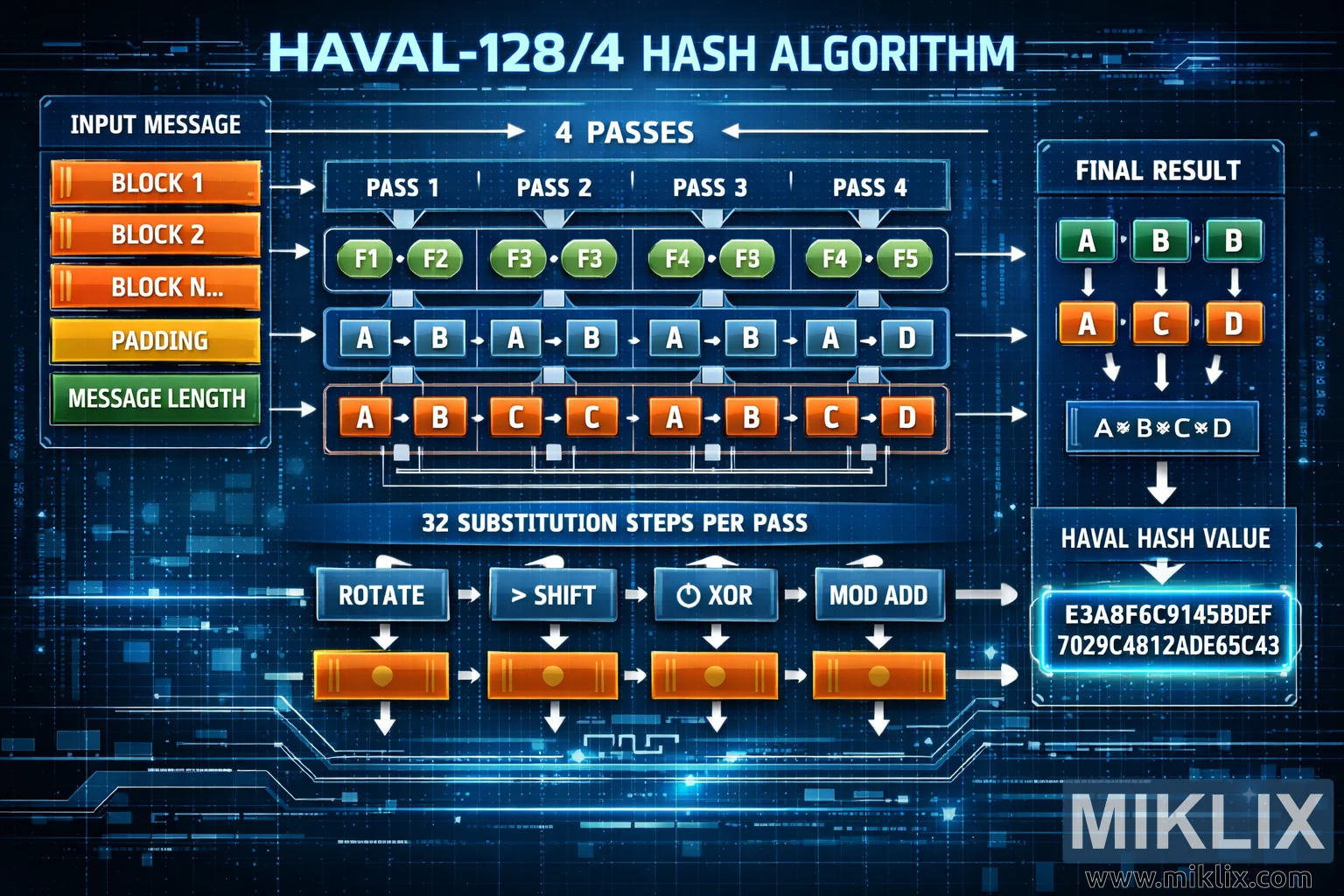
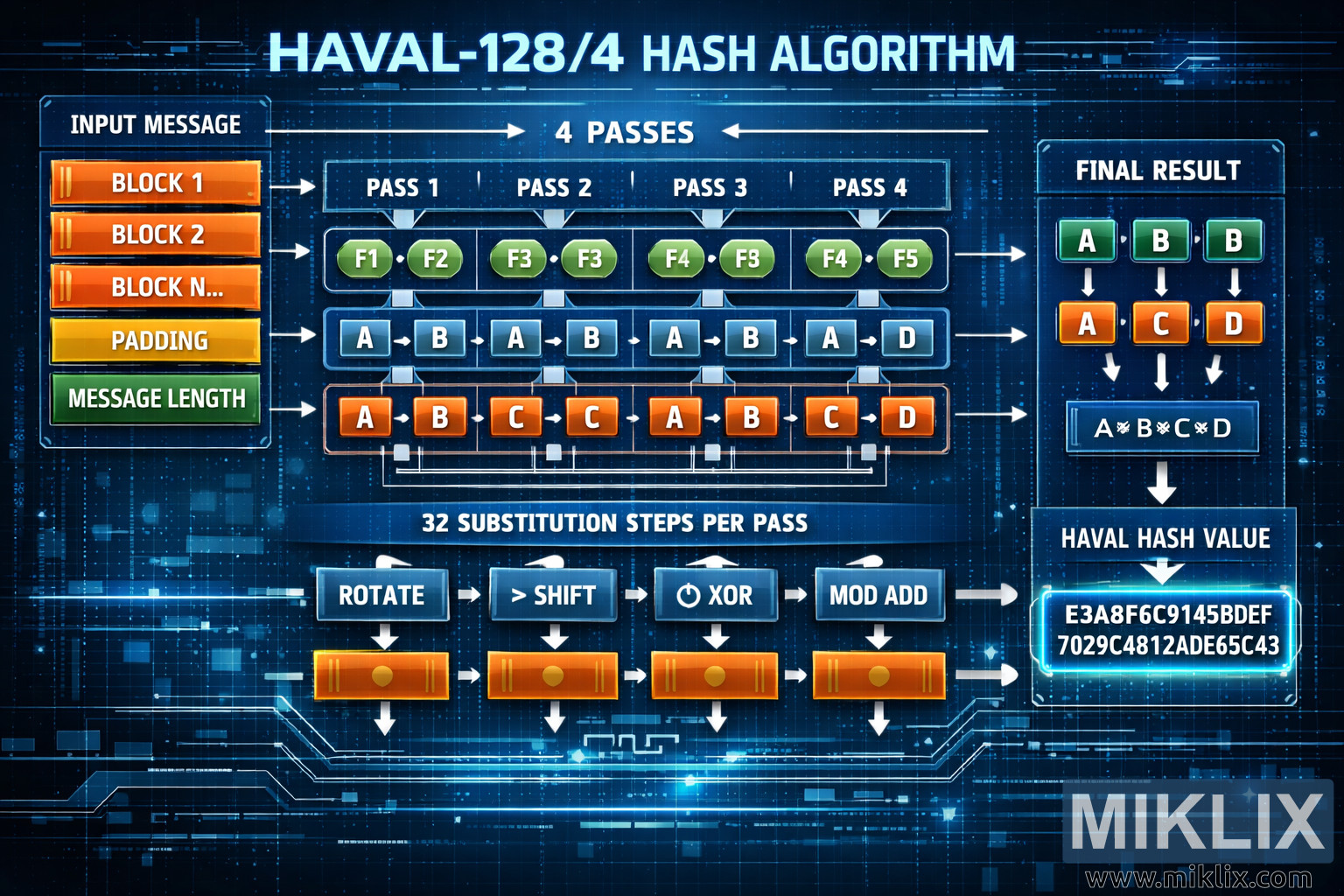
Landscape infographic visualizing the HAVAL-128/4 hash algorithm: message blocks and padding feed four passes of transformations and substitution steps, producing a final 128-bit HAVAL hash value.
Available versions of this image
The image files available for download below are less compressed and higher resolution - and as a result of that, higher quality - than the images embedded in articles and pages on this website, which are more optimized for file size in order to reduce bandwidth consumption.
Regular size (1,536 x 1,024)
Large size (3,072 x 2,048)
Very large size (4,608 x 3,072)
Extra large size (6,144 x 4,096)
Comically large size (1,048,576 x 699,051)
- Still uploading... ;-)
Image description
A wide, landscape-format digital infographic visualizes the HAVAL-128/4 hash algorithm in a futuristic, blue, circuit-board style. The background is a dark-to-bright blue gradient filled with grids, glowing traces, tiny squares, and faint data-like patterns, giving the impression of a high-tech dashboard. Centered along the very top is a large headline in bright, glowing white-blue text reading “HAVAL-128/4 HASH ALGORITHM,” with subtle scanline and neon effects.
On the far left, a vertical panel labeled “INPUT MESSAGE” presents the incoming data as stacked rectangular blocks. Three orange blocks are labeled “BLOCK 1,” “BLOCK 2,” and “BLOCK N…,” indicating multiple message blocks. Beneath them are two greenish blocks labeled “PADDING” and “MESSAGE LENGTH,” signaling the standard preprocessing stage. Thin, glowing arrows point from this input panel toward the central processing area, showing the flow from left to right.
The central portion is dominated by a large, framed section titled “4 PASSES.” Under this header, four adjacent columns are labeled “PASS 1,” “PASS 2,” “PASS 3,” and “PASS 4.” Within these passes, small rounded green capsules labeled with function markers (F1, F2, F3, F4, F5) appear in sequence, representing the nonlinear mixing functions used across the rounds. Below the function capsules, two horizontal lanes of small square tiles show state registers progressing through the passes. The tiles are colored in cool blues and warm oranges and are labeled with single letters such as A, B, C, and D, suggesting the evolving internal state words. Arrows between tiles indicate how the state moves and is updated from one pass to the next, creating a clear left-to-right pipeline. At the bottom edge of the central frame, a caption states “32 SUBSTITUTION STEPS PER PASS,” emphasizing the repeated per-pass operations.
Along the lower middle area, a row of four dark-blue operation boxes summarizes typical bitwise and arithmetic transformations. Each box is labeled with a concise operation name: “ROTATE,” “> SHIFT,” “XOR,” and “MOD ADD.” Beneath each operation label is a stylized orange module with small glow accents, and vertical arrows imply these operations feed into the substitution and mixing process.
On the right, a tall panel labeled “FINAL RESULT” depicts the concluding combination of state values. Near the top of this panel, three green tiles labeled “A,” “B,” and “B” appear, with downward arrows leading to orange tiles labeled “A,” “C,” and “D,” illustrating a final mixing or recombination step. Below, a dark box shows a symbolic expression resembling “A * B * C * D,” reinforcing the idea of combined state words. At the bottom, a prominent label reads “HAVAL HASH VALUE,” pointing to a glowing cyan-outlined rectangle that contains the final hexadecimal digest. The digest is shown as two lines of uppercase hex characters, visually presented as the completed 128-bit output. Overall, the diagram uses crisp neon borders, arrows, and segmented panels to communicate a structured, step-by-step flow from input message blocks through four passes of transformations to the final HAVAL-128/4 hash.
The image is related to: HAVAL-128/4 Hash Code Calculator