
Image: HAVAL-128/5 Hash Algorithm – Five-Pass Cryptographic Workflow
Published: January 7, 2026 at 10:17:54 PM UTC
Last updated: January 7, 2026 at 10:18:27 PM UTC
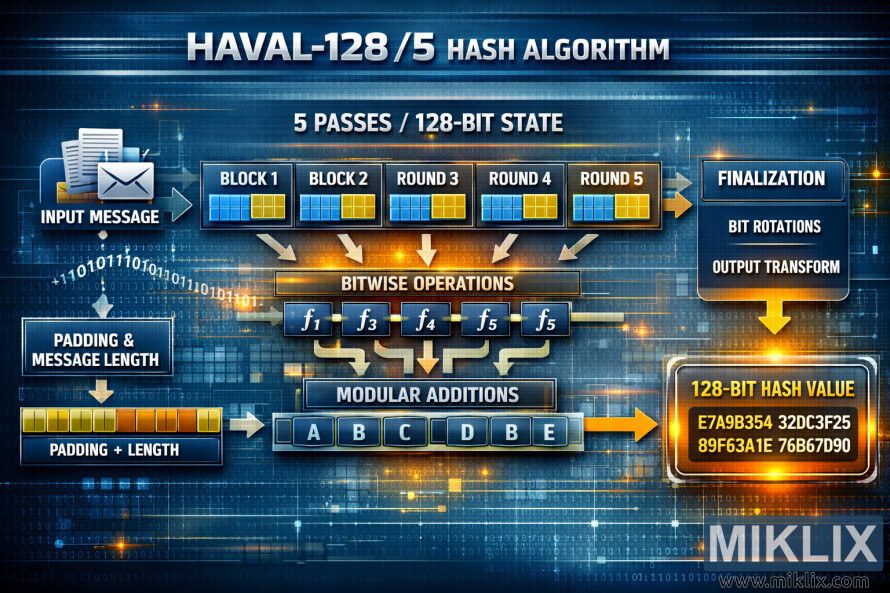
High-resolution visualization of the HAVAL-128/5 cryptographic hash algorithm, illustrating message padding, five processing passes, internal state transformations, and production of a 128-bit digest.
Available versions of this image
The image files available for download below are less compressed and higher resolution - and as a result of that, higher quality - than the images embedded in articles and pages on this website, which are more optimized for file size in order to reduce bandwidth consumption.
Regular size (1,536 x 1,024)
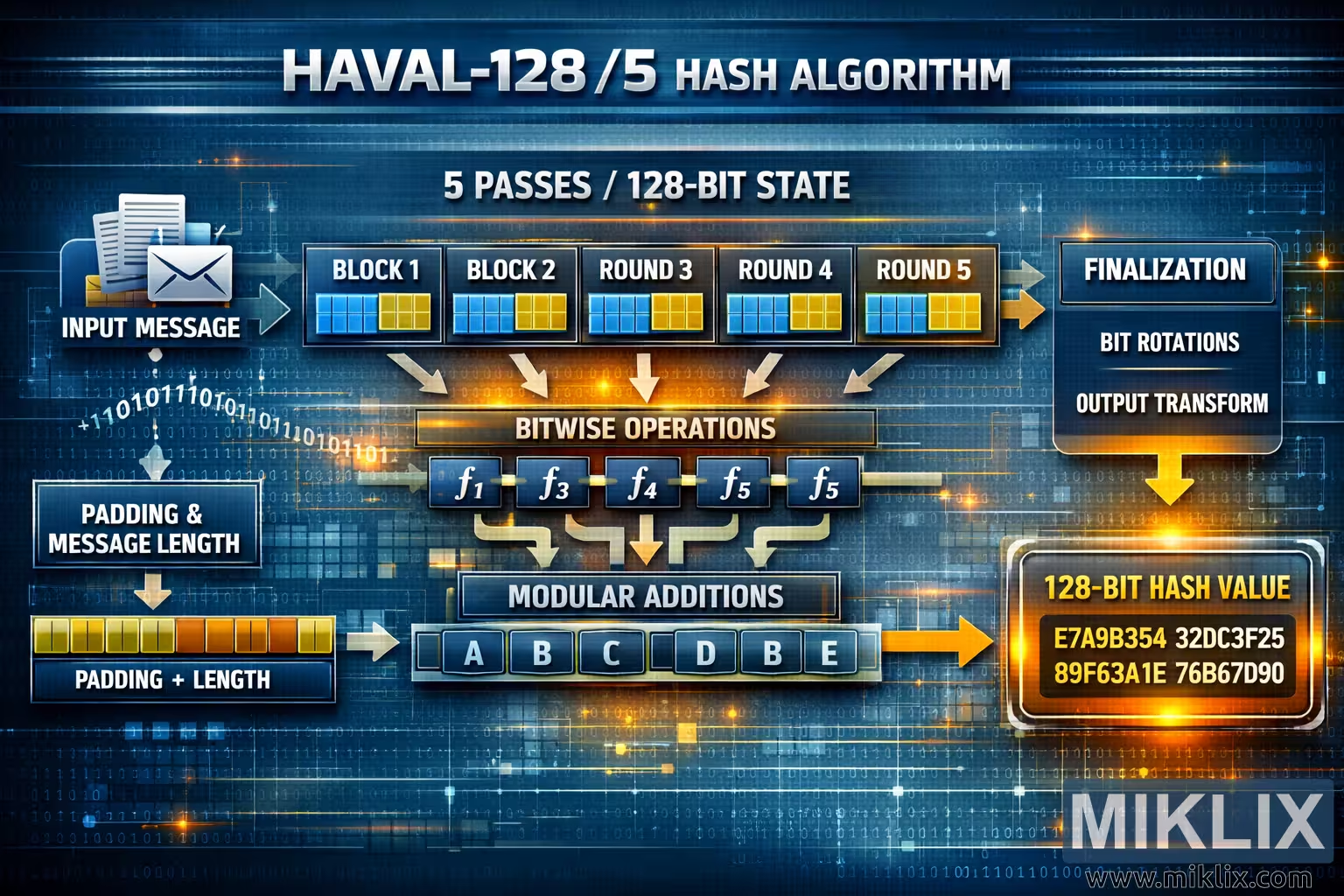
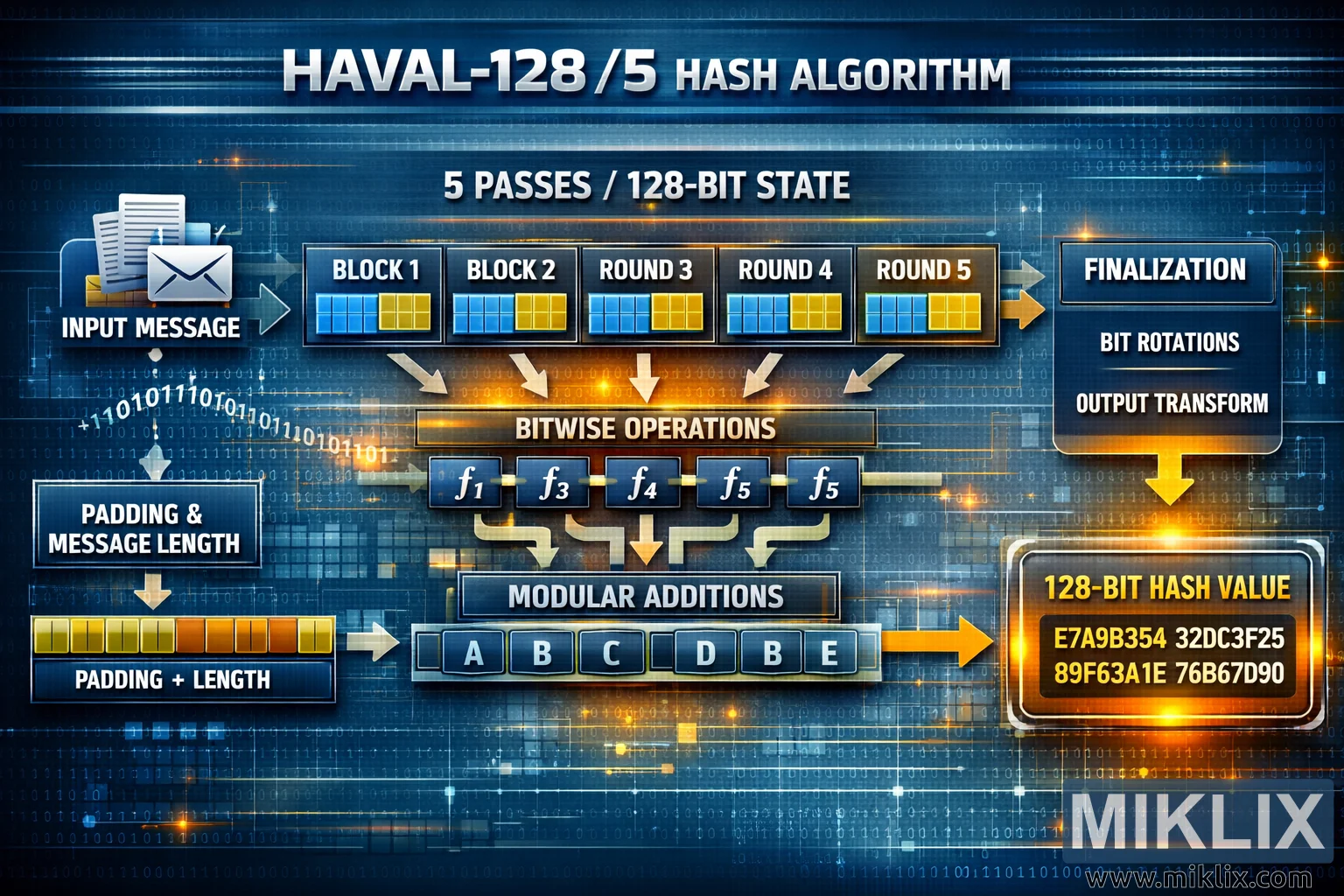
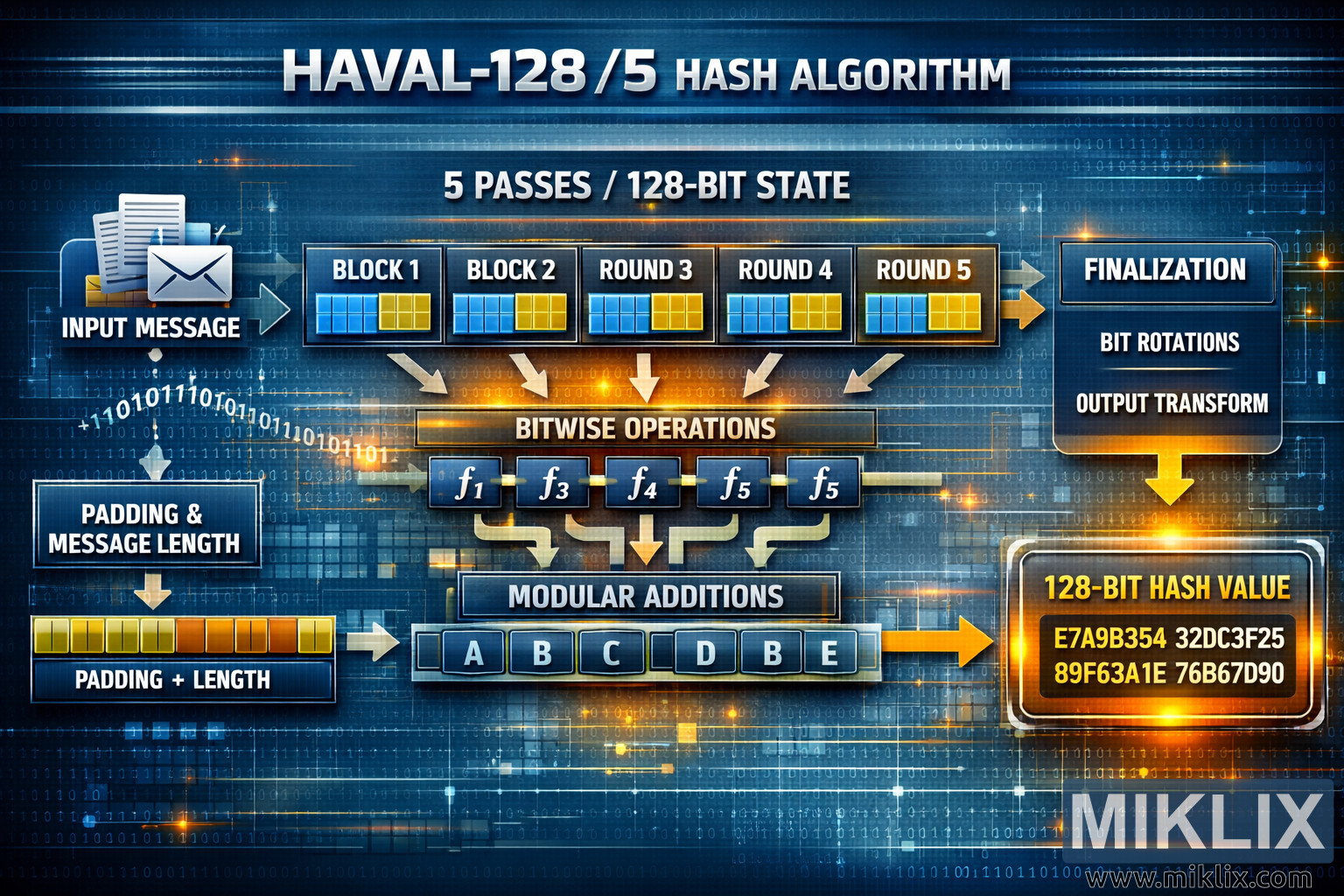
Large size (3,072 x 2,048)
Very large size (4,608 x 3,072)
Extra large size (6,144 x 4,096)
Comically large size (1,048,576 x 699,051)
- Still uploading... ;-)
Image description
The image is a wide, high-resolution, landscape-oriented infographic titled "HAVAL-128/5 Hash Algorithm" displayed across the top in metallic lettering over a deep blue, digital background filled with binary digits, circuit-like traces, and glowing data streams. Beneath the title, a subtitle reads "5 Passes / 128-Bit State," immediately framing the structure of the algorithm. The entire composition is arranged from left to right as a visual pipeline.
On the far left, an "Input Message" panel shows stylized document and envelope icons, symbolizing arbitrary user data entering the hash function. An arrow leads downward to a block labeled "Padding & Message Length," which is illustrated as a segmented bar combining yellow and orange blocks, labeled "Padding + Length," indicating the preprocessing step that appends a 1-bit, zeros, and the original message length to form a complete block stream.
From this preprocessing stage, arrows feed into a horizontal sequence of five rectangular panels across the center of the image. They are labeled "Block 1," "Block 2," "Round 3," "Round 4," and "Round 5," visually representing the five HAVAL passes. Each block is split into blue and gold tiles to imply message words and internal state words being mixed. Above them, the text "5 PASSES / 128-BIT STATE" reinforces that these operations are repeated across five rounds to evolve a 128-bit chaining value.
Downward arrows from each round converge into a glowing band titled "Bitwise Operations." Directly under this band appear five smaller boxes labeled with stylized function names f1, f3, f4, f5, and f5, representing the different nonlinear Boolean functions used in each HAVAL pass. These are drawn as dark blue tiles with white mathematical script, emphasizing that each round uses a distinct mixing function.
The output of these functions flows into another large band labeled "Modular Additions." Beneath it are six small boxes marked A, B, C, D, B, and E, suggesting the multiple internal working registers used by HAVAL as it rotates and adds words modulo 2^32. Bright gold arrows and light flares imply continuous data movement and accumulation.
On the right side of the infographic, a tall panel labeled "Finalization" lists "Bit Rotations" and "Output Transform," summarizing the last stage where the internal state is permuted and compressed. A final downward arrow leads into a glowing, framed box that displays a sample "128-BIT HASH VALUE" in two rows of hexadecimal characters, such as "E7A9B354 32DC3F25 89F63A1E 76B67D90," conveying the fixed-length digest produced regardless of input size.
The overall color scheme alternates between cool blues for data paths and bright gold or orange for active transformations, giving the image a technical, high-energy aesthetic. The background is layered with translucent grids, streams of ones and zeros, and faint circuitry, reinforcing the theme of cryptographic processing and digital security while clearly walking the viewer through the HAVAL-128/5 hashing workflow from message input to final 128-bit output.
The image is related to: HAVAL-128/5 Hash Code Calculator