
Image: HAVAL-160/3 Hash Algorithm — 3-Pass 160-bit Hash Function Visualization
Published: January 9, 2026 at 8:28:16 PM UTC
Last updated: January 9, 2026 at 8:28:28 PM UTC
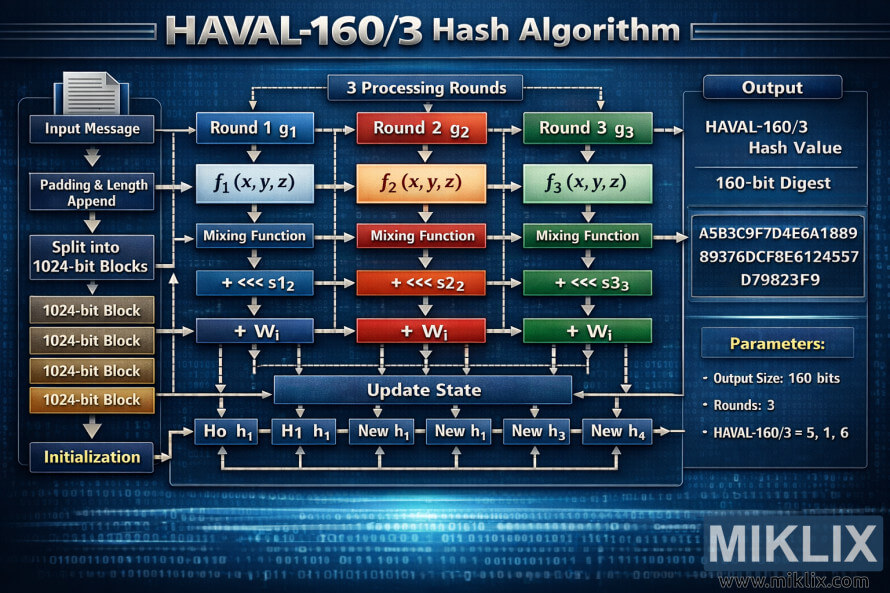
A detailed infographic illustrating the HAVAL-160/3 hash algorithm, including 1024-bit message blocks, padding, initialization, three processing rounds, mixing functions, and 160-bit digest generation.
Available versions of this image
The image files available for download below are less compressed and higher resolution - and as a result of that, higher quality - than the images embedded in articles and pages on this website, which are more optimized for file size in order to reduce bandwidth consumption.
Regular size (1,536 x 1,024)
Large size (3,072 x 2,048)
Very large size (4,608 x 3,072)
Extra large size (6,144 x 4,096)
Comically large size (1,048,576 x 699,051)
- Still uploading... ;-)
Image description
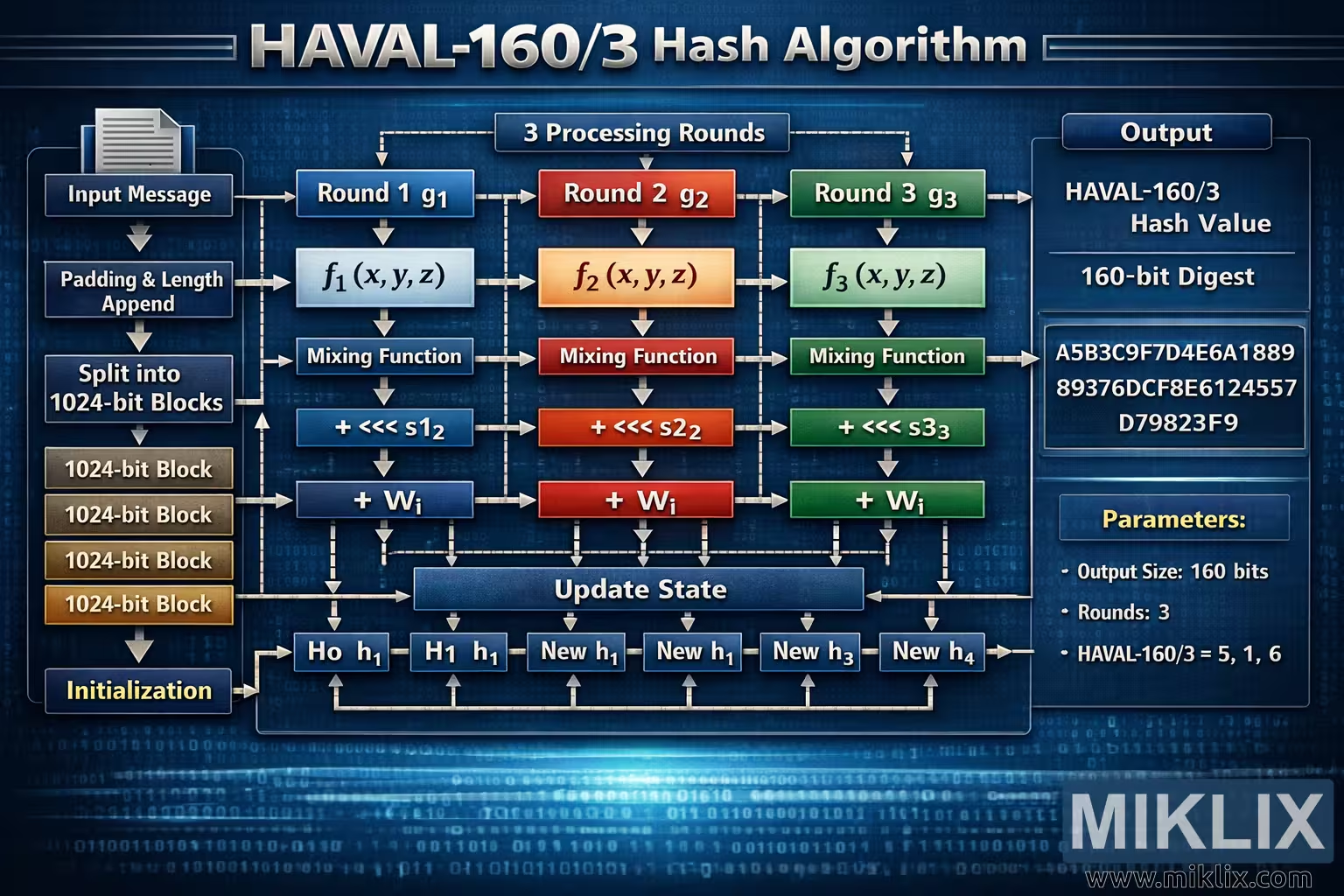
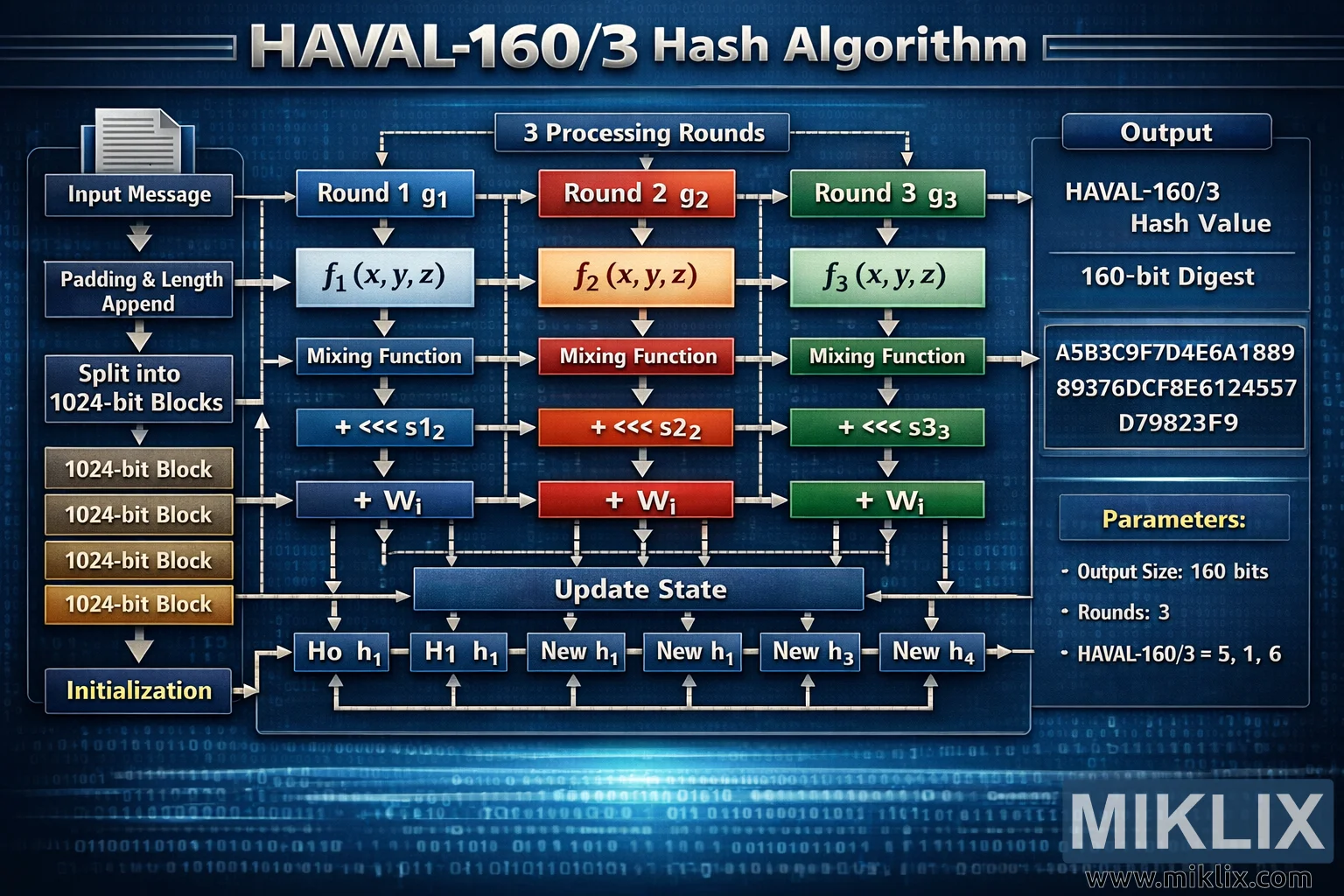
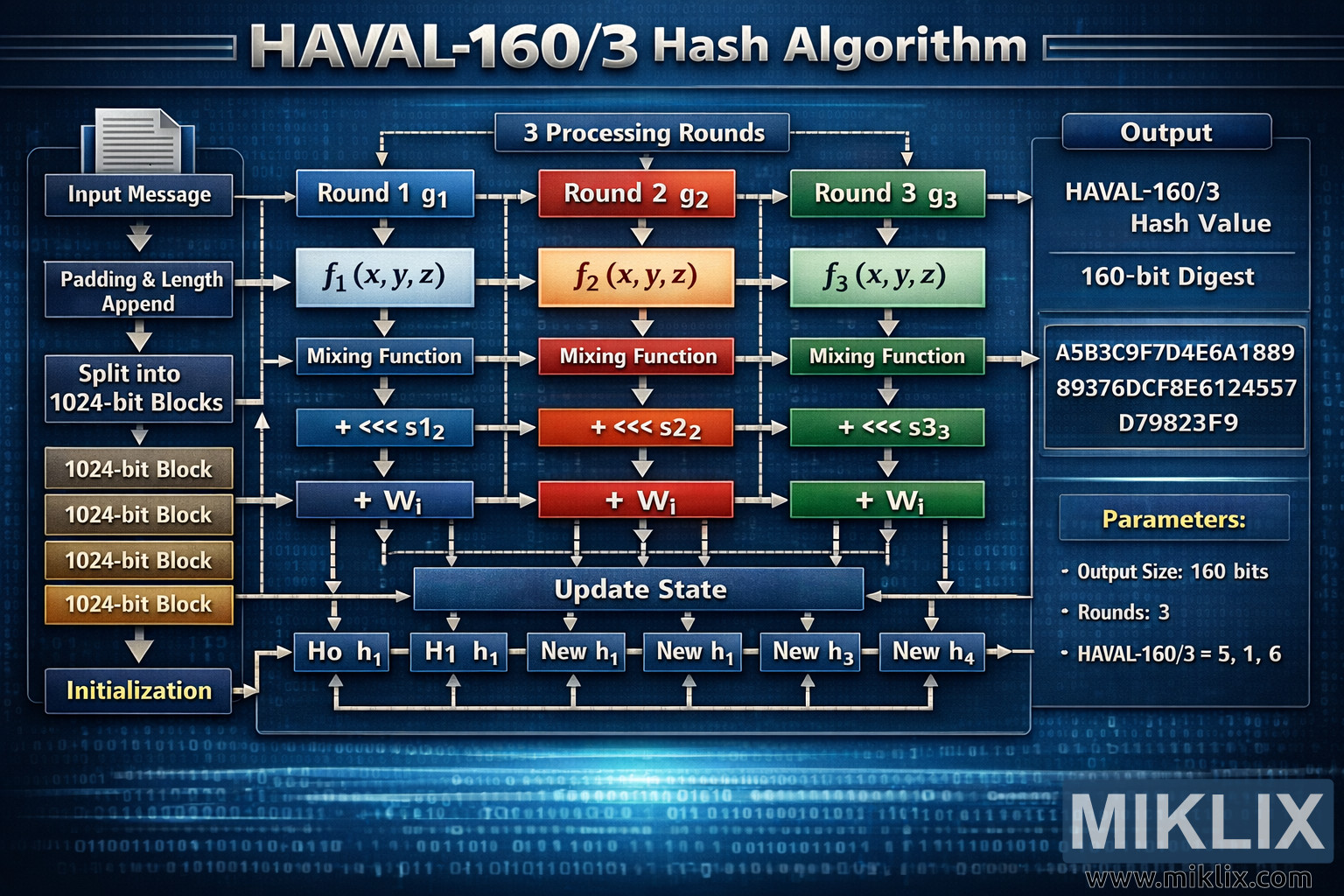
This infographic presents a highly detailed, landscape-oriented visualization of the HAVAL-160/3 hash algorithm, rendered in a blue digital style that evokes the aesthetics of cryptographic and computer science diagrams. The design provides a clear breakdown of the algorithm’s internal structure, emphasizing the three processing rounds and 160-bit output that define this specific variant of the HAVAL family.
The diagram begins on the left with a labeled input pathway titled 'Input Message'. Below this, sequential boxes depict each preprocessing step: 'Padding & Length Append' adds the necessary bits and the message length to prepare the input; next, the message is 'Split into 1024-bit Blocks' — correctly reflecting the HAVAL specification, which operates on 1024-bit (128-byte) data blocks rather than 512-bit ones. Several sample blocks are shown in gradient tones of gold and brown, visually representing the segmented data stream. Beneath these, an 'Initialization' section introduces the starting state of the algorithm, typically defined by predetermined constants that seed the compression function.
At the center, the core of the infographic features a three-column structure labeled '3 Processing Rounds'. Each column corresponds to one of HAVAL’s transformation passes: Round 1 (blue), Round 2 (red), and Round 3 (green). Within each round, the logical transformation functions f1(x,y,z), f2(x,y,z), and f3(x,y,z) are shown, indicating HAVAL’s evolving mixing strategies across passes. These blocks are interconnected by arrows, demonstrating the data flow and dependencies between rounds. Each stage applies a 'Mixing Function' followed by modular additions and left rotations (represented by '+ <<< s1z', '+ <<< s2z', '+ <<< s3z'), along with the addition of message-dependent words (Wi) that feed entropy into the state.
Below the transformation sequence, an 'Update State' bar consolidates the results of the three rounds. This portion symbolizes the iterative accumulation of intermediate hash values, designated as H0, H1, H2, H3, and H4, which evolve after processing each 1024-bit message block. The arrows looping back to the left illustrate the chaining mechanism, where the output of one block becomes the initialization vector for the next.
On the right-hand side, a shaded output panel labeled 'Output' presents the final results of the HAVAL-160/3 computation. It explicitly names the algorithm variant — 'HAVAL-160/3 Hash Value' — and lists a 160-bit digest represented as hexadecimal strings (e.g., A5B3C9F7D4E6A1889...). Below, a parameter summary box confirms key properties: output size of 160 bits, 3 rounds of processing, and configuration constants noted as 'HAVAL-160/3 = 5, 1, 6'. These values correspond to internal function selection and rotation parameters used by the HAVAL algorithm.
Visually, the infographic maintains a consistent blue color theme with metallic gradients and binary numerals subtly embedded in the background, reinforcing the digital and mathematical nature of the content. Each component — from input to output — is enclosed in precise borders and connected by directional arrows that guide the viewer through the logical sequence of transformations. The overall composition is both technical and educational, providing a concise yet complete representation of how HAVAL-160/3 processes data through its padding, block division, state initialization, multi-round transformations, and final hash output.
The image is related to: HAVAL-160/3 Hash Code Calculator