
Image: HAVAL-160/4 Infographic: 4 Passes, 128 Steps
Published: January 9, 2026 at 7:22:11 PM UTC
Last updated: January 9, 2026 at 7:22:46 PM UTC
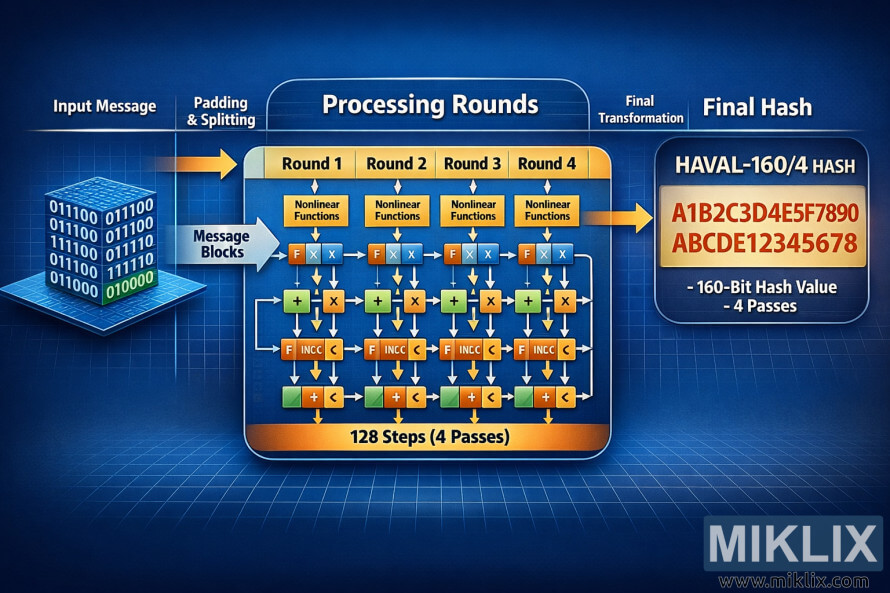
High-resolution landscape visualization of the HAVAL-160/4 hash algorithm, illustrating input preprocessing, four processing passes totaling 128 steps, final transformation, and a 160-bit hash output.
Available versions of this image
The image files available for download below are less compressed and higher resolution - and as a result of that, higher quality - than the images embedded in articles and pages on this website, which are more optimized for file size in order to reduce bandwidth consumption.
Regular size (1,536 x 1,024)
Large size (3,072 x 2,048)
Very large size (4,608 x 3,072)
Extra large size (6,144 x 4,096)
Comically large size (1,048,576 x 699,051)
- Still uploading... ;-)
Image description
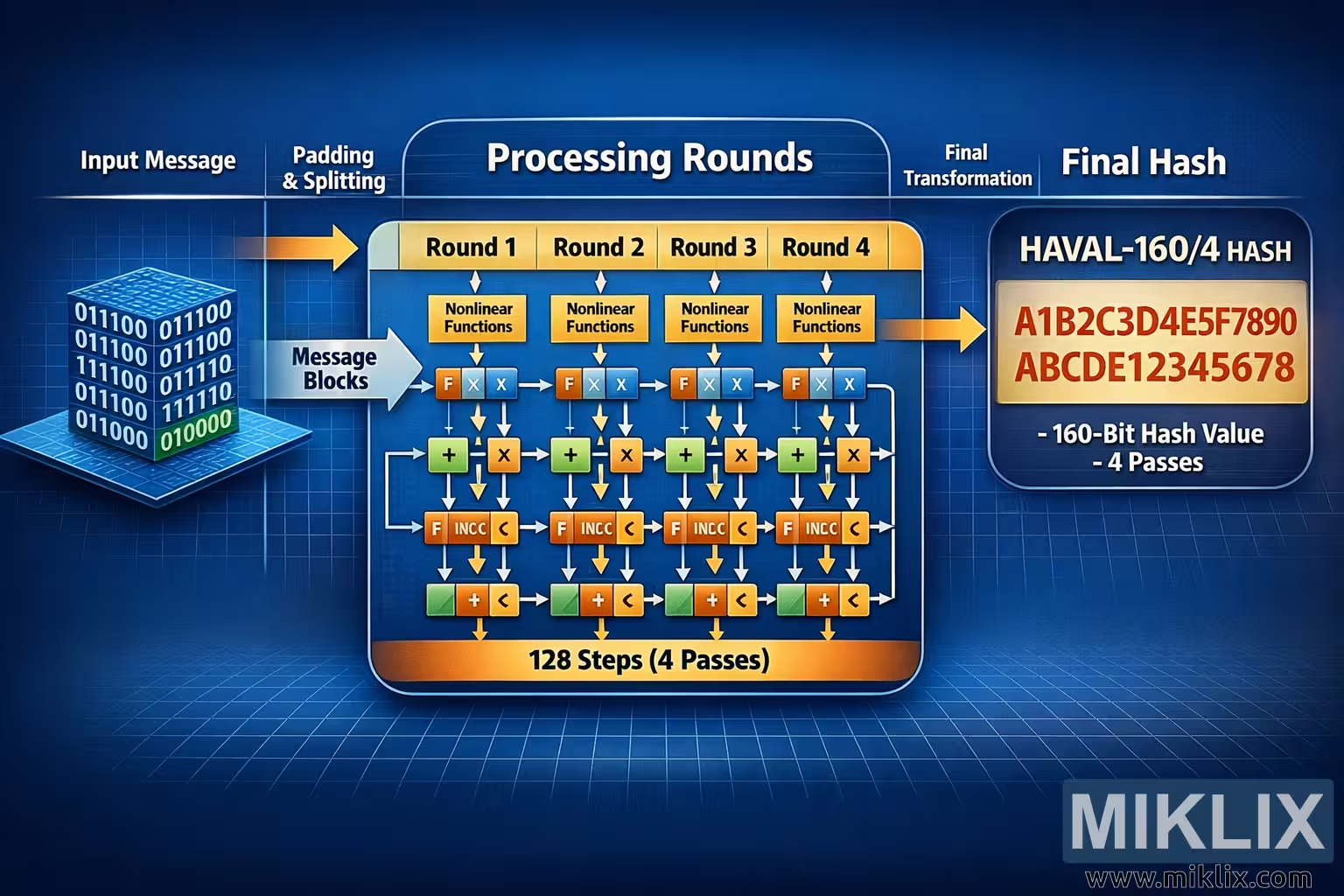
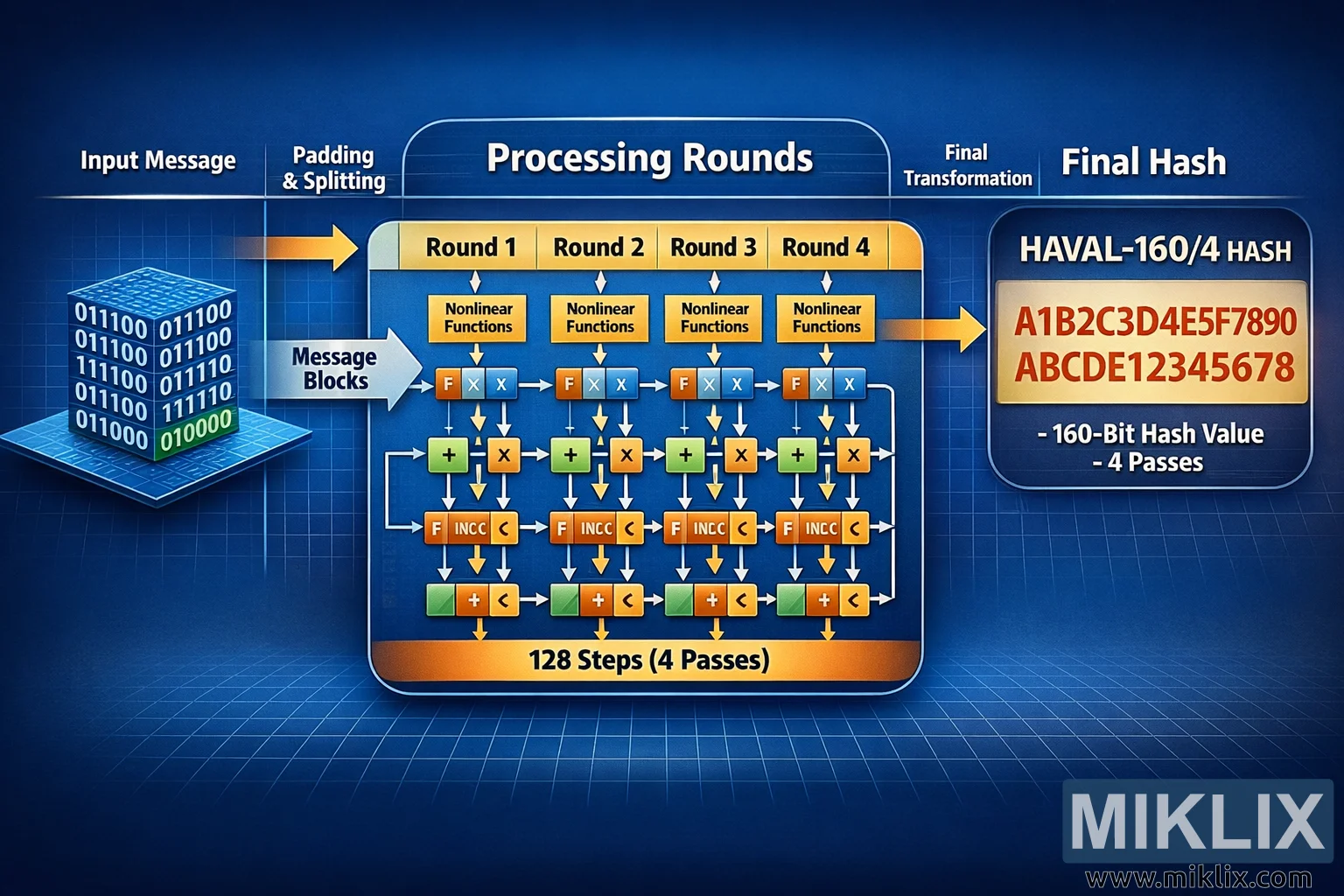
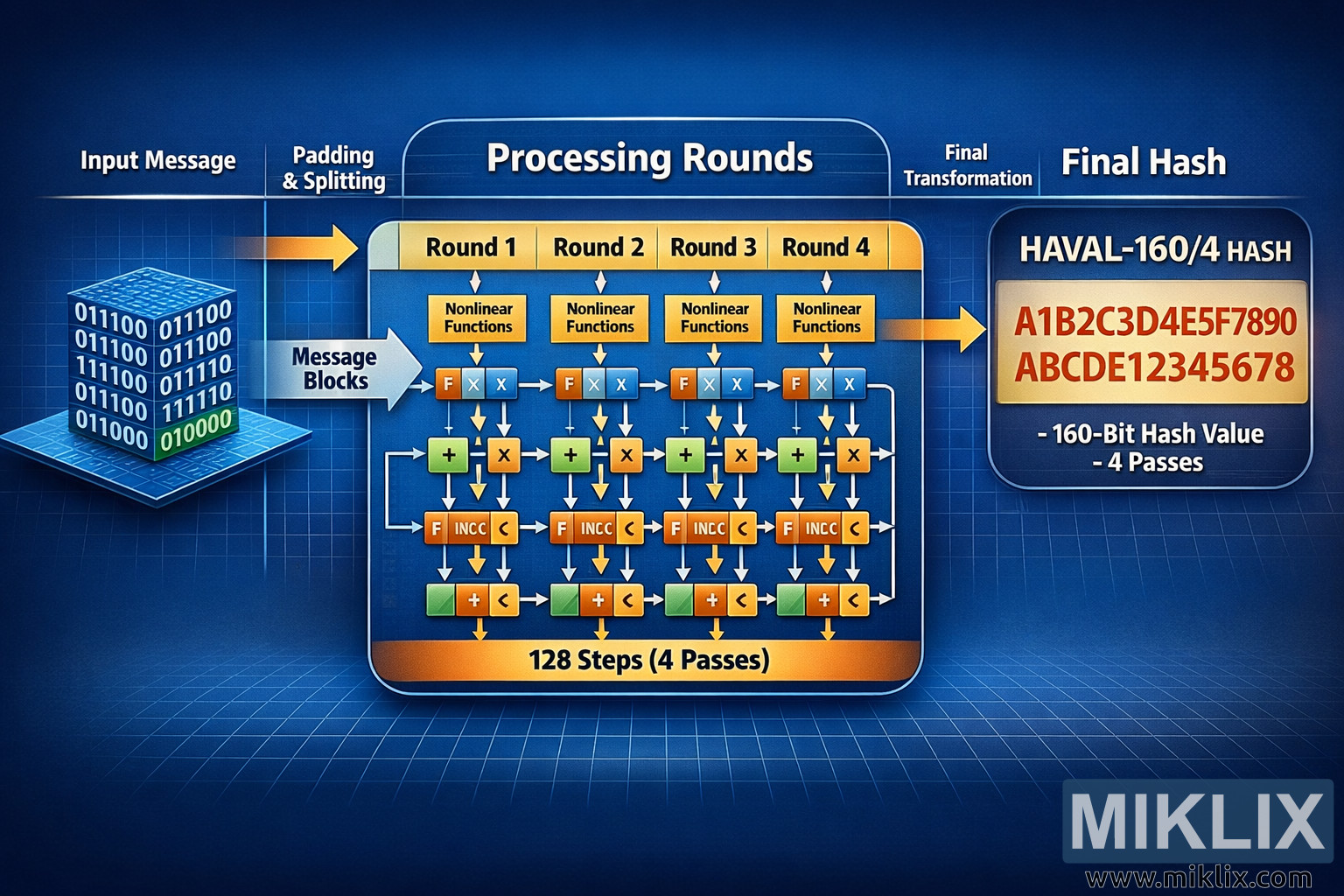
The image is a high-resolution, landscape-oriented infographic that explains the HAVAL-160/4 hash algorithm as a left-to-right processing pipeline. The overall color scheme uses a deep blue gradient background with a subtle grid, giving a technical, computer-science look. Large section headings run along the top, guiding the viewer through the process: “Input Message,” “Padding & Splitting,” “Processing Rounds,” “Final Transformation,” and “Final Hash.”
On the far left, the “Input Message” is depicted as a three-dimensional cube or stack filled with rows of binary digits. The cube sits on a glowing platform, reinforcing the idea of raw digital data. From this block, a prominent orange arrow points to the right toward the “Padding & Splitting” stage, indicating that the message is prepared and divided before hashing. Just to the right of the cube, a label reading “Message Blocks” appears next to a wide, pale arrow pointing into the main processing area, suggesting that the preprocessed message is handled in block form as it enters the compression function.
The central and largest portion of the infographic is framed as a single panel titled “Processing Rounds.” Inside this panel are four vertical columns labeled “Round 1,” “Round 2,” “Round 3,” and “Round 4,” visually representing the four passes of HAVAL-160/4. Beneath each round label, a smaller header box reads “Nonlinear Functions,” indicating that each pass applies a different nonlinear mixing function. Each column contains stacked rows of small, brightly colored blocks and icons connected by arrows. The blocks include symbols like plus signs, angled brackets, and lettered tiles, standing in for common hash operations such as modular addition, bitwise mixing, message word injection, and rotation/shift-like transformations. The arrows show downward progression within each round and also include side connections, implying iterative state updates and internal feedback as the algorithm advances step by step.
At the bottom of the main processing panel, a bold caption reads “128 Steps (4 Passes),” emphasizing the corrected structure for this HAVAL variant: four passes totaling 128 steps of transformation. The visual layout suggests that each pass contributes a repeated sequence of operations, with the chaining state evolving as it moves through the columns.
To the right of the processing panel, an orange arrow labeled “Final Transformation” points to the output section. The “Final Hash” area is a dark blue rounded rectangle labeled “HAVAL-160/4 HASH.” Inside it, two lines of large, orange-red hexadecimal characters are shown as an example digest. Beneath the hex output, smaller text reiterates the key properties: “- 160-Bit Hash Value” and “- 4 Passes,” confirming both the output size and the number of passes used. Overall, the infographic presents HAVAL-160/4 as a clear, staged pipeline: binary input data is padded and split into blocks, processed through four nonlinear passes totaling 128 steps, then transformed into a final 160-bit hash value.
The image is related to: HAVAL-160/4 Hash Code Calculator