
Image: HAVAL-160/5 Hash Algorithm – Five-Pass Cryptographic Flow Diagram
Published: January 7, 2026 at 10:14:21 PM UTC
Last updated: January 7, 2026 at 10:14:47 PM UTC
Detailed visual overview of the HAVAL-160/5 cryptographic hash function, illustrating message preprocessing, five transformation passes, round functions, and the final 160-bit digest.
Available versions of this image
The image files available for download below are less compressed and higher resolution - and as a result of that, higher quality - than the images embedded in articles and pages on this website, which are more optimized for file size in order to reduce bandwidth consumption.
Regular size (1,536 x 1,024)

Large size (3,072 x 2,048)
Very large size (4,608 x 3,072)
Extra large size (6,144 x 4,096)
Comically large size (1,048,576 x 699,051)
- Still uploading... ;-)
Image description
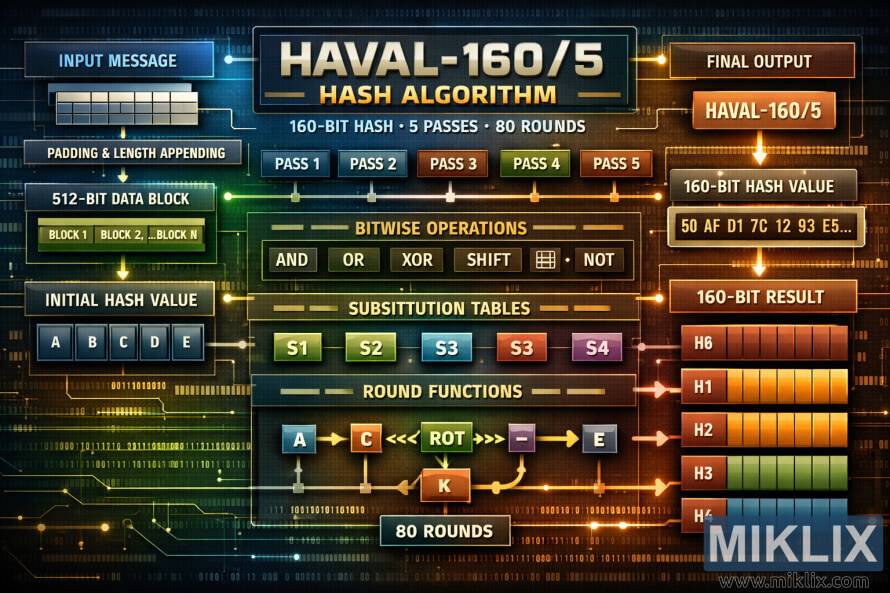
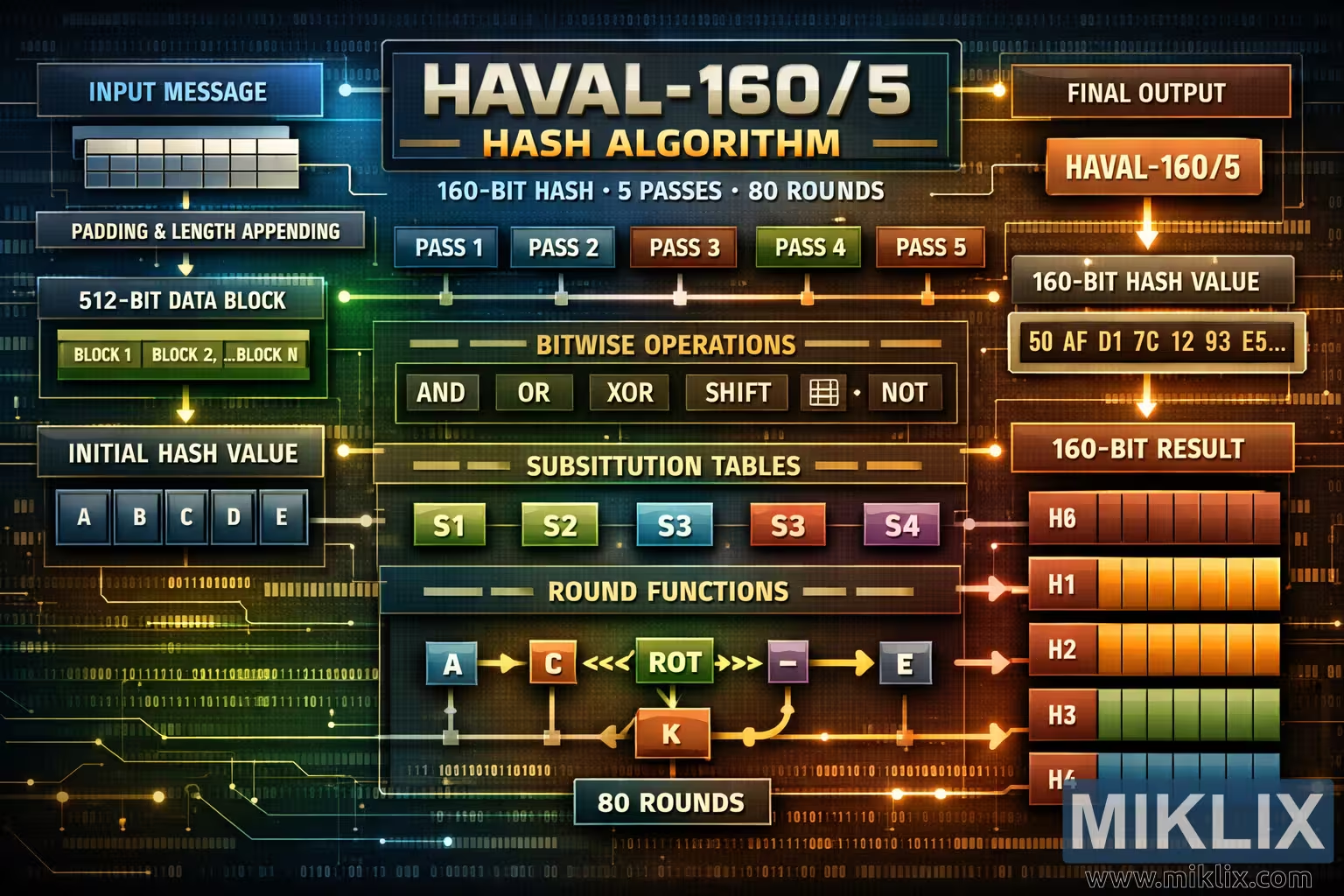
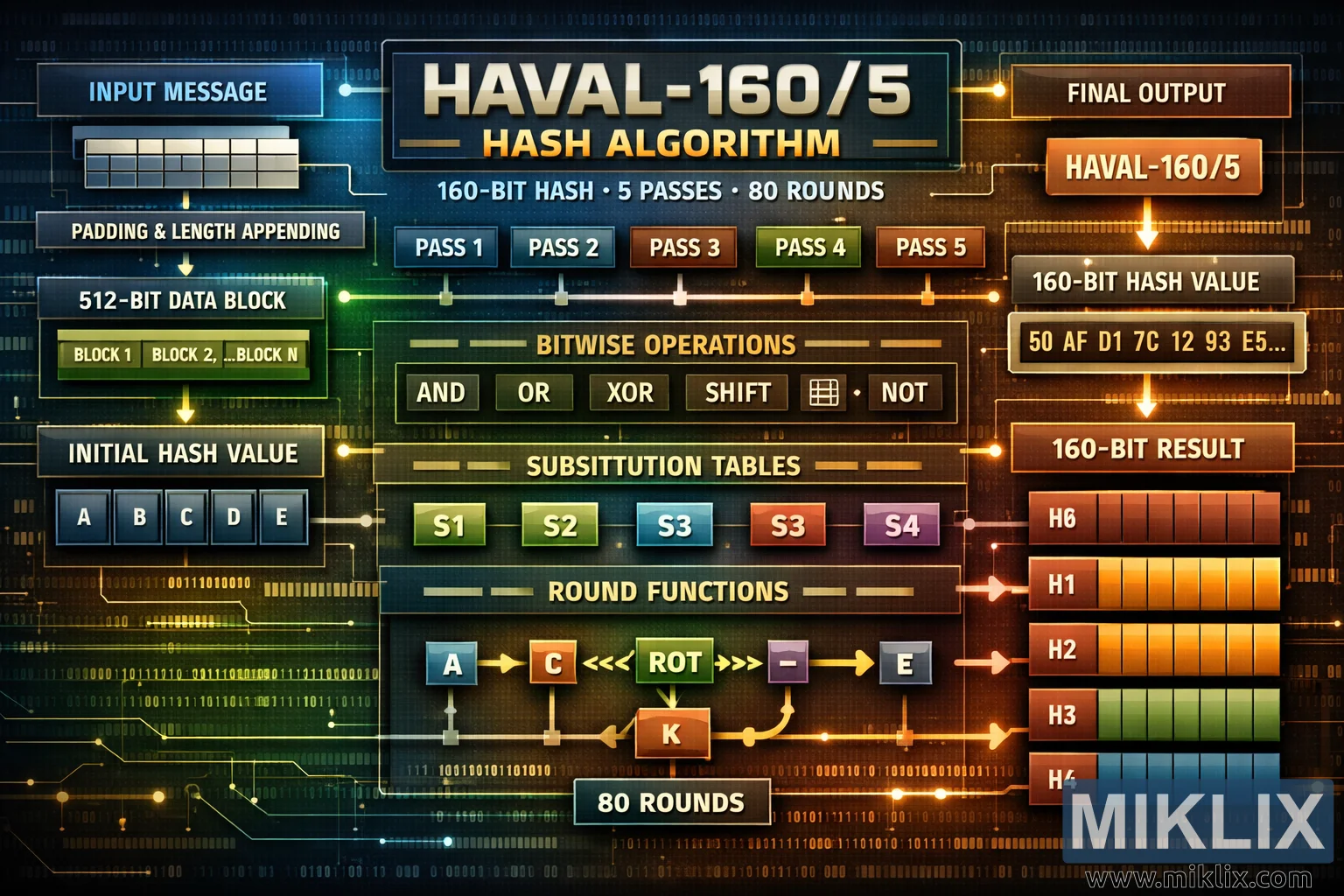
The image is a wide, high-resolution digital infographic that visualizes the internal workflow of the HAVAL-160/5 cryptographic hash algorithm. At the top center, a bold metallic title reads "HAVAL-160/5 HASH ALGORITHM" with a subtitle stating "160-BIT HASH • 5 PASSES • 80 ROUNDS." The overall color scheme transitions from cool blues on the left to warm amber and orange tones on the right, symbolizing data flow from input to final output, with a subtle background of binary digits and circuit-like traces.
On the far left, a section labeled "INPUT MESSAGE" shows a row of rectangular message cells. Below it, a box titled "PADDING & LENGTH APPENDING" indicates the preprocessing step. An arrow leads down to a large green-framed panel labeled "512-BIT DATA BLOCK," which is subdivided into "BLOCK 1," "BLOCK 2," and "BLOCK N," illustrating how the padded message is segmented for processing.
Further down, a box marked "INITIAL HASH VALUE" contains five small registers labeled A, B, C, D, and E, representing the working state words. These feed into the central pipeline, where five colored tabs labeled "PASS 1," "PASS 2," "PASS 3," "PASS 4," and "PASS 5" are arranged horizontally, emphasizing HAVAL’s multi-pass structure.
In the center of the graphic, a prominent panel titled "BITWISE OPERATIONS" lists the fundamental logical functions used by the algorithm: AND, OR, XOR, SHIFT, and NOT, each represented with stylized icons. Beneath it, another panel labeled "SUBSTITUTION TABLES" displays boxes named S1, S2, S3, S3 (duplicated stylistically), and S4, highlighting the non-linear transformations applied during each round.
Below these, the "ROUND FUNCTIONS" area depicts the flow of variables through arrows and operation nodes. Blocks labeled A and C feed into a rotation element marked "ROT," then into a subtraction or mixing node and onward to E, with an additional constant block labeled K injected into the path. At the bottom center, a dark badge reading "80 ROUNDS" summarizes the total number of iterations performed across the five passes.
On the right side, a section titled "FINAL OUTPUT" contains a box labeled "HAVAL-160/5" pointing to "160-BIT HASH VALUE." A sample hexadecimal digest beginning with "50 AF D1 7C 12 93 E5…" is shown to illustrate the result format. Below, five horizontal bars labeled H0, H1, H2, H3, and H4 are stacked, each in a different warm gradient color, representing the five 32-bit words that together form the final 160-bit hash.
Overall, the infographic combines clean typography, color-coded stages, arrows, and modular panels to guide the viewer step-by-step through the HAVAL-160/5 hashing process, from raw input message through preprocessing, multi-pass transformation, logical operations, and finally to the compact cryptographic digest.
The image is related to: HAVAL-160/5 Hash Code Calculator