
Image: HAVAL-192/3 Hash Algorithm – Three-Pass Flow Diagram
Published: January 9, 2026 at 7:59:00 PM UTC
Last updated: January 9, 2026 at 8:01:37 PM UTC
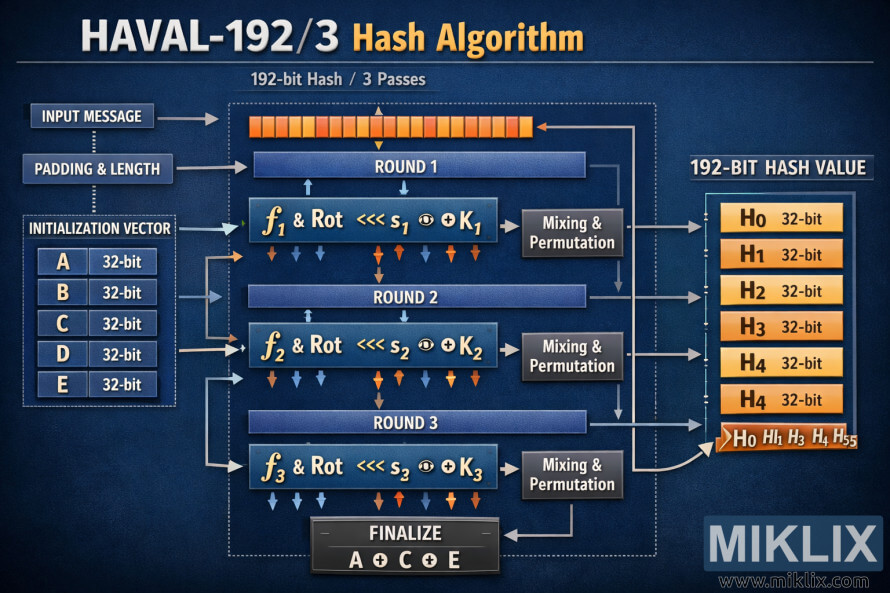
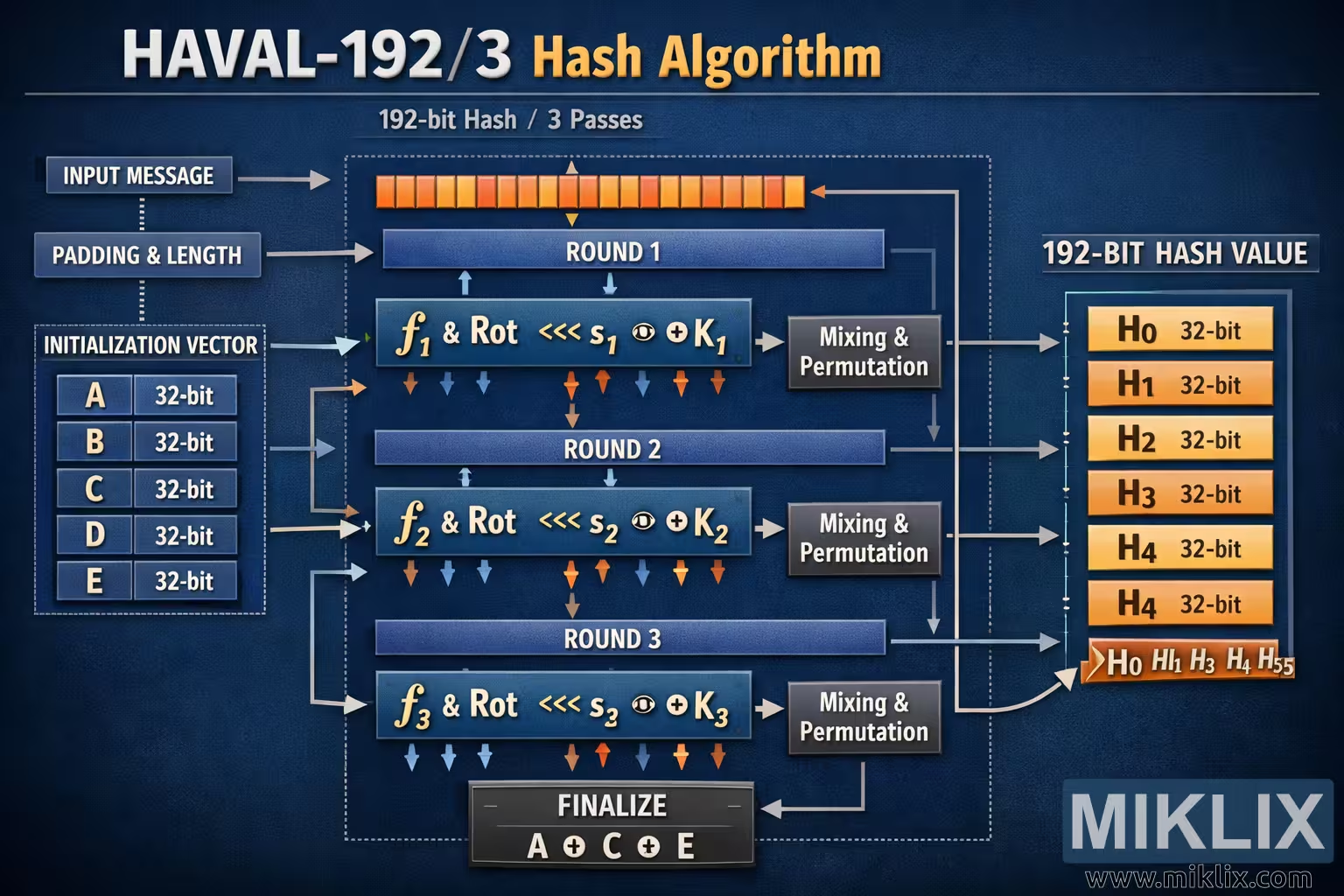
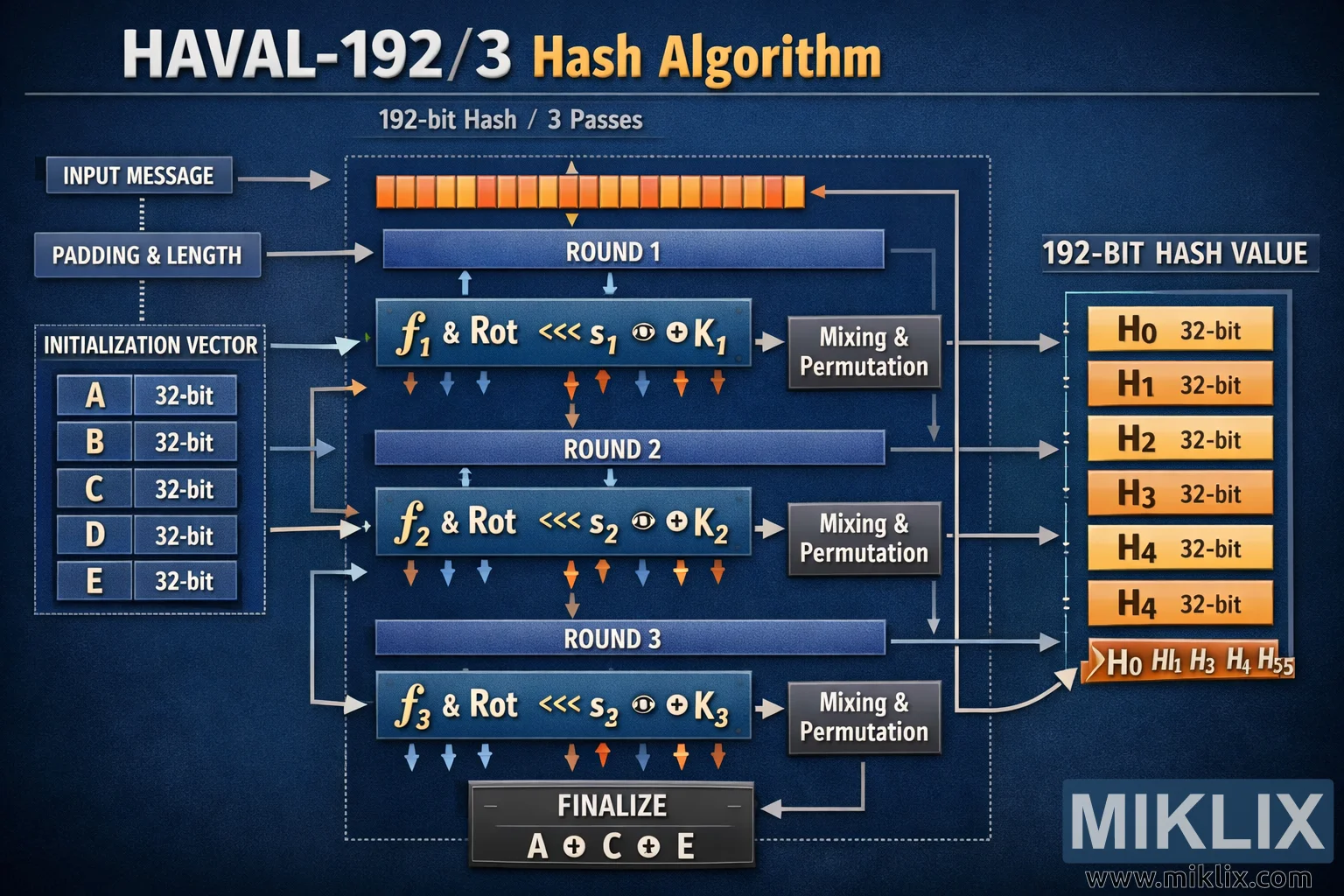
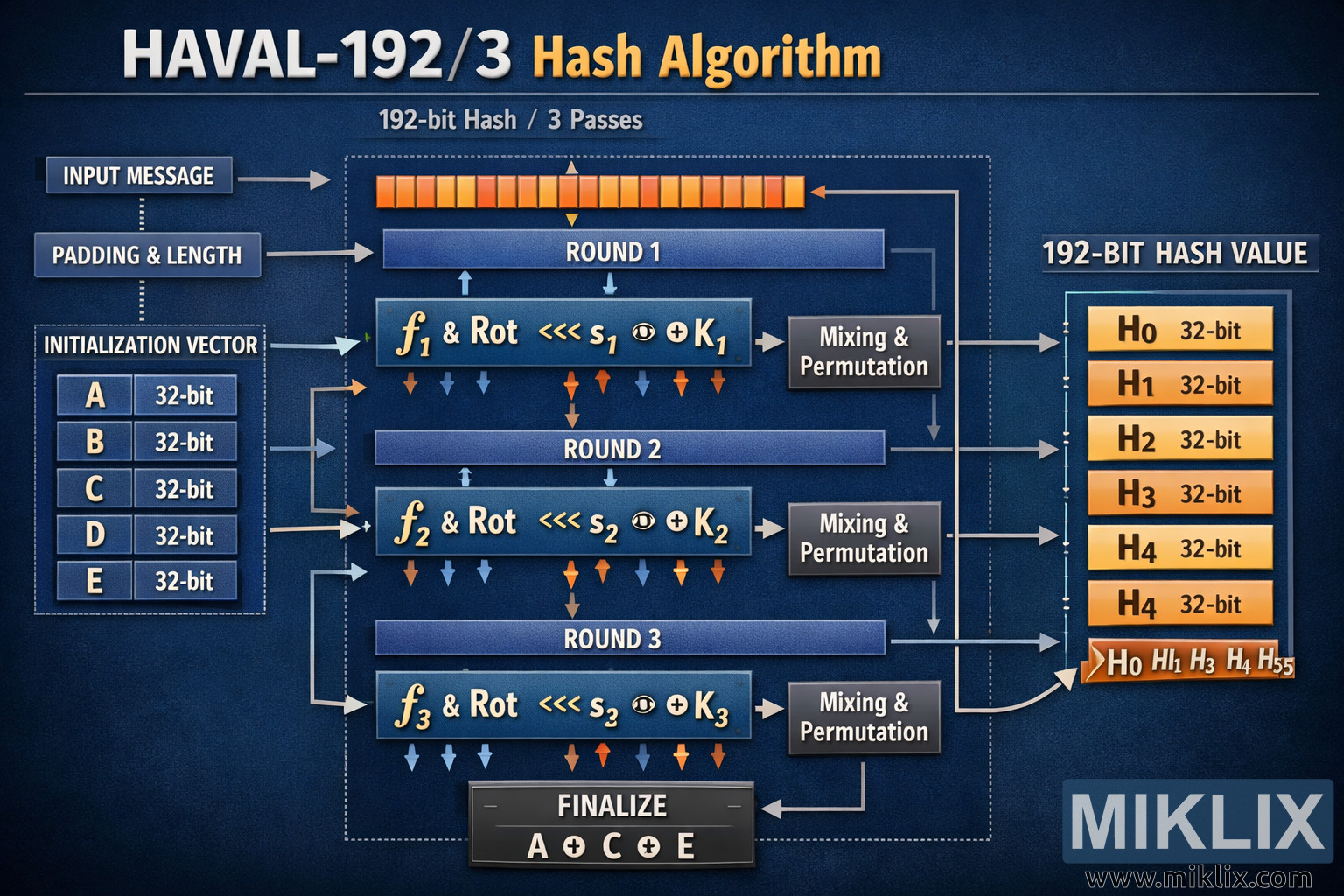
Technical infographic visualizing the HAVAL-192/3 hash algorithm: input and padding, initialization words A–E, three processing rounds with mixing/permutation, and a 192-bit digest output.
Available versions of this image
The image files available for download below are less compressed and higher resolution - and as a result of that, higher quality - than the images embedded in articles and pages on this website, which are more optimized for file size in order to reduce bandwidth consumption.
Regular size (1,536 x 1,024)
Large size (3,072 x 2,048)
Very large size (4,608 x 3,072)
Extra large size (6,144 x 4,096)
Comically large size (1,048,576 x 699,051)
- Still uploading... ;-)
Image description
Landscape infographic titled "HAVAL-192/3 Hash Algorithm" on a textured deep-blue background with a soft vignette. A bold white "HAVAL-192/3" headline spans the upper left, while "Hash Algorithm" appears on the upper right in warm golden yellow; a thin horizontal line runs beneath the title. Centered below is the subtitle "192-bit Hash / 3 Passes." The diagram is organized as a left-to-right dataflow. On the far left, two beveled dark-slate boxes read "INPUT MESSAGE" and "PADDING & LENGTH," each feeding arrows into the main processing region. Below them is a dashed-outline panel titled "INITIALIZATION VECTOR" that contains five stacked blue tiles labeled A, B, C, D, and E; each tile is annotated "32-bit" to the right. Arrows from the message steps and the initialization panel converge into a large, dashed rectangular enclosure in the center that represents the core HAVAL computation. At the top edge of this enclosure sits a row of small orange blocks, suggesting a segmented message schedule or word stream, with a bidirectional arrow motif above it. Inside the enclosure are three wide horizontal bands labeled "ROUND 1," "ROUND 2," and "ROUND 3" (each styled as a long blue bar with metallic highlights). Under each round label is a prominent formula-like block showing the round function and rotations: the first reads "f1 & Rot <<< s1 ⊕ + K1," the second "f2 & Rot <<< s2 ⊕ + K2," and the third "f3 & Rot <<< s3 ⊕ + K3." Small downward arrows in alternating cool blue and warm orange sit beneath these formula blocks, hinting at mixing operations applied to multiple internal words. To the right of each formula block is a smaller dark box labeled "Mixing & Permutation," connected by thick arrows, emphasizing that every pass includes rearrangement and diffusion. Multiple curved and vertical arrows run between the rounds and along the right border of the enclosure, visually indicating feedback between steps and the chaining nature of the compression process. At the bottom of the central enclosure is a heavy dark plaque labeled "FINALIZE" with the expression "A ⊕ C ⊕ E" beneath it, implying a final combining step before producing the digest. On the far right, a separate panel titled "192-BIT HASH VALUE" is framed by a thin outline and connected to the three rounds by three parallel arrows. Inside that panel are stacked orange gradient rectangles labeled H0, H1, H2, H3, and H4, each marked "32-bit"; one additional rectangle repeats the label "H4" rather than introducing a new index, reflecting the graphic’s stylized (and slightly redundant) depiction of the output words. Along the bottom of the output panel is a small orange ribbon with tiny text showing a concatenation-like sequence of H-terms, reinforcing that the final result is assembled from multiple 32-bit pieces. Overall, the color scheme contrasts cool blues for structure with bright orange accents for data words and outputs, and the visual style uses drop shadows, beveled edges, and clear arrows to communicate the three-pass HAVAL-192/3 hashing flow. The composition is clean, technical, and diagram-first.
The image is related to: HAVAL-192/3 Hash Code Calculator