
Image: HAVAL-224/3 Hash Algorithm Flow Diagram
Published: January 9, 2026 at 7:50:59 PM UTC
Last updated: January 9, 2026 at 7:51:21 PM UTC
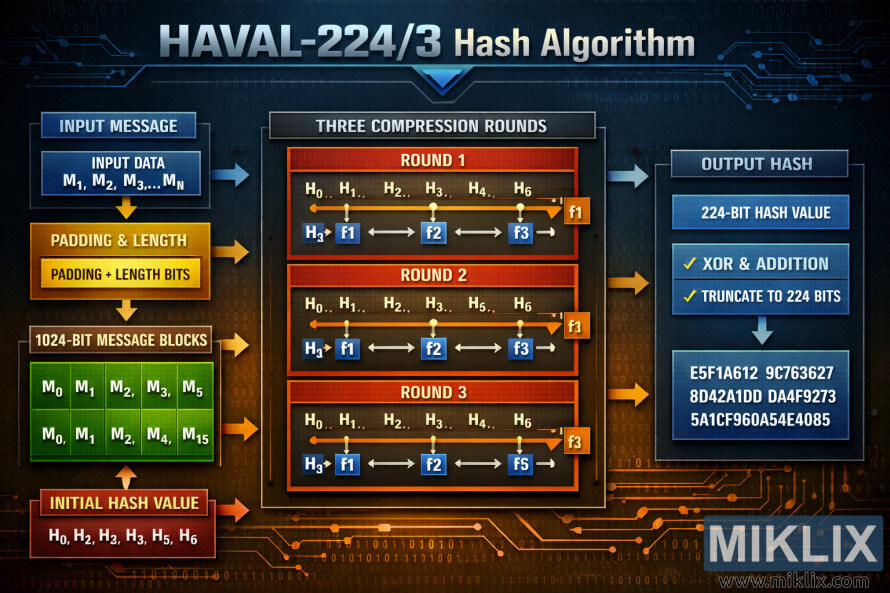
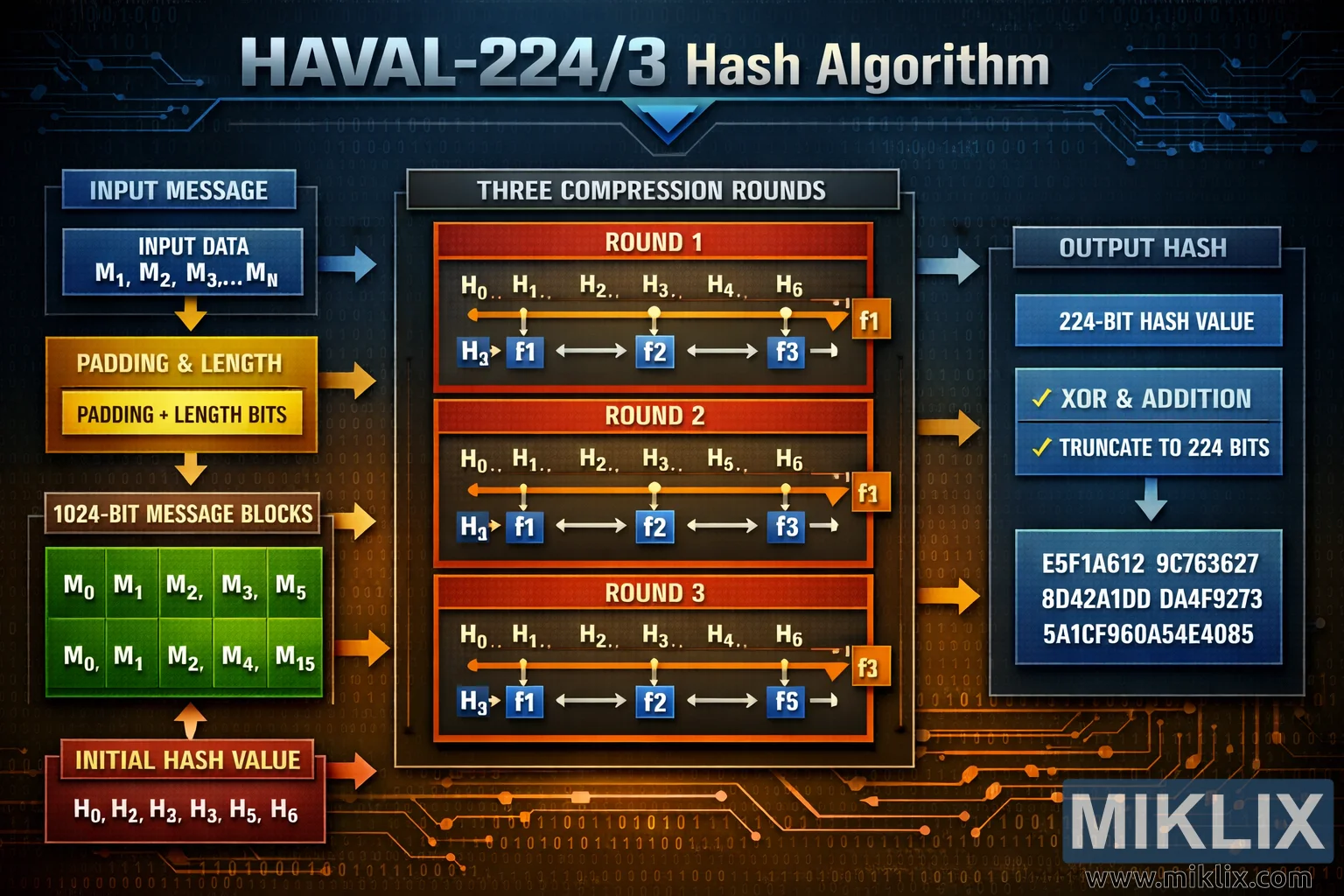
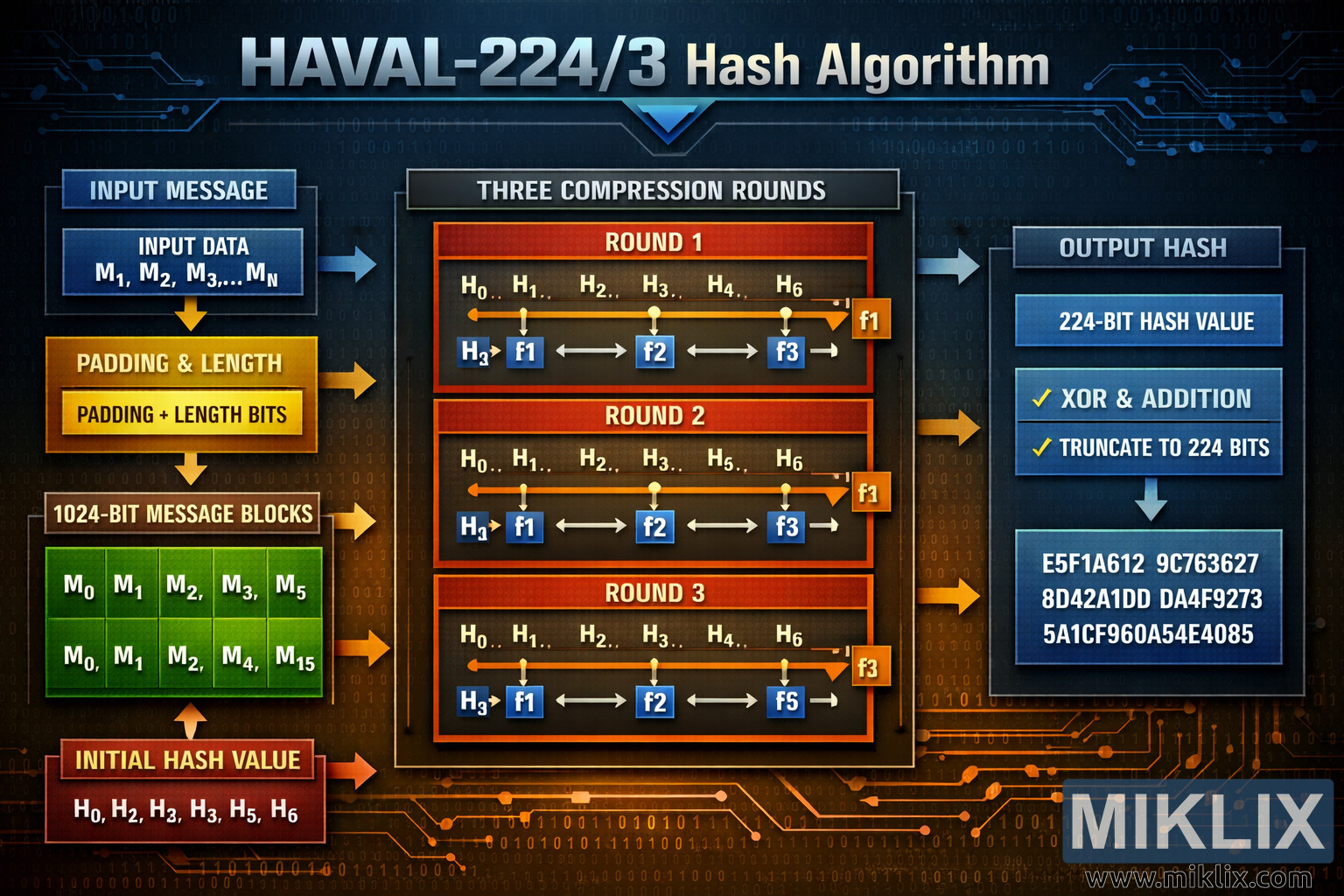
High-level visualization of the HAVAL-224/3 hash algorithm, depicting input preprocessing, 1024-bit blocks, initialization, three compression rounds, and generation of a 224-bit digest.
Available versions of this image
The image files available for download below are less compressed and higher resolution - and as a result of that, higher quality - than the images embedded in articles and pages on this website, which are more optimized for file size in order to reduce bandwidth consumption.
Regular size (1,536 x 1,024)

Large size (3,072 x 2,048)
Very large size (4,608 x 3,072)
Extra large size (6,144 x 4,096)
Comically large size (1,048,576 x 699,051)
- Still uploading... ;-)
Image description
A wide, landscape-oriented infographic titled "HAVAL-224/3 Hash Algorithm" spans the top of the image in large metallic lettering. The background is a dark, tech-themed field combining faint binary digits and circuit-trace motifs, with cool blue tones on the upper half blending into warmer amber tones near the bottom. The diagram is organized as a left-to-right process flow using rectangular panels connected by thick arrows.
On the far left is a blue panel labeled "INPUT MESSAGE". Inside it, a smaller box reads "INPUT DATA" followed by symbolic message chunks written as M1, M2, M3, …, MN. A downward arrow leads to a gold panel labeled "PADDING & LENGTH" with the subtext "PADDING + LENGTH BITS", emphasizing preprocessing before block processing.
Below that, another arrow points to a green section labeled "1024-BIT MESSAGE BLOCKS". This panel contains a grid of smaller green tiles representing words or message sub-blocks, each tile labeled with M-indices (for example M0, M1, M2, M3, and higher indices such as M15). The block panel implies the message is partitioned into fixed-size 1024-bit blocks composed of multiple indexed words.
At the bottom-left, a red panel labeled "INITIAL HASH VALUE" shows an initial state vector with multiple H-variables (e.g., H0, H1, H2, etc.), suggesting a multi-word chaining state typical of iterative hash functions. A right-pointing arrow from this initialization area feeds into the central component.
The center of the infographic is dominated by a large, dark panel titled "THREE COMPRESSION ROUNDS". Inside it are three stacked horizontal sections labeled "ROUND 1", "ROUND 2", and "ROUND 3" in bold orange headers. Each round depicts a row of hash-state registers across the top (shown as H0, H1, H2, H3, H4, and H6-like labels), and beneath them a sequence of colored function blocks labeled f1, f2, and f3 (and in the lowest round an additional function label appears, such as f5). White bidirectional arrows and small vertical connectors indicate data movement and mixing between the state registers and these round functions. At the far right of each round row is a small orange tag-like block (e.g., f1 or f3) marking the round’s function emphasis.
From the central compression panel, a large arrow leads to the rightmost blue panel labeled "OUTPUT HASH". Inside, a prominent box reads "224-BIT HASH VALUE". Beneath it are two checklist-style lines with check marks, reading "XOR & ADDITION" and "TRUNCATE TO 224 BITS", summarizing the final combination and output sizing. At the bottom of the output panel is a dark blue box containing an example digest rendered as grouped hexadecimal characters across multiple lines. Overall, the composition communicates an end-to-end HAVAL-224/3 hashing workflow: message input, padding, block formation, initialization, three compression rounds, and final production of a 224-bit hash.
The image is related to: HAVAL-224/3 Hash Code Calculator