
Image: HAVAL-224/4 Hash Algorithm Visualization
Published: January 7, 2026 at 10:37:10 PM UTC
Last updated: January 7, 2026 at 10:40:30 PM UTC
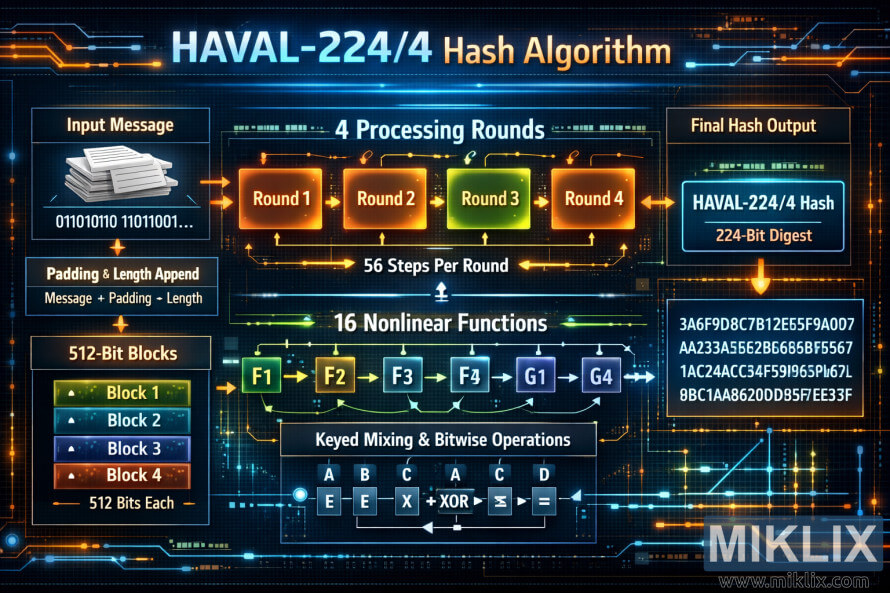
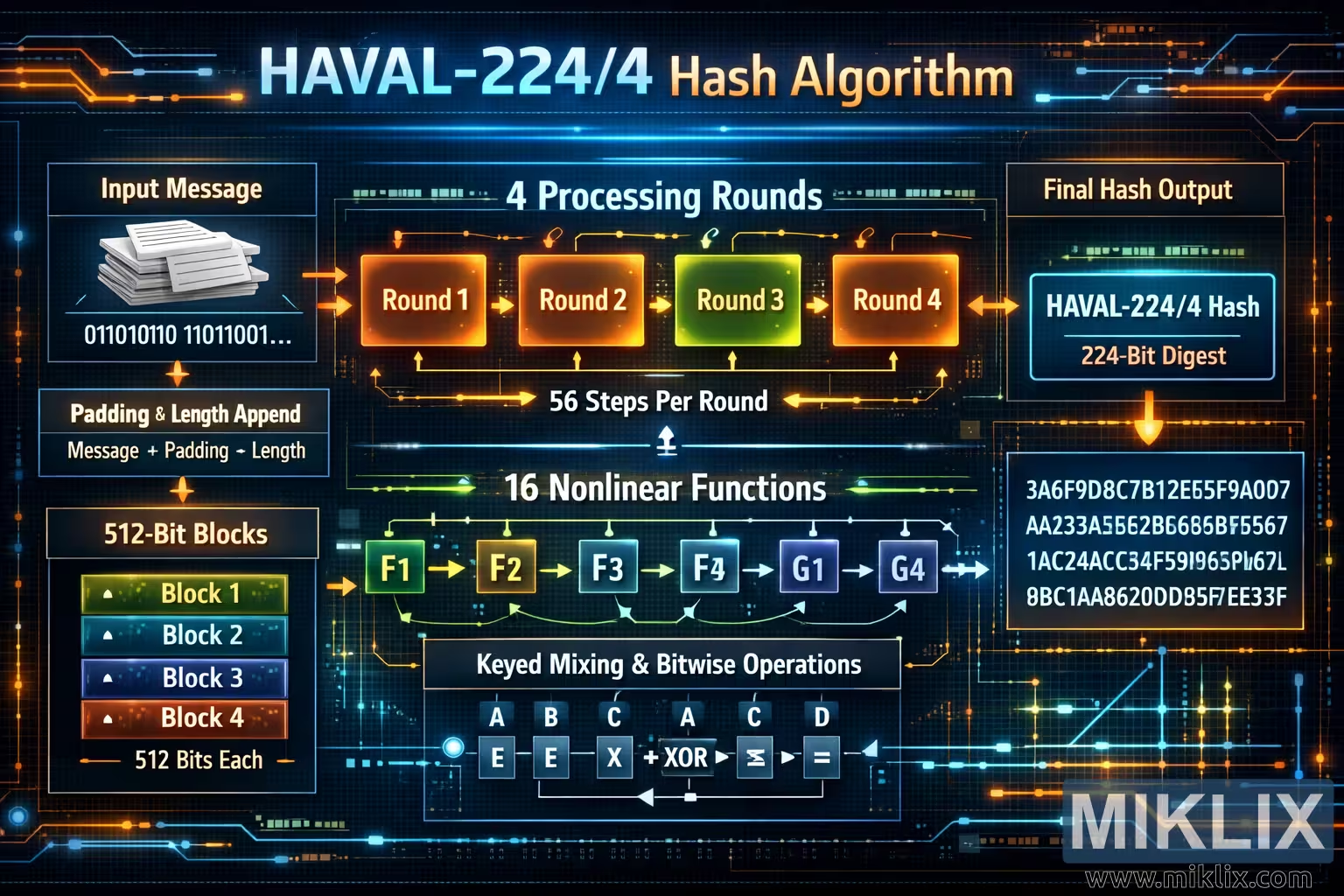
Landscape infographic of the HAVAL-224/4 hash algorithm showing message padding, 512-bit blocks, four processing rounds with 56 steps each, and the 224-bit digest.
Available versions of this image
The image files available for download below are less compressed and higher resolution - and as a result of that, higher quality - than the images embedded in articles and pages on this website, which are more optimized for file size in order to reduce bandwidth consumption.
Regular size (1,536 x 1,024)
Large size (3,072 x 2,048)
Very large size (4,608 x 3,072)
Extra large size (6,144 x 4,096)
Comically large size (1,048,576 x 699,051)
- Still uploading... ;-)
Image description
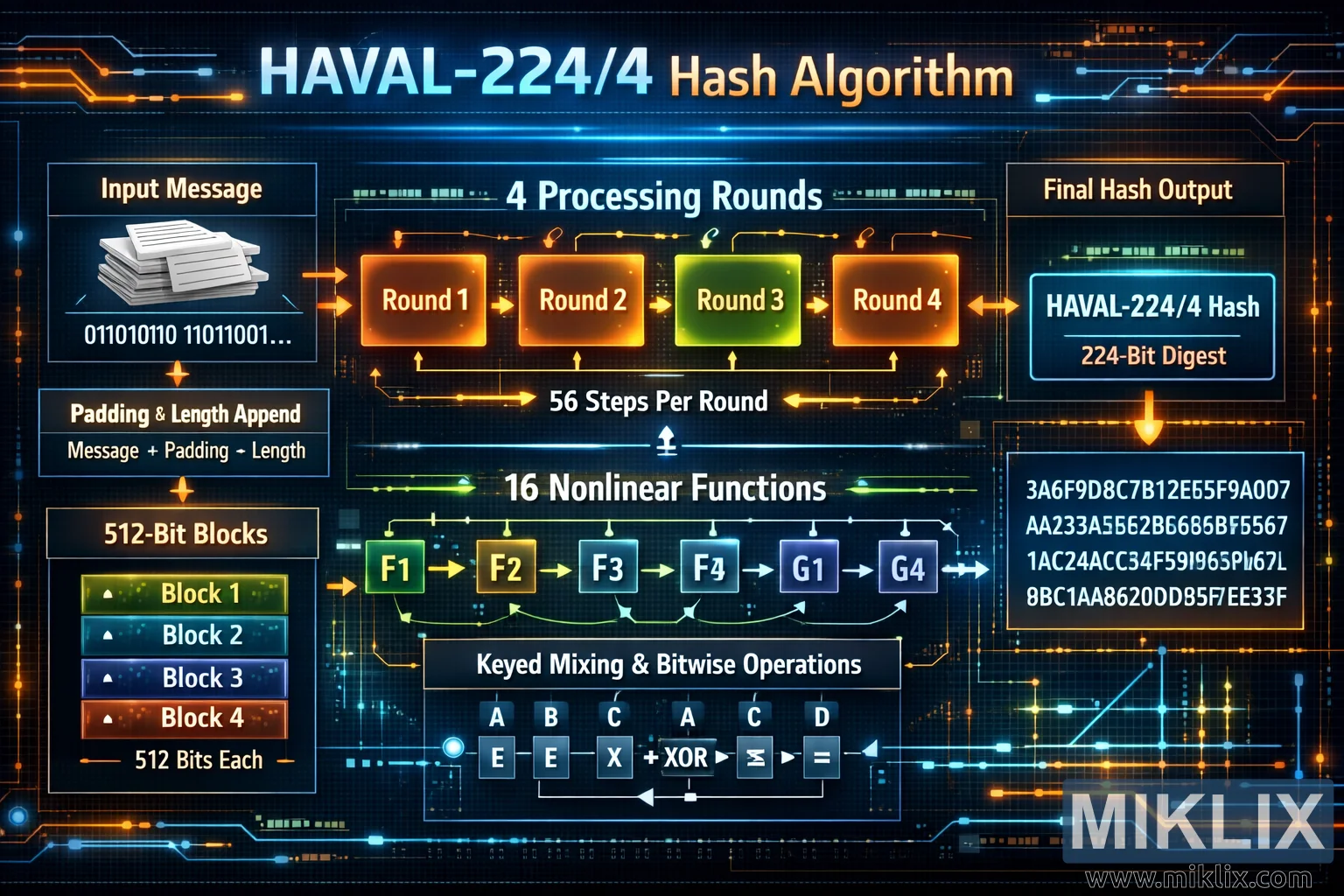
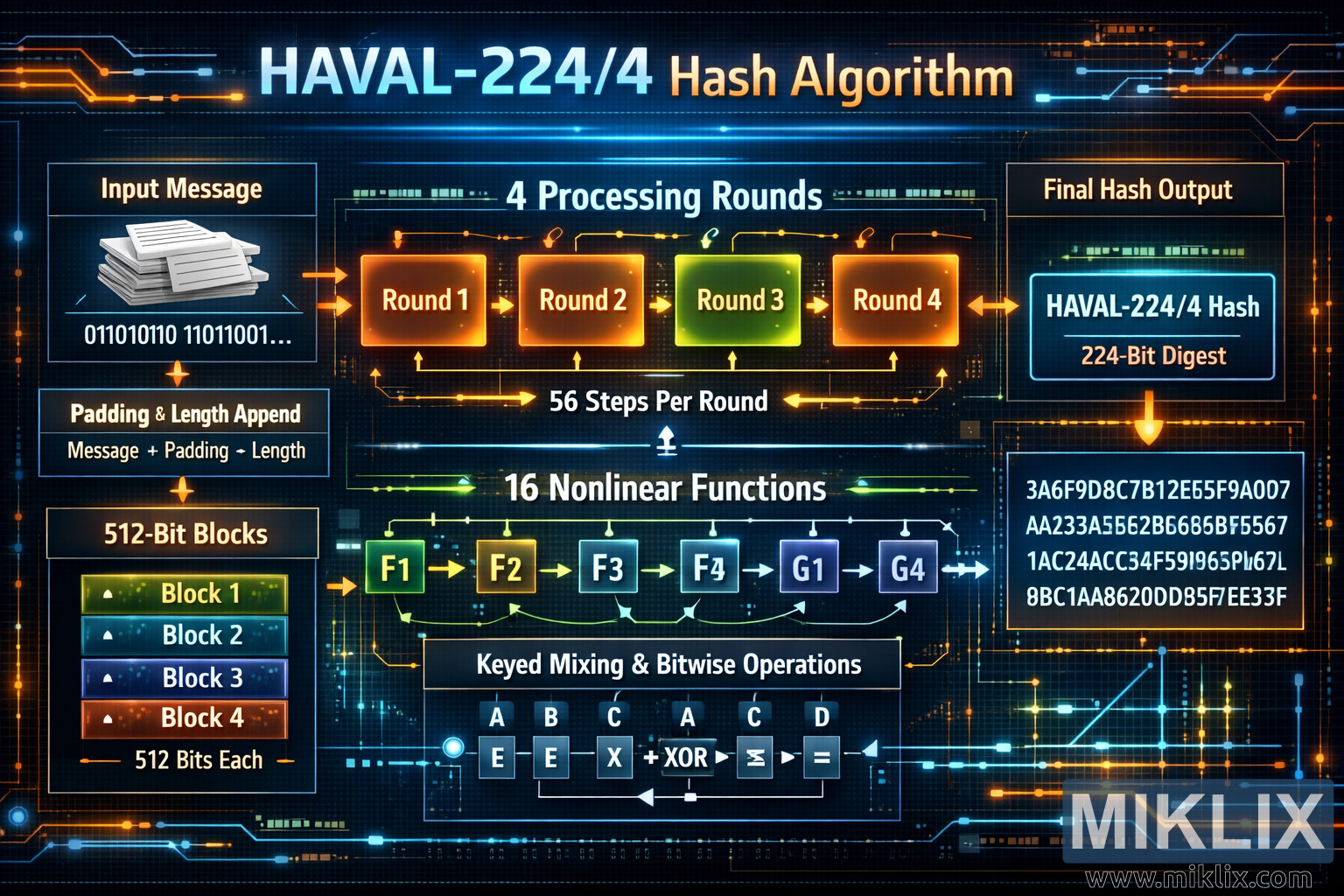
A wide, futuristic infographic explains the HAVAL-224/4 hash algorithm on a dark, gridded circuit-board background. Neon traces in cyan/teal and amber run along the borders like PCB routes, with tiny dots, tick marks, and faint binary patterns adding a tech ambience. Most panels have beveled frames and soft glows, giving the whole graphic a "HUD dashboard" feel. Centered at the top, a large headline reads "HAVAL-224/4 Hash Algorithm," with "HAVAL-224/4" in icy blue and "Hash Algorithm" in warm orange.
The diagram is organized to read left-to-right. On the upper left, a framed panel titled "Input Message" shows a stylized stack of white paper sheets above a short binary snippet ("011010110 11011001..."). A thick orange arrow points downward to "Padding & Length Append," which includes the line "Message + Padding -> Length." Another arrow leads to "512-Bit Blocks," containing four stacked, color-coded bars labeled "Block 1" through "Block 4" (green, teal, blue, and orange hues), plus the caption "512 Bits Each."
The center highlights the compression process. A title "4 Processing Rounds" sits above four glowing tiles laid out horizontally: "Round 1," "Round 2," "Round 3," and "Round 4." The first, second, and fourth tiles glow orange, while "Round 3" glows green. Circuit-like connectors and arrows run between the tiles, and a long indicator beneath them states "56 Steps Per Round," with thin lines branching downward as if tapping intermediate signals.
Below that, a large heading announces "16 Nonlinear Functions." A row of smaller glossy boxes shows function labels "F1," "F2," "F3," "F4," then "G1" and "G4," all linked by arrows to indicate the sequence. Curved luminous guide lines loop underneath, with small junction dots suggesting multiple paths feeding into later functions, reinforcing the idea of nonlinear mixing.
At the bottom center, a wide panel titled "Keyed Mixing & Bitwise Operations" summarizes the low-level work. Inside, small square tokens labeled with letters (A, B, C, D, E) resemble register blocks arranged in two rows. Between them are logic and math symbols, including a prominent "+ XOR" label, as well as extra icons (Σ and equals signs) that imply repeated additions, substitutions, and bitwise transformations.
On the right, the pipeline ends in a tall framed section titled "Final Hash Output." A glowing cyan box reads "HAVAL-224/4 Hash," with "224-Bit Digest" beneath it. An orange arrow drops into a dark rectangle that displays several lines of example digest text in bright cyan—long, grouped strings that look like hexadecimal output. Small glowing specks and horizontal scan lines decorate this output area, as if the digest were being emitted from a terminal. Overall, the design uses directional arrows, glowing frames, and circuitry motifs to communicate a clear flow: input message -> padding/length append -> 512-bit blocks -> four processing rounds (56 steps each) -> nonlinear functions and bitwise mixing -> final 224-bit hash digest.
The image is related to: HAVAL-224/4 Hash Code Calculator