
Image: HAVAL-256/4 Hash Algorithm – Visual Workflow
Published: January 7, 2026 at 10:31:59 PM UTC
Last updated: January 7, 2026 at 10:32:30 PM UTC
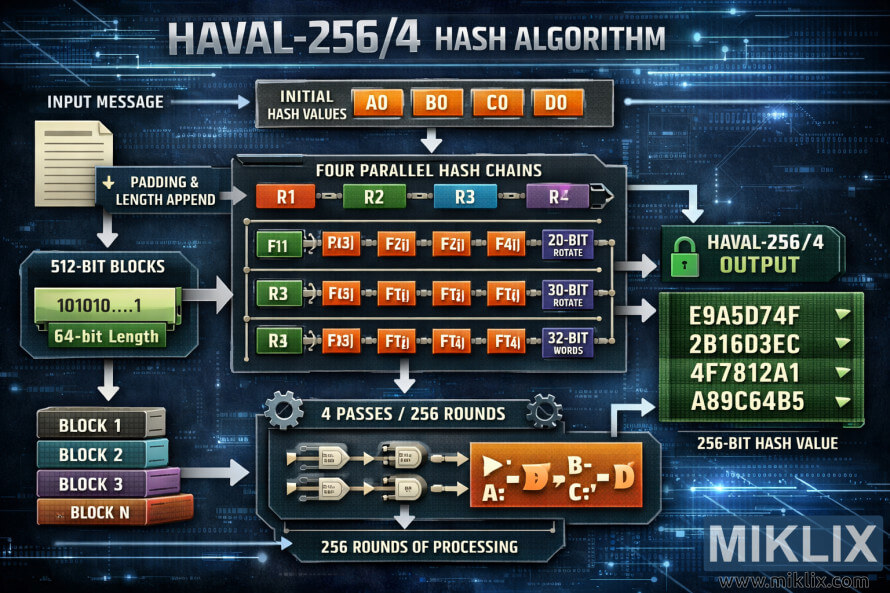
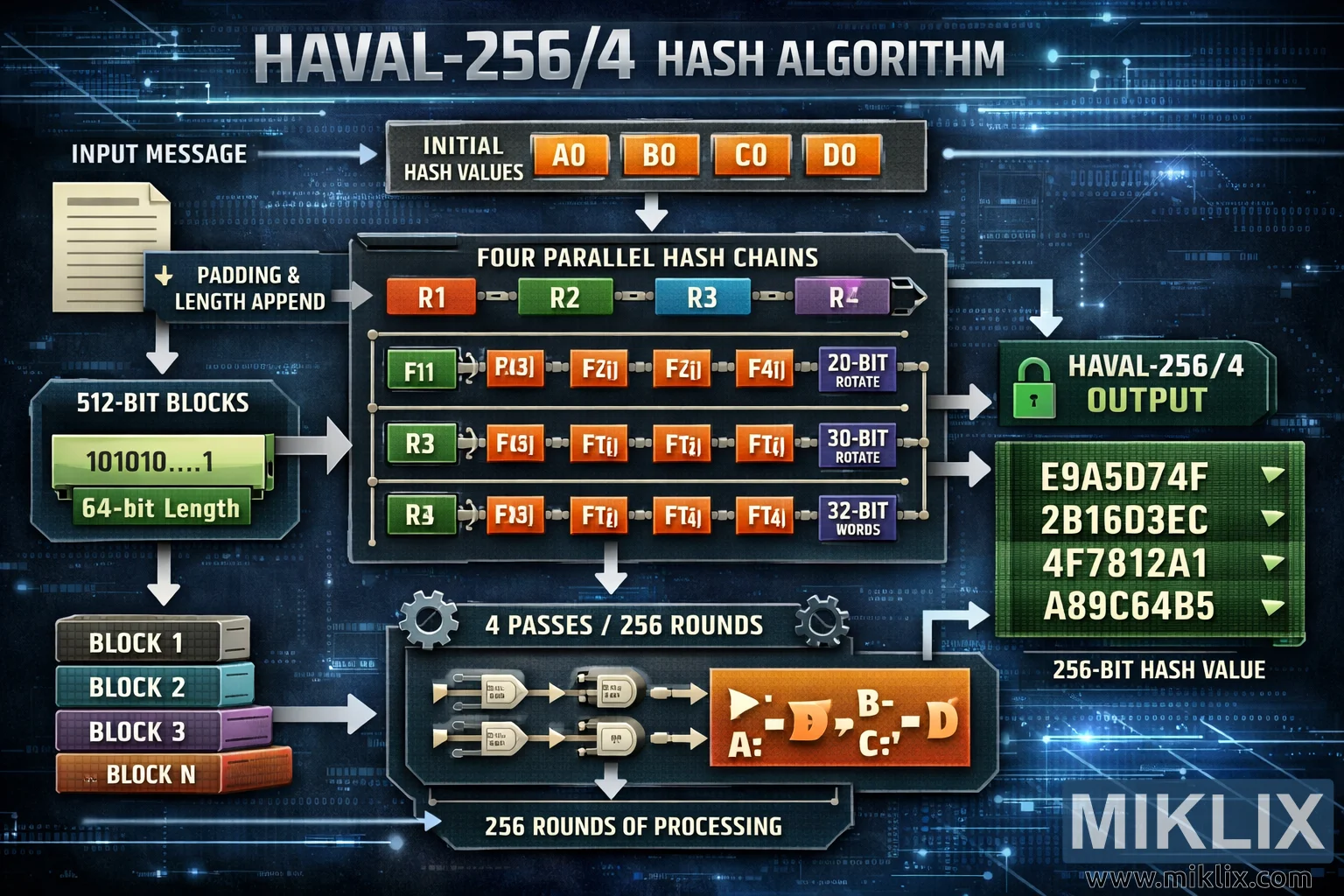
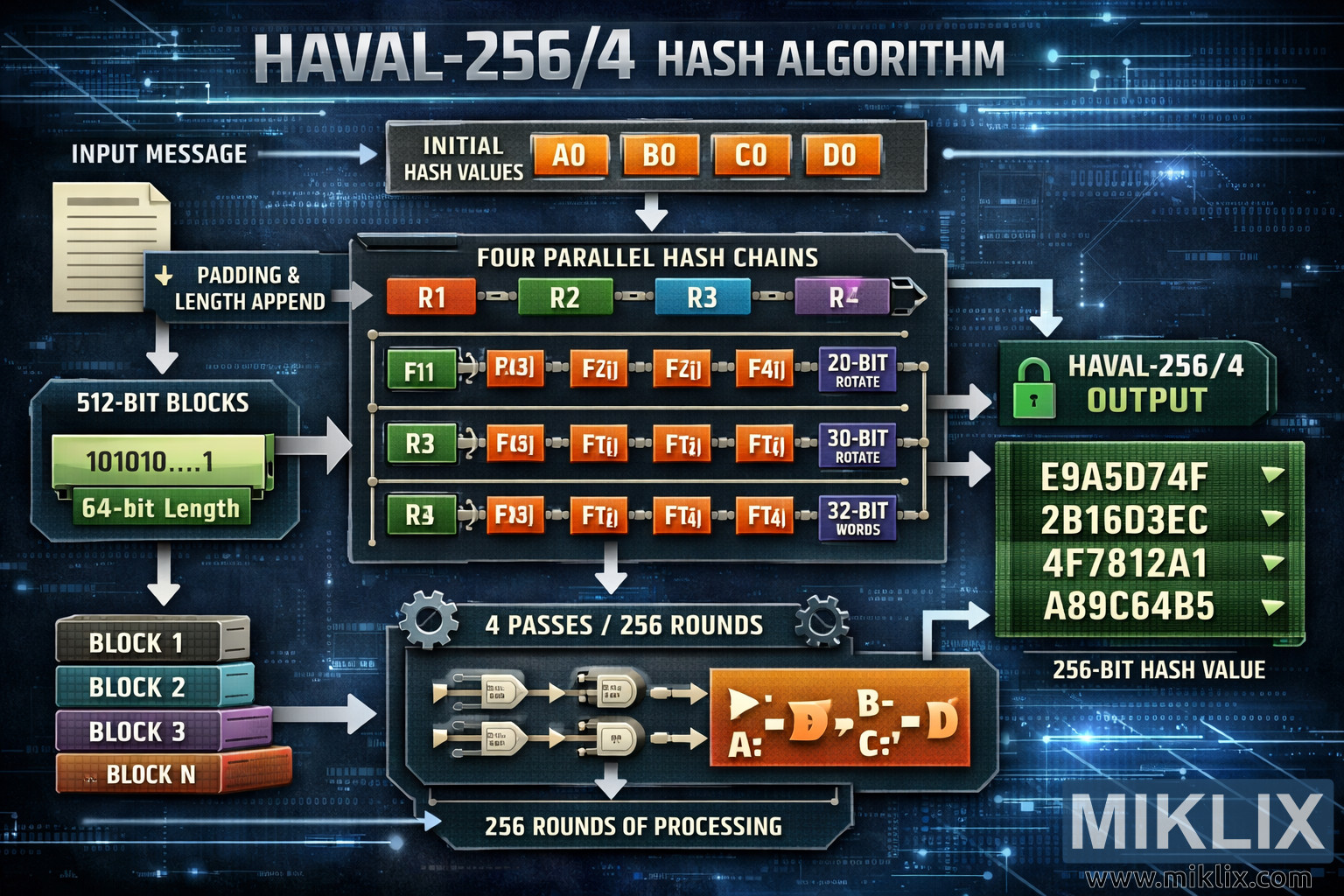
High-resolution landscape infographic explaining the internal workflow of the HAVAL-256/4 hash algorithm, from padded input blocks through four parallel passes to the final 256-bit digest.
Available versions of this image
The image files available for download below are less compressed and higher resolution - and as a result of that, higher quality - than the images embedded in articles and pages on this website, which are more optimized for file size in order to reduce bandwidth consumption.
Regular size (1,536 x 1,024)

Large size (3,072 x 2,048)
Very large size (4,608 x 3,072)
Extra large size (6,144 x 4,096)
Comically large size (1,048,576 x 699,051)
- Still uploading... ;-)
Image description
The image is a wide, landscape-oriented infographic titled \"HAVAL-256/4 Hash Algorithm\" rendered in a futuristic blue, teal, and orange color scheme. It visualizes the full processing pipeline of the HAVAL cryptographic hash function configured for a 256-bit output and four passes. On the far left, a stylized document icon labeled \"Input Message\" feeds into a section called \"Padding & Length Append\", where the message is extended with a binary pattern ending in a 1-bit and a 64-bit length field. This padded message is grouped into clearly marked \"512-bit Blocks\", illustrated as stacked green panels with a sample bit pattern like 101010…1 and a small label noting the appended 64-bit length.
Below this, a vertical stack labeled \"Block 1\", \"Block 2\", \"Block 3\", and \"Block N\" represents the sequence of message blocks flowing into the core algorithm. Arrows guide the reader from these blocks toward the central processing area. At the top center of the diagram, a metallic panel titled \"Initial Hash Values\" displays four orange registers marked A0, B0, C0, and D0, indicating the starting internal state words. A thick arrow points downward from these registers into the main computation core.
The central region is dominated by a large frame labeled \"Four Parallel Hash Chains\". Inside it, four colored lanes named R1, R2, R3, and R4 run horizontally, each connected by small chain-link icons to emphasize their parallel nature. Within each lane are sequences of function blocks such as F1, F2, F3, F4, and permutations like P3, with arrows connecting them step by step. Along the right side of these lanes are labels such as \"20-bit rotate\", \"30-bit rotate\", and \"32-bit words\", highlighting the internal rotation and word operations applied during each round. The functions and rotations are color-coded in green, orange, purple, and blue to visually distinguish the different passes and transformations.
Beneath the four chains is a mechanical-themed section titled \"4 Passes / 256 Rounds\" illustrated with small gear icons, reinforcing the idea of repeated iterative processing. This area feeds into a bold banner reading \"256 Rounds of Processing\", which in turn connects to a highlighted orange box showing symbolic updates to the state registers, labeled A, B, C, and D, with arrows indicating the mixing and updating of these values.
On the far right, a glowing green panel with a padlock icon is labeled \"HAVAL-256/4 Output\". Inside it, four rows of hexadecimal characters such as E9A5D74F, 2B16D3EC, 4F7812A1, and A89C64B5 are stacked to form a 256-bit hash value. A caption beneath this panel reads \"256-bit Hash Value\", clarifying the final result of the algorithm.
The background consists of a dark, circuit-board-style texture with faint binary strings and glowing connection lines, reinforcing the cryptographic and digital theme. White arrows and connectors guide the eye from left to right across the entire process, making the overall data flow—from raw message input, through padding, block splitting, parallel hash passes, multiple rounds of processing, and finally to the secure 256-bit digest—easy to follow at a glance.
The image is related to: HAVAL-256/4 Hash Code Calculator