
Image: HAVAL-256/5 Hash Algorithm Visualization
Published: January 6, 2026 at 9:55:40 PM UTC
Last updated: January 6, 2026 at 9:56:09 PM UTC
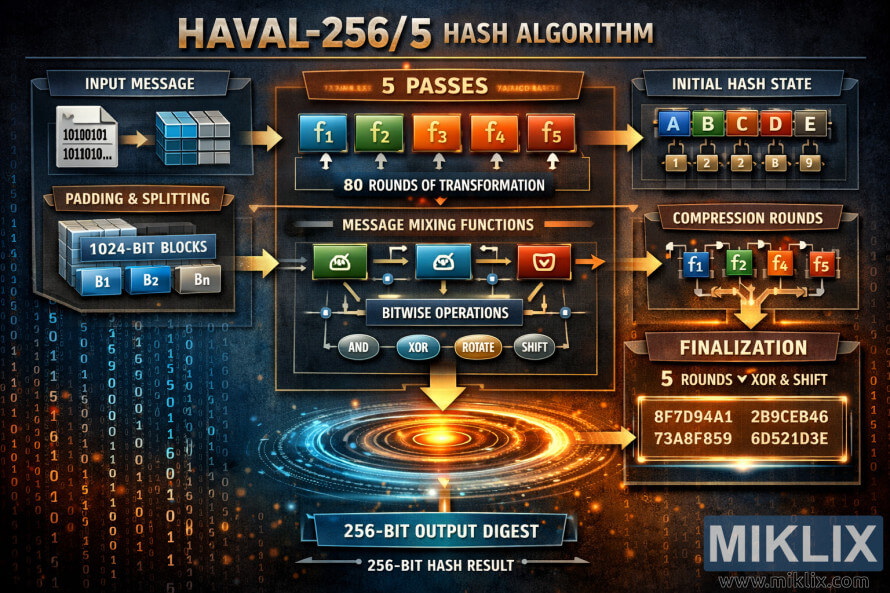
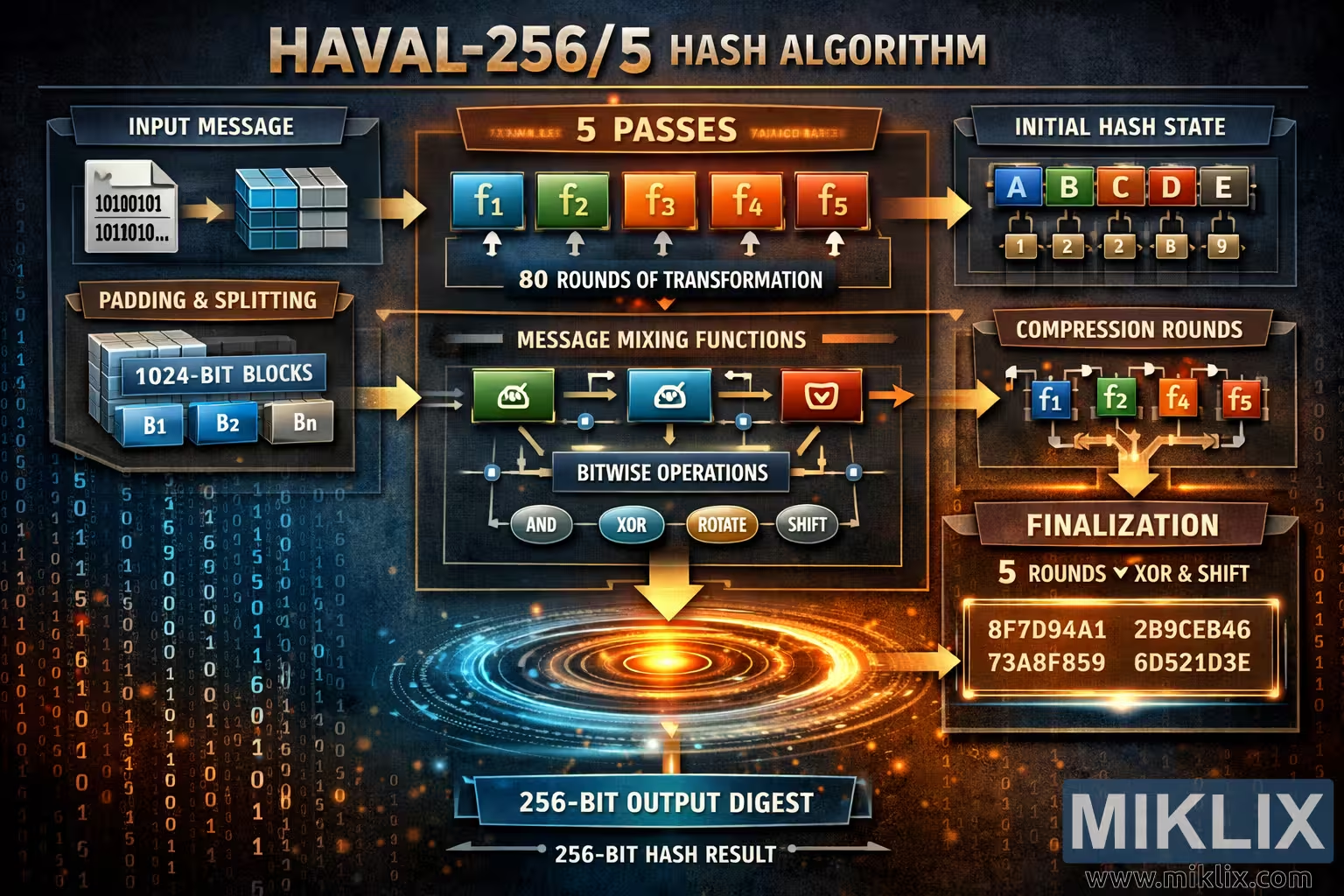
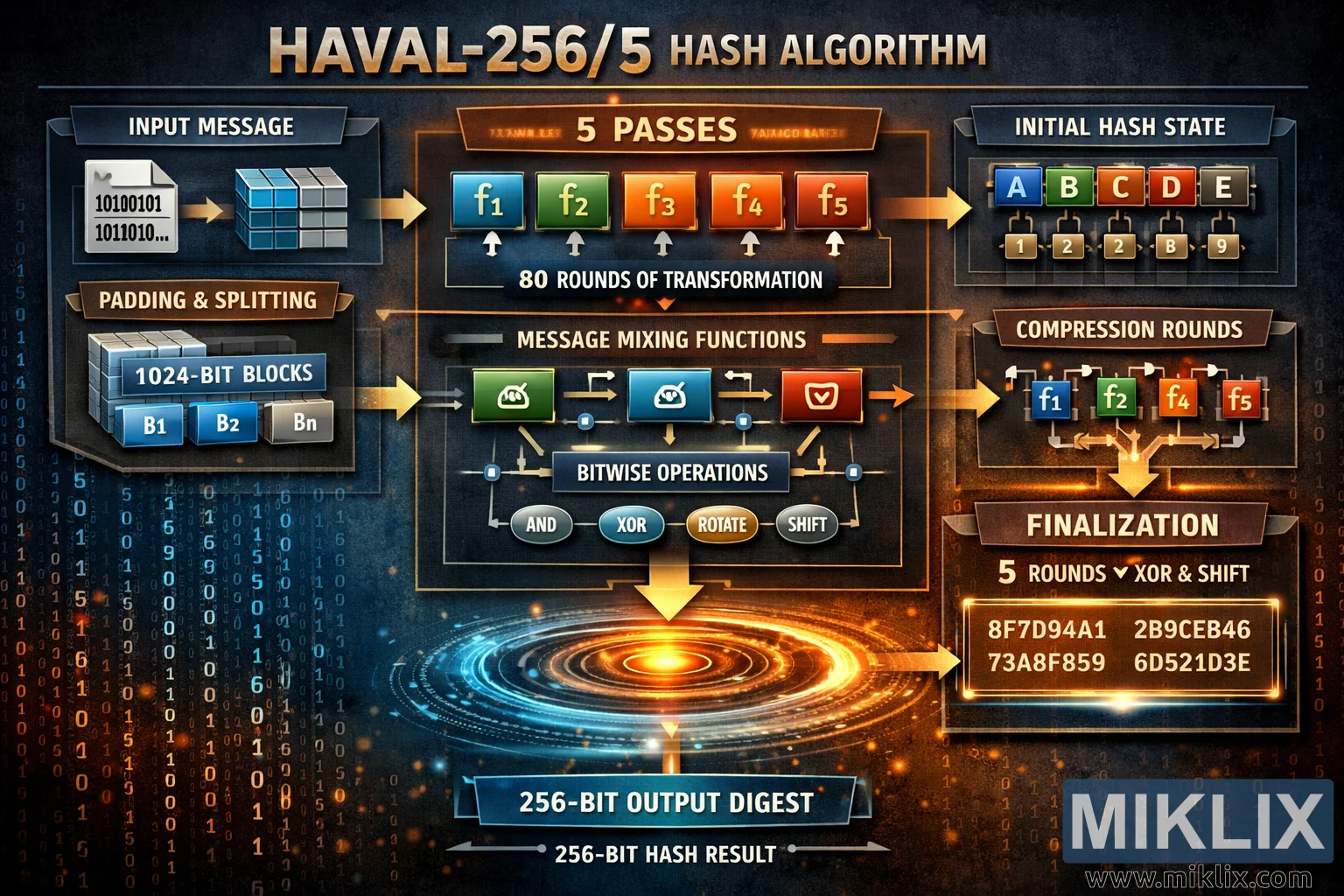
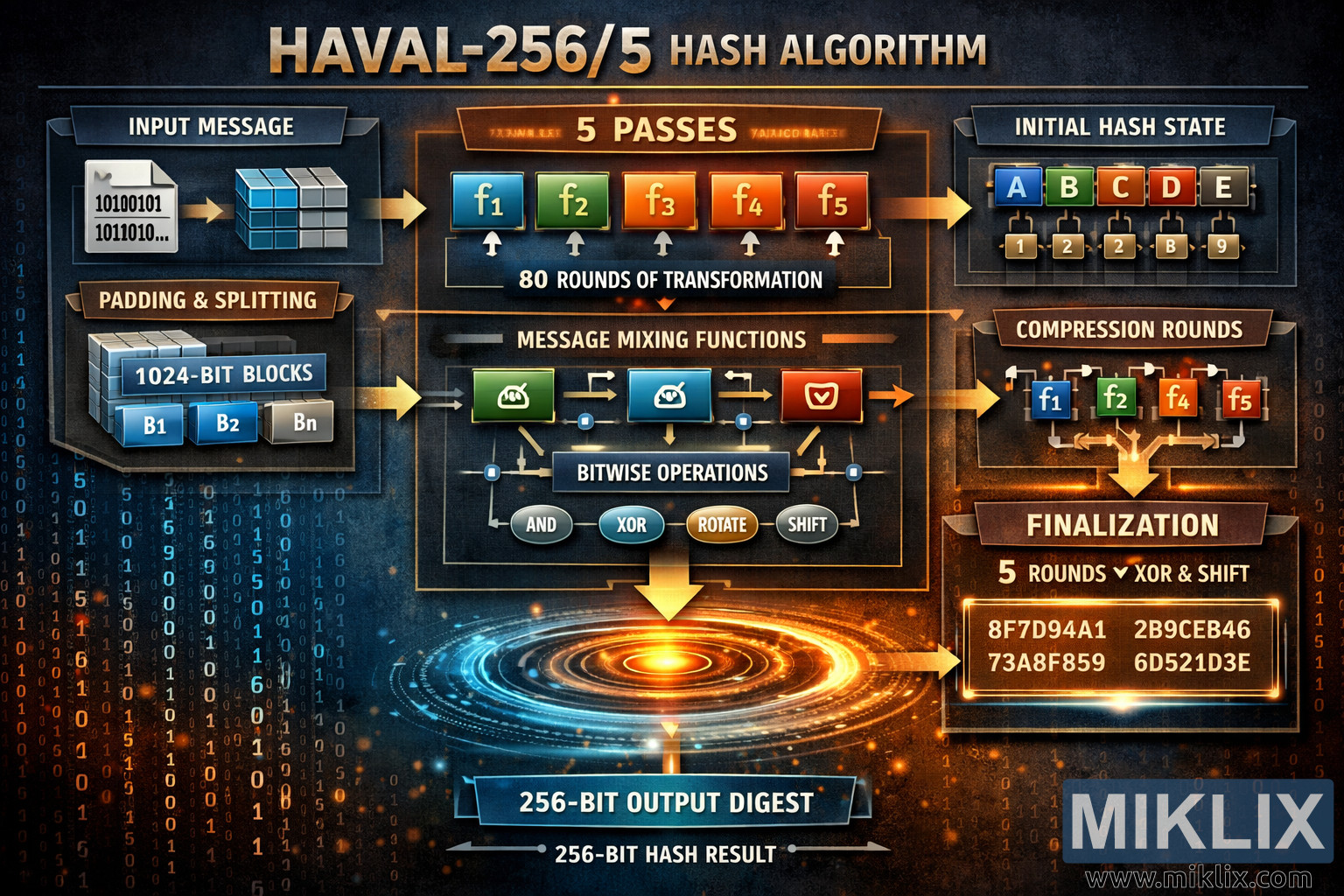
Detailed infographic of the HAVAL-256/5 cryptographic hash process, illustrating message padding, five transformation passes, compression rounds, and production of a 256-bit hash value.
Available versions of this image
The image files available for download below are less compressed and higher resolution - and as a result of that, higher quality - than the images embedded in articles and pages on this website, which are more optimized for file size in order to reduce bandwidth consumption.
Regular size (1,536 x 1,024)
Large size (3,072 x 2,048)
Very large size (4,608 x 3,072)
Extra large size (6,144 x 4,096)
Comically large size (1,048,576 x 699,051)
- Still uploading... ;-)
Image description
The image is a wide, landscape-oriented infographic that visually explains the HAVAL-256/5 cryptographic hash algorithm from left to right, using a futuristic dark-blue and amber color scheme with glowing highlights and floating binary digits in the background. At the far left, a panel titled "Input Message" shows a document icon filled with binary digits flowing into a stack of small data blocks, indicating that an arbitrary message is taken as raw bit input. Beneath it, a second panel labeled "Padding & Splitting" depicts the message being padded and divided into multiple 1024-bit blocks, marked as B1, B2, and Bn, emphasizing that the algorithm processes long messages block by block. Arrows guide the eye toward the central region, which dominates the composition. A large header reads "5 Passes" and underneath are five colorful boxes labeled f1, f2, f3, f4, and f5, representing the five nonlinear Boolean functions used by HAVAL in its five-pass configuration. Below these boxes, the text "80 Rounds of Transformation" appears, conveying that the internal state is iteratively updated many times per message block. In the middle, a complex diagram labeled "Message Mixing Functions" shows arrows looping between several blocks, symbolizing how words from the message and internal state are combined. A subpanel titled "Bitwise Operations" lists the primitive operations AND, XOR, ROTATE, and SHIFT, each inside a rounded icon, highlighting the low-level binary nature of the algorithm. On the right side, a panel titled "Initial Hash State" displays five registers marked A, B, C, D, and E, each with small numeric or hexadecimal placeholders beneath, illustrating the chaining variables that are updated throughout processing. Below that, another panel titled "Compression Rounds" shows the f1, f2, f4, and f5 functions feeding back into the state with curved arrows, representing the compression function applied to each block. Further down, a glowing box labeled "Finalization – 5 Rounds XOR & Shift" contains sample hexadecimal values such as 8F7D94A1 and 2B9CEB46, suggesting the final mixing stage that produces the digest. All arrows converge toward the bottom center, where a swirling, luminous circular vortex visually represents the condensation of all intermediate states into a single result. Beneath this vortex, a banner reads "256-bit Output Digest" followed by "256-bit Hash Result," indicating the fixed-length output of the algorithm. The entire composition uses metallic textures, neon edges, and layered panels to communicate a step-by-step pipeline: input, padding, multi-pass transformation, compression, finalization, and the resulting 256-bit hash value.
The image is related to: HAVAL-256/5 Hash Code Calculator