
Image: MD5 Hash Algorithm – High-Level Visualization
Published: January 10, 2026 at 7:51:22 PM UTC
Last updated: January 10, 2026 at 7:51:56 PM UTC
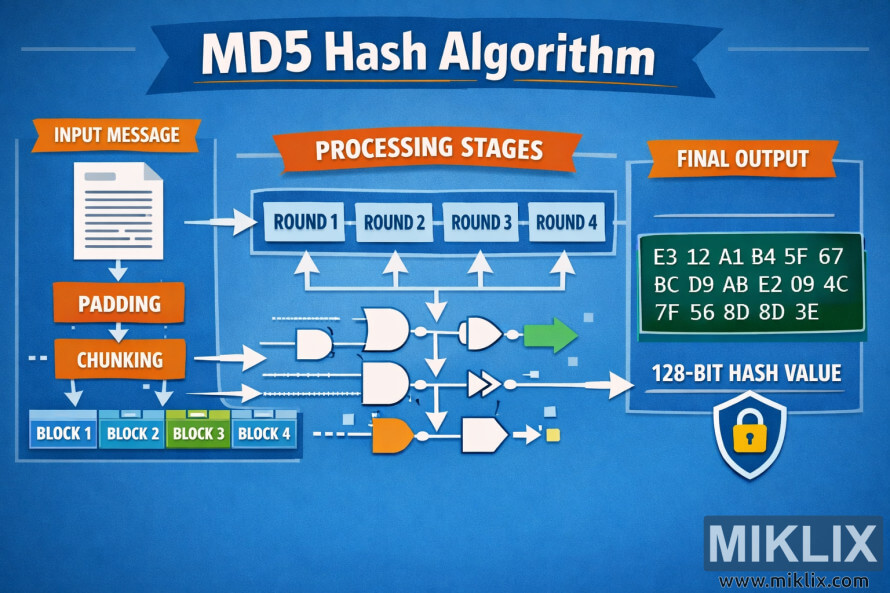
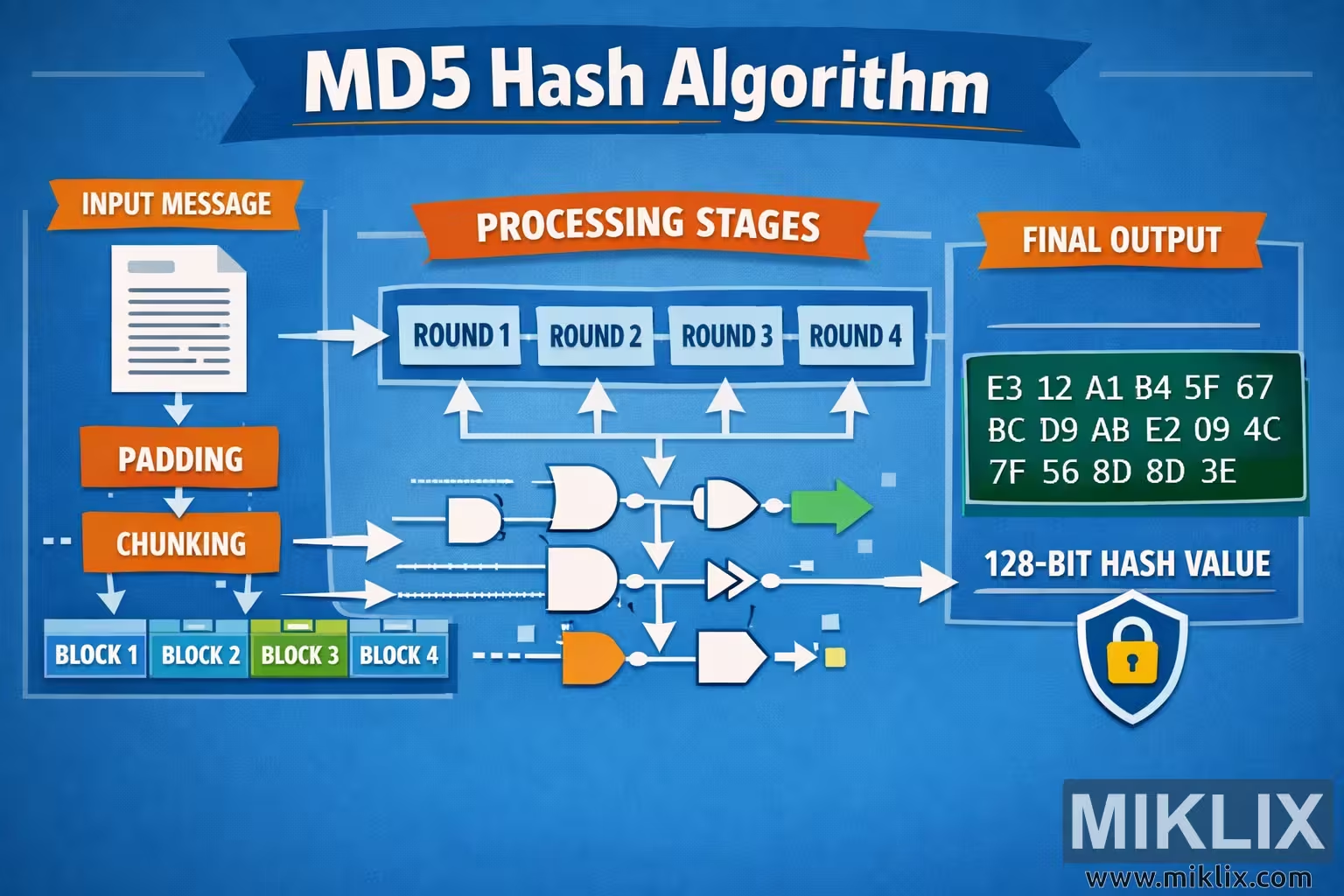
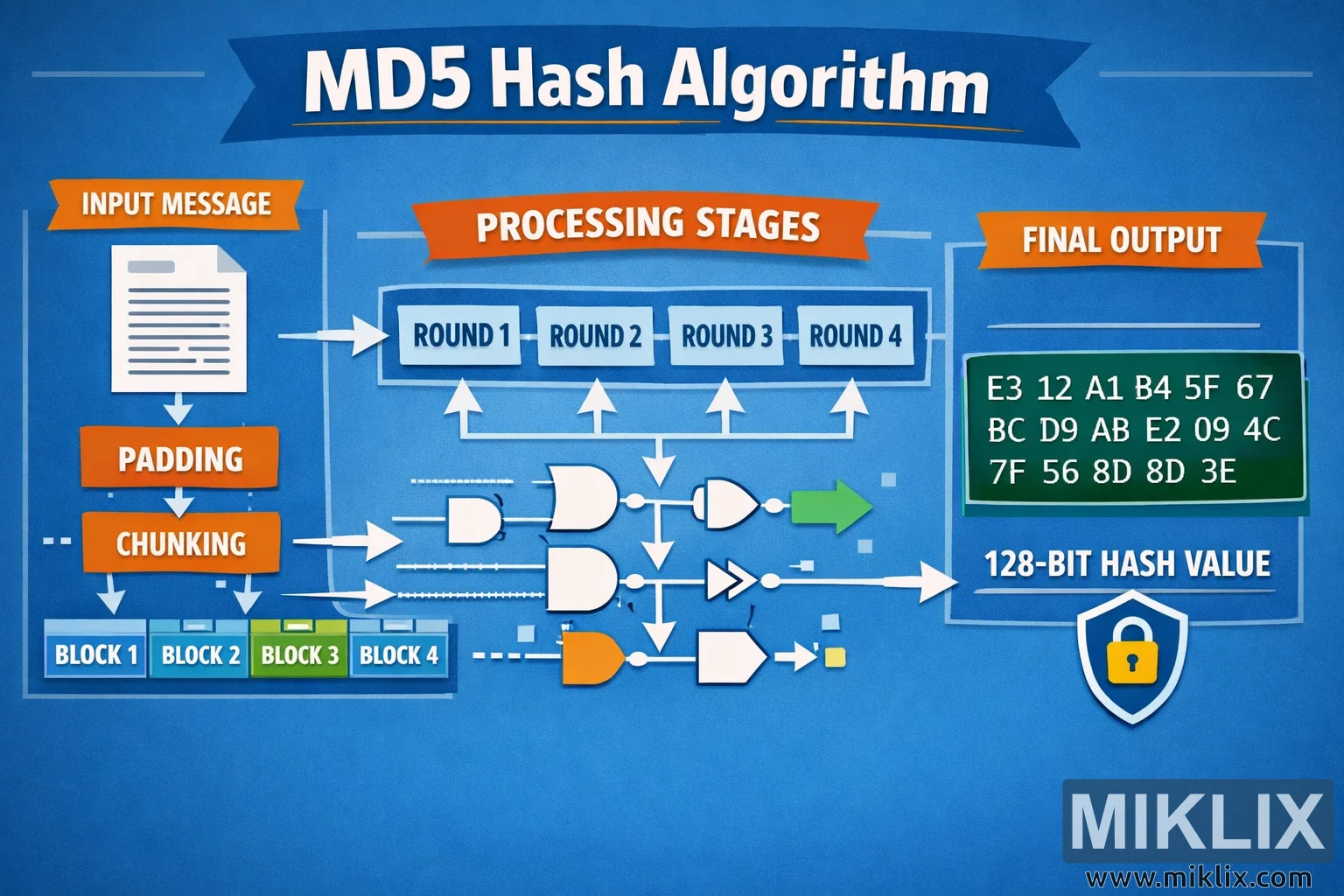
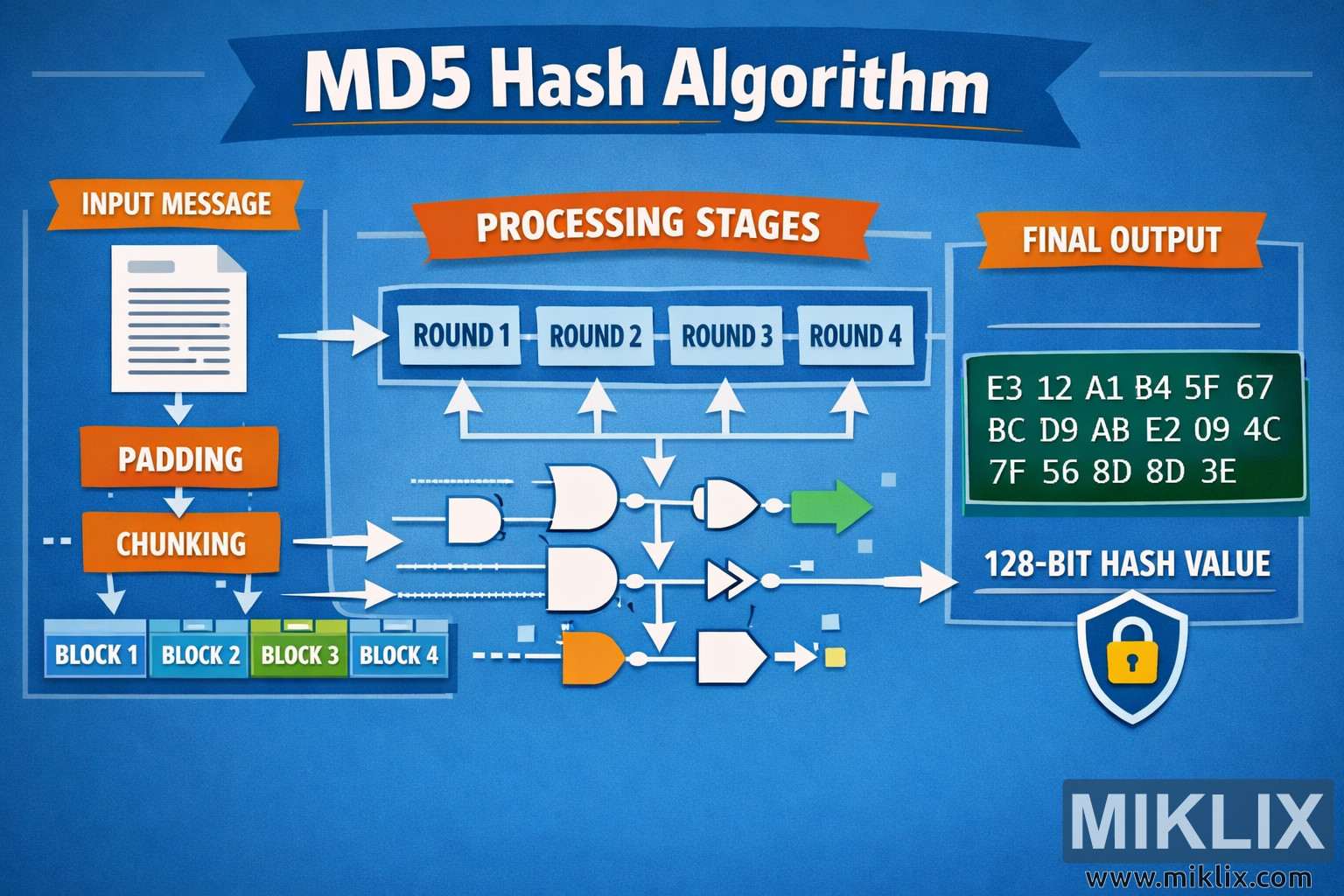
Educational infographic explaining the MD5 hash algorithm with a left-to-right flow from input and preprocessing through multiple rounds to a final 128-bit hash value.
Available versions of this image
The image files available for download below are less compressed and higher resolution - and as a result of that, higher quality - than the images embedded in articles and pages on this website, which are more optimized for file size in order to reduce bandwidth consumption.
Regular size (1,536 x 1,024)
Large size (3,072 x 2,048)
Very large size (4,608 x 3,072)
Extra large size (6,144 x 4,096)
Comically large size (1,048,576 x 699,051)
- Still uploading... ;-)
Image description
The image is a wide, landscape-oriented infographic that visually explains the concept of the MD5 hash algorithm in a simplified and approachable way. At the very top, a large blue ribbon banner stretches across the width of the canvas and contains the headline “MD5 Hash Algorithm” in bold, white lettering, making it immediately clear which cryptographic function is being illustrated. The background is a smooth blue gradient with subtle texture, giving the graphic a clean, modern, educational feel.
The diagram is organized horizontally from left to right to mirror the flow of data. On the far left, a section labeled “Input Message” is represented by a white document icon with grey text lines, symbolizing an arbitrary input such as a file or string. From this icon, a downward arrow leads to an orange box labeled “Padding,” followed by another arrow to a box labeled “Chunking.” Below the chunking step, four small colored rectangles are arranged side by side and labeled “Block 1,” “Block 2,” “Block 3,” and “Block 4,” illustrating that the input is divided into fixed-size pieces before processing.
These blocks feed into the central area of the infographic, which is titled “Processing Stages” on an orange banner. Inside this section, four rounded blue boxes are arranged in a row and labeled “Round 1,” “Round 2,” “Round 3,” and “Round 4.” This deliberately avoids technical internals while conveying that MD5 works through multiple iterative rounds. Beneath the rounds is a stylized circuit-like illustration made up of simple logic-gate shapes, arrows, and connectors. These abstract shapes are not intended to show exact formulas, but instead to give a visual sense of repeated mixing, combining, and transformation steps occurring inside the algorithm. White arrows point upward from the circuit area into each round box, reinforcing the idea that the rounds are driven by these internal operations.
On the right side of the image is the “Final Output” section, framed clearly with a border. At its center is a dark green panel that looks like a chalkboard or terminal screen. On it, a sample hexadecimal string is shown in groups of characters, visually representing the fixed-length MD5 digest without implying that the specific value is meaningful. Below this panel, large text reads “128-bit hash value,” summarizing the output size in a user-friendly way. A small shield icon with a lock appears nearby, suggesting the security-related context of cryptographic hashes, while remaining generic and non-misleading.
Overall, the infographic uses clear arrows, bright orange section headers, and simple icons to guide the viewer from input through preprocessing, multi-round processing, and finally to the hash output. It intentionally abstracts away low-level technical details to avoid inaccuracies, focusing instead on an intuitive, high-level understanding of how the MD5 hash algorithm transforms an input into a fixed-length fingerprint.
The image is related to: MD5 Hash Code Calculator