
Image: RIPEMD-160 Hash Algorithm – High-Level Visual Overview
Published: January 9, 2026 at 11:39:49 PM UTC
Last updated: January 9, 2026 at 11:40:01 PM UTC
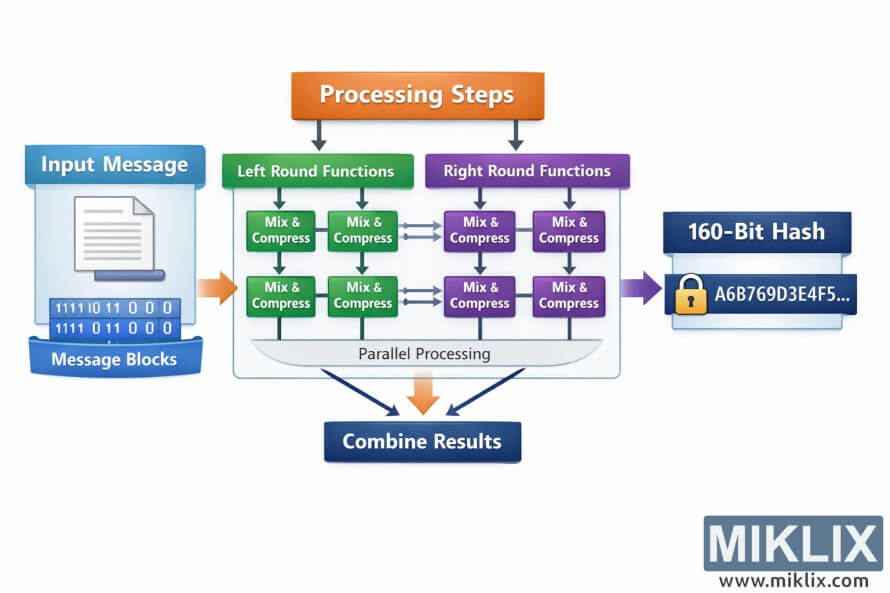
Educational vector diagram explaining the overall flow of the RIPEMD-160 cryptographic hash algorithm, from input preprocessing through parallel compression paths to the final 160-bit output.
Available versions of this image
The image files available for download below are less compressed and higher resolution - and as a result of that, higher quality - than the images embedded in articles and pages on this website, which are more optimized for file size in order to reduce bandwidth consumption.
Regular size (1,536 x 1,024)
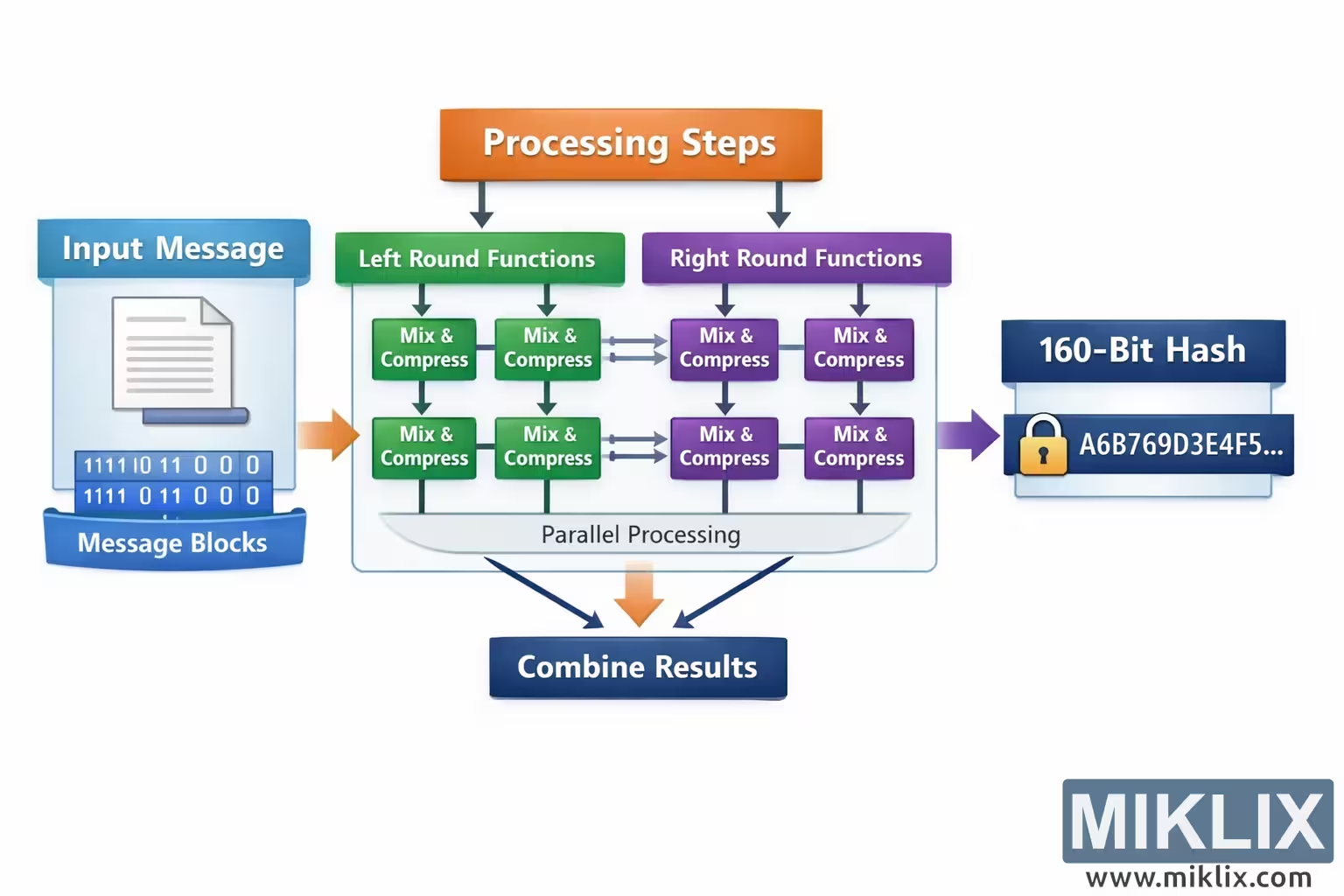
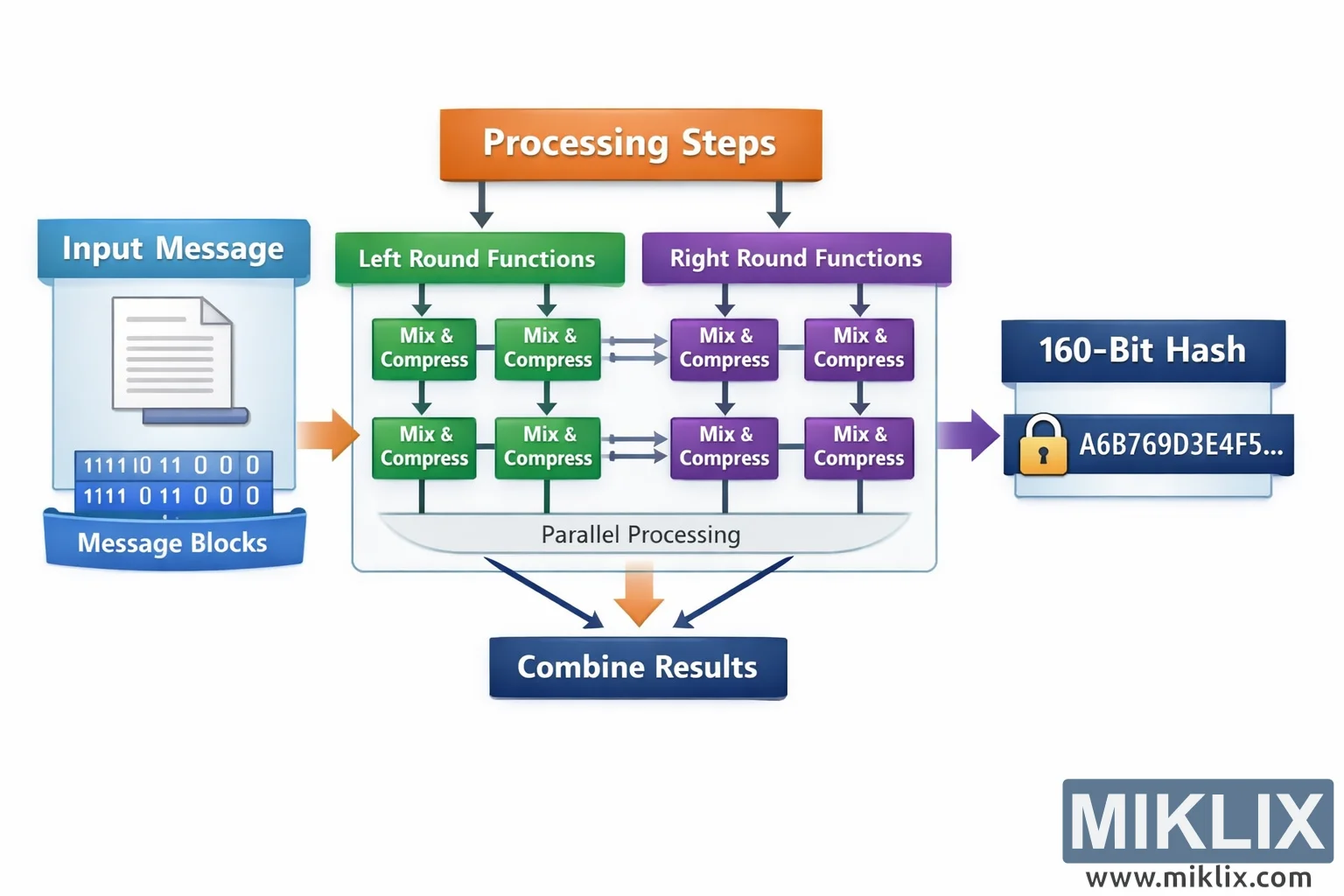
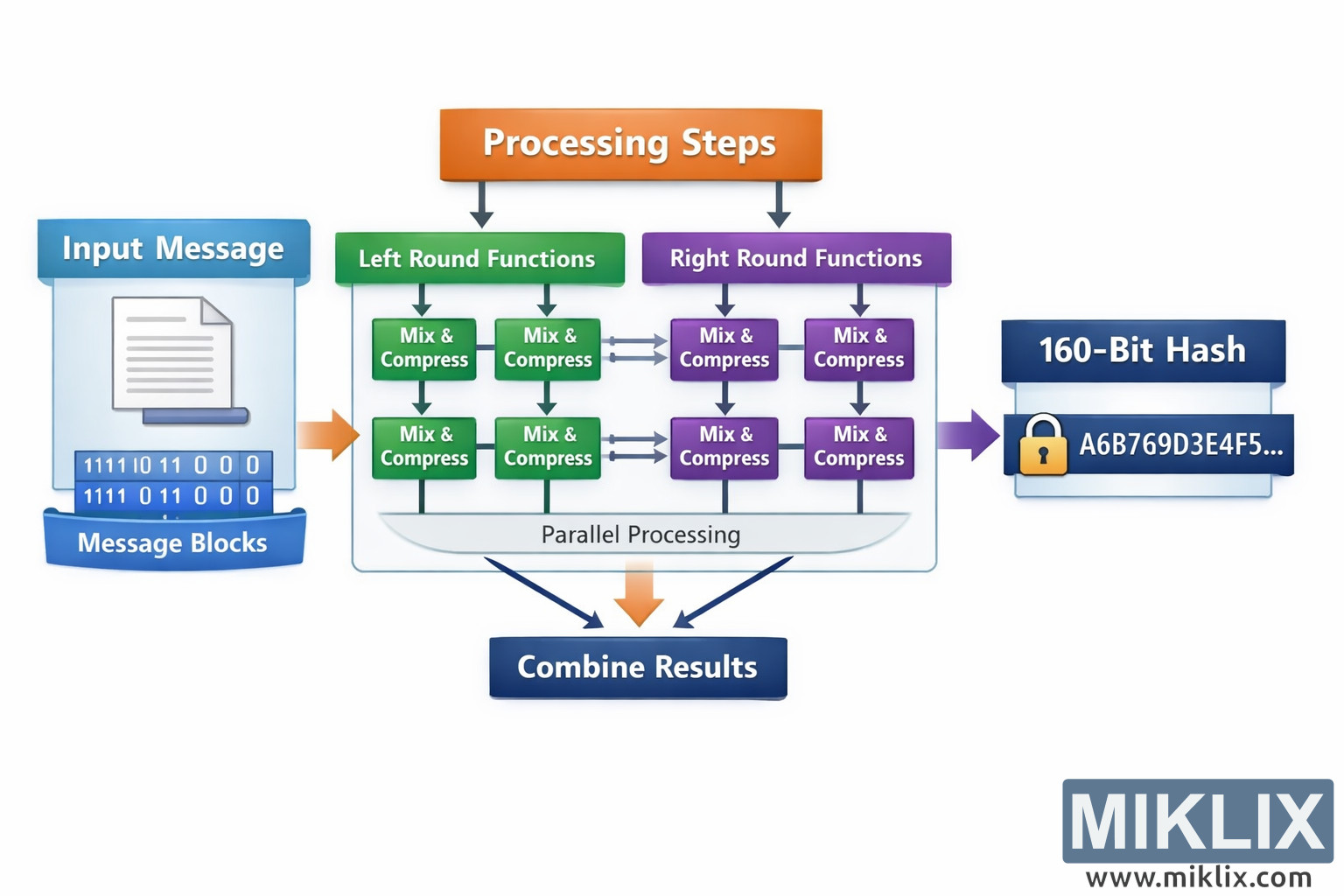
Large size (3,072 x 2,048)
Very large size (4,608 x 3,072)
Extra large size (6,144 x 4,096)
Comically large size (1,048,576 x 699,051)
- Still uploading... ;-)
Image description
The image is a wide, landscape-oriented infographic that explains the RIPEMD-160 hash algorithm at a conceptual level without relying on fragile technical constants. On the far left, a rounded rectangle labeled "Input Message" represents any arbitrary data such as text or a file. A smooth arrow leads from this box into a larger pastel-colored block titled "Preprocessing." Inside this block are small, softly outlined icons that hint at actions like padding, splitting, and preparation, but without showing exact formulas or bit lengths. From preprocessing, the flow divides into a central area called "Compression." This area is visually split into several vertical lanes arranged in parallel, each lane representing one processing path. The lanes are colored in coordinated pastel shades so that the viewer immediately understands that the algorithm works on multiple tracks at the same time.
Within each lane, a stack of gently curved rectangles labeled "Round" is shown, arranged from top to bottom to imply repeated transformation steps. Curved arrows between these rectangles suggest iterative mixing of the data. The labels are intentionally generic, such as "Mixing," "Transformation," or simply "Round," so that the diagram stays correct even if implementation details vary. Subtle circular arrows inside the lanes reinforce the idea of internal state being updated over and over. After the final round in each lane, the paths converge toward the right side of the diagram. The merging area is drawn as a funnel-shaped block titled "Combine Results," indicating that the outputs of all parallel paths are brought together.
From this combining block, a single bold arrow points to the final element on the far right: a long horizontal capsule labeled "160-bit Hash Output." Beneath this capsule, a small caption explains in plain language that this is the fixed-length fingerprint produced from the original input. The background is clean and light, with faint grid lines to suggest structure without clutter. Typography is large and readable, with friendly sans-serif fonts. The overall color palette uses calm blues, greens, and soft oranges to guide the eye from left to right.
At the bottom of the image, a minimal legend explains the meaning of arrows, parallel lanes, and rounded blocks, reinforcing that this is a high-level flow rather than a specification. The entire composition is designed to help non-experts understand that RIPEMD-160 takes an input, prepares it, processes it through several parallel rounds of transformation, and finally produces a fixed-size hash, all while avoiding any specific numeric constants or low-level operations that might be inaccurate.
The image is related to: RIPEMD-160 Hash Code Calculator