
Image: RIPEMD-320 Hash Algorithm — Conceptual Visualization
Published: January 9, 2026 at 11:27:13 PM UTC
Last updated: January 9, 2026 at 11:27:25 PM UTC
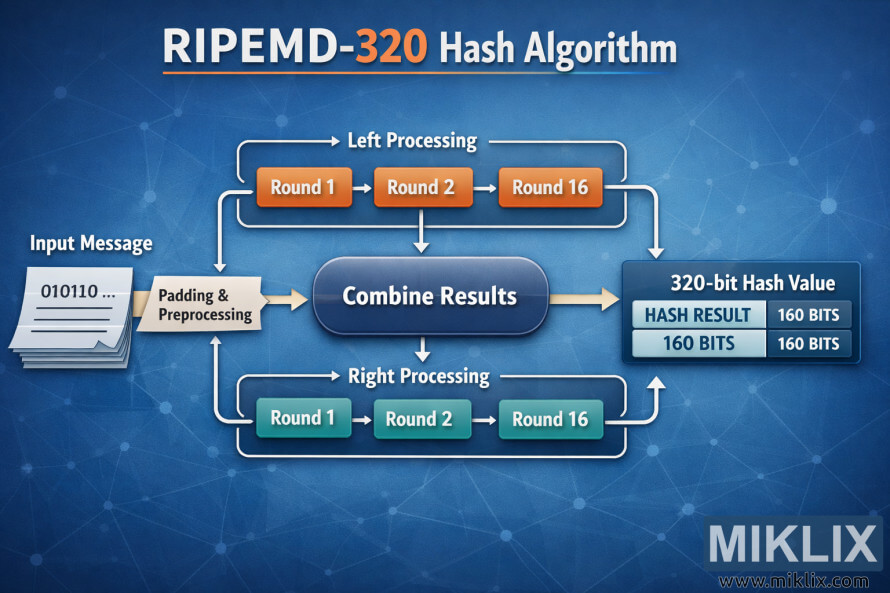
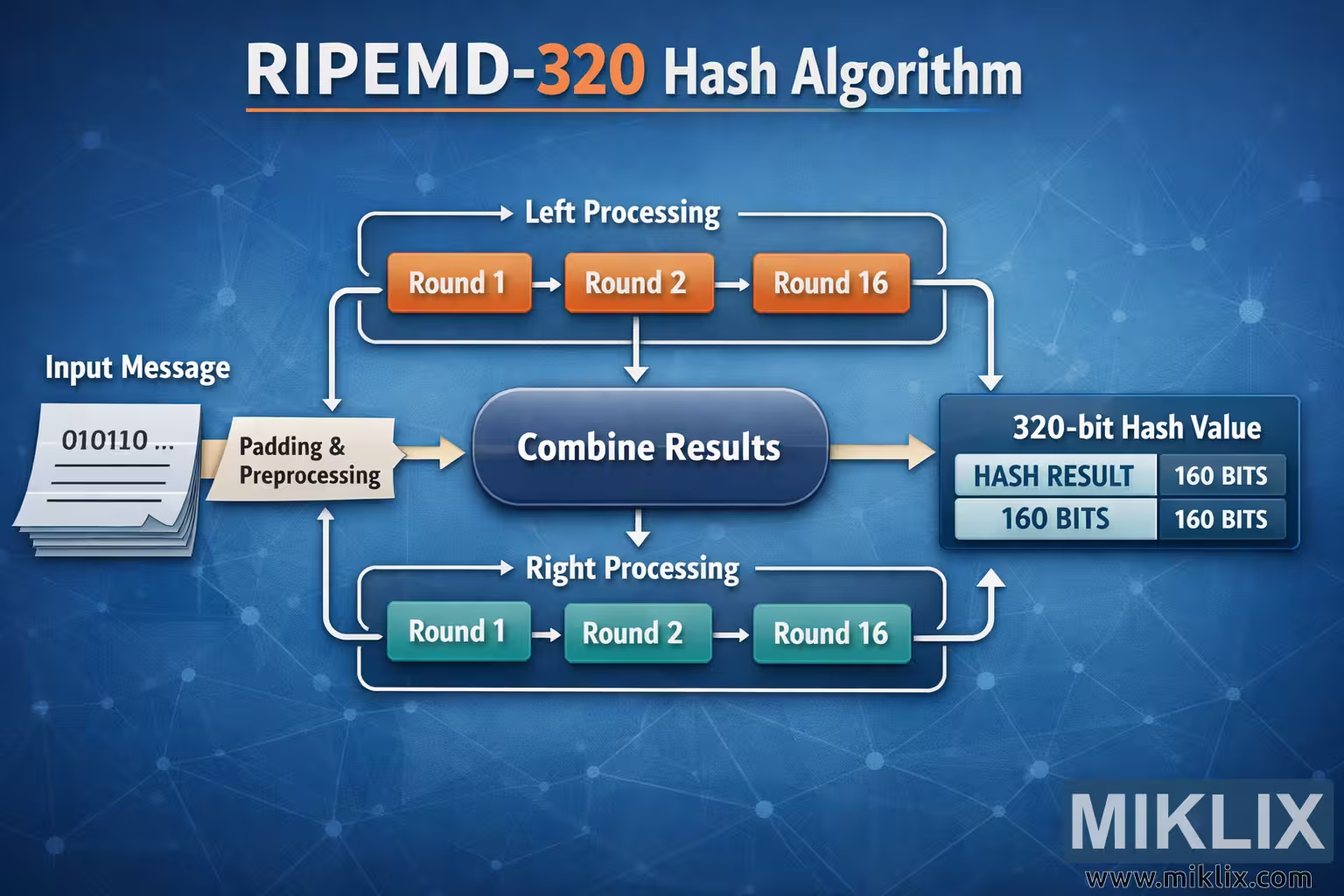
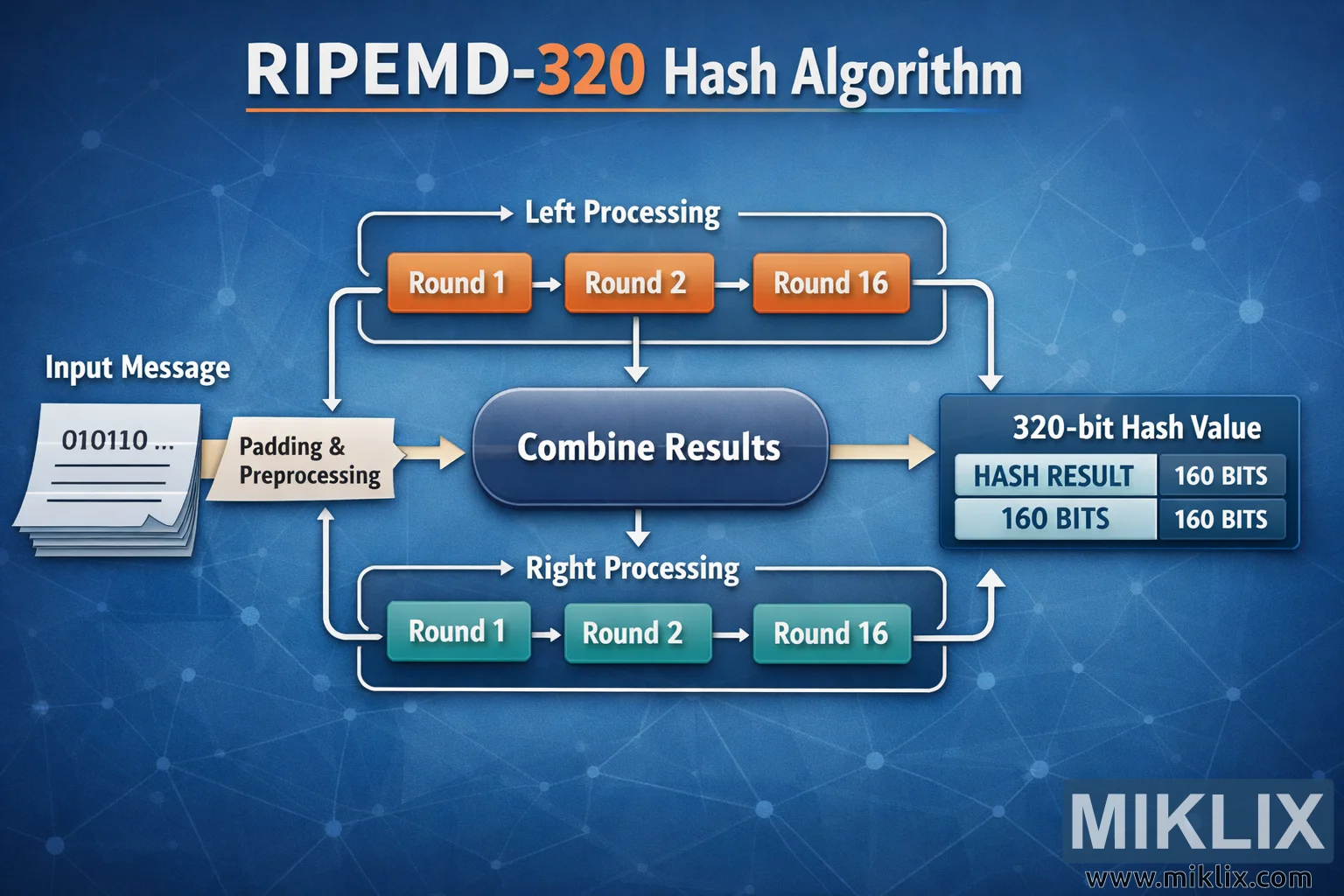
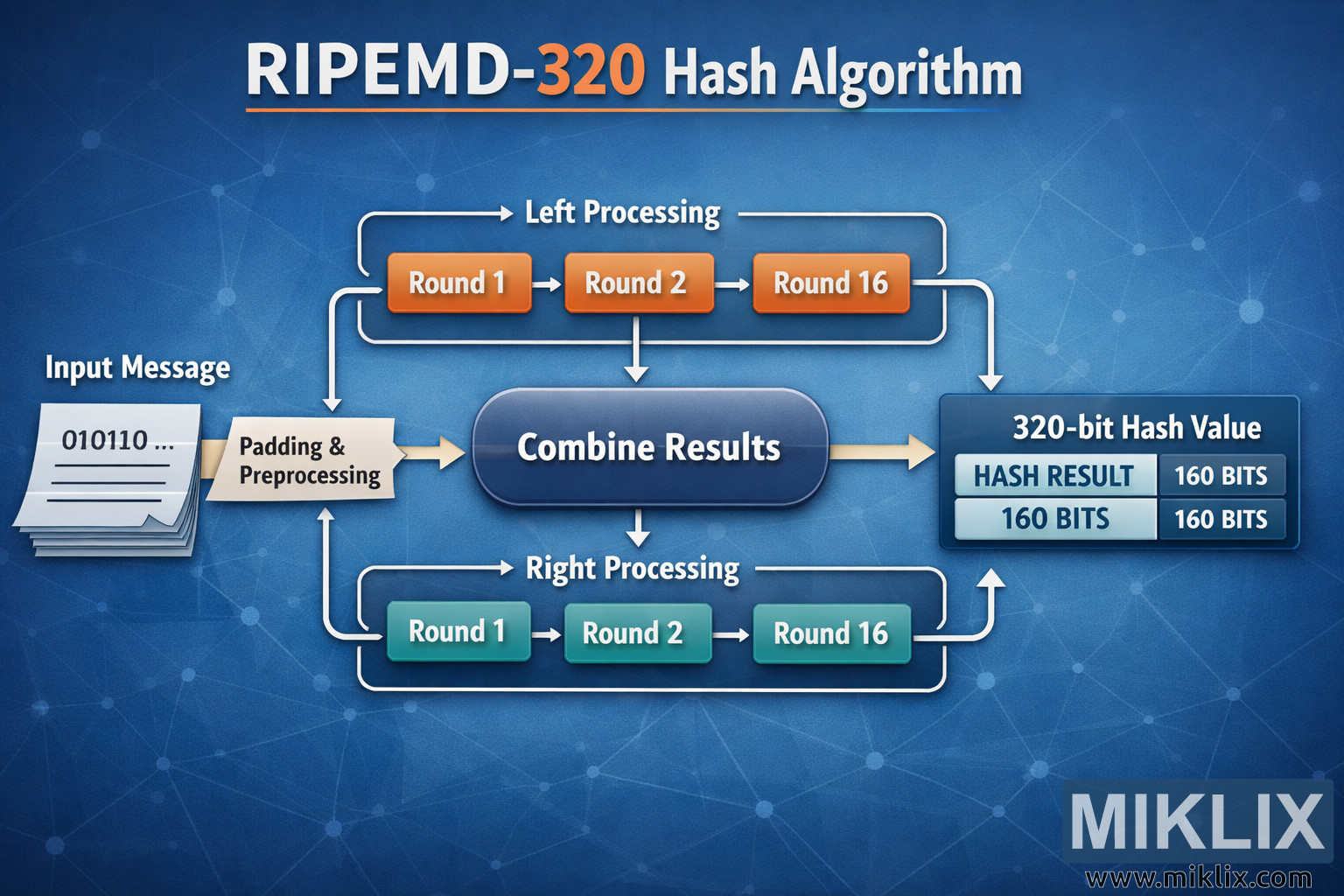
Easy-to-understand visualization of the RIPEMD-320 cryptographic hash function, illustrating how an input message is processed through parallel rounds to produce a fixed 320-bit digest.
Available versions of this image
The image files available for download below are less compressed and higher resolution - and as a result of that, higher quality - than the images embedded in articles and pages on this website, which are more optimized for file size in order to reduce bandwidth consumption.
Regular size (1,536 x 1,024)
Large size (3,072 x 2,048)
Very large size (4,608 x 3,072)
Extra large size (6,144 x 4,096)
Comically large size (1,048,576 x 699,051)
- Still uploading... ;-)
Image description
This landscape illustration presents a high-level, educational visualization of the RIPEMD-320 hash algorithm, designed to communicate the overall workflow without relying on fragile or overly technical specifics. On the far left, a wide input block labeled "Message Input" represents arbitrary-length data such as a file or text. Subtle horizontal lines suggest streaming data entering the system.
The input flows into a section titled "Preprocessing," shown as a rectangular module that symbolically indicates padding, length encoding, and block preparation. Instead of listing formulas or constants, the panel uses simple icons such as checkmarks, alignment guides, and segmented blocks to communicate that the message is normalized into uniform chunks.
From preprocessing, the data moves rightward into the core of the diagram: two large, vertically stacked processing lanes labeled "Parallel Path A" and "Parallel Path B." These lanes visually communicate that RIPEMD-320 processes data in parallel. Each lane contains a series of rounded boxes arranged left to right, labeled generically as "Round 1," "Round 2," and so on, without stating exact counts or parameters. Between the rounds are small mixer icons and curved arrows to suggest non-linear operations, permutations, and message mixing.
Above and below these two lanes are thin feedback arrows that loop forward and backward, indicating that the internal state is repeatedly transformed as it passes through multiple rounds. Occasional merge points show symbolic combination of intermediate values between the two paths, reinforcing the idea that the algorithm blends results from both processing streams.
To the right of the parallel paths is a section labeled "Compression & State Update." Here, several input arrows converge into a central hub icon, implying that the evolving internal state is updated for each message block. The visual language avoids any exact bit widths or constants, focusing instead on the conceptual notion of compression.
Finally, on the far right, a bold rectangular output block titled "Final Hash Output" displays "320-bit Digest" beneath it. This block is highlighted with a distinct color to emphasize that, regardless of input size, the result is a fixed-length fingerprint. A small lock or shield icon near the output reinforces the security purpose of the hash function.
Throughout the image, a calm color palette of blues and teals is used for data flow, while warm accent colors highlight key stages such as preprocessing and output. The background is clean and lightly gridded to suggest technical precision. All labels are short and descriptive, ensuring that viewers unfamiliar with RIPEMD-320 can still grasp the overall process from message input, through parallel processing and compression, to the final 320-bit hash value.
The image is related to: RIPEMD-320 Hash Code Calculator