
Image: Tiger-160/3 Hash Algorithm Overview
Published: January 9, 2026 at 11:04:43 PM UTC
Last updated: January 9, 2026 at 11:05:08 PM UTC
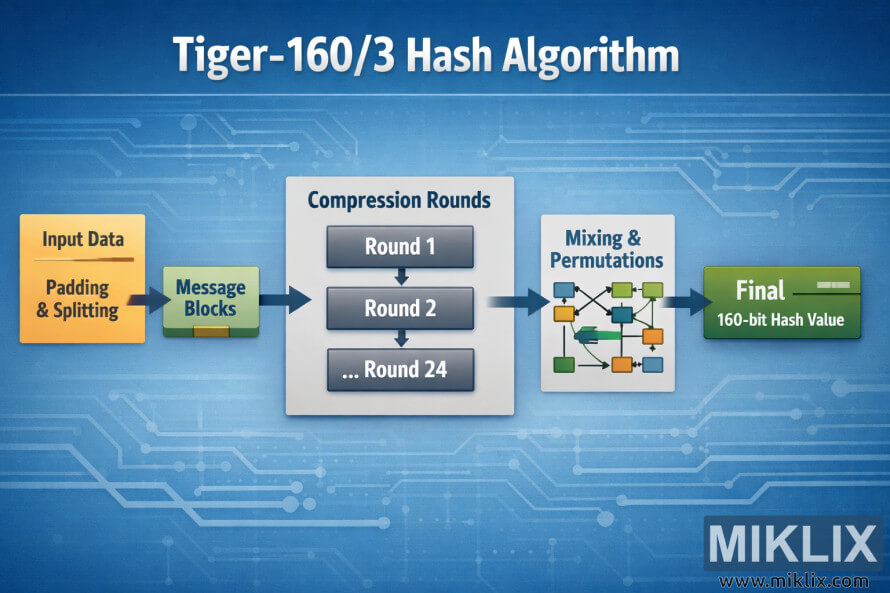
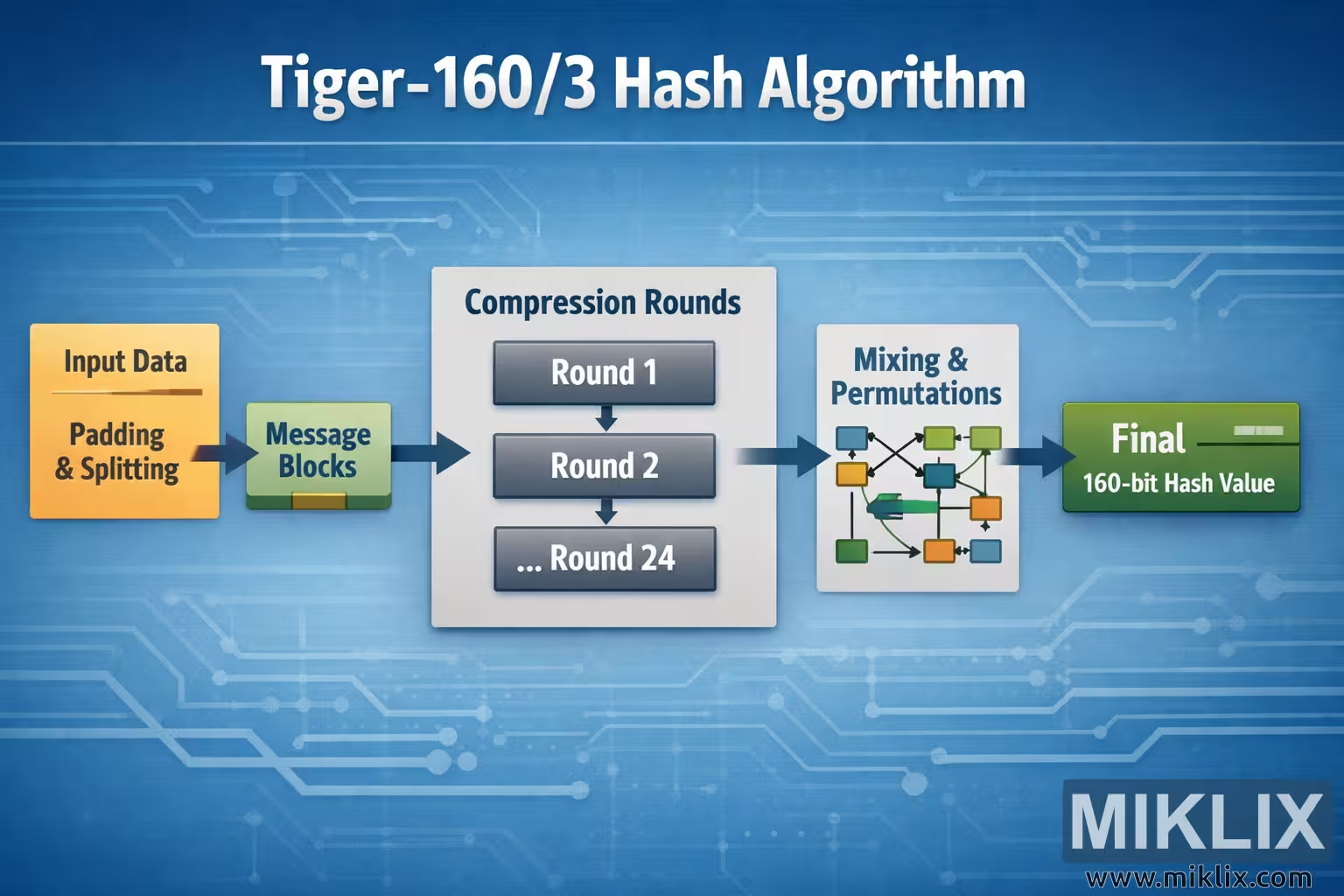
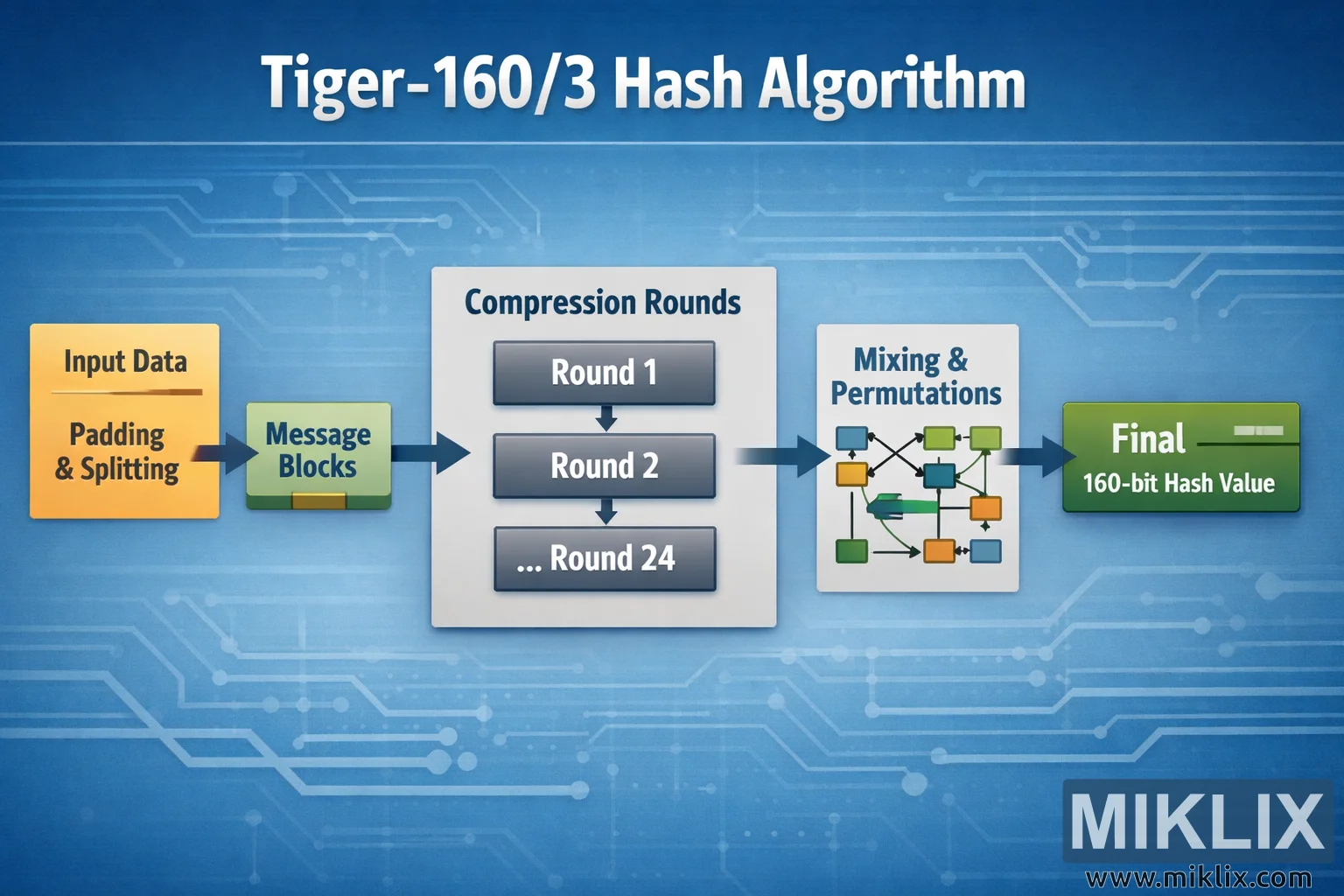
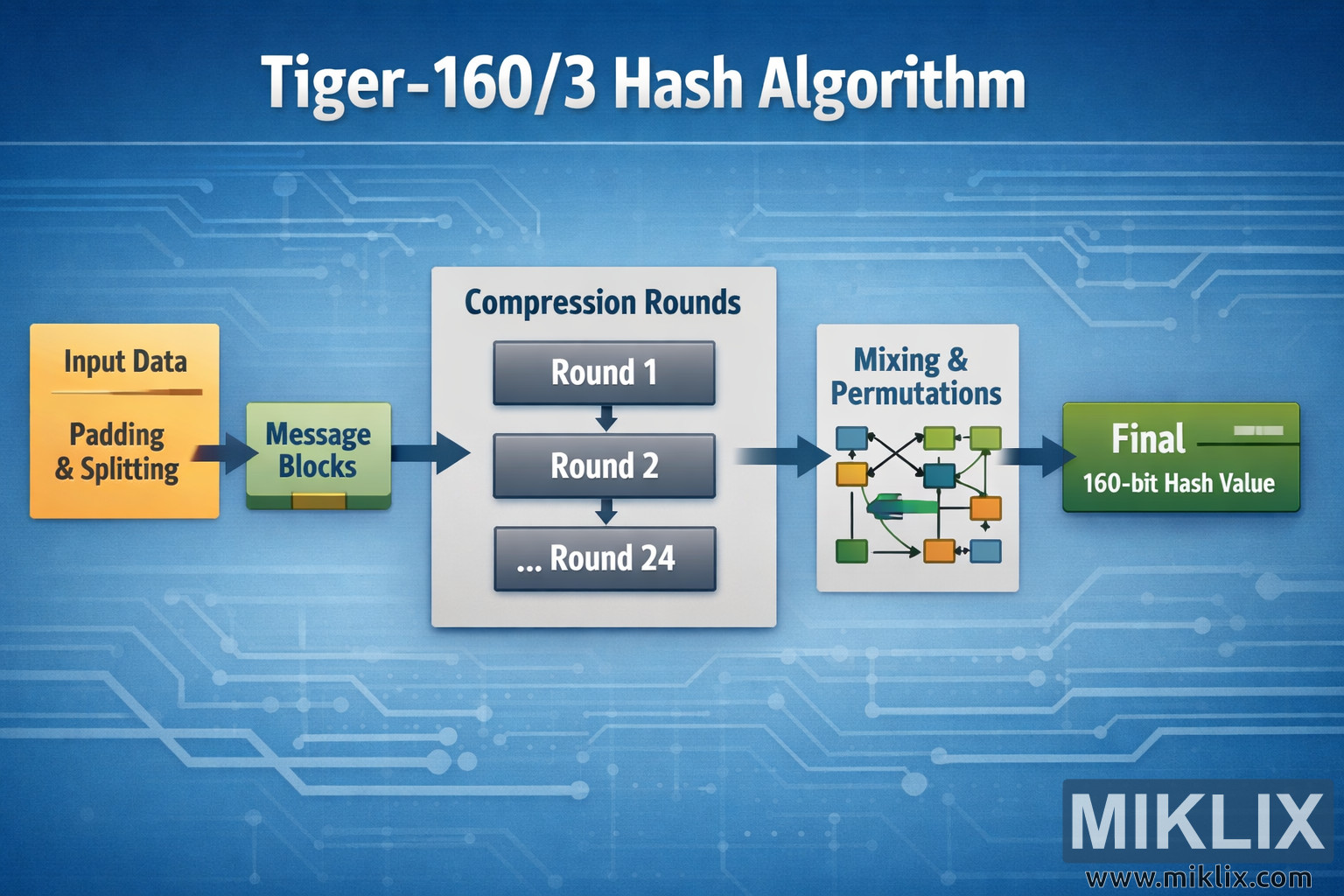
Visual overview of the Tiger-160/3 hash algorithm with a step-by-step flow from input data, padding and message blocks through compression rounds and mixing stages to the final 160-bit hash output.
Available versions of this image
The image files available for download below are less compressed and higher resolution - and as a result of that, higher quality - than the images embedded in articles and pages on this website, which are more optimized for file size in order to reduce bandwidth consumption.
Regular size (1,536 x 1,024)
Large size (3,072 x 2,048)
Very large size (4,608 x 3,072)
Extra large size (6,144 x 4,096)
Comically large size (1,048,576 x 699,051)
- Still uploading... ;-)
Image description
The image is a wide, landscape-oriented infographic that presents a simplified, high-level visualization of the Tiger-160/3 cryptographic hash algorithm. At the very top center, large bold white text reads "Tiger-160/3 Hash Algorithm" against a smooth blue gradient background. The background is decorated with faint circuit-board traces and lines, giving a subtle technological atmosphere without overwhelming the main content.
The process is laid out horizontally from left to right as a clear pipeline. On the far left is a warm yellow-to-orange rounded rectangle labeled "Input Data" with a secondary label "Padding & Splitting" beneath it, suggesting that the raw input is first prepared before processing. A thick dark arrow points from this block to the next stage.
The second block is a green rounded rectangle titled "Message Blocks." This stage represents the prepared input being separated into manageable pieces. Another arrow leads to the central panel, which is the most prominent part of the diagram.
In the center is a large light-gray panel labeled "Compression Rounds." Inside it are stacked dark gray boxes with white text reading "Round 1," "Round 2," and at the bottom "… Round 24," implying a long sequence of similar internal steps without exposing any specific technical parameters. Vertical arrows between these boxes emphasize the repeated iterative nature of the process.
To the right of the compression panel is another light-gray block titled "Mixing & Permutations." Instead of detailed formulas, this section contains an abstract network of small colored squares connected by crossing arrows and curved lines in blue, green, and orange tones. The shapes and interconnections communicate the idea of heavy internal mixing and transformation while intentionally remaining generic.
A final arrow leads to a green rounded rectangle on the far right labeled "Final 160-bit Hash Value." This terminal block visually completes the pipeline, indicating the fixed-length output produced by the algorithm.
Overall, the diagram is clean, modern, and designed for conceptual understanding. It avoids algorithm-specific constants or formulas, relying instead on color-coded stages, clear arrows, and simple labels to communicate the flow from input data through preparation, iterative compression, abstract mixing, and finally to a short, fixed-size hash output.
The image is related to: Tiger-160/3 Hash Code Calculator