
Image: Tiger-160/4 Hash Algorithm — High-Level Visualization | Digest Pipeline
Published: January 9, 2026 at 10:41:25 PM UTC
Last updated: January 9, 2026 at 10:42:00 PM UTC
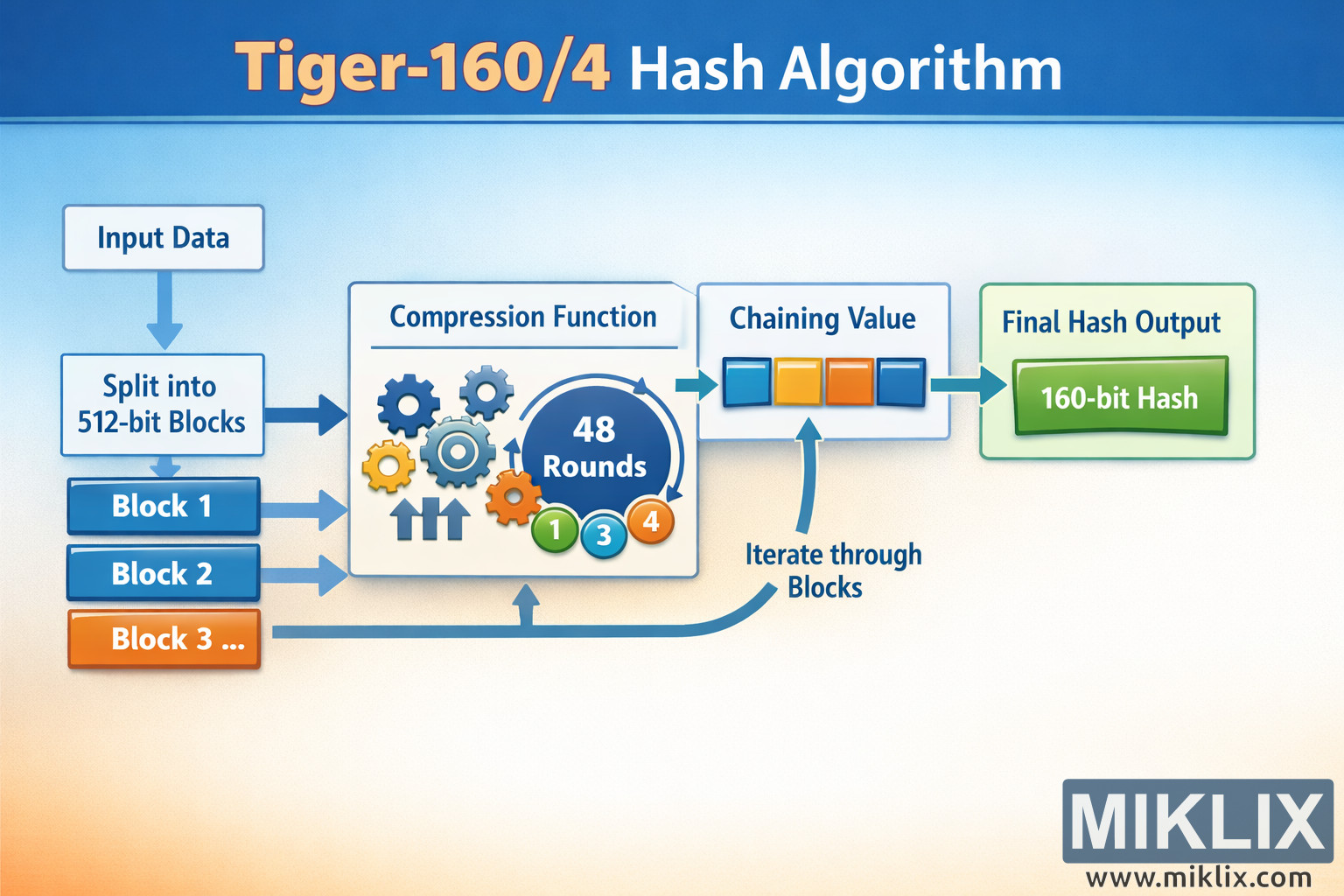
A clear, non-technical infographic of the Tiger-160/4 hashing process, illustrating input blocks flowing through an abstract multi-round compression function to produce a 160-bit digest, without including potentially inaccurate algorithm internals.

Available versions of this image
The image files available for download below are less compressed and higher resolution - and as a result of that, higher quality - than the images embedded in articles and pages on this website, which are more optimized for file size in order to reduce bandwidth consumption.
Regular size (1,536 x 1,024)


Large size (3,072 x 2,048)
Very large size (4,608 x 3,072)
Extra large size (6,144 x 4,096)
Comically large size (1,048,576 x 699,051)
- Still uploading... ;-)
Image description
The image is a landscape, infographic-style visualization labeled "Tiger-160/4" that explains a cryptographic hash workflow without diving into implementation specifics. The layout reads left to right, using simple shapes, icons, and arrows to show how data becomes a fixed-size digest.
On the far left, a rounded rectangle titled "Input" contains a generic document/data icon and a few short lines suggesting "message" or "data". A bold arrow points from this input panel into the next section, where the message is depicted as being split into multiple uniform pieces. This section is labeled "Block preparation" (or similar) and shows a small stack or row of equally sized tiles/cards representing data blocks. The tiles are intentionally unlabeled beyond neutral placeholders (e.g., "Block 1", "Block 2", "Block 3", "..."), emphasizing the concept of chunking rather than any exact block size.
From the block tiles, several arrows converge into a larger central processing area. This centerpiece is a prominent box labeled "Hashing process" or "Compression function" with an additional tag like "Abstract rounds". Around or within the box, the graphic indicates repeated processing using a short loop arrow or a sequence of identical markers (for example, four rounded badges or four small dots) accompanied by wording such as "multiple rounds" or "repeat". The design deliberately avoids technical detail: there are no constants, no equations, no named internal variables, and no precise step counts beyond the high-level notion of repetition.
Inside the central box, the flow is represented by a simple internal path: data enters at the left edge of the box, passes through a stylized "mixing" area (often shown as a swirl, interlocking shapes, or a set of crossing arrows), and exits on the right. The mixing icon communicates diffusion and transformation visually, but remains generic so it cannot be mistaken for an exact specification.
To reinforce the idea of iterative processing, a smaller side element appears adjacent to the main box: a compact panel labeled "State" or "Internal state" with a few neutral bars or squares, linked by arrows to the hashing box. This suggests that each block updates an evolving state, but again provides no algorithm-specific state size or structure.
On the right side of the image, an arrow leads from the hashing box to a final output panel labeled "Output digest" or "Hash". The output is explicitly described as "160-bit" in a simple callout, and the digest is illustrated as a short hexadecimal placeholder string (for example, "AB12…EF90") inside a monospace-style capsule. The placeholder includes an ellipsis to indicate length without committing to exact formatting. Near the output, a brief note emphasizes properties like "fixed-length result" and "same input → same output" using short, general statements.
The overall style is clean and modern: soft neutral colors, consistent line weights, ample white space, and minimal text. Arrows are clear and directional, and section headers are concise. Any decorative elements (such as subtle grids, faint circuit patterns, or gentle gradients) are understated to keep the focus on the conceptual flow. The entire image prioritizes readability and conceptual accuracy, presenting Tiger-160/4 as a pipeline from input data, to block handling, to an abstract multi-round compression stage, ending with a 160-bit hash digest—without embedding details that could be inaccurate or misleading.
The image is related to: Tiger-160/4 Hash Code Calculator