
Image: Tiger-192/4 Hash Algorithm (Conceptual Flow Diagram)
Published: January 9, 2026 at 10:35:21 PM UTC
Last updated: January 9, 2026 at 10:38:12 PM UTC
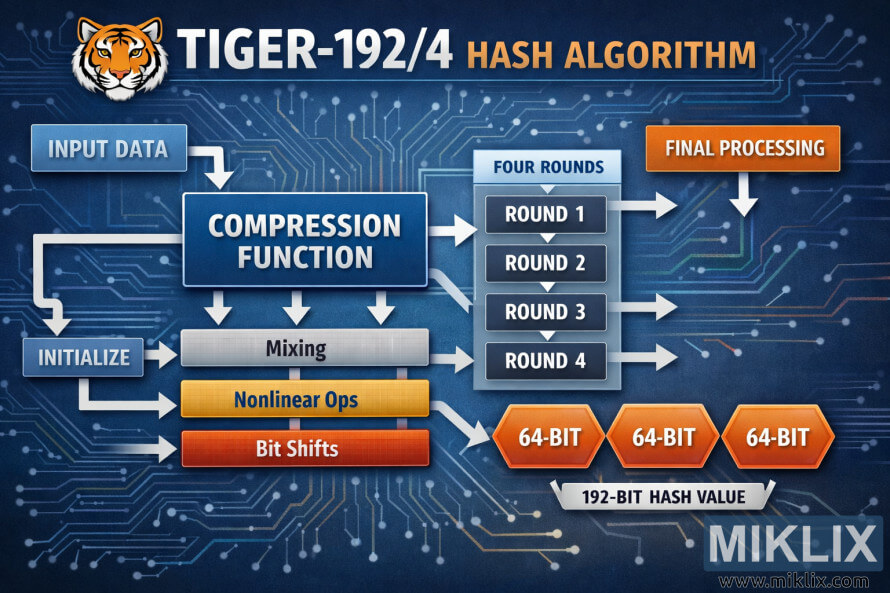
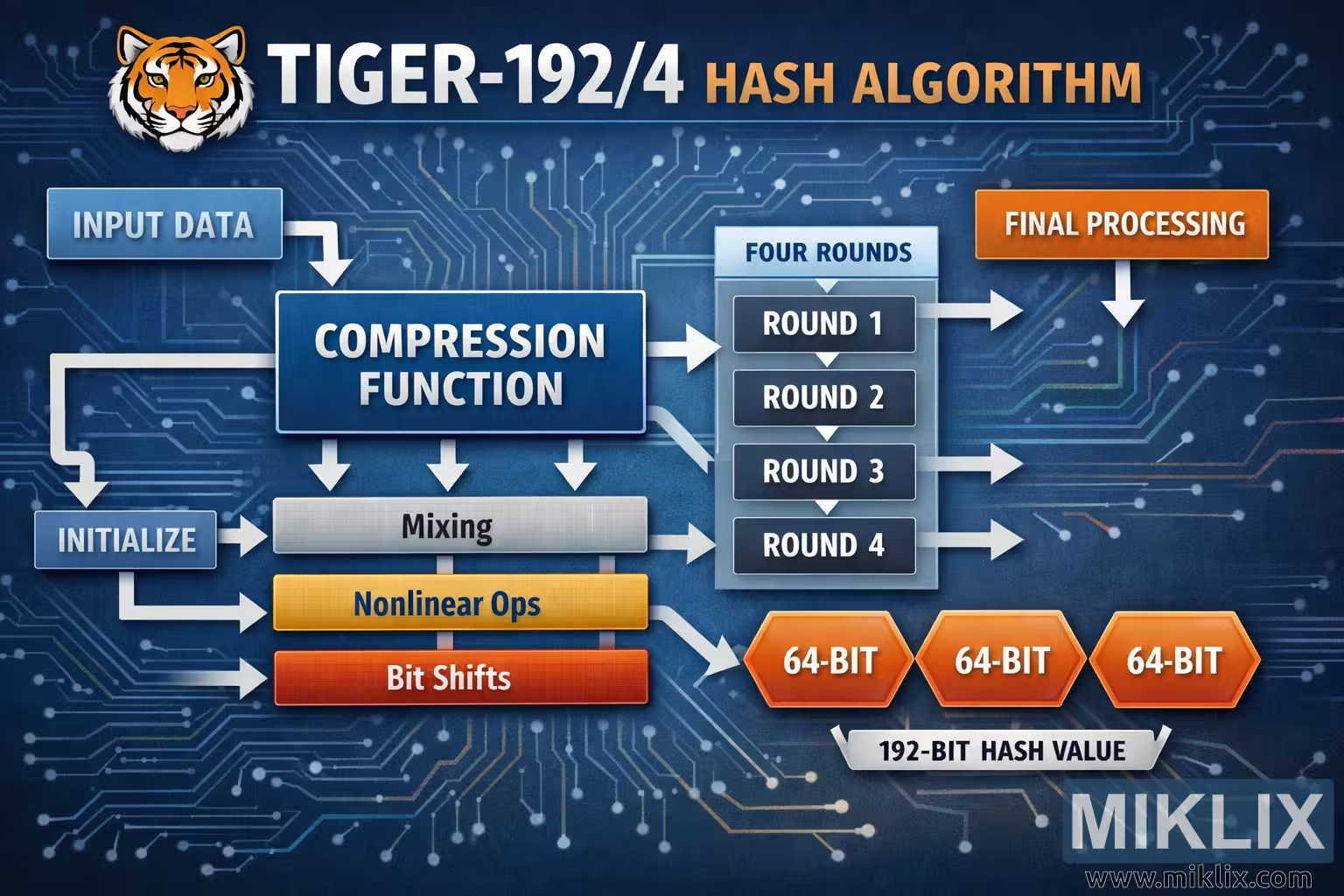
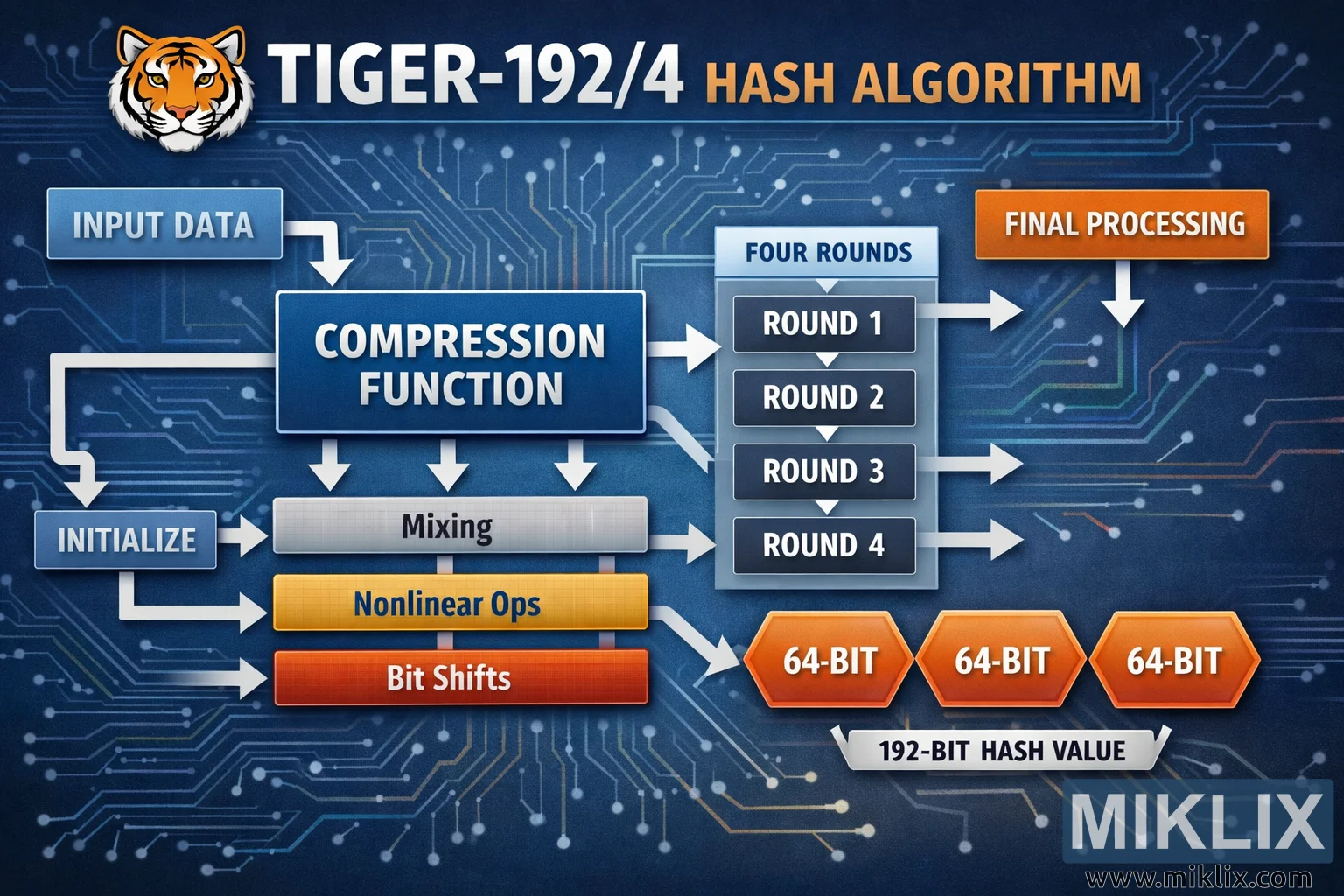
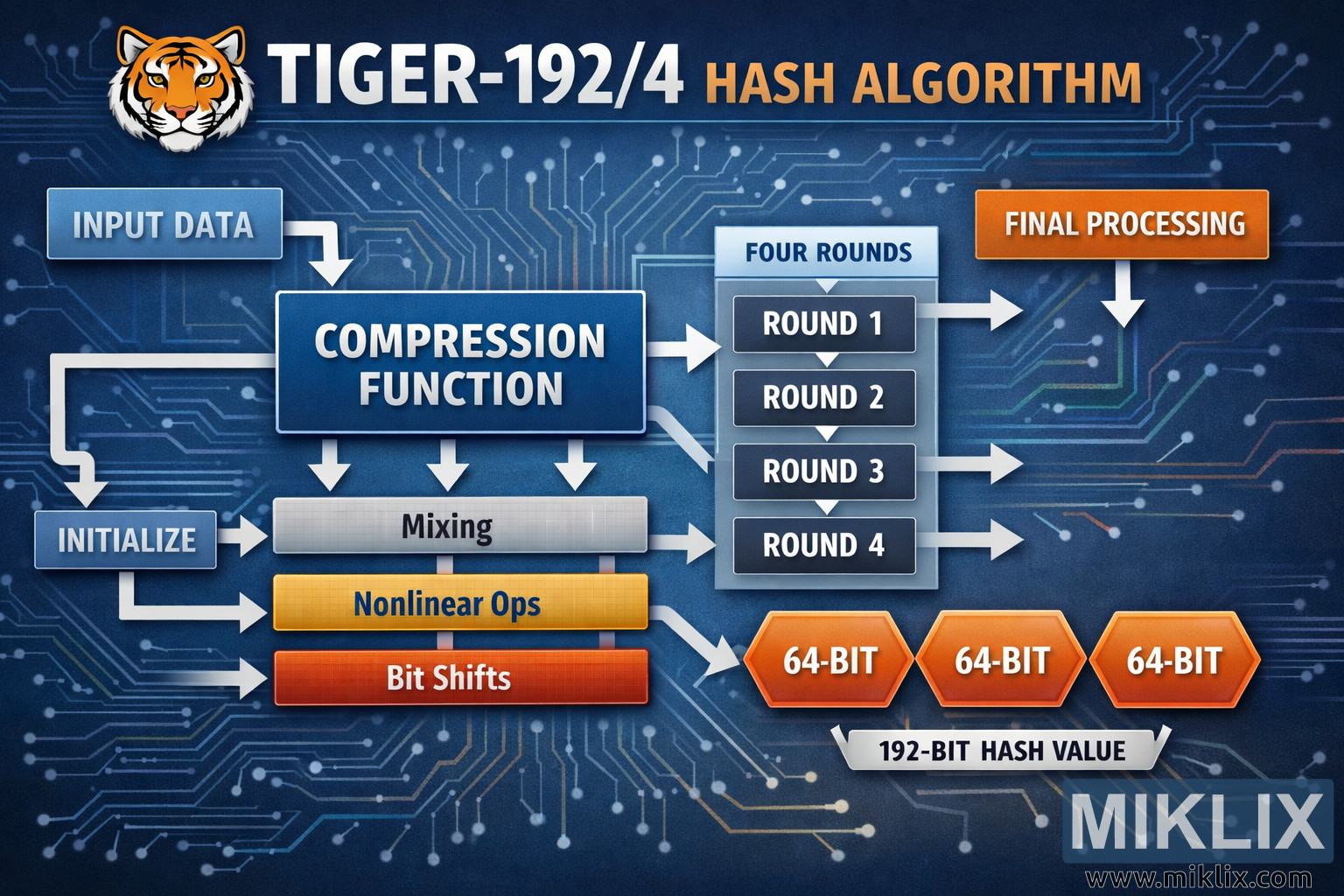
A clean, high-tech visualization of the Tiger-192/4 hash concept, showing left-to-right data flow from abstract inputs through staged processing blocks to a final digest output.
Available versions of this image
The image files available for download below are less compressed and higher resolution - and as a result of that, higher quality - than the images embedded in articles and pages on this website, which are more optimized for file size in order to reduce bandwidth consumption.
Regular size (1,536 x 1,024)
Large size (3,072 x 2,048)
Very large size (4,608 x 3,072)
Extra large size (6,144 x 4,096)
Comically large size (1,048,576 x 699,051)
- Still uploading... ;-)
Image description
Landscape infographic illustrating a conceptual “Tiger-192/4” hash pipeline in a dark, high-tech style. Across the top, a bold header spans nearly the full width, combining a small tiger head emblem at the far left with large, blocky lettering that suggests the algorithm name and a short numeric suffix; the exact characters are stylized and softly blurred, communicating the theme without committing to specific, potentially inaccurate text. Beneath this title area, a long translucent strip stretches from left to right like a data bus, filled with repeated barcode-like ticks and faint vertical marks that resemble streams of bytes. On the left side of the composition, stacked white panels act as input and reference blocks. Each panel contains minimal, abstract markings—short bars, tiny dots, and faint lines—evoking message fragments, padding, and metadata without spelling out concrete values. Thin connectors extend from these panels toward the center, where the main processing area forms a grid of rounded rectangles arranged like a flowchart. The boxes vary in size and opacity: some look like stages, others like internal buffers, and several are grouped to imply repeated rounds. Soft orange outlines and corner highlights trace the edges of the grid, suggesting routing paths and state movement through the system. A few narrow horizontal capsules within the grid resemble registers, while small blocks near intersections imply mixing steps, substitutions, or additions, but the illustration stays intentionally generic and symbolic. On the right half, the connectors converge into a brighter region, indicating aggregation and finalization. An orange label panel sits prominently to the mid-right, representing the output digest or final hash result; its lettering is also stylized rather than perfectly legible. Nearby, white output cards echo the input panels and include more barcode-like stripes, reinforcing the idea of a fixed-length digest. At the bottom, a long white band runs across the canvas, again filled with dense vertical ticks like an encoded summary, while the background remains a deep navy and charcoal gradient with faint circuitry textures and soft glow effects. The overall layout reads left-to-right: inputs enter, are transformed through layered stages, and emerge as a compact, deterministic output. The design emphasizes conceptual clarity—data flow, staged transformation, and a final digest—while deliberately avoiding exact constants, bit counts, or round-specific details that could be misleading. Small decorative details aid readability: divider lines separate the side panels, and soft drop shadows lift key blocks so the arrows are easy to trace. Bold, geometric type and strong contrast between white panels and orange accents guide the eye along the “active” path. The diagram is presented as an educational overview rather than a specification, keeping labels broad—input, stages, state, output—so it stays credible across different implementations.
The image is related to: Tiger-192/4 Hash Code Calculator