
Image: Understanding the XXH3-64 Hash Algorithm at a Glance
Published: January 9, 2026 at 9:02:51 PM UTC
Last updated: January 9, 2026 at 9:03:14 PM UTC
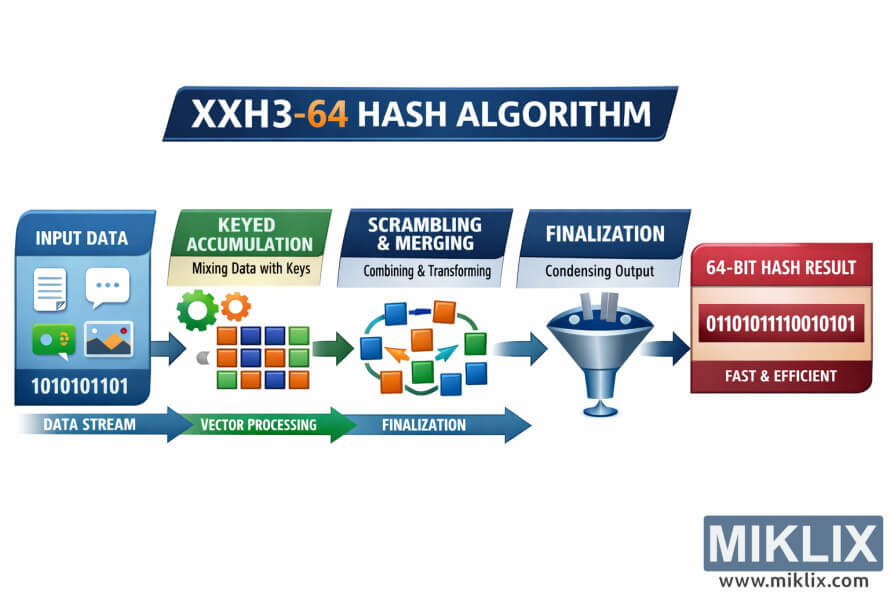
A clear, non-technical visualization of the XXH3-64 hash algorithm, illustrating how input data is mixed, transformed, and condensed into a fast 64-bit hash output.
Available versions of this image
The image files available for download below are less compressed and higher resolution - and as a result of that, higher quality - than the images embedded in articles and pages on this website, which are more optimized for file size in order to reduce bandwidth consumption.
Regular size (1,536 x 1,024)
Large size (3,072 x 2,048)
Very large size (4,608 x 3,072)
Extra large size (6,144 x 4,096)
Comically large size (1,048,576 x 699,051)
- Still uploading... ;-)
Image description
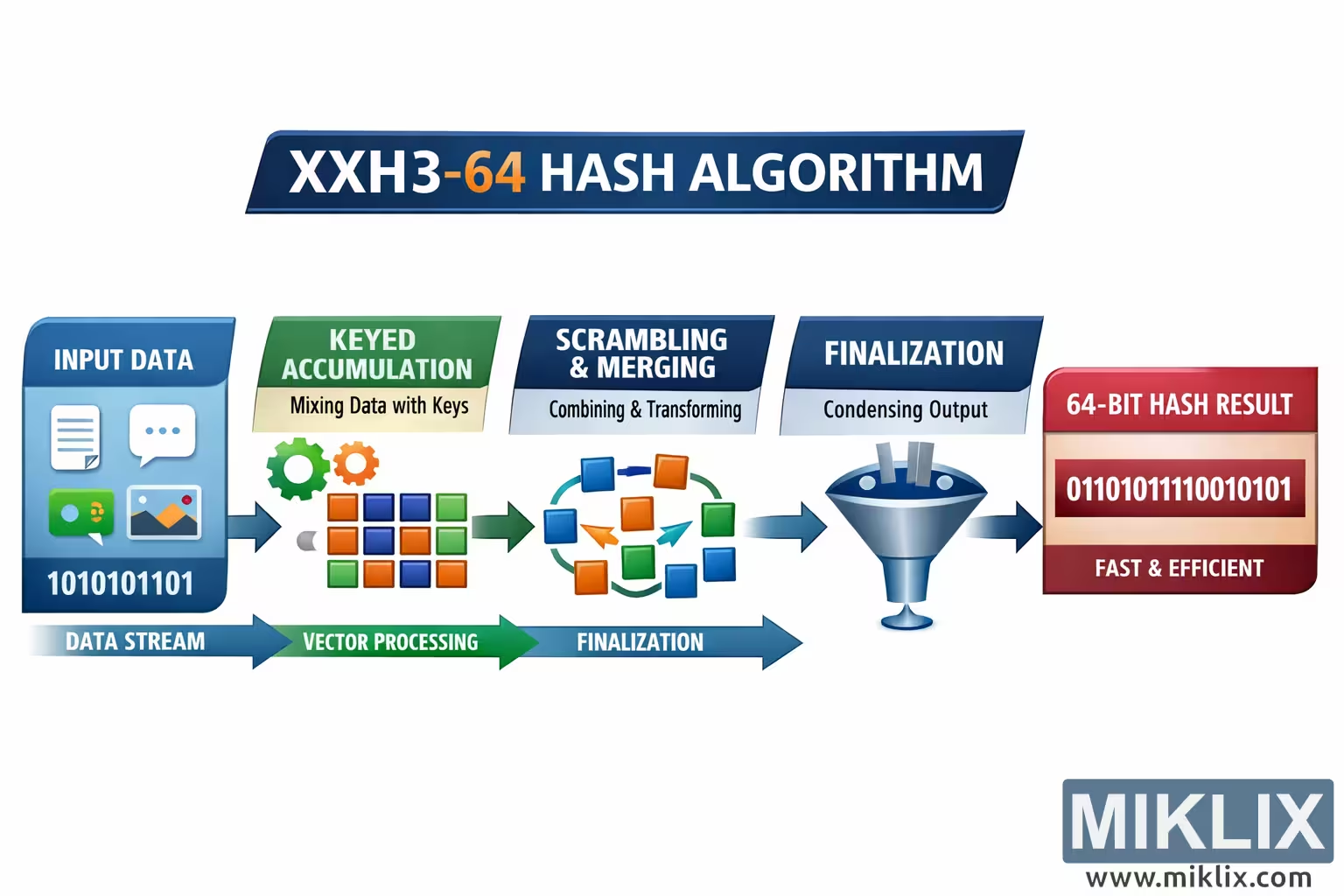
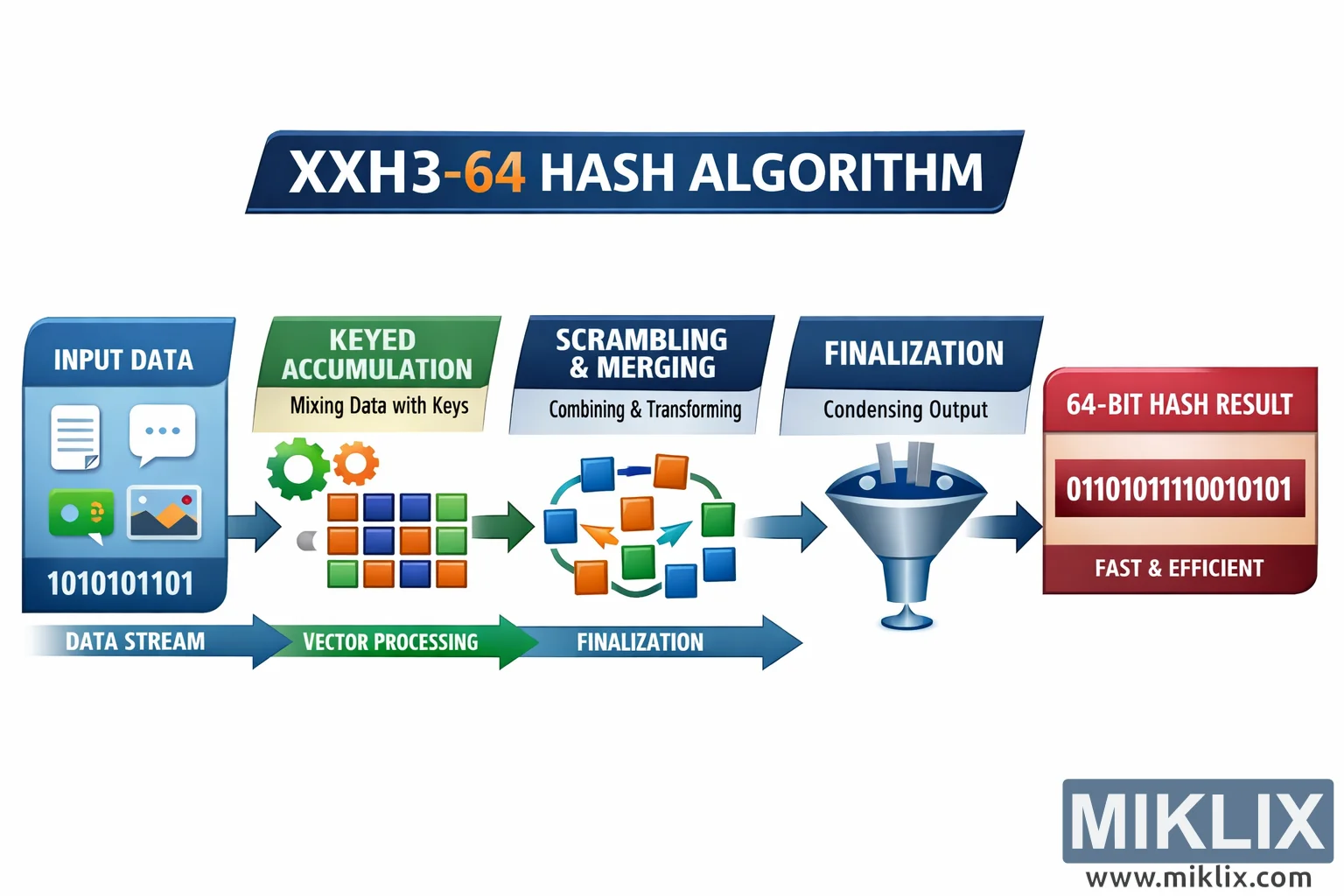
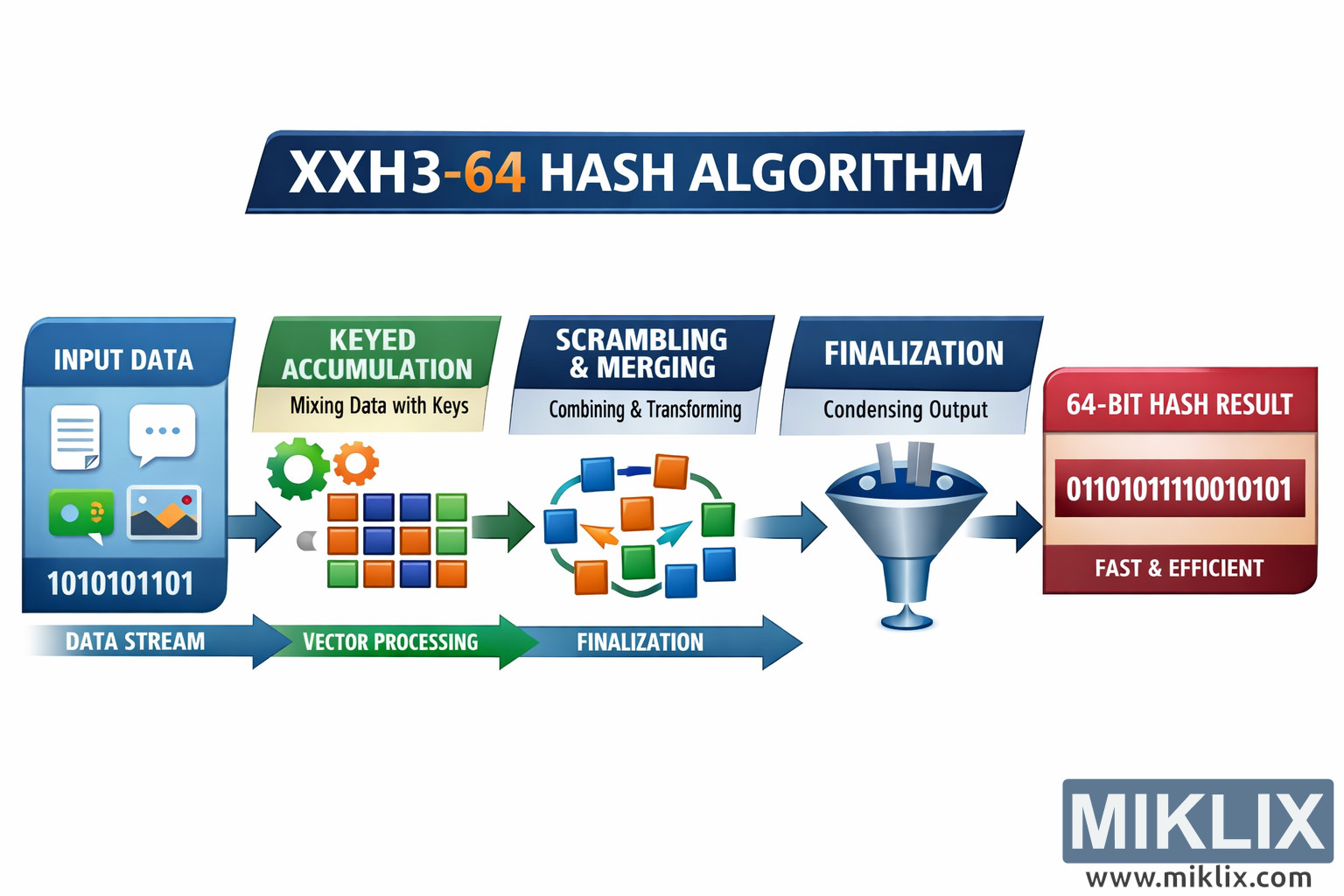
The image is a wide, landscape-oriented infographic that presents a simplified, conceptual visualization of the XXH3-64 hash algorithm. At the very top, a large blue banner spans almost the full width of the canvas and contains the title “XXH3-64 HASH ALGORITHM,” with the “64” highlighted in orange to draw attention to the output size. Below the title, the diagram is laid out horizontally from left to right, guiding the viewer through the main processing stages using bold arrows and clearly separated panels.
On the far left is a tall blue panel labeled “INPUT DATA.” Inside this panel are small, generic icons representing different kinds of information, such as a text document, a chat bubble, a small application window, and an image thumbnail, indicating that the algorithm can accept arbitrary binary data. Near the bottom of this panel is a short binary string, reinforcing the idea that all inputs are treated as raw bits. Beneath the panel, a long arrow labeled “DATA STREAM” points to the right, indicating the flow of information through the algorithm.
The next stage is a green and cream-colored block labeled “KEYED ACCUMULATION,” with a subtitle reading “Mixing Data with Keys.” Under this header are stylized gears and a grid of colored squares. The gears imply mechanical mixing, while the grid of blocks suggests chunks of data being combined with internal constants or keys. This entire block visually communicates that the input data is first blended and accumulated rather than passed through unchanged.
To the right of this is a dark blue block titled “SCRAMBLING & MERGING,” with a smaller subtitle “Combining & Transforming.” Inside this section, a ring of colored squares is shown rotating with curved arrows between them. The circular motion and arrows emphasize reordering, diffusion, and transformation of intermediate values. This step is framed as a high-level scrambling phase without exposing any low-level or potentially inaccurate technical details.
Continuing rightward, the diagram shows a block labeled “FINALIZATION,” with the subtitle “Condensing Output.” The illustration inside this panel is a metallic funnel with multiple bars dropping into it. The funnel metaphor represents the idea of reducing a large, complex internal state into a compact final value. The arrow leaving this stage points to the final result panel.
On the far right is a red panel titled “64-BIT HASH RESULT.” In its center is a long binary-style number string displayed in white on a darker red background, symbolizing the final hash value. At the bottom of this panel is the phrase “FAST & EFFICIENT,” summarizing the intended performance characteristics of the algorithm.
Along the bottom of the overall diagram, a set of long horizontal arrows labeled “VECTOR PROCESSING” and “FINALIZATION” reinforce the notion of a multi-stage pipeline. The overall color palette uses blues, greens, and reds to clearly separate phases, while arrows and spacing guide the reader naturally from input on the left to output on the right. The entire visualization is designed to be easy to understand at a glance, presenting the algorithm as a clean, linear flow of mixing, scrambling, and condensing, without relying on any precise or potentially misleading implementation details.
The image is related to: XXH3-64 Hash Code Calculator