
Imagen: Step-by-Step Honeydew Melon Cutting Techniques Demonstration
Publicado:
Última actualización: 20 de agosto de 2026, 14:16:15 UTC
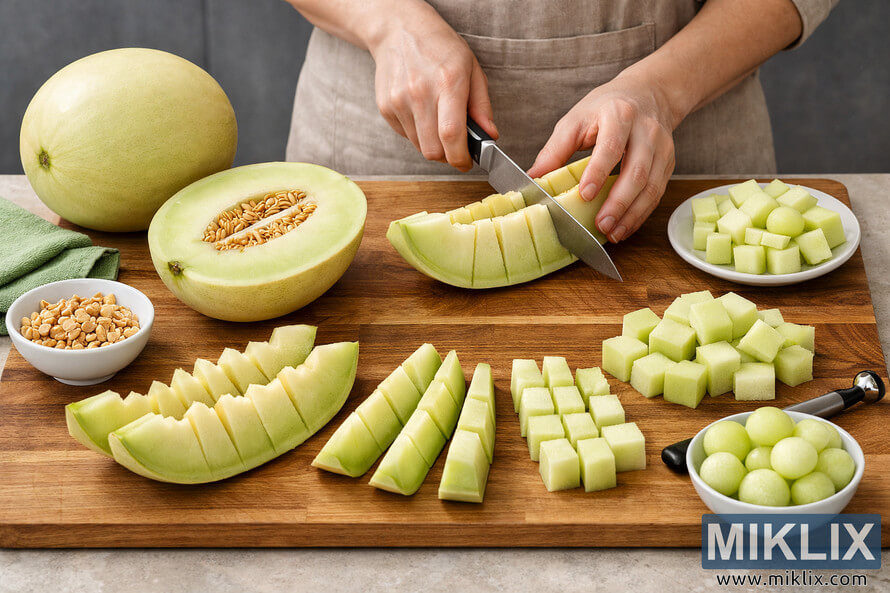
A detailed, high-resolution honeydew melon cutting demonstration shows a person in a beige apron slicing a halved melon on a wooden cutting board. The image features a whole melon, seeded halves, wedges, spears, cubes, and melon balls arranged neatly with a chef’s knife, a melon baller, a bowl of seeds, and a light green kitchen towel on a light countertop, highlighting multiple cutting techniques and presentation styles.
Step-by-Step Honeydew Melon Cutting Techniques Demonstration
Versiones disponibles de esta imagen
Los archivos de imagen que se pueden descargar a continuación están menos comprimidos y tienen mayor resolución -y, por tanto, mayor calidad- que las imágenes incrustadas en artículos y páginas de este sitio web, cuyo tamaño está más optimizado para reducir el consumo de ancho de banda.
Talla normal (1,536 x 1,024)
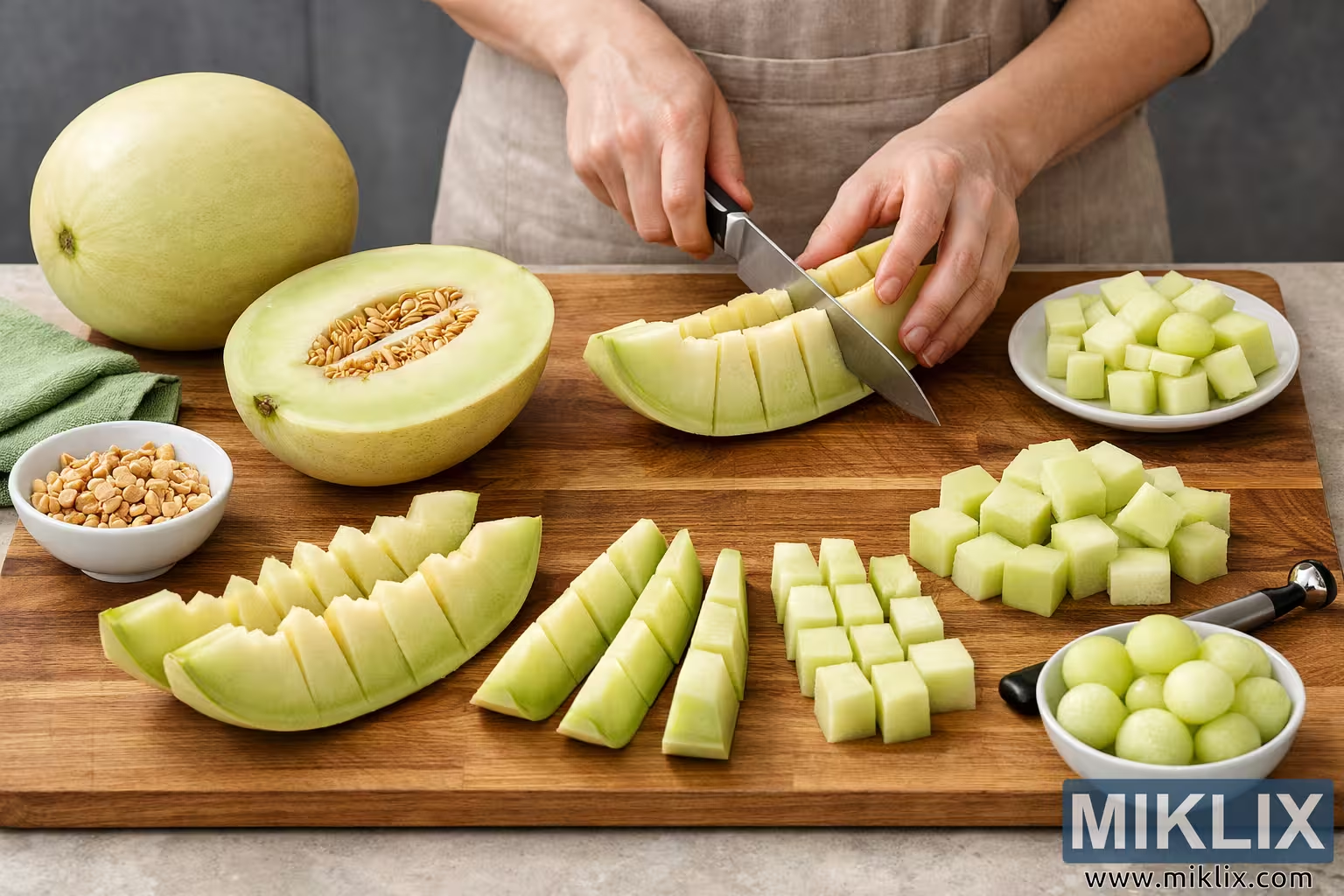
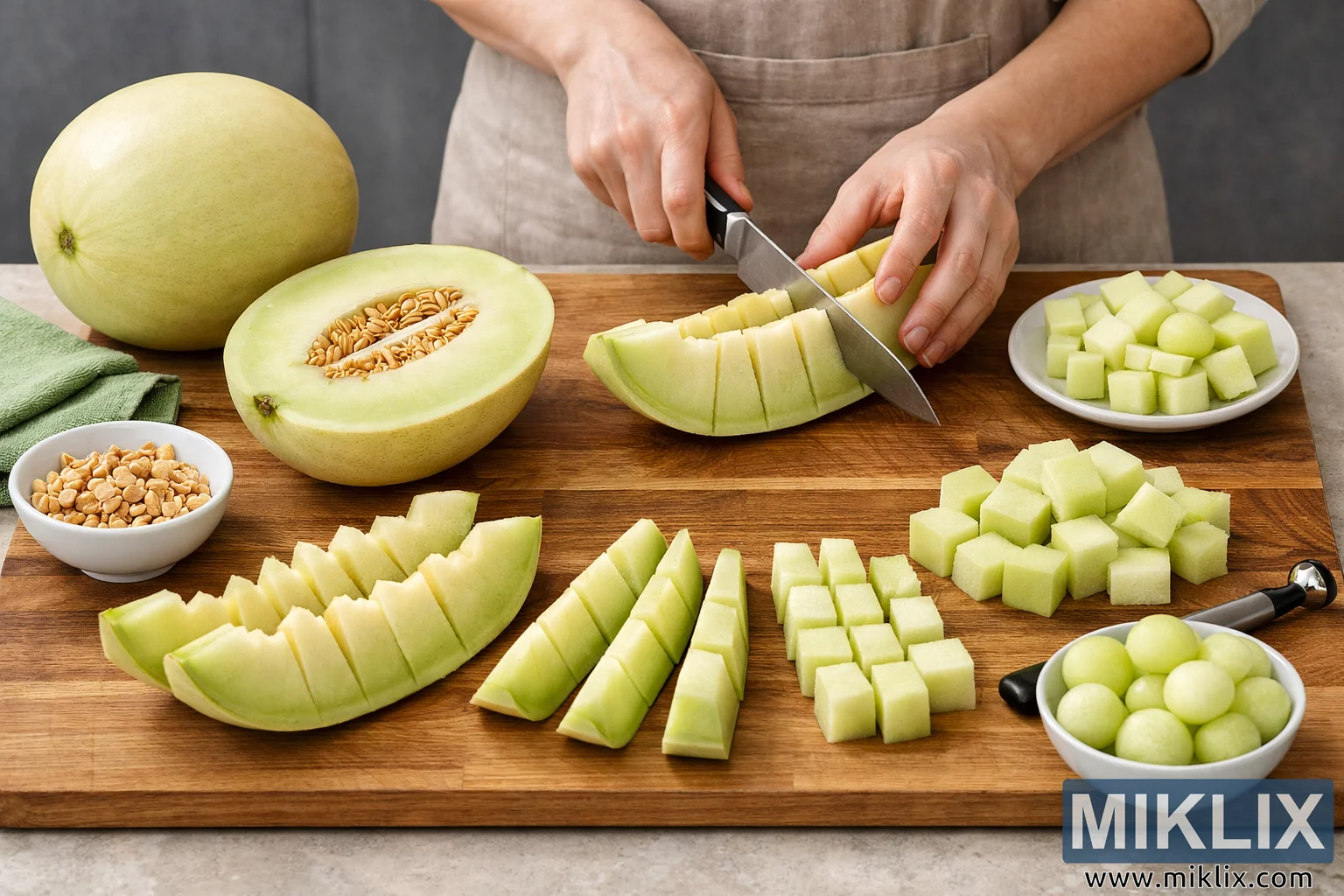
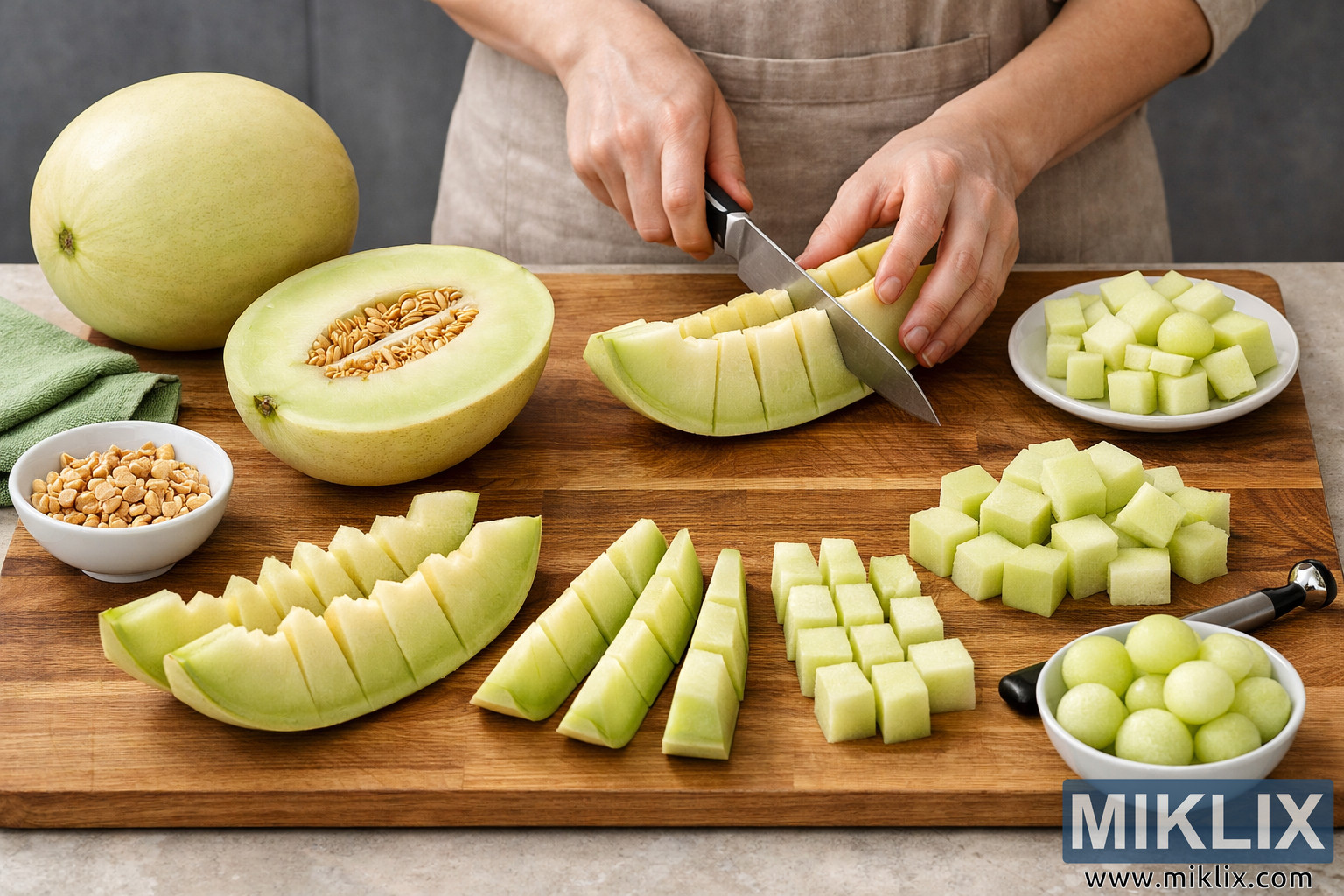
Tamaño grande (3,072 x 2,048)
Tamaño muy grande (4,608 x 3,072)
Tamaño extragrande (6,144 x 4,096)
Tamaño cómicamente grande (1,048,576 x 699,051)
- Sigo subiendo... ;-)
Descripción de la imagen
A high-resolution digital photograph captures a detailed, step-by-step demonstration of honeydew melon cutting techniques on a wooden cutting board with a rich, natural grain. The cutting board sits on a light-colored countertop that suggests a clean, modern kitchen environment. The overall composition is carefully arranged to showcase not only the cutting process itself, but also the variety of possible cuts and presentations that can be achieved with a single honeydew melon.
In the center of the image, a person wearing a simple beige apron is partially visible from the torso down. Their face is intentionally out of frame, keeping the focus on their hands and the melon. The person’s left hand is gently but firmly holding a halved honeydew melon in place on the cutting board, fingers curved slightly to keep a safe distance from the blade. Their right hand is gripping a chef’s knife with a stainless steel blade and a black handle, poised in mid-cut as it slices through the pale green flesh of the melon near the seed cavity. The knife angle and hand positioning subtly demonstrate proper cutting technique, suggesting both control and precision.
On the left side of the cutting board, a whole honeydew melon rests with its smooth, pale greenish-yellow rind intact. The melon’s surface is unblemished, giving it a fresh, appealing look. Next to the whole melon is a halved melon, its interior exposed to reveal the soft, pale green flesh and a central seed cavity filled with light golden seeds attached to a fibrous, pale orange membrane. The contrast between the rind and the flesh highlights the melon’s natural color gradient. Just to the left of the cutting board, a small white bowl holds a collection of seeds that have already been scooped out, showing one of the early steps in preparing the fruit. Beside the bowl, a folded light green kitchen towel adds a subtle touch of color and texture, reinforcing the fresh, clean atmosphere.
The cutting board itself is a central stage for the demonstration, displaying multiple styles of cuts and arrangements. In the top section of the board, several types of honeydew slices are laid out in an orderly fashion. On the far left, long wedges of melon with the rind still attached are arranged in a neat row, each wedge showing the transition from rind to flesh. In the center, melon slices have been cut into elongated spears, their uniform shape suggesting they might be ideal for snacking or for use in fruit platters. On the right side of the top section, small, evenly cut honeydew cubes are neatly piled on a small white plate, ready to be served or used in fruit salads.
In the foreground, closer to the viewer, the cutting board displays even more variety. On the left side, fan-like slices of honeydew are arranged in a visually pleasing row, each slice slightly overlapping the next. This arrangement emphasizes the delicate translucence of the melon flesh and the gentle curve of each piece. To the right of these fan slices, a series of melon spears are aligned in parallel, their straight edges and consistent thickness demonstrating careful knife work. Further to the right, a small pile of honeydew cubes is gathered, each cube cut to a similar size, suggesting attention to detail and an emphasis on uniformity.
On the far right side of the frame, just beyond the cutting board, a small white bowl is filled with honeydew melon balls. These balls are pale green, smooth, and perfectly round, indicating that they were shaped using a melon baller. Next to the bowl lies a stainless steel melon baller with a black handle, reinforcing the idea that multiple tools can be used to achieve different textures and shapes from the same fruit. The presence of the melon baller and the bowl of melon balls adds another dimension to the demonstration, showing that honeydew can be prepared not only in slices and cubes, but also in decorative spheres suitable for elegant presentations.
The person’s hands remain the focal point of the cutting action. The left hand stabilizes the halved melon, while the right hand guides the knife through the flesh. The knife is captured mid-motion, cutting near the seed cavity, suggesting that the person is in the process of creating wedges that will later be trimmed or further sliced. The positioning of the hands and the knife subtly conveys safe cutting practices, such as keeping fingers curled away from the blade and maintaining a firm grip on both the knife and the fruit.
The lighting in the photograph is bright and even, illuminating the entire scene without harsh shadows. This lighting highlights the natural colors of the honeydew melon—the soft, pale green flesh, the slightly deeper green near the rind, and the warm golden tones of the seeds. The wooden cutting board’s grain is clearly visible, adding warmth and a sense of craftsmanship to the image. The light-colored countertop and neutral background keep the focus on the cutting board and the melon, avoiding distractions and emphasizing the instructional nature of the scene.
The depth of field is moderate, ensuring that the cutting process, the person’s hands, and the various melon pieces are all sharply in focus. This clarity allows viewers to see the details of each cut, from the fan-like slices to the cubes and melon balls. The arrangement of the different cuts on the board serves as a visual guide, demonstrating the progression from whole melon to halved, seeded, sliced, speared, cubed, and balled. The image effectively communicates that a single fruit can be transformed into multiple shapes and textures, each suitable for different culinary uses.
Overall, the photograph functions as both an aesthetically pleasing still life and a practical demonstration of honeydew melon cutting techniques. The careful composition, the variety of cuts, and the focus on the hands and tools all work together to create an image that is informative, inviting, and visually rich. It encourages viewers to appreciate the versatility of honeydew melon and to consider how thoughtful preparation can enhance both the presentation and enjoyment of this refreshing fruit.
La imagen está relacionada con: Honeydew Melon: The Refreshing Fruit Packed with Nutrients