
Image: Burdock Plants Thriving Across Diverse Climate Conditions
Published: March 12, 2026 at 3:15:48 PM UTC
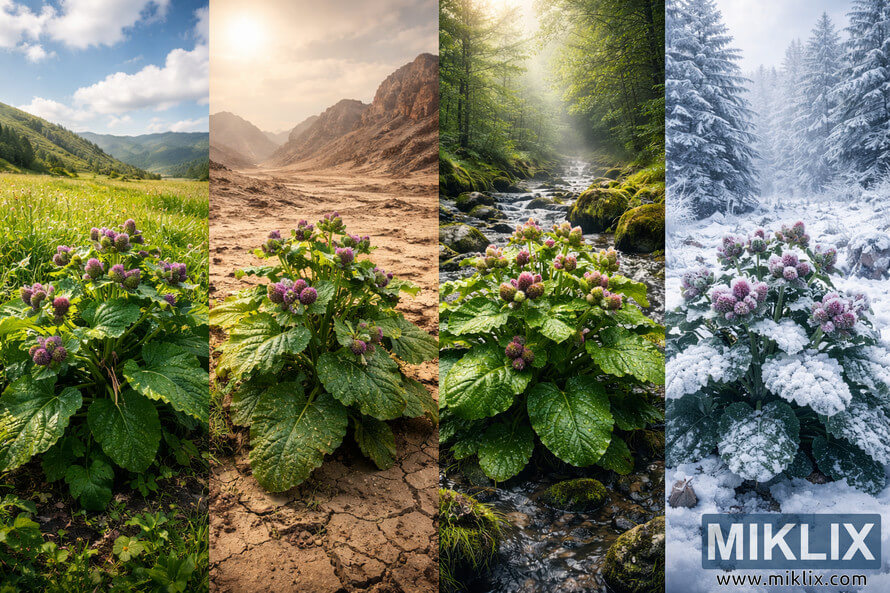
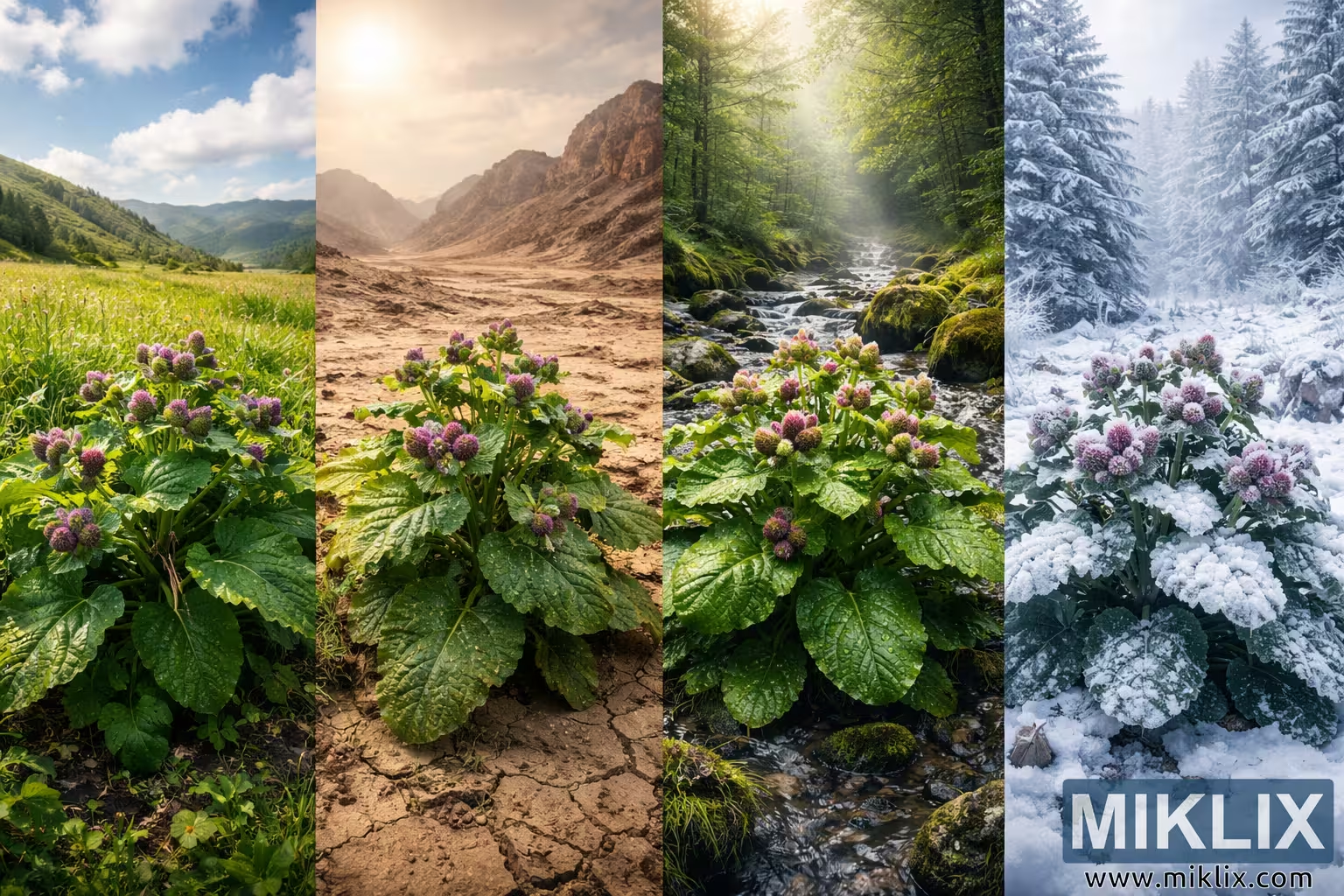
High-resolution landscape image of burdock plants growing in contrasting climate conditions, from dry plains to cool mountains, highlighting their environmental adaptability.
Available versions of this image
The image files available for download below are less compressed and higher resolution - and as a result of that, higher quality - than the images embedded in articles and pages on this website, which are more optimized for file size in order to reduce bandwidth consumption.
Regular size (1,536 x 1,024)
Large size (3,072 x 2,048)
Very large size (4,608 x 3,072)
Extra large size (6,144 x 4,096)
Comically large size (1,048,576 x 699,051)
- Still uploading... ;-)
Image description
A high-resolution landscape-oriented photograph captures a sweeping panorama of burdock plants (Arctium) flourishing across dramatically different climate zones within a single continuous scene. The composition is divided naturally by subtle shifts in terrain and atmosphere, illustrating the plant’s remarkable adaptability.
On the left side of the image, burdock plants grow in a dry, sunlit environment reminiscent of semi-arid plains. The soil appears sandy and light brown, textured with small stones and sparse grasses. Despite the dryness, the burdock plants stand resilient, their broad, slightly wilted green leaves showing minor dust accumulation yet maintaining structural integrity. Their thick stems rise upright, and several spiny burr seed heads cling firmly, suggesting successful reproduction even in harsher conditions. The sunlight is warm and golden, casting defined shadows that emphasize the rugged texture of the ground and the toughness of the foliage.
Toward the center, the environment transitions into a temperate meadow with rich, dark soil and moderate moisture. Here, the burdock plants appear especially vigorous. Their leaves are expansive, deeply veined, and a saturated green, spreading outward in layered clusters. The stems are sturdy and upright, supporting numerous round burrs that catch the light. Surrounding vegetation includes wild grasses and small flowering plants, adding subtle hints of purple and yellow. The sky above is partly cloudy, with soft white clouds diffusing the sunlight and creating balanced, natural illumination. This central section conveys optimal growing conditions and showcases the plant at its most robust.
On the right side, the scene shifts again, this time toward a cooler, mountainous climate. The background rises into gentle slopes with distant blue-gray peaks partially veiled in light mist. The soil here is darker and slightly rocky, with patches of moss and low groundcover. The burdock plants in this section are somewhat shorter but denser, their leaves thicker and slightly curled at the edges, suggesting adaptation to cooler temperatures and brisk winds. The lighting is cooler as well, with a faint bluish tone that contrasts subtly with the warmer hues on the left. A light breeze appears to move through the foliage, giving a sense of vitality and endurance.
Across the entire panorama, the continuity of the burdock species visually unifies the diverse environments. The repeated forms of large heart-shaped leaves and spherical burr seed heads create a rhythm that draws the eye from one climate zone to the next. The image emphasizes resilience, ecological versatility, and natural strength, presenting burdock not merely as a wild plant but as a symbol of botanical adaptability. The overall clarity and fine detail—visible leaf veins, soil granularity, and atmospheric depth—reinforce the high-resolution quality and immersive realism of the scene.
The image is related to: Growing Burdock: Your Complete Guide from Seed to Harvest