
Hops in Beer Brewing: Golding (US)
પ્રકાશિત:
છેલ્લે અપડેટ કરેલ: 21 મે, 2026 એ 04:05:01 PM UTC વાગ્યે
Golding (US) hops hold a pivotal yet understated role in American craft brewing. This piece aims to enlighten growers, homebrewers, professional brewers, and ingredient buyers. It focuses on the refined, traditional English hops character available in the United States.
Hops in Beer Brewing: Golding (US)
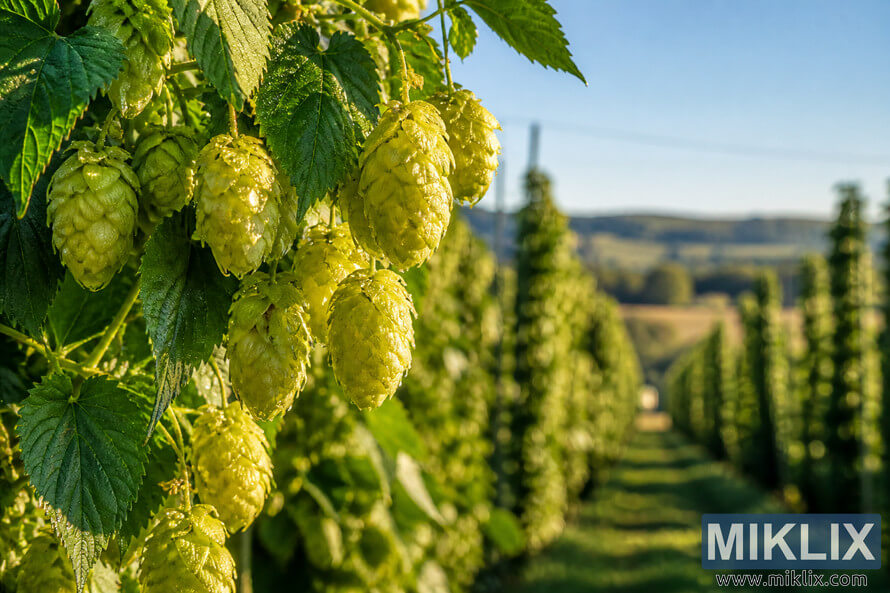
વધુ માહિતી અને ઉચ્ચ રિઝોલ્યુશન માટે છબી પર ક્લિક કરો અથવા ટેપ કરો.
Key Takeaways
- Golding (US) hops bring a gentle, floral Golding hop aroma ideal for traditional English-style beers.
- US Golding is suited to late additions and dry hopping when subtle aroma is desired.
- Brewers value Golding hops for balance rather than bold bitterness.
- Availability in whole-cone and pellet forms makes sourcing straightforward for U.S. brewers.
- Matching Golding hops with restrained malts and English yeast highlights its classic character.
History and Origin of Golding Hops
The tale of Golding hops starts in England in the 18th century. Growers chose varieties for their delicate aroma and balanced bitterness. Over time, Golding became essential for traditional British ales. It's celebrated for its floral and honeyed notes, perfect for cask-conditioned beer.
Golding's history is closely tied to East Kent Golding, a key ancestor. It's known for its stable aroma and reliable crop traits. Brewers and growers documented its lineage as East Kent selections spread through Kentish farms. They became linked with local brewing practices.
English roots and 18th-century lineage
Records indicate Golding varieties emerged from small English hop gardens and nurseries. Growers sought plants with gentle, refined aromas for pale ales, bitters, and milds. These early choices shaped the English hop heritage in farmhouse and brewery use.
Development of US Golding strains and synonyms (Early Bird, Eastwell, Mathon)
Hop cultivation expanded beyond Britain, leading to the selection of strains adapted to new climates. US-grown Golding strains were given local names and synonyms. Common aliases include Early Bird, Eastwell, and Mathon, reflecting regional selection and propagation practices.
How Golding connects to traditional British brewing heritage
Golding became crucial in classic recipes for ordinary bitters and cask ales. Its consistent use in bitters, porters, and milds connects modern brewing to historic practices. Today, brewers seeking authenticity still choose Golding. It helps evoke the English hop heritage in balanced, traditional beers.
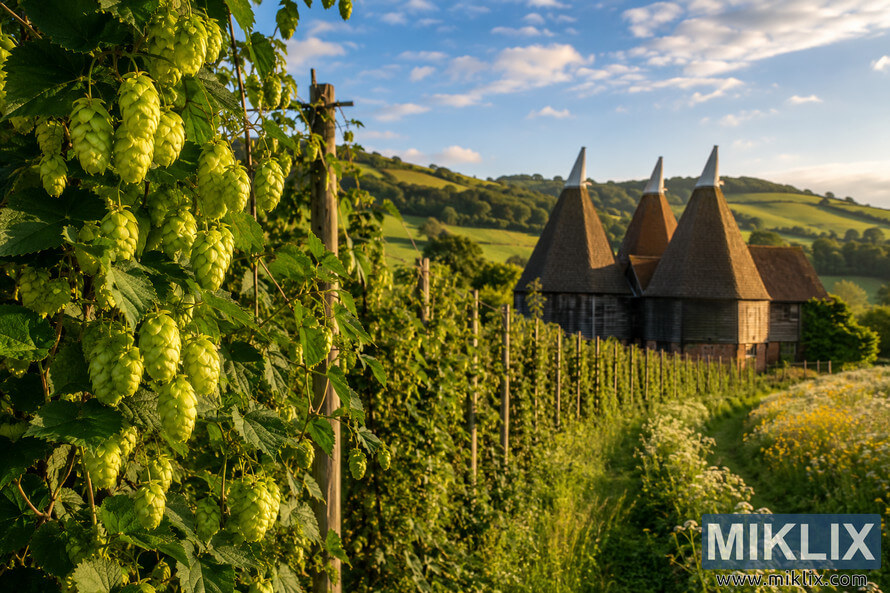
વધુ માહિતી અને ઉચ્ચ રિઝોલ્યુશન માટે છબી પર ક્લિક કરો અથવા ટેપ કરો.
Botanical and Agricultural Characteristics of Golding
Golding, a classic aroma hop, exhibits growth habits similar to other heritage varieties. Farmers employ sturdy trellis systems for bine training. They also practice seasonal pruning, irrigation, and pest management to safeguard yield and oil quality.
In U.S. conditions, Golding thrives in full-sun sites with well-drained soil. Standard bine support and timely care facilitate even cone set development. Growers closely monitor moisture and leaf health to protect the delicate aromatic oils.
Harvest timing for Golding in the United States typically starts in mid-to-late August. The timing can vary based on microclimate and year. Many farms adopt staged harvesting to capture the optimal cone maturity and preserve the aroma.
Year-to-year hop crop variability impacts both alpha acids and oil compounds. Alpha and oil ranges fluctuate with weather, soil, and harvest timing. Brewers should anticipate some variation and verify lab certificates by lot.
- Alpha and oil profiles change with seasonal stress and rainfall.
- Late-season heat spikes can concentrate alpha acids while altering oil balance.
- Cold, wet springs may reduce yield and shift aromatic character.
Golding suppliers manage inventory differences in price, formats, and harvest year. Buyers can find whole cone and pellet formats from regional hop merchants, national distributors, and online retailers.
Practical purchase steps help manage hop crop variability. Confirm the harvest year, requested alpha percentage, and chosen format before ordering. This approach minimizes the risk of freshness or profile surprises.
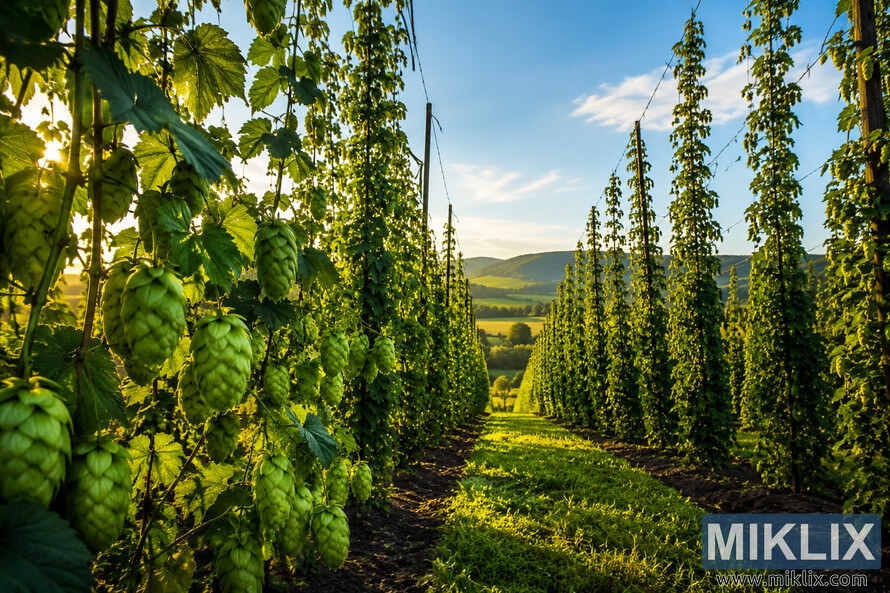
વધુ માહિતી અને ઉચ્ચ રિઝોલ્યુશન માટે છબી પર ક્લિક કરો અથવા ટેપ કરો.
Chemical Profile and Brewing Values of Golding
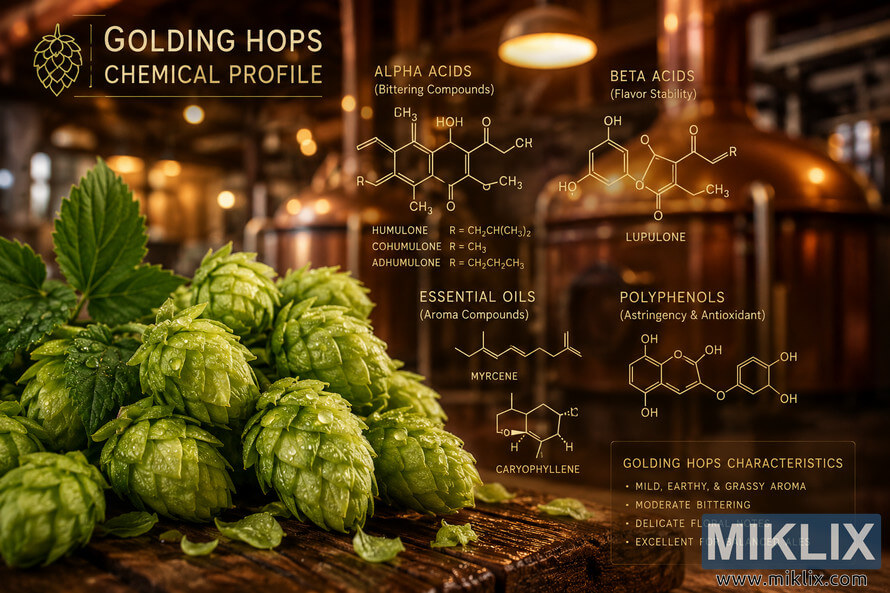
Golding hop samples consistently exhibit chemistry crucial for brewers. Lab reports typically reveal alpha acids ranging from 4–6%, averaging around 5%. Beta acids usually fall between 2–3%, averaging 2.5%. These figures are key to the Golding chemical profile, influencing bitterness and aging stability.
The alpha-beta ratio, ranging from 1:1 to 3:1, averages 2:1 for Golding. This ratio impacts bitterness and aroma development. The co-humulone share, about 20% of alpha acids, contributes to a smoother bitterness. Monitoring Golding alpha acids aids brewers in determining hop charges and boil durations.
Oils are vital for aroma. Golding's oil content typically ranges from 0.4 to 1.0 mL per 100 g, averaging 0.7 mL/100 g. This composition gives a distinct aromatic profile, especially when used in late or dry-hop phases.
Major oil fractions define the aroma. Myrcene, making up 25–35%, contributes resinous, citrus, and fruity notes. Humulene, about 35–45%, adds woody, noble, and spicy tones. Caryophyllene, at roughly 13–16%, brings peppery and herbal facets. Small amounts of farnesene and trace compounds like linalool and geraniol enhance the aroma.
- Alpha acids: 4–6% (avg ~5%)
- Beta acids: 2–3% (avg ~2.5%)
- Total oils: 0.4–1.0 mL/100 g (avg ~0.7)
- Typical oil split: myrcene ~30%, humulene ~40%, caryophyllene ~14%
Golding's moderate alpha acids make it suitable for both base and finishing hops. Its oil profile supports delicate floral, earthy, honey, and spice aromas. Understanding the hop oil composition and acid ratios is essential for balancing bitterness, aroma, and aging behavior.
વધુ માહિતી અને ઉચ્ચ રિઝોલ્યુશન માટે છબી પર ક્લિક કરો અથવા ટેપ કરો.
Aroma and Flavor Profile of Golding Hops
The Golding aroma is known for its delicate balance, adding a soft floral touch without dominating the beer. This hop is cherished for its subtlety, blending light sweetness and earthy undertones with a clean base. Its full range of nuances is best showcased in low-dose late additions or as a single-hop showcase.
Descriptors and tasting notes
- Delicate floral hops perfume with soft tea-like florals and light geranium-like hints.
- Sweet notes that read as honey and biscuit when paired with malty backbones.
- Earthy, woody edges from humulene and caryophyllene that give a restrained spice quality.
How oil composition shapes the aroma
Myrcene contributes resinous, slightly fruity undertones, often perceived as green or citrus-like in certain beers. Humulene and caryophyllene provide a woody, noble-hop and spice impression, forming a solid foundation. Minor terpenes like linalool and geraniol add floral and honey-like aspects, explaining the honey spice hop character in well-crafted pours.
Perception in tasting situations
Hop tasting Golding can vary greatly depending on the context. In open tastings, the classic floral and honey notes are often highlighted. However, in blind panels, those not expecting the traditional flavors might perceive it as generic fruit or green.
Methodology is key: using randomized descriptors and neutral glassware helps reduce bias. To truly appreciate Golding, try it in late additions or dry hopping in a neutral pale ale. This allows the floral and honey spice hops to shine without interference from other aromas.
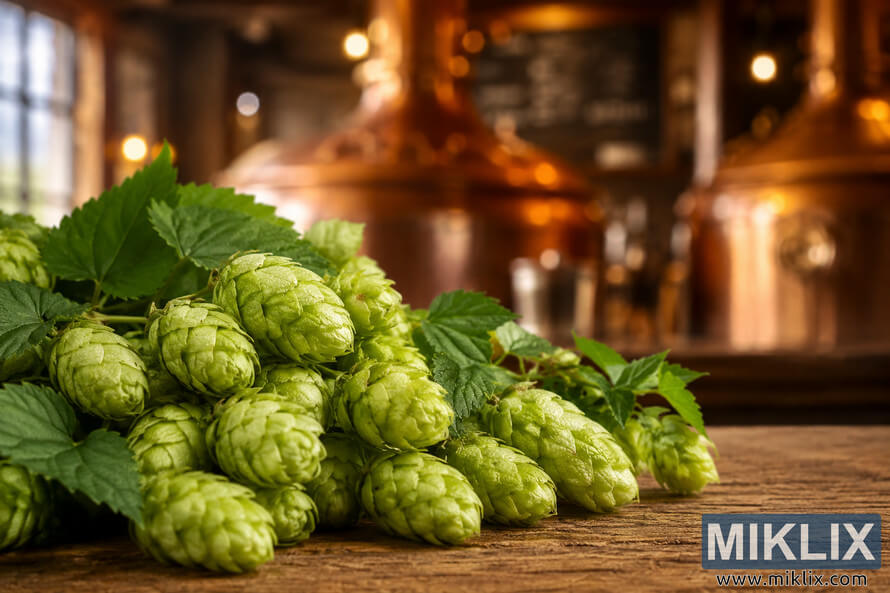
વધુ માહિતી અને ઉચ્ચ રિઝોલ્યુશન માટે છબી પર ક્લિક કરો અથવા ટેપ કરો.
Brewing Uses and Timing for Golding Additions
Golding hops require precise timing to showcase their floral and honeyed notes without overpowering malt. Use them sparingly, adding most to the kettle late or after the boil. This approach helps preserve their delicate aromas.
Late boil additions for delicate aroma
Introduce Golding hops with 5–15 minutes remaining in the boil. This timing releases oils that contribute soft floral and honey aromas. Use small amounts to ensure the aroma is subtle, not dominant.
Dry hopping and whirlpool use for subtle aromatic lift
Cold-side additions are effective. A light dry hop with Golding adds a refined aromatic lift without the harshness of resinous hops. Whirlpool additions at 160–170°F capture aroma while avoiding vegetal compounds.
Balancing bitterness vs. aroma
Golding's moderate alpha acids allow for early bittering additions. However, most brewers prefer to use them later. This approach ensures a smooth bitterness from cohumulone levels while preserving the variety's nuanced profile.
Usage strategy
Keep overall hop quantities moderate to protect malt flavors. Combine a few late kettle additions with a restrained dry hop or whirlpool pass. This strategy layers complexity without overwhelming subtle notes.
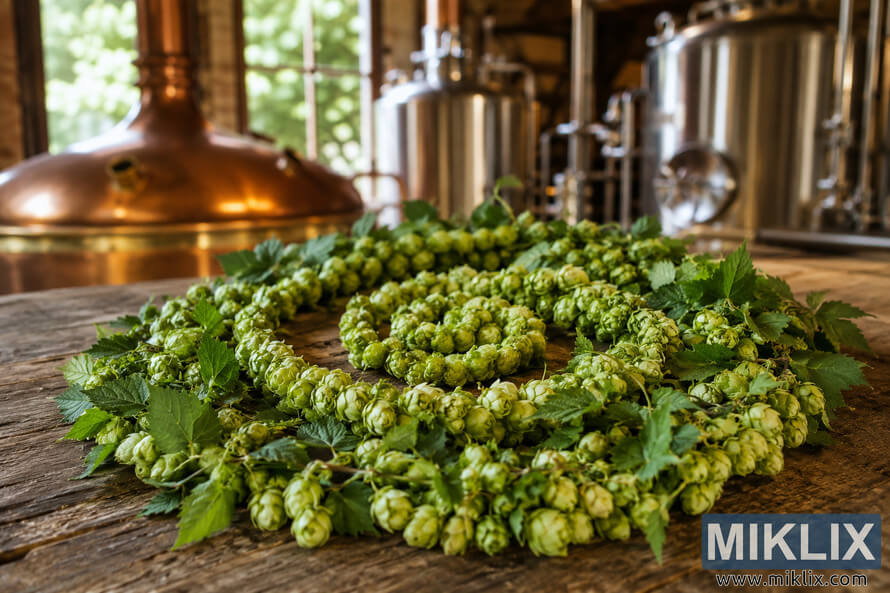
વધુ માહિતી અને ઉચ્ચ રિઝોલ્યુશન માટે છબી પર ક્લિક કરો અથવા ટેપ કરો.
Beer Styles that Showcase Golding Hops
Golding hops add a delicate floral and honey note to a variety of beers. They are chosen for their subtlety, avoiding the bold citrus or tropical flavors. This hop's balance is perfect for malt-forward beers, enhancing their aroma.
Classic English ales, ESB Golding, and bitters benefit from small, well-timed additions. These highlight floral and earthy notes. In these beers, the hop complements yeast esters and biscuit malts without overpowering them. ESB Golding excels in late kettle or whirlpool additions, preserving delicate aromas.
Porters, milds, and heritage-style pale ales gain depth from Golding's use. In porters, it adds a soft spice and honey note to roasted and chocolate malts. This enhances mouthfeel and finish without obscuring the roast.
Beyond traditional uses, Golding also fits in Belgian ales, barleywines, and American pale ales. In barleywine, a cautious dry hop or late addition can counterbalance heavy malt sweetness. In pale ales, it tempers aggressive American hop profiles, guiding the beer towards a balanced finish.
- Single-hop showcases reveal subtle apricot, marmalade, and balanced sweetness when the malt base is simple.
- For bitters and English-style ales, use Golding for aroma and late bitterness control.
- When experimenting with Golding in porters, start low and adjust by tasting to avoid masking roast.
Golding (US) hops
US-grown Golding hops share a lineage with their English counterparts but exhibit distinct traits that brewers find appealing. This brief overview contrasts common strains, explores regional flavor profiles, and identifies typical sources for these hops among breweries and homebrewers.
How the US-grown Golding compares to East Kent Golding and other variants
The debate between US Golding and East Kent Golding is a staple among traditionalists. The US varieties, tracing back to East Kent Golding, maintain the floral and earthy characteristics brewers cherish. American-grown Goldings are often noted for their slightly more pronounced floral notes, alongside honey and mild spice undertones.
Regional flavor nuances and typical US alpha averages
Flavor profiles of Golding hops vary by region, influenced by terroir, soil, and harvest timing. The alpha acid content of US Golding typically ranges from 4–6 percent, averaging around 5 percent. However, crop variations can cause these numbers to fluctuate, making it crucial to review supplier analyses for specific harvests.
Where US Golding is sourced and common commercial uses
US Golding hops originate from various commercial growers and established hop merchants in the Pacific Northwest and select specialty farms. They are available as whole cones or pellets, commonly used in classic English ales, subtle pale ales, and mixed-style beers. Currently, no major producer offers cryo or lupulin-concentrate forms, so they are used in traditional formats.
- Typical uses: late additions, whirlpool, and light dry hopping to preserve delicate notes.
- Buyers: check yearly lab sheets for alpha and oil values before purchase.
- Formats: whole cone and pellet only, not cryo or lupulin powders.
Pairing Golding Hops with Malts and Yeasts
Golding hops' floral and honey notes are best showcased with the right malt and yeast. Opt for a clean, rounded malt bill and a yeast that adds soft fruit esters or remains neutral. Below, you'll find practical malt choices, yeast pairing ideas, and recipe tips to craft balanced beers that highlight Golding.
Malt choices that complement Golding’s sweetness and earthiness
- Maris Otter: offers a rich, biscuity base that lifts honeyed Golding notes without overpowering them.
- Golden Promise: gives a soft sweetness that echoes Golding’s floral tone in English pale ales.
- Pale Ale malt or quality pilsner: use as the main base for clarity and balance in Golding-forward recipes.
- Light crystal (5–20L): add 5–10% to enhance body and give a touch of caramel that pairs well with Golding’s earthiness.
- Darker malts for porters and milds: include sparingly so roasted flavors do not mask subtle hop aroma.
Yeast strains for traditional English profiles
- Wyeast 1968 London Ale III and Wyeast 1098 British Ale: produce gentle esters that complement Golding’s floral character.
- White Labs WLP002 English Ale: creates a classic cask-style finish that melds with Golding’s honey notes.
- Neutral American ale yeasts (e.g., Wyeast 1056, White Labs WLP001): choose these when you want malt and hop interaction to be more pronounced without fruity esters.
Recipe examples and hop balance recommendations
For a classic English pale ale, use 85–90% base pale malt or pilsner and 10–15% specialty malts. Keep total IBU moderate, around 25–35, to avoid overpowering the aroma.
- Hop schedule: favor late additions at 15–5–0 minutes and a small whirlpool or hop stand to extract aroma without harsh bitterness.
- Dry hop: a light dry hop can add lift; keep quantities modest to preserve Golding’s subtlety.
- Malt balance: use Maris Otter or Golden Promise as the base with 5–10% light crystal for body and mouthfeel.
When experimenting with malt pairings Golding and yeast pairing Golding, test small batches and keep records. Try a single-hop showcase to refine your Golding recipe ideas and tune the interplay between base malt, specialty malts, and yeast esters for the clearest expression of this classic hop.
Blending and Hop Pairings with Golding
Golding brings a delicate floral and honey character to beer. It shines best when complemented, not overshadowed. Brewers pair it with hops that add depth or contrast, ensuring Golding remains the star. This approach preserves its subtlety and builds complexity.
- Common companion hops: Fuggle, Challenger, Willamette, and Styrian Golding are frequent partners. Fuggle and Golding create a classic English profile with soft earth and floral notes. Challenger provides firm bittering and structure without clashing.
- Designing multi-hop profiles: Start with a stronger bittering hop early, then reserve Golding for late additions. Use Willamette for added floral lift or Styrian Golding for a gentle spice note. This method keeps the core aroma intact while expanding the palette.
- Layering technique for late additions: Break aroma additions into small, repeated doses in the last five to ten minutes of the boil. Add a cautious whirlpool rest to coax oils without driving off volatile aromatics. A light dry hop of Golding blend hops can enhance depth if used sparingly.
- Practical strategy: Begin with a single-hop Golding showcase to learn its signature. Introduce one companion hop at a time across test batches to judge interactions. That way you can refine ratios and avoid overpowering delicate notes.
When planning hop pairing Golding, think of Golding as the finishing brushstroke. Keep heavier modern hops out of the final aroma zone unless you intend a hybrid style. Balanced restraint yields beers that celebrate Golding’s timeless charm.
Substitutes and Alternatives for Golding
When Golding hops are scarce, several reliable alternatives can preserve a beer’s traditional English character. Choose a substitute based on desired aroma, alpha acid target, and how subtle you want the hop presence to be.
Practical options include East Kent Golding, Fuggle, Willamette, Styrian Golding, and Whitbread Golding. East Kent Golding is the closest match for classic floral and honey notes. Fuggle offers earthier tones and a softer high-end, useful when a brewer wants a muted finish.
- East Kent Golding — best when you want that traditional English aroma and a similar alpha-acid range.
- Fuggle — choose this for rustic, woody character and straightforward bitterness.
- Willamette — a mellow, floral option with slightly different oil balance for more citrus undertones.
- Styrian Golding — brighter and spicier; use carefully to avoid overpowering subtle malt detail.
- Whitbread Golding — holds close to older English profiles and works well in heritage recipes.
Consider Fuggle vs Golding when deciding how bold the hop aroma should be. Fuggle tends to read earthier and broader, while Golding leans floral and delicate. Match the alpha acids to your recipe goals; a higher-alpha substitute requires a quantity reduction for bittering parity.
Adjust timing and amounts to retain Golding’s subtlety. Keep late-boil and whirlpool additions similar to preserve aroma. If the substitute has greater total oil, cut dry-hop weights by 20–30 percent to avoid masking floral and honey notes.
- Check alpha acid and scale bittering additions to maintain IBU targets.
- Keep late additions late to protect volatile aroma compounds.
- Reduce dry-hop rates for higher-oil substitutes to keep balance.
Use these guidelines to swap hops without losing the intent of a Golding-forward recipe. Thoughtful choice and small timing tweaks yield beers that honor the original profile while adapting to available stocks.
Recipe Examples and Single-Hop Showcases
To showcase Golding, use a Quiet Storm Goldings-style single-hop showcase. Keep the malt bill simple and the yeast classic English ale. This approach lets floral and honey notes shine while yeast esters add gentle fruitiness.
Quiet Storm Goldings-style single-hop showcase approach
Start with a controlled mash using Maris Otter as the base and a small amount of light crystal. Mash at a balanced temperature for a medium body that enhances hop aroma. Use a neutral bittering hop at 60 minutes to reach the target IBUs, then add most Golding hops late.
Stagger Golding additions at 10 minutes, flameout/whirlpool, and a light dry hop. This method highlights volatile oils in a Golding single-hop trial, revealing layers from early spice to late floral lift.
Sample homebrew recipe for a classic English pale ale featuring Golding
- Batch size: 5 gallons
- ABV: ~5.0% (OG 1.048–1.052)
- Grains: Maris Otter 92%, Light Crystal 8% (10–20L)
- Yeast: English ale strain (Wyeast 1968 or White Labs WLP002 alternatives)
- Hop schedule:
- Neutral bittering hop at 60 min to provide 20 IBU
- Golding 0.5 oz at 10 min
- Golding 1.0–1.5 oz at flameout/whirlpool
- Optional dry hop Golding 0.25–0.5 oz/gal for 2–4 days
- Mash: single infusion 152°F for balanced body
Tasting notes to expect and how to evaluate your finished beer
Expect delicate floral top notes and a clear honey sweetness on the nose. Earthy and mild spice tones should be present but not overpowering. The palate will feature a gentle bitterness and a smooth malt backbone that supports the hop character.
Evaluate by checking aroma intensity, balance between malt and hops, and clarity of Golding single-hop traits. If floral and honey elements are weak, reduce crystal malt or shorten whirlpool time to preserve volatile oils. When tasting side-by-side, the Quiet Storm Goldings method makes subtle differences easier to hear.
Common Brewing Mistakes and Tips When Using Golding
Golding hops require careful handling. This guide aims to help you avoid common pitfalls and enhance their unique floral and honey notes.
Be cautious with additions. Overusing Golding in the kettle or early boil can overwhelm its delicate flavors. Instead, opt for late boil additions and small dry-hop quantities to preserve its essence.
- Late kettle additions at five minutes or less preserve aroma without adding harsh bitterness.
- Whirlpool or hop-stand at lower temperatures locks in floral oils while minimizing vegetal extraction.
- Dry hop lightly; a little goes a long way with Golding’s subtle profile.
Conduct single-hop trials to understand a specific batch's behavior. Use consistent malt and yeast but vary the hop amount. Track alpha levels and tasting notes to refine your recipes.
Blind tasting can uncover surprising results. Expect your perceptions to change when tasters are unaware of the hop type. Golding tasting bias often leads to the expectation of citrus or bold fruit, when in fact, it's gentle and honeyed.
- Randomize samples in a blind panel to reduce expectation effects.
- Ask tasters to list descriptors before revealing the hop to limit suggestion.
- Compare harvest years side by side to spot year-to-year variation.
Keep detailed records. Note boil times, hop weights, whirlpool rest temperatures, and sensory impressions. These records make your brewing tips practical and repeatable for future batches.
Conclusion
Golding (US) hops conclusion: these American-grown Goldings carry the English lineage into modern brewing. They offer a gentle floral, earthy, and honey-like aroma. Their moderate bitterness, in the 4–6% alpha range, makes them perfect for traditional English ales, bitters, and heritage-style pale ales. Here, subtlety is key, not aggressive citrus or resinous character.
Use Golding in brewing primarily as a late-boil, whirlpool, or dry-hop addition. This preserves delicate aromatics. Pair Golding with English malts and yeast strains to enhance breadiness and soft sweetness. Avoid heavy early additions that can mask the hop’s nuance. For recipe testing, run single-hop showcases to hear regional and yearly variation in aroma and flavor.
When buying, check harvest-year lab data and choose whole-cone or pellet formats from reputable suppliers. This ensures freshness. This Golding hop summary aids brewers in making informed choices. It highlights moderate bitterness, refined aroma, and excellent compatibility with traditional malt and yeast builds. For U.S. brewers seeking classic English character with reliable American availability, Golding (US) is a refined, time-tested option for balanced, nuanced beers.
FAQ
What is Golding (US) and where did it originate?
Golding (US) is an American-grown hop with roots in 18th-century England. It's closely related to East Kent Golding. This hop preserves the classic floral, earthy, and honeyed flavors of traditional British ales. It also reflects the terroir of U.S. hop farms.
What are common synonyms and genetic connections for Golding?
Golding is known by synonyms like Early Bird, Early Choice, Eastwell, and Mathon. Research links modern Golding to East Kent Golding. This explains their shared aromatic traits and historical use in British brewing.
How does Golding connect to traditional British brewing heritage?
Golding has been key in bitters, milds, porters, and cask ales since the 18th–20th centuries. Its delicate floral and earthy profile complements malt-forward recipes. It also preserves the traditional English brewing practices and authenticity in heritage recipes.
What are Golding’s growth habits and typical U.S. harvest timing?
Golding grows on bine trellises and requires standard care. In the U.S., it's commonly harvested in mid-to-late August. The exact timing depends on the region and season.
How variable are Golding crops year to year?
Crop variability affects alpha acids and essential oil concentrations. Weather, soil, and harvest handling can change these profiles. Brewers should check each harvest year's lab analysis for accurate brewing values.
Where can U.S. brewers source Golding hops?
Golding is sold by multiple hop suppliers and specialty retailers. Homebrew quantities are available on marketplaces like Amazon. Availability, price, and lab-analysis details change by supplier and crop year. Confirm harvest year and testing data before purchase.
What are Golding’s typical alpha and beta acid ranges?
Golding typically shows alpha acids between 4–6% (average ~5%) and beta acids around 2–3% (average ~2.5%). These moderate levels make Golding primarily an aroma hop with usable—but not aggressive—bittering potential.
What is Golding’s co‑humulone percentage and why does it matter?
Co‑humulone is typically about 20% of total alpha acids. Lower co‑humulone generally relates to a smoother perceived bitterness in finished beer. This aligns with Golding’s reputation for elegant, balanced bitterness when used in the boil.
What is the total oil content and key oil breakdown for Golding?
Total oil concentration usually ranges 0.4–1.0 mL/100 g (avg ~0.7 mL/100 g). Typical oil percentages: myrcene 25–35% (avg ~30%), humulene 35–45% (avg ~40%), caryophyllene 13–16% (avg ~14.5%), farnesene ~0–1% (avg ~0.5%). Minor amounts of linalool, geraniol, β‑pinene, and selinene contribute nuance.
How do those oils translate into aroma and flavor?
Humulene and caryophyllene bring woody, spicy, and noble nuances; myrcene offers resinous, citrusy, or fruity undertones. Minor compounds like linalool and geraniol add floral and honey-like notes. Together they produce Golding’s delicate floral, earthy, honey, and spice profile.
How is Golding typically used in the brewing process?
Golding is best used as a late-addition aroma hop—last 5–15 minutes of the boil—or in a lower-temperature whirlpool or hop stand. It also works for restrained dry hopping to lift subtle aromas. Early additions can contribute moderate bitterness but will mute the hop’s delicate aromatics.
Can Golding be used for bitterness or is it only an aroma hop?
With alpha acids around 4–6%, Golding can add moderate bitterness if used early. However, brewers generally reserve it for aroma applications so its floral and honey notes aren’t lost. When used for bitterness, the smoother co‑humulone profile helps keep a gentle finish.
Which beer styles best showcase Golding?
Golding excels in Classic English Pale Ale, ESB, bitters, milds, and porters—styles where malt and yeast take center stage and hops should add subtle complexity. It can also serve in Belgian ales, barleywines, and restrained American pales when a refined floral-spice character is desired.
How does U.S. Golding compare to East Kent Golding and other variants?
U.S.-grown Golding retains the delicate floral and earthy core of East Kent Golding but shows terroir-driven nuance. Alpha averages remain similar (roughly 4–6%), yet oil balances and intensity can vary with region and harvest year, giving U.S. Golding its own expression.
What malts and yeasts pair best with Golding?
Use Maris Otter, Golden Promise, pale ale malt, and light crystal malts to highlight Golding’s honey and floral notes. Traditional English ale yeasts (e.g., White Labs WLP002, Wyeast 1968 or 1098) that produce gentle esters complement Golding, while a neutral American ale yeast can let malt and hop interplay be more obvious.
What companion hops blend well with Golding?
Fuggle, Challenger, Willamette, and Styrian Golding are common companions. Use a sturdier bittering hop like Challenger early, with Golding reserved for late additions to preserve its nuance. Willamette or Fuggle can support the floral/earthy character without overpowering it.
How should I design multi-hop schedules to keep Golding’s subtlety?
Keep bolder hops in the early or mid boil for bitterness and backbone. Add Golding late (10–0 minutes), use a low-temperature whirlpool or hop stand, and, if dry hopping, use small amounts. Layer one new companion hop at a time in successive brews to learn interactions without masking Golding.
What are recommended substitutes if Golding is unavailable?
East Kent Golding is the closest match. Fuggle, Willamette, Styrian Golding, and Whitbread Golding are also practical alternatives. When substituting, match alpha acid targets, keep late-addition timing, and reduce dry-hop amounts if the substitute carries stronger oils.
In what formats is Golding sold and are lupulin/cryo forms available?
Golding is commonly sold as whole cone or pellet hops. There are currently no mainstream lupulin-concentrate or cryo (LupuLN2/Lupomax) products widely available for Golding from major suppliers such as Yakima Chief, BarthHaas, or Hopsteiner.
What should buyers check before purchasing Golding hops?
Confirm harvest year, lab analysis for alpha and oil content, packaging and storage (vacuum or oxygen-barrier), and supplier reputation. Freshness matters for aroma performance, and prices vary by crop year and supplier volume.
Can you provide a simple sample recipe outline using Golding?
Classic English Pale Ale (approx. 5% ABV): Maris Otter base malt with 5–8% light crystal 10–20L. Mash for balanced body; OG ~1.048–1.052. Bittering: neutral hop to ~20 IBU at 60 min. Aroma: Golding at 10 min and 0 min/whirlpool; optional light dry hop 0.25–0.5 oz/gal. Ferment with an English ale yeast for traditional esters.
What tasting notes should I expect from a Golding-forward beer?
Expect delicate floral and honey aroma, subtle earthiness and spice, balanced malt sweetness, and smooth, gentle bitterness. Freshness of the hops and restrained adjuncts help Golding’s nuances come forward; heavy roast or aggressive modern hops will mask them.
What common mistakes do brewers make with Golding?
Overuse is frequent: too much Golding or heavy early additions will either create unwanted bitterness or bury aroma. Using aggressive modern hops in late additions will overpower Golding’s subtlety. Failing to check harvest data and freshness also reduces aromatic potential.
How can I objectively evaluate Golding in trials and tastings?
Run single-hop showcases and blind tastings to reduce expectation bias. Randomize descriptor lists, document sensory notes per batch, and compare harvest years. Controlled trials—altering only timing or form (whole vs. pellet)—help isolate Golding’s contribution.
Any final practical tips for U.S. brewers working with Golding?
Treat Golding as a delicate aroma hop: use late additions, low-temperature whirlpool, and modest dry hops. Pair it with English malts and cask-style yeasts when seeking traditional profiles. Buy from reputable suppliers, check harvest year lab data, and start with single-hop tests to learn its regional and yearly character.
વધુ વાંચન
જો તમને આ પોસ્ટ ગમી હોય, તો તમને આ સૂચનો પણ ગમશે: