
Hoto: Various Beer Styles Brewed with Alliance Hops
Buga:
An sabunta ta ƙarshe: 14 Satumba, 2026 da 20:35:52 UTC
A photorealistic display of varied beer styles with fresh hops and brewing grain in a rustic brewery setting, with sunlit hop plants in the background.
Various Beer Styles Brewed with Alliance Hops
Sigar da ake da ita ta wannan hoton
Fayilolin hotunan da ake da su don saukewa a ƙasa ba su da matsewa kuma suna da ƙuduri mafi girma - kuma sakamakon haka, inganci mafi girma - fiye da hotunan da aka saka a cikin labarai da shafuka akan wannan gidan yanar gizon, waɗanda aka fi inganta su don girman fayil don rage yawan amfani da bandwidth.
Girman yau da kullun (1,536 x 1,024)
Babban girma (3,072 x 2,048)
Girma mai girma sosai (4,608 x 3,072)
Girman da ya fi girma (6,144 x 4,096)
Girman barkwanci mai girma (1,048,576 x 699,051)
- Har yanzu ana lodawa... ;-)
Bayanin Hoto
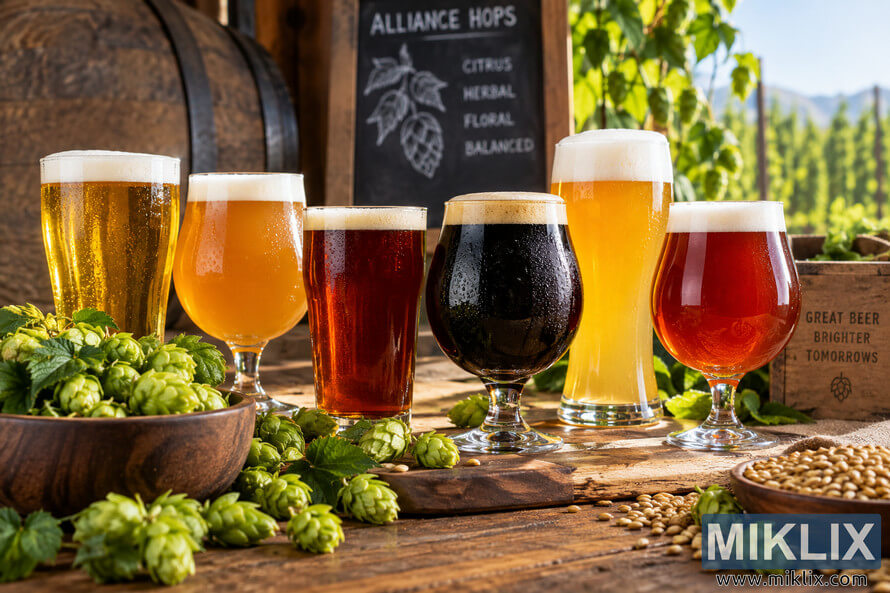
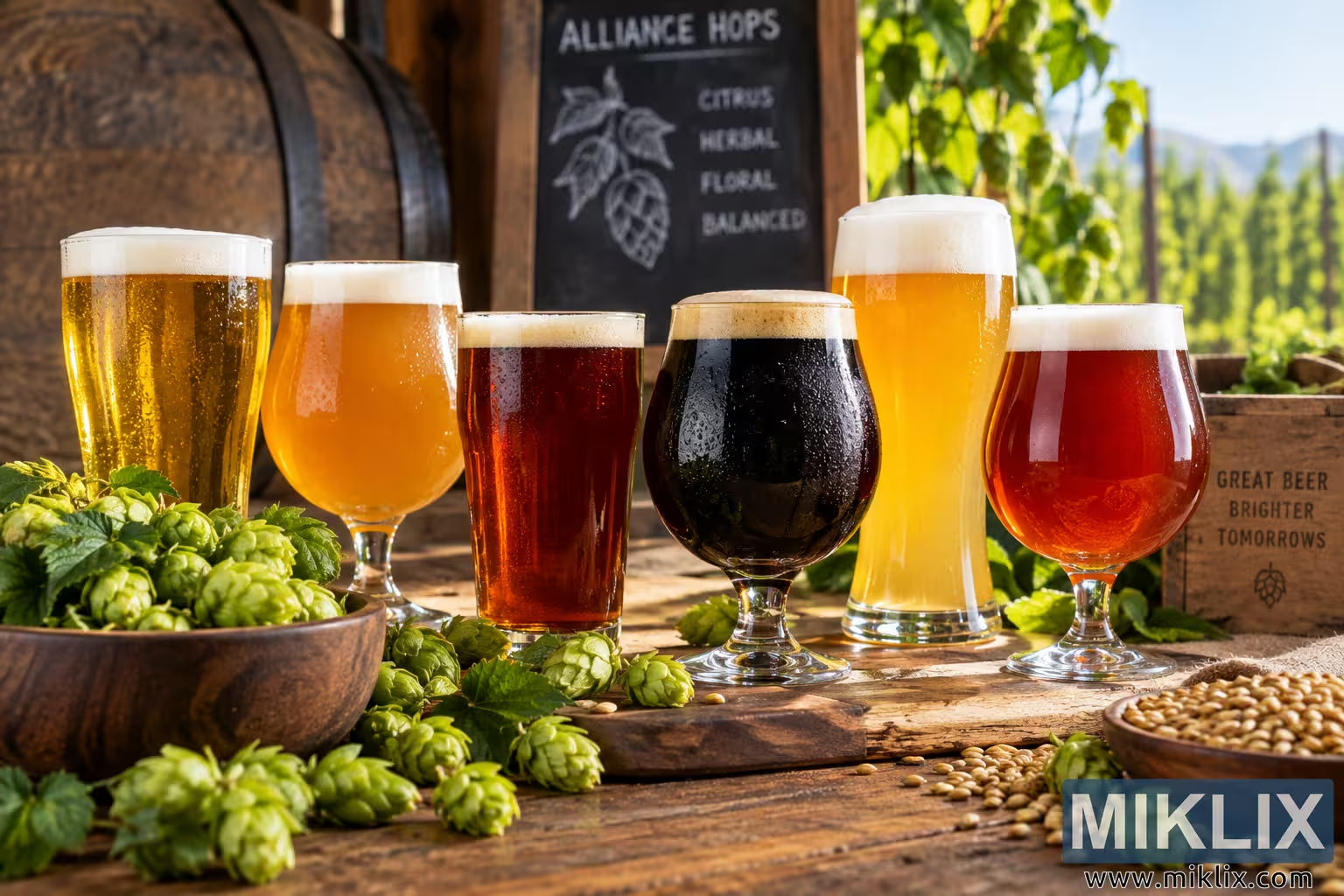
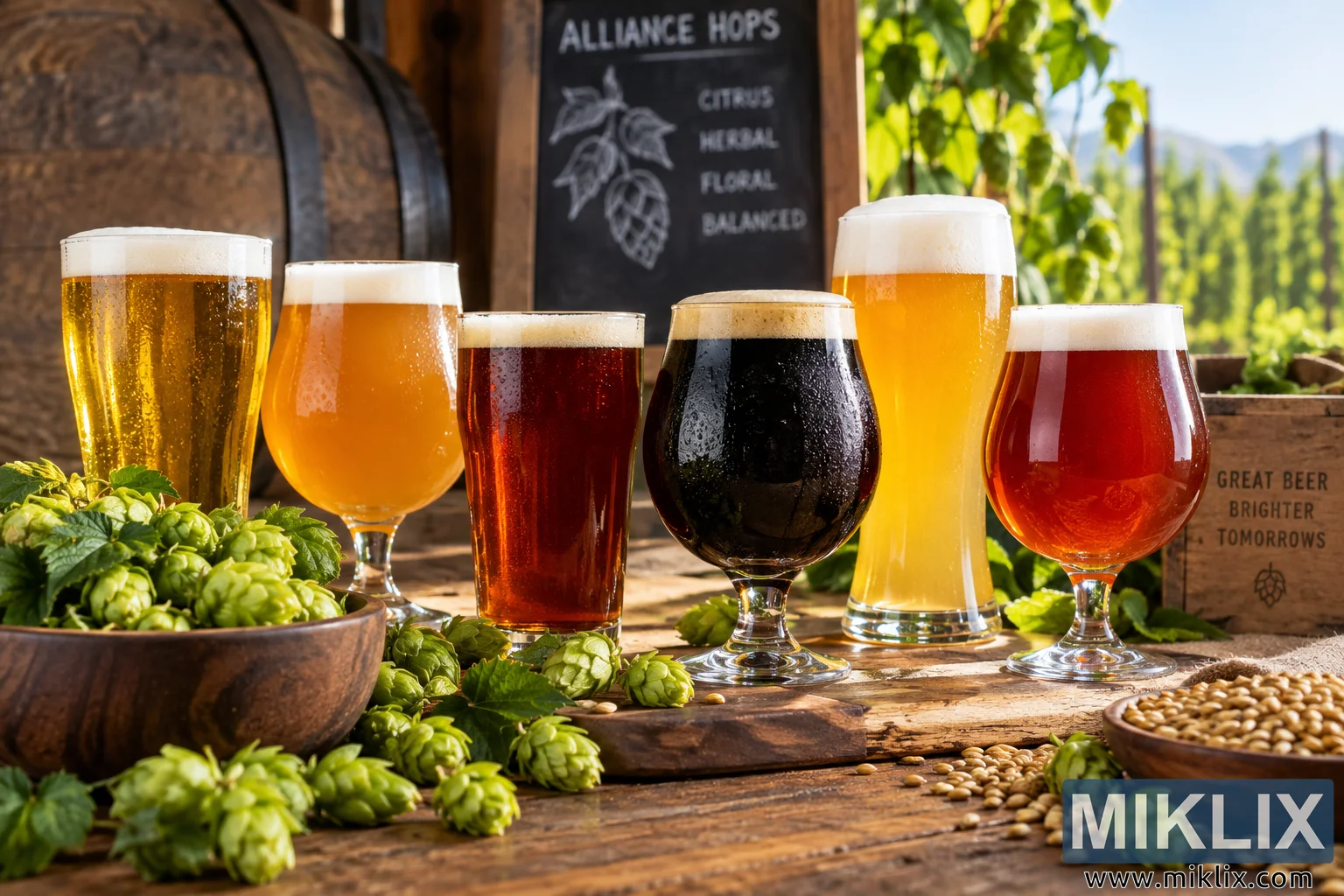
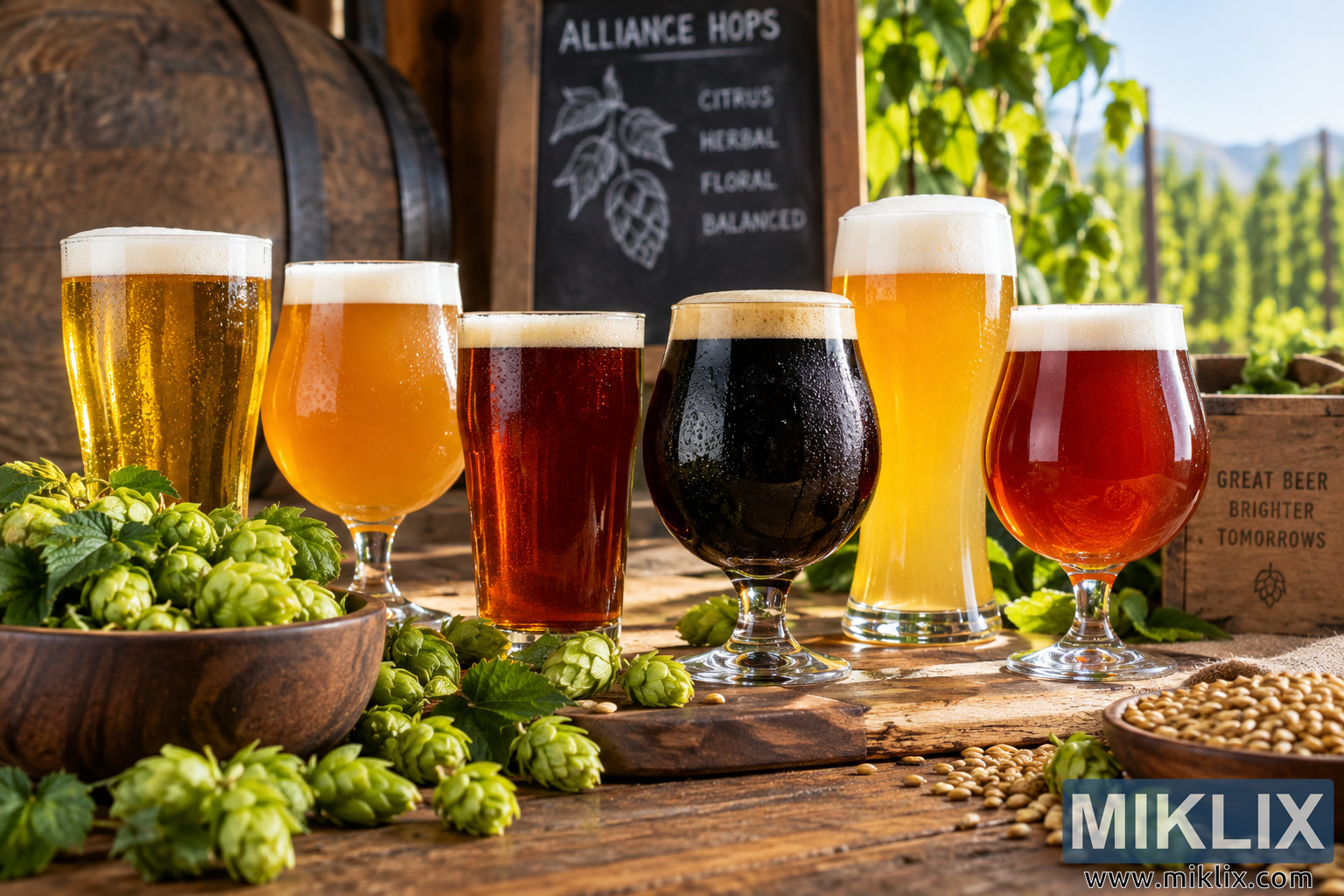
A wide, landscape-oriented photorealistic still-life scene presents a diverse selection of beer styles together in a warm, rustic brewing environment. Six glasses of beer form the central composition, arranged in a loose row across a substantial wooden tabletop and serving board. Each glass contains a visibly different beer, creating a spectrum of colors, levels of clarity, and glass shapes that immediately communicates variety. From left to right, the selection includes a clear golden beer in a tall, gently tapered glass; a hazy orange-gold beer in a rounded stemmed glass; a deep amber to reddish-brown beer in a straight-sided pint glass; an almost opaque dark beer in a rounded, short-stemmed glass; a luminous pale yellow and slightly hazy beer in a tall, curving wheat-style glass; and a rich copper-red beer in a rounded stemmed glass. All six beers are topped with pale, creamy foam, although the thickness and texture of the heads vary naturally from one glass to another. Fine carbonation bubbles are visible in some of the lighter beers, while beads of condensation on the glass surfaces give the drinks a cool, freshly poured appearance.
Fresh green hop cones are prominently incorporated throughout the foreground, visually connecting the beers with the brewing ingredient highlighted by the scene. A large rustic bowl on the lower left is filled generously with hop cones and leafy green foliage. Additional hop cones are scattered loosely across the wooden surface, including several directly in front of and between the beer glasses. Their layered, papery green bracts and organic shapes contrast with the smooth, reflective glassware. More hop leaves and vines frame portions of the composition, strengthening the impression of freshly harvested brewing ingredients. On the lower right, a wooden bowl contains pale golden grains, while additional grains are scattered naturally over the table. Together, the hops and grain establish a clear visual connection between agricultural raw materials and the finished beers displayed at the center of the image.
The setting combines the atmosphere of a traditional brewery, a tasting room, and a hop-growing landscape. Behind the beer on the left stands a large weathered wooden barrel or cask with dark metal hoops. Its curved form and aged surface contribute to the handcrafted, traditional character of the scene. Near the center of the background is a dark chalkboard-style sign featuring a simple line drawing of hop cones and descriptive brewing-related words. The surrounding wooden architecture has a warm, natural finish that complements the amber and golden colors of the beer. These darker background elements provide visual contrast, helping the illuminated glasses and vivid green hops stand out clearly.
On the right side, the background opens into a bright outdoor agricultural landscape. Rows of tall hop plants climb vertical supports, their green leaves illuminated by strong natural sunlight. The plants extend into the distance, where softly rendered hills or mountains are visible beneath a clear, bright sky. This outdoor view introduces depth and gives the image a farm-to-glass feeling, suggesting a connection between hop cultivation and brewing. The background is gently softened compared with the foreground, maintaining attention on the beers and brewing ingredients while still making the hop-growing environment recognizable.
The lighting is warm, directional, and strongly influenced by sunlight entering from the right. Highlights pass through the lighter beers, making their golden, yellow, orange, and red tones glow with rich translucency. Reflections along the rims and curved surfaces of the glasses emphasize their clean contours, while the darkest beer absorbs much of the light and creates a bold visual anchor near the center. Soft shadows fall across the textured wooden table and serving board, revealing scratches, grain patterns, knots, and other imperfections that contribute to the authentic rustic aesthetic. The combination of crisp foreground detail and softer background focus gives the photograph a polished commercial quality without losing its natural atmosphere.
The composition is balanced around the contrasting beer styles. The dark beer occupies a central position and is surrounded by progressively brighter amber, gold, yellow, and red tones. Differences in glass height and silhouette create a varied skyline across the arrangement rather than a rigidly uniform product lineup. The tallest glasses rise above the shorter stemmed vessels, while the hops and grains form a lower layer of visual interest across the foreground. The wooden barrel on the left and sunlit hop plants on the right provide larger background masses that frame the central tasting selection. This creates a strong sense of depth, with ingredients in the immediate foreground, beers in the primary focal plane, brewery elements in the middle distance, and hop fields in the far background.
Overall, the image conveys variety, craftsmanship, freshness, and the agricultural origins of brewing. The range of pale, hazy, amber, red, and dark beers suggests that the featured hops can be associated visually with numerous brewing styles rather than a single type of beer. Fresh hop cones serve as the dominant ingredient motif, while malt grain, wood, glass, and traditional brewery details reinforce the broader brewing context. The photograph has an inviting, premium editorial character suitable for illustrating an article, feature, or informational page about hop varieties, brewing applications, beer diversity, or the relationship between hop cultivation and finished beer. No recognizable commercial beer branding, branded bottles, cans, packaging, or logos are present; the focus remains on the generic beer styles, hops, grain, glassware, and rustic brewing environment.
Hoton yana da alaƙa da: Hops in Beer Brewing: Alliance