
Hoto: Macro Close-Up of an Open Hop Cone with Golden Lupulin
Buga:
An sabunta ta ƙarshe: 16 Satumba, 2026 da 19:08:17 UTC
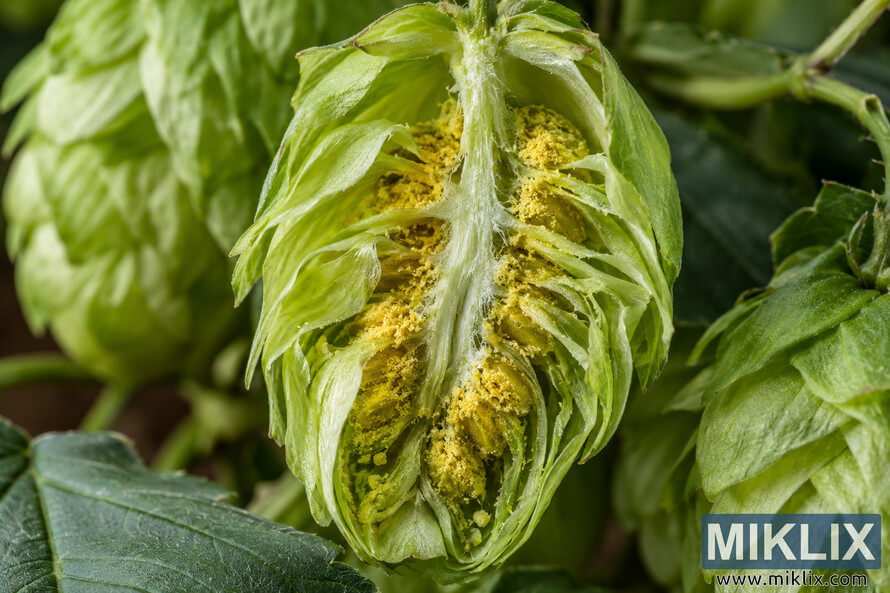
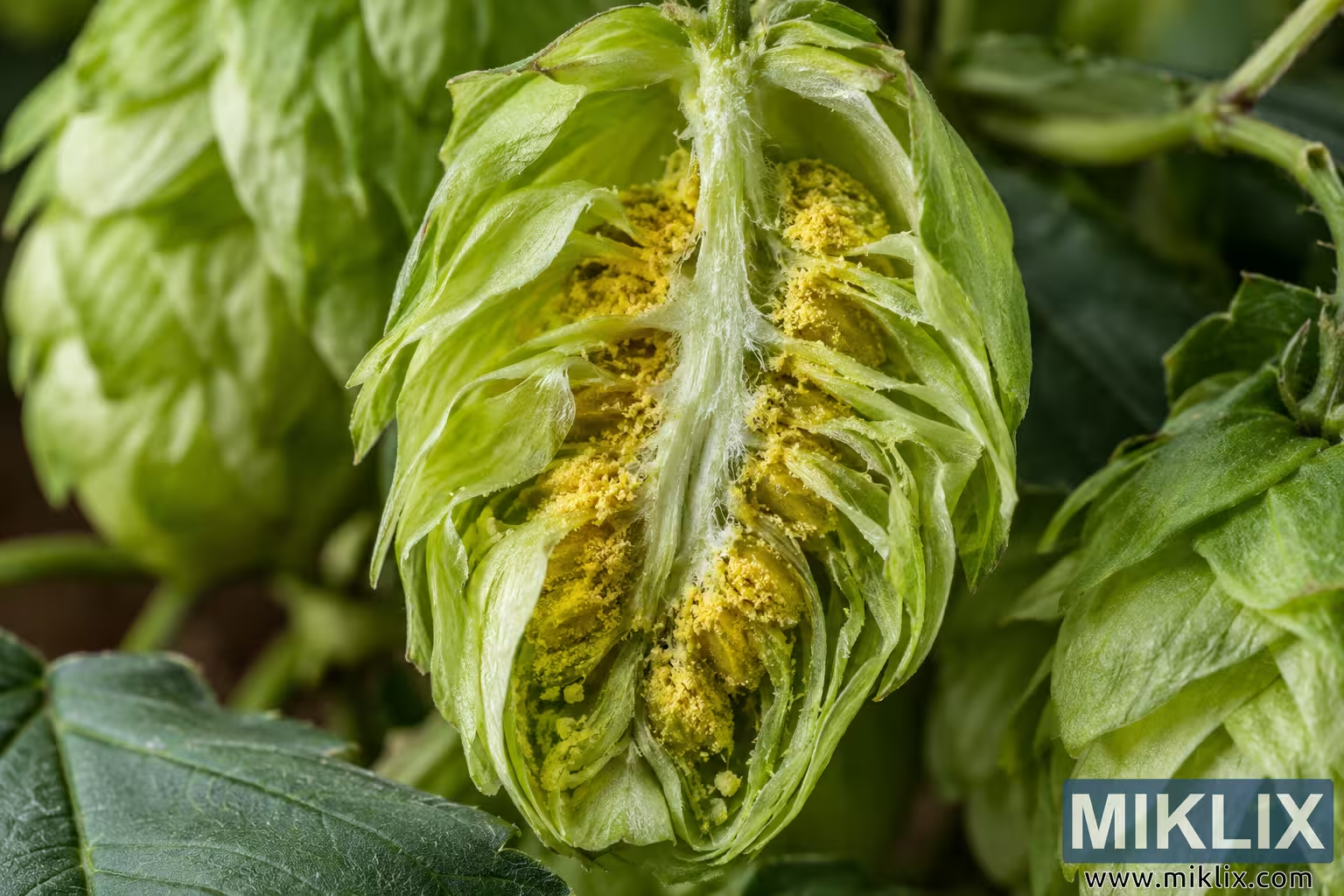
Detailed macro photograph of an opened hop cone revealing layered green bracts, internal botanical structure, and abundant golden-yellow lupulin glands.
Macro Close-Up of an Open Hop Cone with Golden Lupulin
Sigar da ake da ita ta wannan hoton
Fayilolin hotunan da ake da su don saukewa a ƙasa ba su da matsewa kuma suna da ƙuduri mafi girma - kuma sakamakon haka, inganci mafi girma - fiye da hotunan da aka saka a cikin labarai da shafuka akan wannan gidan yanar gizon, waɗanda aka fi inganta su don girman fayil don rage yawan amfani da bandwidth.
Girman yau da kullun (1,536 x 1,024)
Babban girma (3,072 x 2,048)
Girma mai girma sosai (4,608 x 3,072)
Girman da ya fi girma (6,144 x 4,096)
Girman barkwanci mai girma (1,048,576 x 699,051)
- Har yanzu ana lodawa... ;-)
Bayanin Hoto
A highly detailed, landscape-oriented macro photograph presents an intimate close-up view of a fresh hop cone that has been opened lengthwise to reveal its internal structure. The central hop cone dominates the composition and occupies most of the frame, allowing the viewer to examine the botanical details that would normally remain concealed beneath the overlapping outer bracts. Its overall coloration ranges from fresh yellow-green and lime green to deeper olive tones, while the exposed lupulin appears as vivid golden-yellow deposits distributed throughout the interior. The combination of green plant tissue and warm yellow lupulin creates a strong natural contrast and immediately draws attention to the resin-rich structures inside the cone.
The opened cone is positioned almost vertically in the center of the image. A pale green central axis runs from the upper portion toward the bottom of the cone, forming the structural backbone from which numerous thin bracts and bracteoles extend outward. These delicate layers curve, fold, and overlap around the axis, creating a complex arrangement of botanical forms. Because the cone has been spread open, individual internal layers are clearly visible rather than being compressed into the familiar compact exterior shape of an intact hop cone. Some of the bracts curl toward the camera, while others recede into the interior, producing a strong sense of depth. Fine fibers and tiny hair-like structures can be seen along portions of the central stem and surrounding tissues, emphasizing the extreme level of magnification.
The most visually distinctive feature is the abundance of golden-yellow lupulin visible between and across the internal bracts. The lupulin forms irregular granular patches and clusters, with especially dense accumulations near the central axis and at the bases of the inner structures. In the sharpest areas of the photograph, the material has a powdery, resinous appearance composed of countless minute yellow particles and glands. Some deposits appear as compact golden masses, while others are scattered more loosely across the pale green plant surfaces. Their saturated yellow color stands out clearly against the surrounding green tissue and makes the internal resin-bearing regions easy to identify visually. The photograph therefore provides an unusually close observational view of the relationship between the hop cone's leafy structures and its lupulin-rich interior.
The outer bracts surrounding the exposed center are thin, slightly translucent, and richly textured. Their surfaces show subtle wrinkles, veins, ridges, and variations in thickness. Light passing across these surfaces creates small highlights along raised edges and folds, while recessed areas remain in gentle shadow. This interplay of illumination and shadow gives the cone a tactile, almost three-dimensional quality. The central axis has a fibrous, softly hairy texture that contrasts with the smoother, papery appearance of the surrounding bracts. Together, these details convey the delicate yet intricate construction of the hop cone at macro scale.
Naturalistic directional lighting illuminates the central specimen strongly enough to reveal fine surface detail without flattening its structure. Highlights are concentrated on the pale green edges of the bracts and on the yellow lupulin deposits, while shadows between overlapping layers help separate the individual botanical elements. The lighting also gives portions of the green tissue a slightly glossy or moist appearance, enhancing the impression of a freshly harvested plant specimen. The depth of field is relatively shallow, as expected in macro photography: the opened central cone is rendered with considerable sharpness, while surrounding vegetation becomes progressively softer as it moves away from the focal plane.
Several additional hop cones and leaves form the background and contextualize the central subject. On the left side, a large intact hop cone is visible but noticeably out of focus. Its overlapping green bracts form a recognizable cone silhouette without competing with the detailed central specimen. On the right side, another hop cone enters the frame and is partially cropped by the edge, providing additional visual balance. Darker green leaves and stems occupy the remaining background areas. A broad leaf in the lower-left foreground displays prominent veins and a deeper blue-green coloration, contrasting with the brighter yellow-green tones of the main cone. The upper and rear portions of the image dissolve into soft green shapes and shadows, producing a natural botanical backdrop.
The composition is deliberately focused on structure and texture rather than on a wider agricultural setting. There are no people, tools, labels, packaging, logos, text, or identifiable commercial branding anywhere in the frame. The visual presentation resembles specialized botanical, agricultural, brewing, or horticultural macro photography intended to reveal details that are difficult to observe with the unaided eye. The opened cone functions almost like a natural cross-section, exposing the central axis, layered bracts, fine fibers, and concentrated lupulin deposits simultaneously.
Overall, the photograph communicates freshness, botanical complexity, and the resin-rich character of a mature hop cone. The extreme close-up perspective transforms a relatively small plant structure into a richly detailed landscape of folded green bracts, pale fibrous tissue, and golden lupulin. The central specimen remains the unmistakable focal point, while the softly blurred surrounding cones and foliage establish that it belongs to a living hop plant. The resulting image is both visually striking and informative, offering a clear macro-level view of the internal anatomy of a hop cone and prominently displaying the yellow lupulin glands associated with its inner surfaces.
Hoton yana da alaƙa da: Hops in Beer Brewing: Blisk