
Image: Nutritional Breakdown of Fresh Basil Leaves
Published: May 21, 2026 at 4:07:23 PM UTC
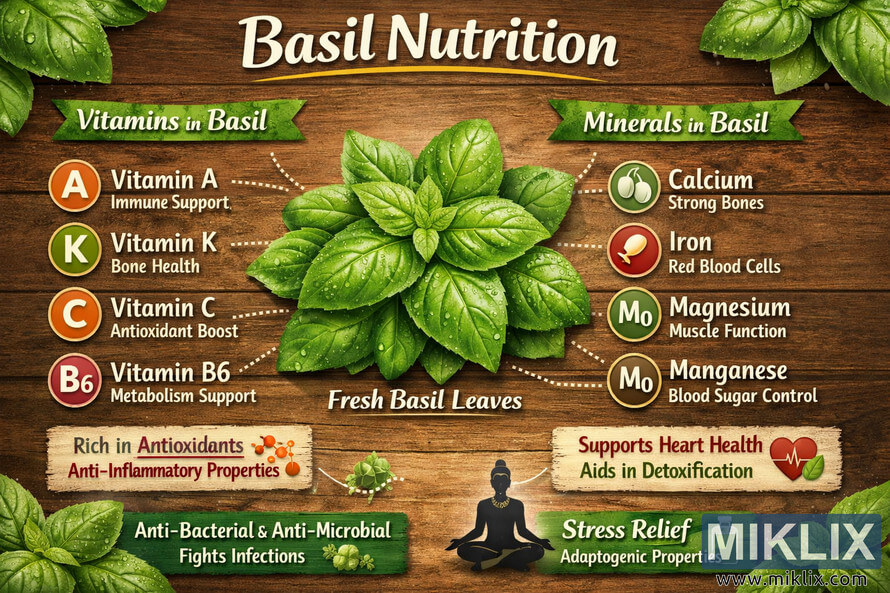
Explore the nutritional breakdown of fresh basil leaves in this detailed infographic highlighting essential vitamins and minerals that support immunity, bone health, metabolism, and overall wellness.
Available versions of this image
The image files available for download below are less compressed and higher resolution - and as a result of that, higher quality - than the images embedded in articles and pages on this website, which are more optimized for file size in order to reduce bandwidth consumption.
Regular size (1,536 x 1,024)
Large size (3,072 x 2,048)
Very large size (4,608 x 3,072)
Extra large size (6,144 x 4,096)
Comically large size (1,048,576 x 699,051)
- Still uploading... ;-)
Image description
This high-resolution landscape infographic titled "Basil Nutrition" presents a visually rich and educational depiction of the nutritional composition of fresh basil leaves. The design features a rustic wooden background that evokes a natural, organic feel, complemented by vibrant green basil leaves arranged centrally under the label "Fresh Basil Leaves." The composition is symmetrical, with two main sections flanking the central illustration: one dedicated to vitamins and the other to minerals.
On the left side, the section titled "Vitamins in Basil" is marked by a green banner and includes four circular icons, each representing a key vitamin found in basil. Vitamin A is associated with immune support and is depicted with a shield icon. Vitamin K, linked to bone health, is shown with a skeletal motif. Vitamin C, known for its antioxidant properties, is represented by a citrus-like symbol, while Vitamin B6, supporting metabolism, is illustrated with a gear icon. Beneath these, a text box highlights basil’s antioxidant and anti-inflammatory properties, accompanied by stylized molecular and heart-shield graphics that reinforce its health benefits.
On the right side, the "Minerals in Basil" section mirrors the left in layout and color balance. It features four circular icons for Calcium, Iron, Magnesium, and Manganese. Calcium is associated with strong bones, Iron with red blood cell formation, Magnesium with muscle function, and Manganese with blood sugar control. Each mineral is paired with a concise health benefit statement and a corresponding symbol, such as a bone, droplet, muscle fiber, or glucose molecule. Below these icons, a text box emphasizes basil’s role in supporting heart health and aiding detoxification, illustrated by a heart with a heartbeat line and a detox bottle with a leaf motif.
At the bottom of the infographic, two additional panels expand on basil’s broader wellness effects. The left panel, titled "Anti-Bacterial & Anti-Microbial," explains how basil helps fight infections, accompanied by a stylized depiction of bacteria. The right panel, titled "Stress Relief," highlights basil’s adaptogenic properties, represented by a serene figure in a lotus position, symbolizing mental balance and calm.
Dashed lines connect the central basil illustration to each vitamin and mineral icon, visually linking the plant’s natural composition to its health benefits. The overall color palette blends earthy browns, lush greens, and warm yellows, creating a harmonious and inviting aesthetic. The typography is clear and modern, with bold white and yellow lettering for section titles and smaller, legible text for details. The image conveys both scientific accuracy and visual appeal, making it suitable for educational, culinary, and wellness contexts. It effectively communicates that fresh basil is not only a flavorful herb but also a powerhouse of nutrients that contribute to immunity, bone strength, metabolic efficiency, and emotional well-being.
The image is related to: A Guide to the Health Benefits of Basil