
Image: Artichoke Nutritional Breakdown and Health Benefits Infographic
Published: July 19, 2026 at 1:00:25 PM UTC
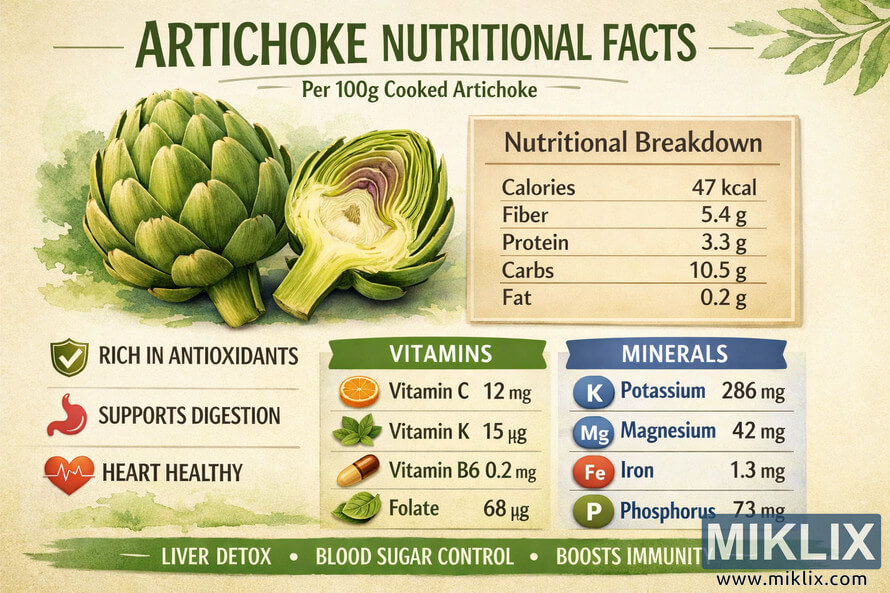
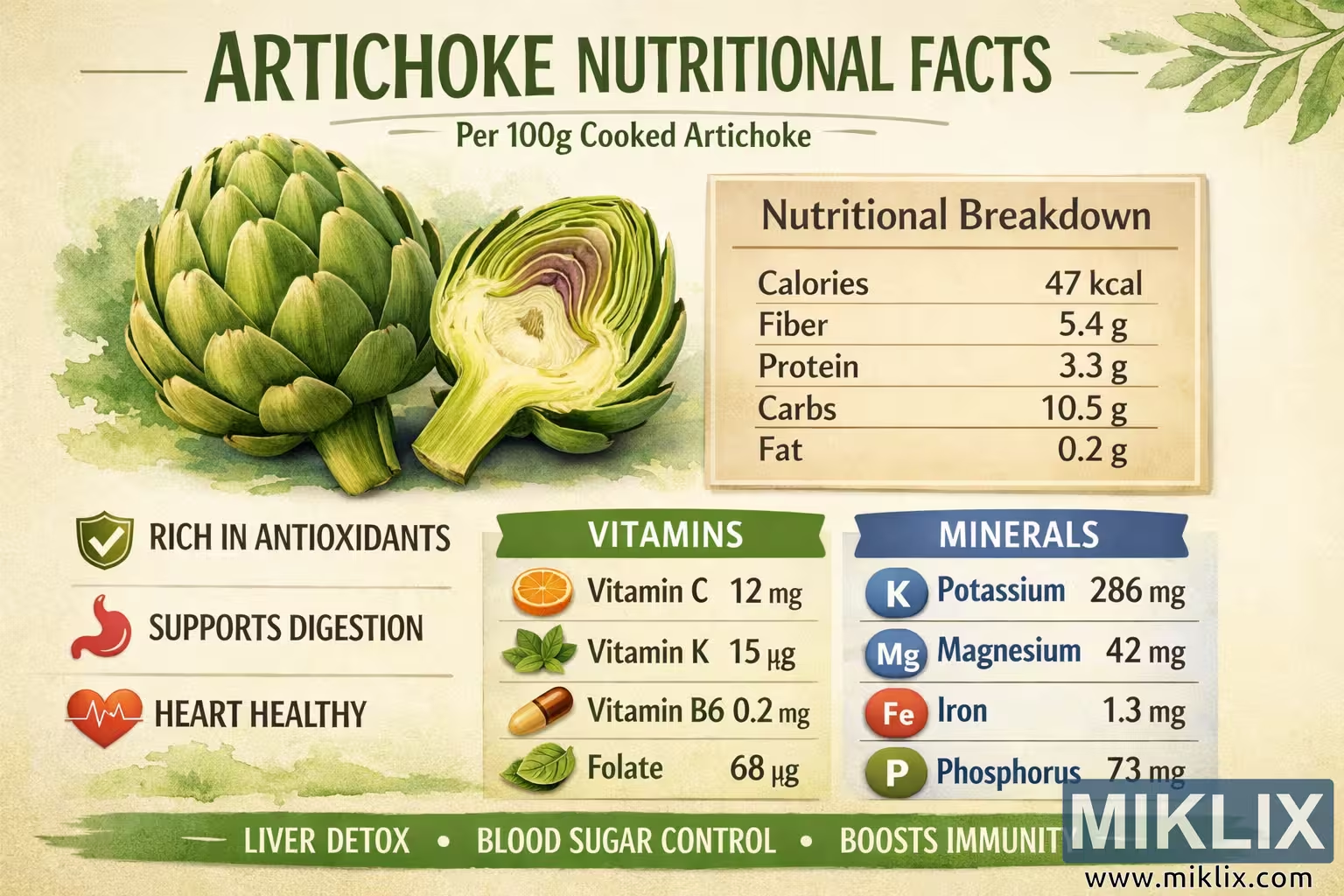
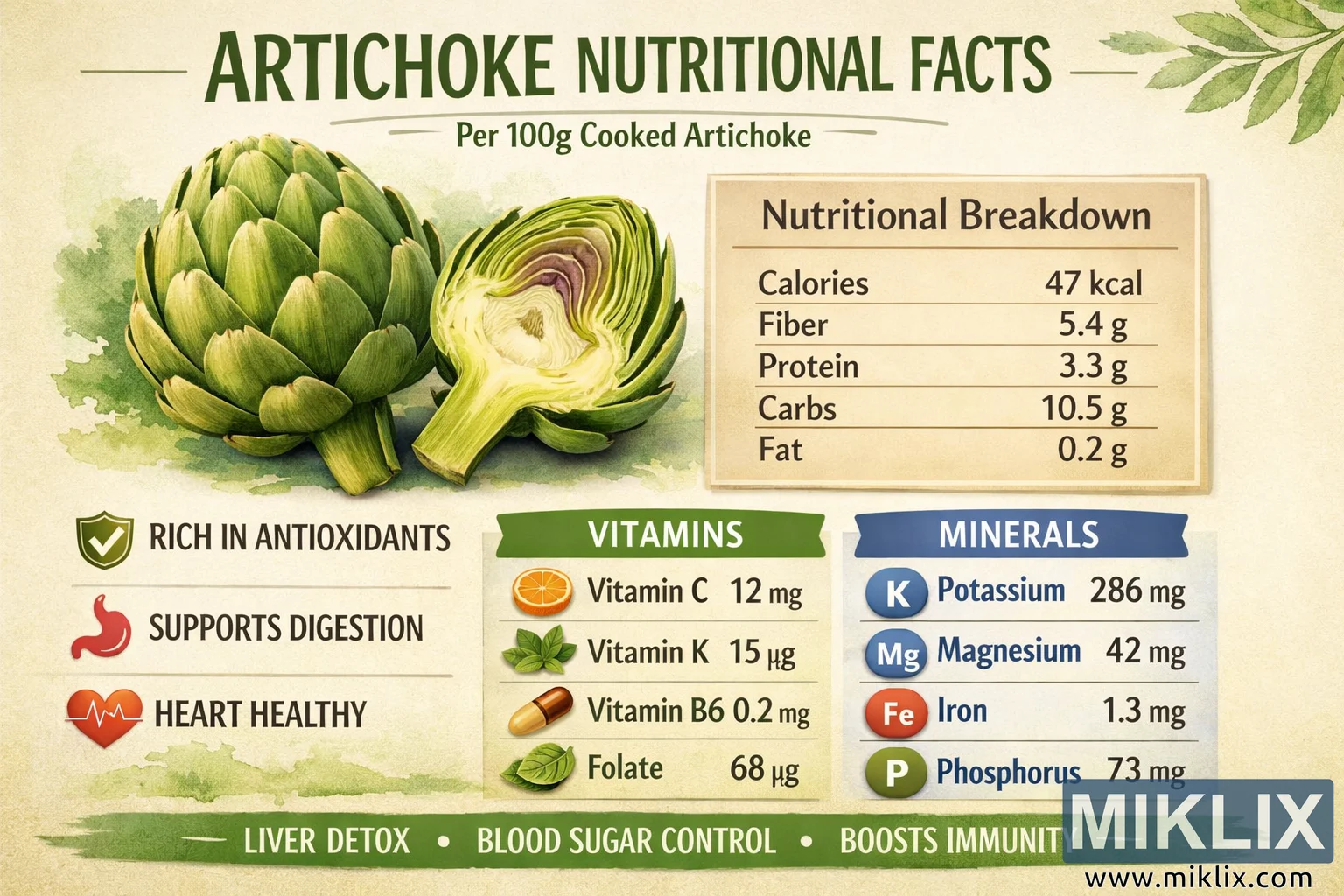
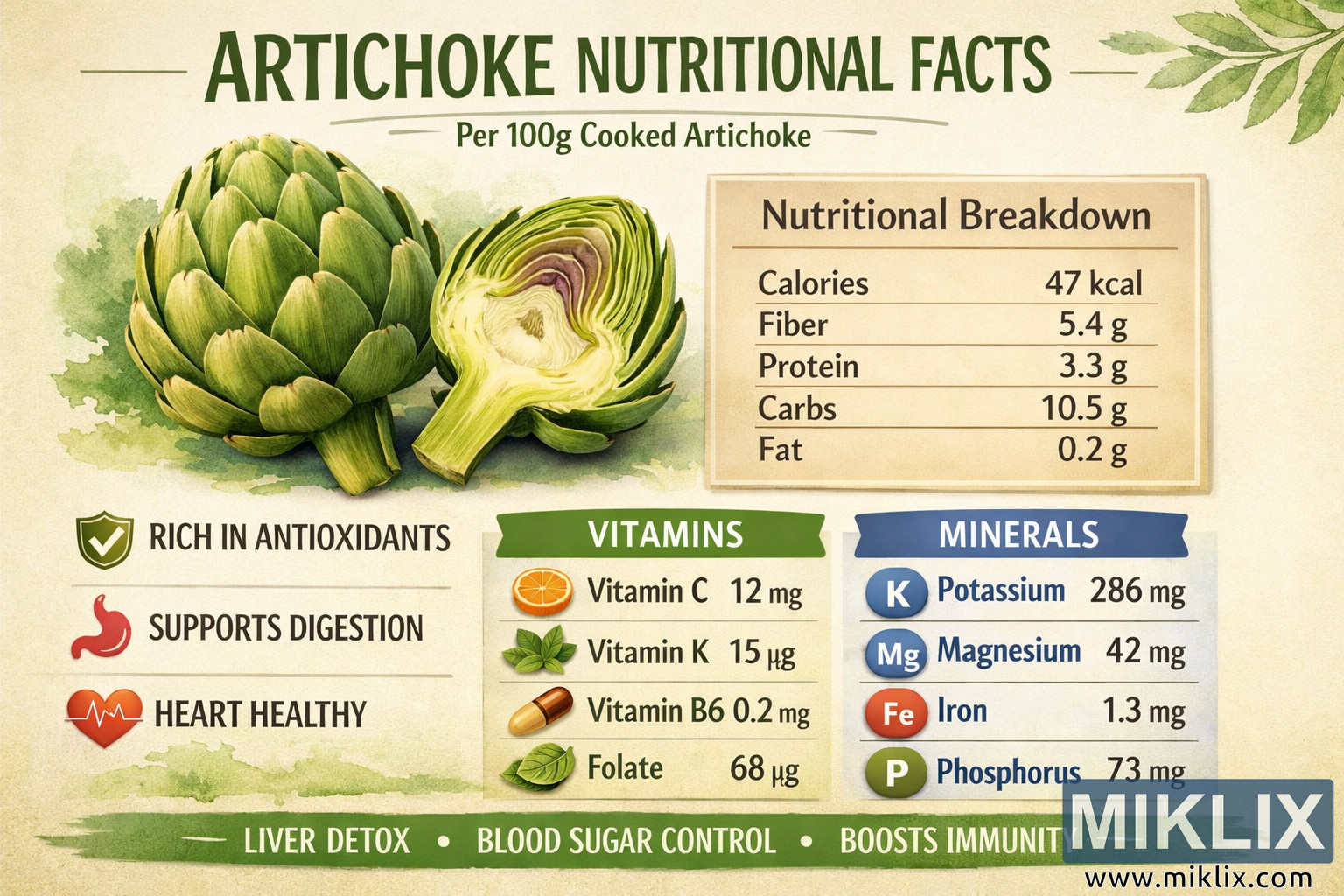
Detailed artichoke nutrition infographic showing calories, fiber, protein, carbs, fat, key vitamins, essential minerals, and health benefits including antioxidant support, improved digestion, heart health, liver detox, blood sugar control, and boosted immunity.
Available versions of this image
The image files available for download below are less compressed and higher resolution - and as a result of that, higher quality - than the images embedded in articles and pages on this website, which are more optimized for file size in order to reduce bandwidth consumption.
Regular size (1,536 x 1,024)
Large size (3,072 x 2,048)
Very large size (4,608 x 3,072)
Extra large size (6,144 x 4,096)
Comically large size (1,048,576 x 699,051)
- Still uploading... ;-)
Image description
This landscape-oriented infographic presents a comprehensive visual overview of the nutritional breakdown and health benefits of cooked artichokes, designed to be both educational and aesthetically pleasing. The background is a soft beige tone with subtle watercolor-like textures that evoke a natural, organic feel. Across the image, green accents and touches of blue are used to highlight key sections, reinforcing the theme of plant-based wellness and balanced nutrition. The layout is carefully structured into multiple panels and banners so that viewers can easily navigate from the general concept of artichoke nutrition to specific macronutrient values, vitamins, minerals, and health benefits.
At the top center of the infographic, a bold, uppercase heading reads \"ARTICHOKE NUTRITIONAL FACTS\" in large green letters. The font is modern, clean, and slightly rounded, suggesting clarity and approachability. Directly beneath this main title, a smaller subtitle states \"Per 100g Cooked Artichoke\". This subtitle is crucial because it sets the context for all the numerical values presented throughout the infographic, indicating that the data is standardized to a 100-gram serving of cooked artichoke. The top section thus immediately tells the viewer what the infographic is about and how to interpret the information that follows.
On the left side of the infographic, occupying a prominent portion of the visual space, there is a detailed illustration of a whole artichoke. The artichoke is depicted with layered green leaves that overlap in a natural pattern, each leaf shaded with gradients of green and hints of darker tones to create depth and dimension. The illustration has a watercolor style, with soft edges and gentle transitions between colors, giving it a hand-painted, organic look. Below the whole artichoke, there is a second illustration showing a half artichoke sliced open lengthwise. This cutaway view reveals the inner heart and the layered structure inside, emphasizing the edible core and reinforcing the idea of wholesome, plant-based nutrition. Together, these illustrations serve as the central visual anchor of the infographic, immediately signaling that the content is focused on artichokes.
Beneath the artichoke illustrations, three key health benefits are listed in a vertical arrangement, each accompanied by a simple, easily recognizable icon. The first benefit reads \"RICH IN ANTIOXIDANTS\" and is paired with a shield icon featuring a checkmark. The shield symbolizes protection, while the checkmark suggests approval or validation, visually conveying the idea that artichokes help protect the body from oxidative stress. The second benefit states \"SUPPORTS DIGESTION\" and is illustrated with a stylized stomach icon. The stomach graphic is simple yet clear, hinting at digestive comfort, gut health, and the role of fiber in promoting regularity. The third benefit is \"HEART HEALTHY\", accompanied by a red heart icon with a heartbeat line running through it. This combination of heart and pulse imagery suggests cardiovascular wellness, healthy circulation, and the potential role of artichokes in supporting heart health. These three benefit statements are spaced evenly, with consistent typography and icon style, making them easy to scan and remember.
To the right of the main artichoke illustration, there is a rectangular beige box labeled \"Nutritional Breakdown\". This box presents the macronutrient profile of 100 grams of cooked artichoke in a clear, text-based format. Inside the box, the following entries are listed on separate lines: \"Calories 47 kcal\", \"Fiber 5.4 g\", \"Protein 3.3 g\", \"Carbs 10.5 g\", and \"Fat 0.2 g\". The typography is consistent with the rest of the infographic, using a clean sans-serif font that is easy to read. The arrangement of these values highlights that artichokes are relatively low in calories and fat, while providing a notable amount of dietary fiber and a modest amount of protein. This section functions as a quick reference for viewers who want to understand the basic energy and macronutrient composition of artichokes at a glance.
Below the central artichoke and the \"Nutritional Breakdown\" box, the infographic is divided into two side-by-side panels: one dedicated to vitamins and the other to minerals. The left panel focuses on vitamins and is headed by a green banner labeled \"VITAMINS\" in white uppercase letters. Under this header, several key vitamins found in artichokes are listed, each accompanied by a small icon and its corresponding amount per 100 grams. The vitamins include \"Vitamin C 12 mg\", represented by an orange slice icon that evokes citrus fruits and immune support; \"Vitamin K 15 µg\", paired with a leafy icon that hints at its presence in green vegetables and its role in blood clotting and bone health; \"Vitamin B6 0.2 mg\", illustrated with a capsule icon, suggesting its importance in metabolism, brain function, and nervous system health; and \"Folate 68 µg\", accompanied by a leaf icon, emphasizing its role in cell division, DNA synthesis, and prenatal health. The icons are colorful yet simple, helping viewers quickly associate each nutrient with its function or common sources without overwhelming them with detail.
On the right side, mirroring the vitamins panel, is the minerals section. This panel has a blue header labeled \"MINERALS\" in white uppercase letters, creating a visual contrast with the green vitamins banner while maintaining overall harmony in the color palette. Below the header, several essential minerals present in artichokes are listed along with their amounts and symbolic icons. The minerals include \"Potassium 286 mg\" with a \"K\" symbol icon, highlighting its role in fluid balance, nerve function, and blood pressure regulation; \"Magnesium 42 mg\" with an \"Mg\" icon, indicating its importance for muscle function, energy production, and hundreds of enzymatic reactions; \"Iron 1.3 mg\" with an \"Fe\" icon, referencing its role in oxygen transport, hemoglobin formation, and preventing anemia; and \"Phosphorus 73 mg\" with a \"P\" icon, pointing to its contribution to bone health, cellular energy (ATP), and structural integrity of cell membranes. The layout of this section mirrors the vitamins chart, creating visual symmetry and making it easy for viewers to compare the two categories of micronutrients side by side.
At the bottom of the infographic, spanning the width of the design, there is a green banner that lists three additional health-related benefits of artichokes. The text in this banner reads: \"LIVER DETOX\", \"BLOOD SUGAR CONTROL\", and \"BOOSTS IMMUNITY\". Each phrase is separated by small white dots, giving the banner a clean, organized appearance and visually grouping the benefits while still distinguishing them from one another. This section reinforces the idea that artichokes are not only nutritionally dense but also supportive of various aspects of overall health, including liver function, metabolic balance, and immune resilience. The banner serves as a concluding highlight reel of the broader wellness advantages associated with including artichokes in the diet.
Throughout the infographic, the color palette remains consistent and thoughtfully chosen. Green is used extensively to emphasize plant-based nutrition, freshness, and vitality. Beige provides a neutral, calming background that allows the text and icons to stand out without harsh contrast. Blue is introduced in the minerals section to create visual differentiation while still harmonizing with the overall design. The icons and illustrations share a cohesive style, characterized by soft edges, gentle shading, and a slightly playful yet professional tone. The text is well-spaced and aligned, ensuring that viewers can easily read and understand the information without feeling overwhelmed.
Overall, this infographic communicates that artichokes are a nutrient-rich food offering a balanced combination of macronutrients, important vitamins, and essential minerals. It highlights multiple health benefits related to antioxidants, digestion, heart health, liver support, blood sugar regulation, and immune function. The structured layout, clear headings, and engaging visuals make the information accessible to a wide audience, from casual viewers curious about artichokes to health-conscious individuals and educators seeking a visually appealing way to present nutritional information.
The image is related to: Artichokes: The Delicious Vegetable That's Good for Your Health