
Bilde: Yellowing Mustard Leaves Showing Nitrogen Deficiency
Publisert:
Sist oppdatert: 7. mars 2026 kl. 18:30:03 UTC
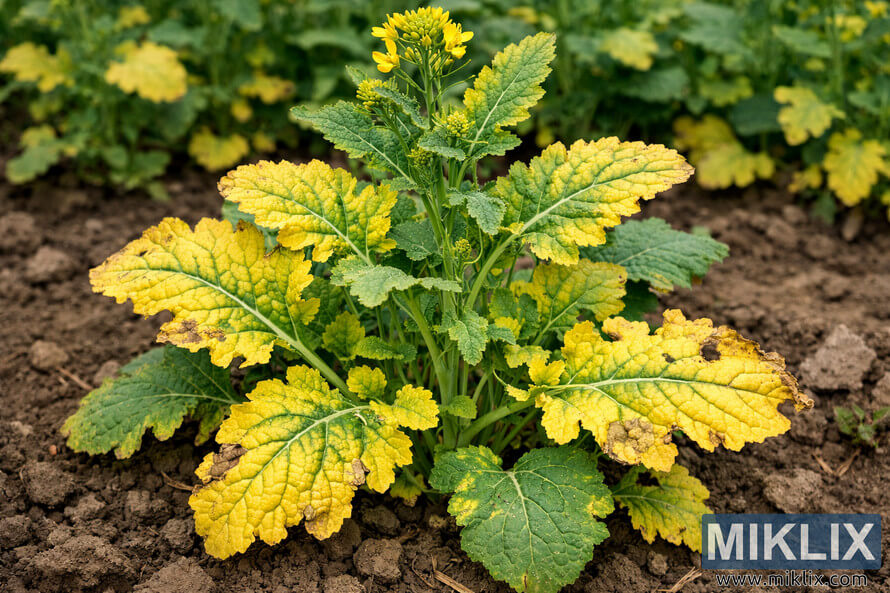
High-resolution landscape image of mustard leaves displaying nitrogen deficiency symptoms, including yellowing older foliage, interveinal chlorosis, and marginal browning in field conditions.
Yellowing Mustard Leaves Showing Nitrogen Deficiency
Tilgjengelige versjoner av dette bildet
Bildefilene som kan lastes ned nedenfor, er mindre komprimerte og har høyere oppløsning - og dermed høyere kvalitet - enn bildene som er innebygd i artikler og sider på dette nettstedet, som er mer optimalisert med tanke på filstørrelse for å redusere båndbreddeforbruket.
Vanlig størrelse (1,536 x 1,024)
Stor størrelse (3,072 x 2,048)
Svært stor størrelse (4,608 x 3,072)
Ekstra stor størrelse (6,144 x 4,096)
Komisk stor størrelse (1,048,576 x 699,051)
- Laster fortsatt opp... ;-)
Bildebeskrivelse
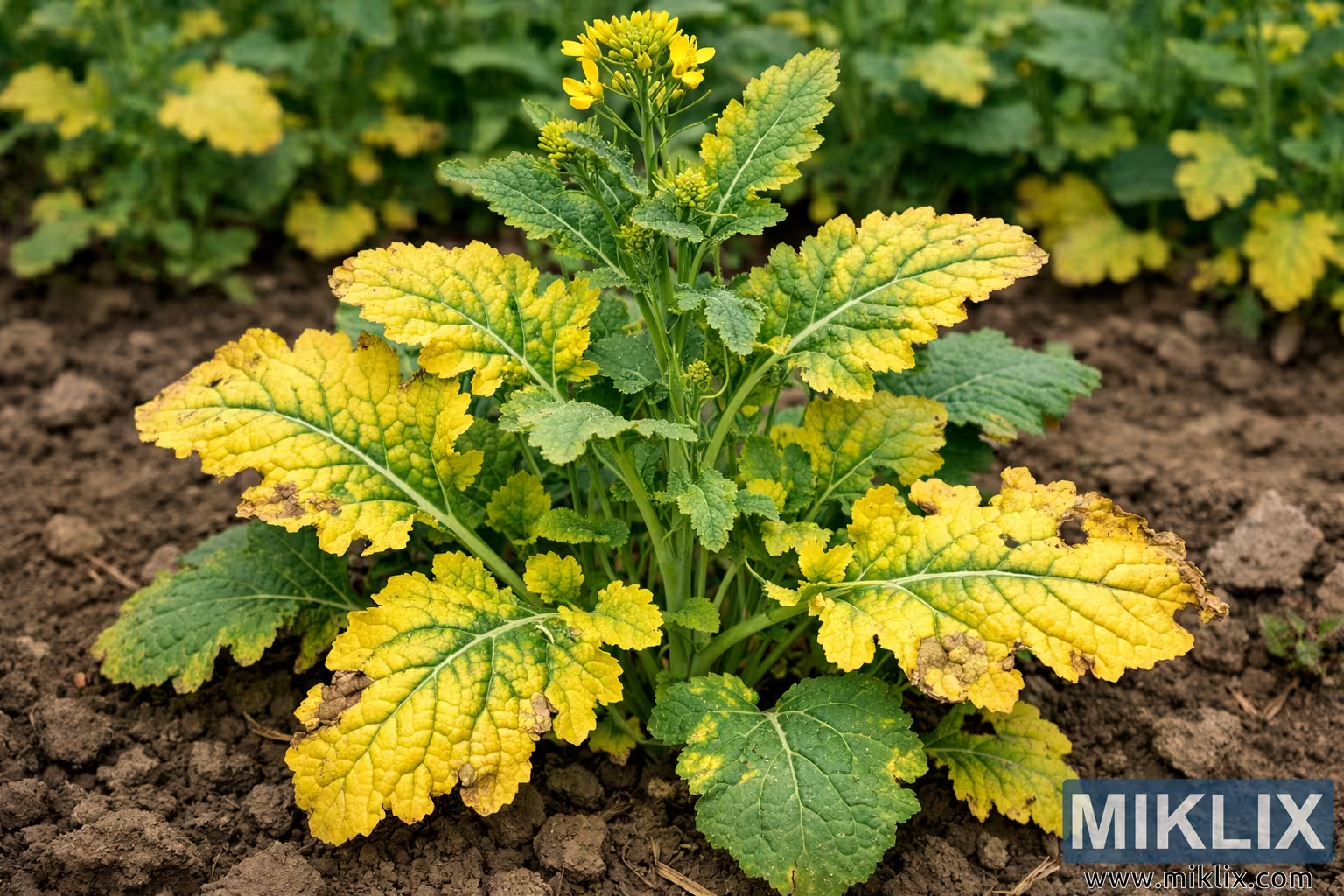
This high-resolution landscape photograph presents a detailed close-up view of a mustard plant growing in open field conditions and exhibiting clear symptoms of nitrogen deficiency. The plant is positioned centrally in the frame, surrounded by dry, brown, and visibly compacted soil with a coarse, cloddy texture. The cracked and uneven surface of the soil enhances the sense of field realism and suggests nutrient stress conditions. The mustard plant’s lower and older leaves are prominently yellowed, displaying a classic pattern of chlorosis associated with insufficient nitrogen availability. The yellowing appears more intense between the veins, while the main veins remain comparatively greener, creating a distinct interveinal contrast. Several of the affected leaves show slight curling at the edges and irregular brown necrotic patches near the margins, indicating prolonged nutrient stress.
In contrast to the lower foliage, the upper and younger leaves appear relatively greener, though slightly lighter than a fully healthy plant would typically show. This gradient of discoloration from bottom to top reflects the mobile nature of nitrogen within plants, where the nutrient is translocated from older tissues to support new growth under deficient conditions. The leaves are broad, lobed, and textured, with visible venation patterns that are sharply defined due to the high clarity of the image. Small water droplets are present on some leaf surfaces, adding a subtle sheen and enhancing the fine surface details.
At the top of the plant, a cluster of small, bright yellow mustard flowers emerges, providing a vivid color contrast against the chlorotic foliage below. The blossoms are compact and arranged in a tight inflorescence, standing upright on green stems. The flowering stage suggests that the plant has progressed developmentally despite nutrient limitations. The background shows additional mustard plants, slightly out of focus, many of which also display varying degrees of yellowing, reinforcing the impression of a broader field-level nutrient deficiency issue.
Lighting in the photograph is natural and even, likely captured during daylight under diffused sunlight. The image maintains sharp focus on the central plant while gently blurring the background to create depth. Overall, the photograph effectively documents the visual indicators of nitrogen deficiency in mustard, including generalized yellowing of older leaves, interveinal chlorosis, marginal necrosis, and differential coloration between older and younger foliage, all within an authentic agricultural field setting.
Bildet er relatert til: Complete Guide to Growing Your Own Mustard Plants