
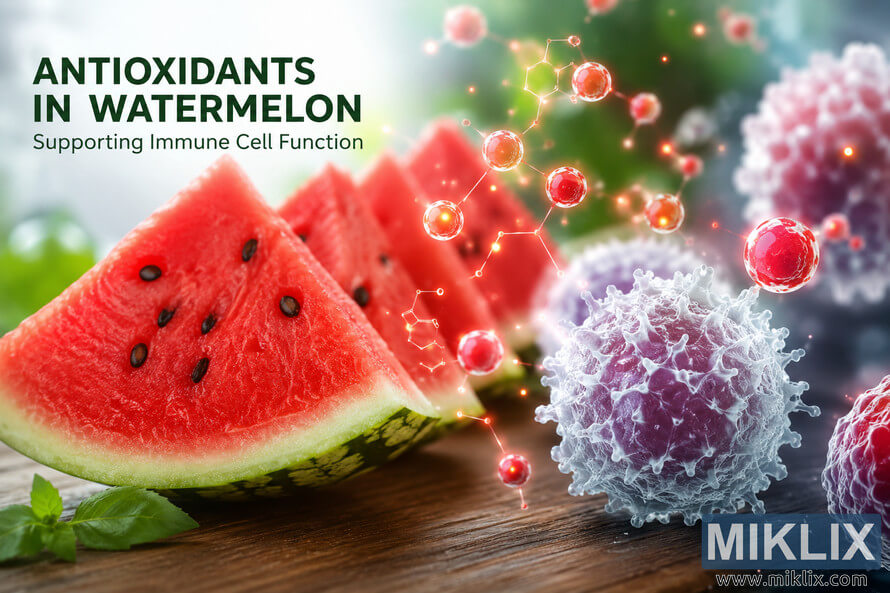
ภาพ: Antioxidants in Watermelon Supporting Immune Cell Function
ที่ตีพิมพ์:
ปรับปรุงล่าสุด : 16 สิงหาคม 2026 เวลา 19 นาฬิกา 10 นาที 16 วินาที UTC
Detailed scientific-style illustration of watermelon, antioxidant molecules, and immune cells, visually representing the role of antioxidant compounds in supporting healthy immune cell function. Ideal for nutrition, wellness, and educational content.
Antioxidants in Watermelon Supporting Immune Cell Function
เวอร์ชันต่างๆ ของภาพนี้
ไฟล์ภาพที่สามารถดาวน์โหลดได้ด้านล่างนี้ มีการบีบอัดน้อยกว่าและมีความละเอียดสูงกว่า ส่งผลให้มีคุณภาพสูงกว่าภาพที่ฝังอยู่ในบทความและหน้าเว็บต่างๆ บนเว็บไซต์นี้ ซึ่งได้รับการปรับขนาดไฟล์ให้เหมาะสมเพื่อลดการใช้แบนด์วิดท์
ขนาดปกติ (1,536 x 1,024)
ขนาดใหญ่ (3,072 x 2,048)
ขนาดใหญ่มาก (4,608 x 3,072)
ขนาดใหญ่พิเศษ (6,144 x 4,096)
ขนาดใหญ่เกินจริงอย่างน่าขัน (1,048,576 x 699,051)
- กำลังอัปโหลดอยู่... ;-)
คำอธิบายภาพ
This landscape-oriented scientific illustration presents a visually engaging concept centered on the relationship between antioxidants found in watermelon and healthy immune cell function. The composition combines realistic food photography aesthetics with stylized biomedical visualization to create an image that communicates nutrition, wellness, and biological activity in a clear and approachable manner. The overall color palette is dominated by vivid reds, fresh greens, warm natural wood tones, glowing amber highlights, and soft violet hues that together establish a vibrant, energetic atmosphere while maintaining a clean scientific appearance.
The foreground is occupied by several freshly cut watermelon slices arranged diagonally across a rustic wooden tabletop. The largest slice is positioned prominently near the lower left portion of the composition and displays vibrant red flesh with numerous glossy black seeds embedded naturally throughout the fruit. The rind transitions smoothly from pale white near the flesh to a deep green outer skin with darker green striping, emphasizing freshness and realism. Behind the primary slice, additional watermelon wedges gradually recede into the background, creating depth through shallow focus while reinforcing the central nutritional theme. The fruit appears juicy and freshly cut, with subtle surface texture and gentle highlights suggesting moisture and freshness.
Surrounding the watermelon are numerous glowing spherical particles connected by thin luminous lines, representing antioxidant molecules and beneficial biochemical interactions. These glowing molecular elements vary slightly in size and brightness, creating the impression of an active microscopic network suspended in the air above the fruit. Small points of light are distributed throughout the scene, contributing to a feeling of biological energy and continuous cellular communication. The molecular structures are intentionally stylized rather than chemically precise, serving as an accessible visual metaphor for naturally occurring antioxidant compounds that participate in protecting cells from oxidative stress.
On the right side of the image are several large stylized immune cells rendered with intricate surface textures. These spherical biological forms possess softly translucent membranes with delicate protrusions and highly detailed three-dimensional structure, giving them a realistic microscopic appearance while remaining visually appealing. Their coloration ranges from pale lavender to cool purple with subtle white highlights that enhance depth and dimensionality. The immune cells appear suspended within the composition rather than resting on the tabletop, reinforcing the transition between the visible food and the invisible biological processes occurring inside the human body. Their positioning establishes a visual connection between the watermelon and the concept of immune health without depicting any specific disease or medical condition.
The background consists of a smooth, artistically blurred environment that transitions between soft green, white, and muted purple tones. This shallow depth-of-field effect isolates the primary subjects while providing a clean backdrop suitable for educational graphics, wellness presentations, nutritional articles, or scientific communication. Gentle bokeh lighting and diffused illumination contribute to an inviting, contemporary visual style. Warm sunlight appears to illuminate the watermelon from the upper left, producing soft shadows across the wooden surface while subtle glowing highlights emphasize the floating molecular network.
The upper left region contains a clean textual layout with a bold headline reading "ANTIOXIDANTS IN WATERMELON" followed by the smaller subtitle "Supporting Immune Cell Function." The typography is modern and highly legible, occupying open negative space that balances the composition without distracting from the imagery. The placement naturally guides the viewer's eye from the educational title toward the fruit and then across the molecular structures to the immune cells, creating a logical visual narrative that links nutrition with biological function.
Overall, the illustration communicates the general concept that watermelon contains antioxidant compounds associated with supporting normal immune function as part of a healthy diet. The image uses symbolic scientific elements instead of literal medical diagrams, making the subject approachable for a broad audience including health educators, nutrition professionals, students, wellness organizations, and publishers. The scene avoids depicting any commercial products, branded materials, or identifiable trademarks, focusing entirely on natural food imagery and generalized scientific visualization. The result is a polished educational graphic that blends realistic food photography with contemporary biomedical illustration to create an engaging visual representation of nutrition science suitable for articles, presentations, infographics, websites, educational materials, and health-related communications.
รูปภาพนี้เกี่ยวข้องกับ: Watermelon: The Hydrating Superfruit You Should Eat More Often