
图像: Okra Plant Affected by Southern Blight at Soil Line
已出版:
最后更新 2026年3月17日 UTC 21:38:04
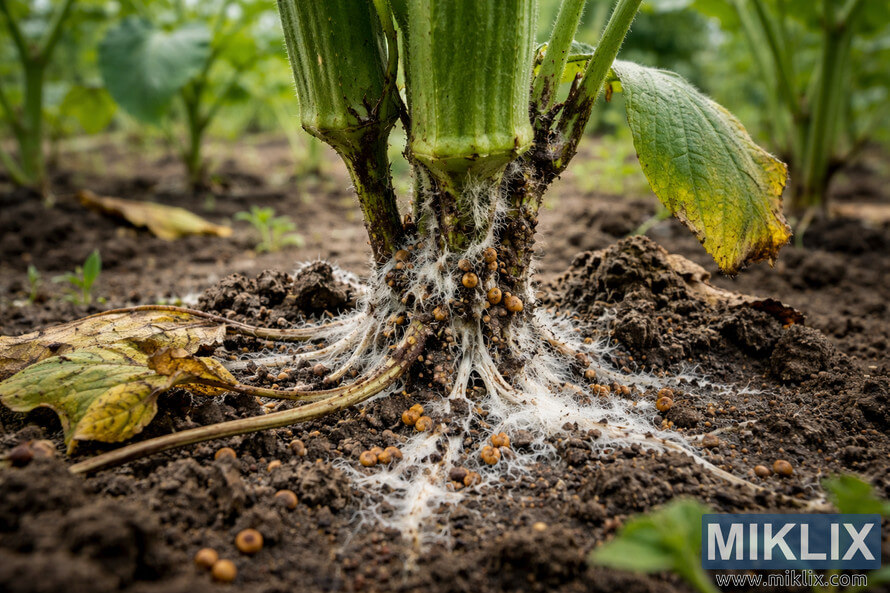
Detailed close-up image of an okra plant infected with Southern Blight, featuring white fungal mycelium and tan sclerotia forming around the base of the stem at soil level.
Okra Plant Affected by Southern Blight at Soil Line
该图片的可用版本
与本网站文章和网页中嵌入的图片相比,以下可供下载的图片文件压缩程度更低,分辨率更高,因此质量也更高。
正常尺寸 (1,536 x 1,024)
大尺寸 (3,072 x 2,048)
尺寸非常大 (4,608 x 3,072)
超大尺寸 (6,144 x 4,096)
夸张的大尺寸 (1,048,576 x 699,051)
- 仍在上传......;-)
图片说明
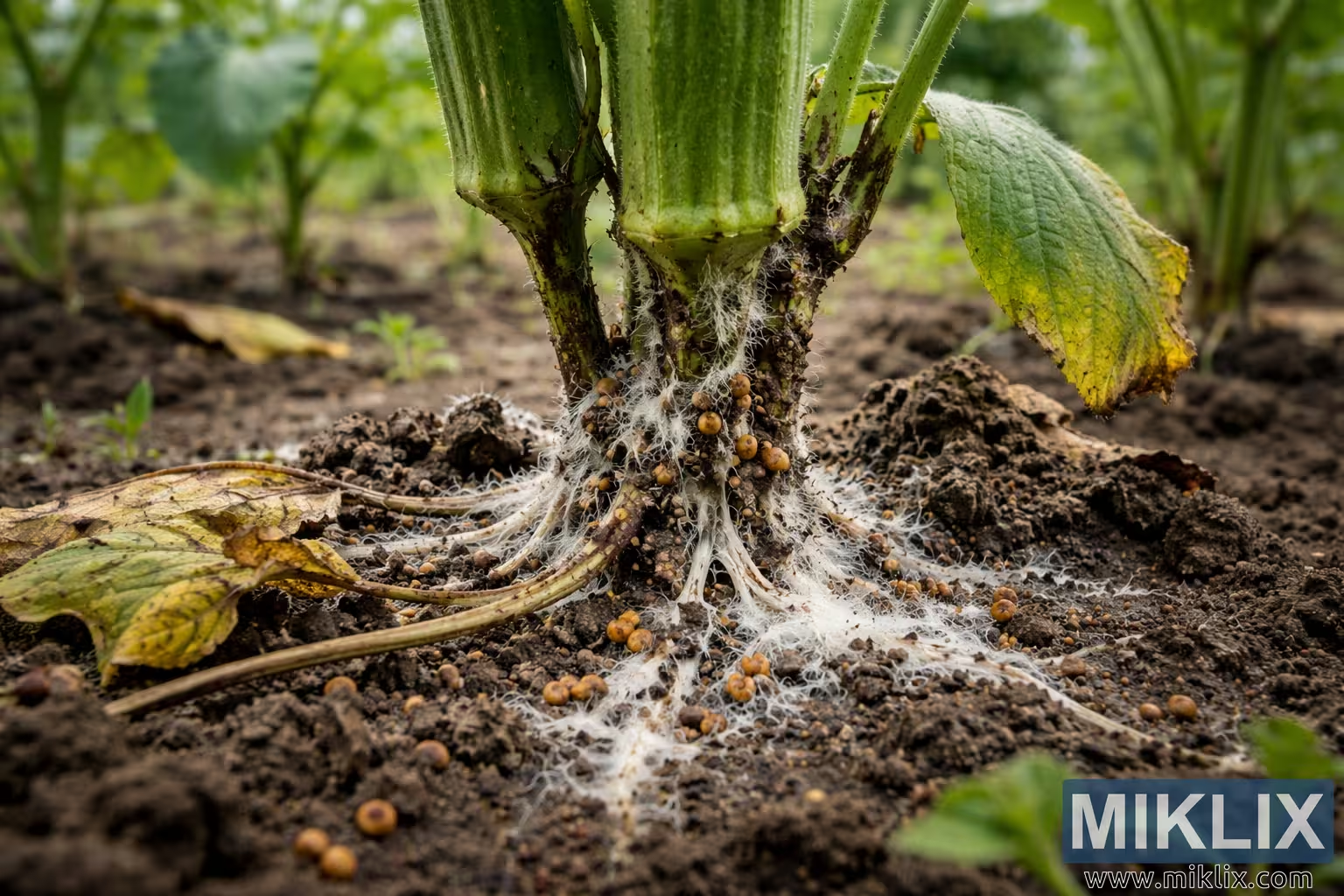
This high-resolution landscape photograph presents a detailed close-up view of an okra plant infected with Southern Blight, a destructive soil-borne fungal disease commonly caused by the pathogen Sclerotium rolfsii. The image focuses on the base of the okra stems where they emerge from the soil, clearly highlighting the characteristic signs of infection at the soil line. Several sturdy green stems rise vertically from the ground, but the lower portions of these stems show clear symptoms of stress and damage associated with disease development.
At the point where the stems meet the soil, dense white fungal growth spreads outward in a cotton-like network of mycelium. The mycelial strands cling tightly to the stem surface and extend across the surrounding soil, forming irregular patches that resemble delicate threads or fine spiderwebs. Embedded within this fungal mass are numerous small spherical structures known as sclerotia. These structures appear as tiny round beads scattered throughout the mycelium and on the soil surface, displaying shades of light tan to golden brown. Their presence is a defining diagnostic feature of Southern Blight and indicates the fungus’s survival structures that allow it to persist in soil.
The surrounding soil appears dark, loose, and slightly clumped, providing a natural background that contrasts strongly with the bright white fungal growth. Small particles of soil adhere to the mycelium, while several sclerotia rest directly on the ground around the stem base. The disease appears concentrated around the lower stem tissue where infection typically begins, gradually weakening the plant and interfering with its ability to transport water and nutrients.
One of the nearby leaves attached to the plant shows visible signs of stress, displaying yellowing and browning along the edges. The leaf droops downward toward the soil, suggesting wilting associated with the infection’s progression. In contrast, other parts of the plant remain green, illustrating the early-to-mid stage of disease where symptoms may begin locally before spreading further through the plant.
The background of the image is softly blurred, revealing additional green plants growing in rows within what appears to be a cultivated garden or agricultural field. This shallow depth of field keeps the viewer’s attention centered on the infected plant base while still providing environmental context. Natural daylight illuminates the scene, enhancing the textures of the soil, the fibrous fungal growth, and the ribbed surfaces of the okra stems.
Overall, the image serves as a clear visual example of Southern Blight infection on okra, emphasizing the diagnostic features of white cottony mycelium and tan sclerotia at the soil line. The photograph captures both the biological detail of the pathogen and the visible impact on the host plant, making it useful for agricultural education, plant pathology reference, and disease identification in vegetable crops.
图片与此有关: The Complete Guide to Growing Okra in Your Home Garden