
Hops in Beer Brewing: Aurora
Published: January 27, 2026 at 10:51:40 PM UTC
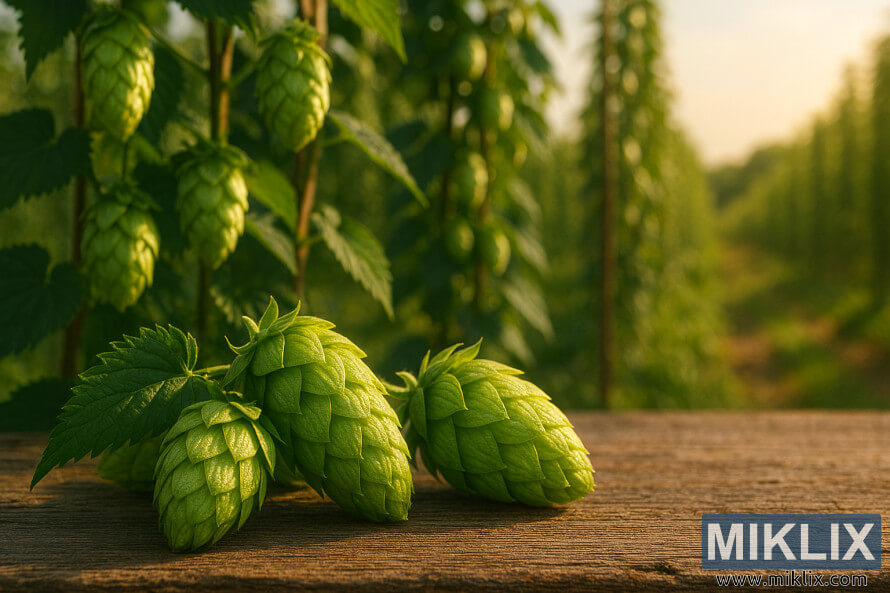
Aurora hops, also known as Super Styrian or Styrian Aurora, are a versatile variety grown mainly in Slovenia. As a diploid hybrid, Aurora hops offer reliable agronomy and balanced chemistry. This makes them suitable for both bittering and aroma roles.
Click or tap the image for more information and higher resolutions.
This article will cover the essentials of Aurora brewing. We'll explore its origin, chemistry, aroma, and flavor. We'll also discuss its growing habits, practical brewing uses, and substitutions. Additionally, we'll look at buying options in the U.S., storage, recipe guidance, sensory evaluation, and comparisons with other Styrian and international hops. Our goal is to provide craft brewers and homebrewers with actionable guidance on using this notable Slovenian hop.
Key Takeaways
- Aurora hops (aka Super Styrian / Styrian Aurora) are a dual-purpose Slovenian variety.
- Commonly listed under codes SSA, 12/61, and HUL005 and sold by major suppliers.
- Suitable for both bittering and aroma additions in a wide range of beer styles.
- Used by commercial brewers like Hopvine Brewing Company and Mayflower.
- This guide covers origin, chemistry, brewing uses, buying, storage, and recipe design.
Origin and genealogy of Aurora hops
Aurora's roots stem from a careful breeding project in Slovenia, merging global and local genetics. It's widely acknowledged to be a result of Northern Brewer crossed with a TG seedling from the former Yugoslavia. This blend is why it's often referred to as having a Super Styrian origin.
The Northern Brewer side of its lineage is known for its strong bittering potential. On the other hand, the TG seedling adds floral and herbal notes, along with balanced oils. This combination makes Aurora unique in the world of hops.
Genealogy Aurora falls within a lineage that includes Northern Brewer, used to create high-alpha Styrian varieties. This places it alongside two other notable Slovenian hops. These hops are known for their balance of bitterness and aromatic complexity.
For brewers, understanding Aurora's origins helps predict its performance in the brewing process. It promises a robust bitterness from its Northern Brewer heritage and a distinctive aroma from its Super Styrian parentage.
Botanical characteristics and growing habits
The Aurora hop plant is a diploid hybrid from Slovenia, tailored for Central European climates. It exhibits a high to very high growth rate, producing dense cones with excellent density. Its mid-to-late seasonal maturity necessitates careful planning for harvest windows.
On average, Aurora yields around 1,055 kg per hectare (approximately 940 lbs per acre). This makes it a prime choice for commercial growers. Its strong vegetative vigor ensures consistent yields under proper management. Plants perform well in Slovenian fields and similar climates.
Disease resistance is moderate against downy mildew. Hence, regular pest and disease monitoring is crucial. Standard Styrian hop cultivation practices—such as timely fungicide applications, canopy management, and irrigation—are key to maintaining cone quality. This approach supports practical Aurora agronomy without requiring exotic measures.
Storage and chemical stability are critical for farming decisions. Aurora cones retain about 70%–75% of alpha acids after six months at 20°C (68°F). This affects processing and sale timing. Producers must consider this when planning post-harvest handling to preserve brewing value.
Practical Aurora agronomy emphasizes sites with good airflow, balanced soil, and reliable water. Growers in the United States, mirroring Central European management, can expect similar results. Multiple suppliers offer Aurora from Slovenia, making it easier to source for those expanding Styrian hop cultivation outside Europe.
Chemical composition and brewing values
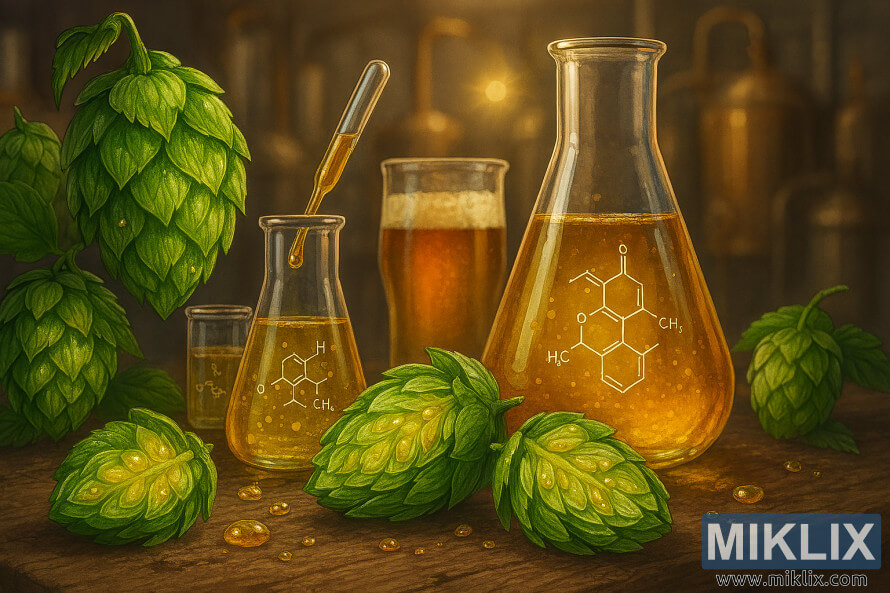
Aurora alpha acids range from 6.5% to 13%, with averages around 9.8% for bittering. The alpha to beta acid ratio is moderate, averaging 3:1. This balance is crucial for brewers aiming for a balanced flavor.
Co-humulone Aurora values are between 20% and 26%, averaging 22%–23%. This middle ground is ideal for both bittering and aroma enhancement. The alpha/beta ratio of 3:1 ensures a consistent bitterness quality.
HSI Aurora values are stable, ranging from 0.25 to 0.30. This indicates good retention of alpha acids, with 70%–75% remaining after six months at 20°C (68°F). Such data aids in inventory management and aging predictions.
- Total oils in Aurora hops are 0.9–1.8 mL per 100 g, averaging 1.4 mL/100 g. This supports aromatic additions in brewing.
- Oil composition varies. Myrcene and humulene are often reported between 20% and 25%. Caryophyllene and farnesene are consistently in the 5%–10% range.
These variations are due to factors like crop year, processing, and analysis methods. Reviewing batch certificates is essential to understand the exact hop oil composition for a specific batch.
Aurora hops offer flexibility due to their balanced alpha and beta acids, moderate co-humulone, and stable HSI. They are suitable for early bittering or late aromatic additions in pale ales and hybrid lagers.
Click or tap the image for more information and higher resolutions.
Aroma and flavor profile in finished beer
The Aurora hop aroma is known for its unique blend of floral, spice, and lemongrass notes. These characteristics are particularly pronounced in late additions and dry hopping. Brewers find that it adds an intense yet pleasant top note to pale ales, pilsners, and softer IPAs. This enhances the beer without overpowering the malt character.
In the glass, the Aurora flavor profile is marked by spicy and herbal undertones. It also boasts a moderate bitterness that complements the rounded mouthfeel. The presence of myrcene and humulene contributes resinous and woody flavors. Meanwhile, caryophyllene adds a peppery, herbal dimension. Farnesene, on the other hand, brings fresh green floral notes that harmonize the overall profile.
Adding Aurora in late boil or whirlpool additions helps preserve its floral spice lemongrass essence. Dry hopping further enhances the lemongrass clarity and noble-like floral aspects. These methods result in a hoppy yet smooth finish, ideal for balanced beer recipes.
- Primary scent: floral with bright green highlights
- Secondary notes: spice and herbal pepper from caryophyllene
- Texture: moderate bitterness with a velvety mouthfeel
Brewers aiming for a distinctive aromatic touch can rely on the Aurora flavor profile. It adds complexity without harshness. Pair it with soft malt bills and restrained late hopping for the cleanest floral spice lemongrass expression.
Brewing uses and addition timing
Aurora is a versatile hop, suitable for both bittering and flavor/aroma additions. For bittering, add Aurora in the early boil. This is when you need alpha acids in the 6.5–13% range. It helps create a balanced bitterness without overpowering the malt.
For mid-boil and late additions, use 10–15 minute additions. This timing helps bring out spice and light citrus notes. It preserves the hop's delicate oils better than longer boils.
Save the last five minutes for Aurora aroma additions. This late addition enhances floral, lemongrass, and spicy notes. It ensures these aromas are bright and integrated into the beer's head and surface.
Consider whirlpool additions for Aurora to extract aromatic oils gently. A whirlpool at 170–180°F for 15–30 minutes is ideal. It brings out rounded florals and soft herbal tones while minimizing bitterness.
For dry hopping, use Aurora to intensify floral and lemongrass flavors. It also helps maintain a smooth mouthfeel when added in small amounts during conditioning.
- Early boil: Aurora bittering for base IBUs.
- 10–15 min: Aurora hop additions for flavor lift.
- Last 5 min / whirlpool Aurora: peak aroma extraction.
- Conditioning: dry hop Aurora for top-note freshness.
Beer styles that showcase Aurora hops
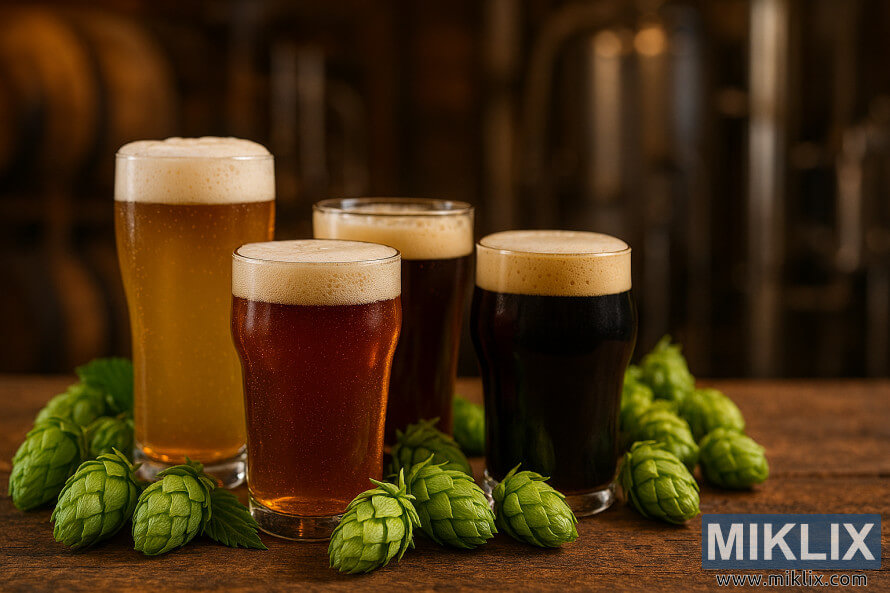
Aurora hops are versatile, fitting into both classic and modern beer styles. In pale ales and American Pale Ales, they bring out floral and spicy notes. This is especially true when used for late additions and dry hopping.
English ales benefit from Aurora's noble, herbal edge. This hop is great for those seeking a balanced spice without overpowering the malt.
Belgian ales gain complexity from the interaction of yeast esters and Aurora's floral-herbal tones. Even a single-hop treatment can add subtle perfumed layers to Belgian dubbels and saisons.
Aurora lagers are perfect for showcasing clean malt expression with a hint of spice. They work well in dark lagers, enhancing roasted or caramel malts with their herbal bite.
In IPAs and hop-forward pale ales, Aurora adds a unique floral-spicy dimension. This complements citrus or resinous hop blends. Single-hop showcases, like Mayflower’s Styrian Aurora, demonstrate its versatility in craft brewing.
- American Pale Ale — late additions for floral lift
- IPA — blending partner to add spice
- English Bitter and Ordinary Ale — noble-like profile
- Belgian Ale — complements yeast esters
- Dark Lager — herbal notes that balance malt
Commercial examples show small and regional brewers' interest in Styrian Aurora beers. Hopvine Brewing Company and Funwerk have featured Aurora in limited releases. This highlights practical ways to adapt recipes.
When planning recipes, consider hop rates and timing. This will help you decide whether to let Aurora lagers show restraint or let Aurora in ales deliver more aroma. Trial batches can help determine if the hop should be a main feature or a supporting note in your beer lineup.
Click or tap the image for more information and higher resolutions.
Aurora hops substitutions and pairing
When Aurora is scarce, brewers seek substitutes that retain its unique spicy, herbal, floral, and lemongrass notes. Styrian Golding and Northern Brewer are viable alternatives, each bringing distinct qualities to aroma and bitterness.
Styrian Golding is ideal for capturing the noble, floral, and earthy aspects of Aurora. It adds a soft, delicate top note that enhances the herbal and floral elements without dominating lighter malt profiles.
Northern Brewer, on the other hand, offers a firm bittering backbone and resinous character. It pairs well with Styrian Golding, especially in earlier additions where predictable alpha acids and a clean, piney finish are desired.
- Single-hop swap: For hop-forward pale ales, try Styrian Golding on late additions and Northern Brewer for bittering to mimic Aurora substitutions.
- Blend approach: Combine a floral/earthy variety like Styrian Golding with a resinous, higher-alpha bittering variety such as Northern Brewer or Perle.
- Perle options: Perle from Germany or the U.S. can replace part of Aurora’s profile by adding bright spice and moderate bitterness.
Practical ratios often start at 60/40 or 50/50 floral to bittering hop when attempting hop pairing Aurora. Adjust ratios based on aroma and alpha acid targets. Taste during trial brews to fine-tune balance for your recipe.
Consider hop timing as part of substitution strategy. Place the floral component in whirlpool or late-boil additions. Reserve the resinous, bittering hops for early boil additions. This preserves Aurora’s layered character even when using substitutes.
Document your changes and sensory results. Small tweaks in blend and timing can push a mixed substitution toward the signature lemongrass and herbal cues that define Aurora substitutions in many recipes.
Buying and availability in the United States
Aurora hops are available through various hop merchants and retail channels in the U.S. Buyers can find them on national vendors, craft-brewing shops, and large marketplaces like Amazon. It's crucial to compare offers as stock, price, and pack sizes vary by supplier.
When searching for Aurora hop suppliers, ensure each listing includes crop year, alpha-acid analysis, and hop storage index (HSI). These details indicate freshness and brewing value. Northwest Hop Farms and other North American stockists sometimes list Aurora. Many sellers also ship across states.
- Compare harvest year and alpha assay before purchase.
- Decide on whole-cone or pellet forms based on your brew method.
- Read merchant notes about packaging and cold-chain handling.
Global availability of Aurora hops can fluctuate by harvest. Small crops or allocation can limit availability in any given year. Brewers should contact vendors directly for large orders to ensure production batches.
Practical buying tips include ordering from reputable hop merchants or verified Amazon listings. Ensure they specify crop year and lab data. If a listing lacks analysis, request it. This step reduces risk and aligns hops with recipe goals.
For homebrewers and small breweries, consider buying small lots of Aurora hops USA first. Test their aroma and bitterness contributions before committing to larger quantities. Monitor supplier reviews and shipping policies for the best results.
Storage, freshness and best practices
Aurora hop storage impacts aroma and bittering power. The Hop Storage Index for Aurora is around 0.25–0.30, indicating good initial stability but growing volatility over time. Brewers need to plan accordingly to maintain hop freshness Aurora.
At room temperature near 68°F (20°C), Aurora retains about 70%–75% of its alpha acids after six months. This means storing hops at ambient conditions leads to steady alpha loss. To achieve the best results, avoid storing hops at room temperature for extended periods.
Cold storage in a refrigerator or freezer slows alpha degradation and volatile oil loss. Use vacuum-sealed bags or nitrogen-flushed packaging to limit oxygen exposure. These methods reduce the impact of HSI Aurora and preserve key aromatic compounds.
Open packages release oxygen, accelerating degradation. Use small portions, reseal immediately, and consume opened hops quickly. For the brightest aroma, plan additions late in the boil, at whirlpool, or as dry-hop charges.
- Keep whole leaf or pellet hops frozen when not in use.
- Label packages with date received and alpha values.
- Use nitrogen flushing or vacuum sealing to extend storage life.
- Avoid repeated thaw-freeze cycles to protect lupulin and oils.
Major lupulin producers currently do not market a lupulin or cryo product for Aurora. This means concentrating aromatic fractions is limited to careful storing hops and smart addition timing, rather than a cryo shortcut.
When tracking hop freshness Aurora, pair sensory checks with date and storage records. Simple routines make it easier to judge HSI Aurora trends and decide when to replace inventory for consistent beer quality.
Click or tap the image for more information and higher resolutions.
Quantifying hopping rates and recipe design
Begin by examining Aurora's alpha acid range, usually between 6.5–13% with an average of 9.8%. Use this data as the foundation for calculating bittering additions. Always verify the supplier's assay before setting your target IBUs.
For a balanced pale ale or lager, allocate most of the bittering to Aurora during the boil. Measure the weights to achieve the desired Aurora IBUs, then add small late additions for aroma. These late additions help preserve the hop's volatile oils, unlike long boil times.
Consider a dual-purpose approach for beers that require both bitterness and character. Use Aurora for 60–70% of the total bittering, with 20–30% in late additions to enhance floral and herbal notes. For very hop-forward IPAs, reduce late rates. Conversely, increase them when aroma is paramount.
- Calculate bittering: use measured alpha acids and boil utilization to set Aurora IBUs.
- Adjust for substitution: scale weight proportional to alpha acid differences when replacing Styrian Golding or Northern Brewer.
- Emphasize weight for whirlpool and dry-hop additions, since total oils are volatile.
When substituting, perform a simple ratio: desired alpha acid contribution divided by substitute alpha acid equals new weight. This ensures consistency in Aurora recipe design, maintaining bitterness and aroma balance across hops.
Practical tip: plan hop schedules around target IBUs and aroma weight. Track Aurora hopping rates in the brew log and revise Aurora alpha acid calculation with each batch assay to keep results predictable and repeatable.
Sensory evaluation and tasting notes
Conduct a controlled tasting to fully appreciate Aurora hops in beer. Utilize single-hop finishes or measured blends to discern floral from spicy characteristics. Serve fresh samples in tulip or snifter glasses. Then, assess aroma, flavor, mouthfeel, and finish in brief, focused sessions.
Start with aroma. Aurora sensory notes reveal a distinct floral top, with bright lemongrass hints and a touch of spice. In some beers, the scent is intense yet pleasing, enhancing the brew without overpowering malt or yeast.
Next, evaluate taste. Aurora tasting often introduces herbal and peppery notes from caryophyllene, woody-noble tones from humulene, and a resinous citrus or fruity lift from myrcene. Farnesene contributes a subtle green-floral note, enhancing the overall profile.
- Appearance and head retention: note clarity and foam stability before aroma testing.
- Aroma: record floral, lemongrass, and spice intensity for each addition timing.
- Palate: assess bitterness level, herbal notes, and a velvety mouthfeel.
- Finish: observe lingering spice, citrus lift, or a clean dry end.
Test addition timing separately. Late-kettle and whirlpool hops emphasize floral and lemongrass nuances. Dry-hopping enhances volatile myrcene and brighter top-note aromas. Kettle additions, on the other hand, push more spicy and bitter elements.
Utilize small-scale batches or split-fermenter trials to compare results. Rate each sample for aroma clarity, flavor balance, and perceived complexity. Document how Aurora sensory notes evolve with hopping rate, yeast choice, and mash profile.
For objective records, employ a simple intensity scale and a short descriptor list. Include terms like floral, lemongrass, resinous, woody, peppery, and velvety to facilitate comparison. Repeat trials across different days to verify consistency in Aurora tasting.
Comparing Aurora to other Styrian and international hops
Aurora falls between traditional Styrian hops and more resinous international varieties. It boasts nearly double the alpha acid content of Styrian Golding. This makes Aurora a stronger bittering agent while retaining the soft floral and herbal notes expected from Styrian hops.
When deciding between Aurora and Styrian Golding, brewers must consider bitterness and aroma goals. Styrian Golding is ideal for achieving a noble, floral character with lower alpha acids. Aurora, with its firmer bittering and Styrian aromatic traits, is better suited for ales requiring both.
Comparing Aurora to Northern Brewer reveals a clear lineage. Northern Brewer is known for its resinous, woody bitterness. Aurora retains some of this bitterness but balances it with lighter, herbaceous oils. This balance enhances Aurora's versatility in modern ales, where both bitterness and delicate aroma are crucial.
Styrian Golding and Northern Brewer are common substitutes for Aurora. Perle, both German and U.S. varieties, can also be used for their peppery-citrus notes and firm bittering.
- Alpha acids: Aurora typically higher than Styrian Golding, similar to Northern Brewer for bittering use.
- Aroma: Aurora blends Styrian floral notes with a Northern Brewer backbone.
- Substitutes: Styrian Golding, Northern Brewer, Perle for select profiles.
- Availability: Aurora is one of the more widely exported Slovenian hops, easier to source internationally than many Super Styrian seedlings.
This comparison aids brewers in selecting the right hop for aroma, bittering, or both. To incorporate Aurora in recipes, adjust hopping rates for its higher alpha acids. Taste to appreciate the unique aromatic profile Aurora offers.
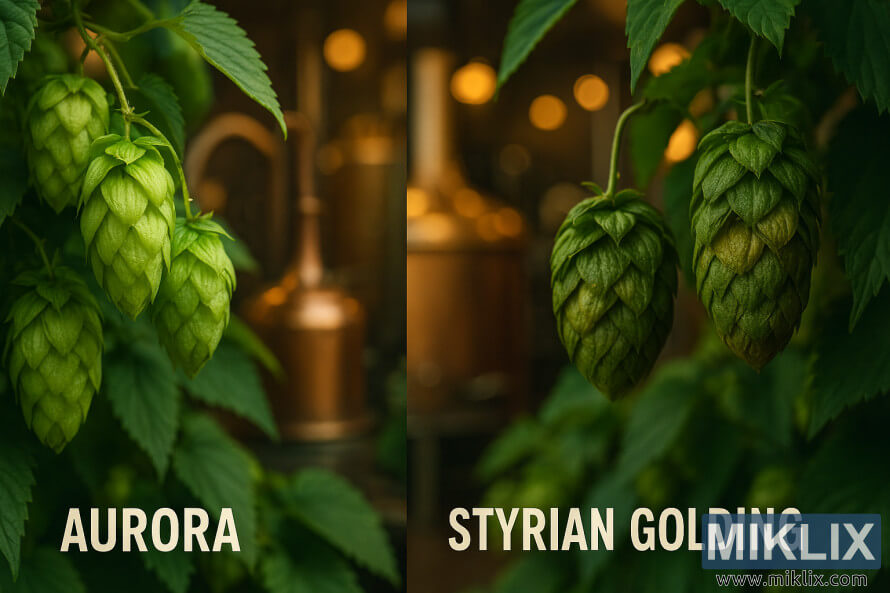
Click or tap the image for more information and higher resolutions.
Commercial and craft brewing case studies
Several breweries have showcased Aurora's delicate spice and floral lift in their beers. Hopvine Brewing Company and Funwerk’s Aurora are prime examples of beers that emphasize the hop's aromatic qualities. These beers guide drinkers towards the hop's unique scent.
Mayflower brewed a single-hop release called Styrian Aurora. This beer provides brewers with a clear reference for aroma and mouthfeel expectations. Aurora single hop beers act as practical benchmarks for recipe testing and sensory calibration.
Craft brewers have noted a velvety, smooth mouthfeel when using Aurora in late additions and dry hopping. Brewers who experiment with Aurora hop breweries’ recipes find it easy to scale up from pilot batches to 5-barrel runs. This is especially true when they match crop-year assay numbers.
Procuring Aurora is straightforward, as multiple hop merchants list it. Some even stock it on marketplaces like Amazon. This ease of access allows smaller breweries to replicate commercial examples and offer Aurora single hop beers as taproom specials.
Use these case studies to plan controlled trials. Compare early and late additions, track aroma retention, and measure how Styrian Aurora beers behave in ales versus lagers. This practice sharpens understanding of aroma intensity and helps predict consumer response.
Regulatory, naming and copyright notes for hop data
Brewers must accurately list hops on labels and technical sheets. Aurora hop naming is seen in three forms: Aurora, Super Styrian trademark, and Styrian Aurora. The SSA code is the international shorthand used by labs and breeders.
In the United States, there are routine rules for agricultural and food labeling. There are no specific bans on naming beers after hop varieties, as long as the label is truthful about ingredients and origin. Breweries should always cite the source and crop year of assay numbers to maintain clarity.
Databases and merchant pages often display assay charts and breeding IDs. In most cases, the original providers own the copyright to hop data. Republishing charts usually requires proper attribution. For instance, catalog entries with HUL005, 12/61, or similar IDs are proprietary and may have reuse restrictions.
When republishing assays and aroma descriptors, it's crucial to credit the provider and verify the values. This includes alpha acids, beta acids, and oil composition per harvest. If you repost supplier tables, include the hop cultivar code SSA and the assay year to clarify seasonal variability.
When discussing the Super Styrian trademark, confirm the trademark owner and follow their brand use guidelines. Proper attribution is key to protecting hop data copyright and maintaining good relations with growers like Hopsteiner, BarthHaas, and independent Styrian producers.
Follow these practical steps:
- List the hop name exactly as provided by the supplier, noting variants like Styrian Aurora.
- Include the hop cultivar code SSA when sharing lab results or recipes.
- Credit the source of assay data and verify the crop year.
- Respect trademark rules when using the Super Styrian trademark in marketing.
Clear labeling and proper attribution reduce legal risks and enhance transparency for brewers and consumers. Treating hop data with the same care as other ingredients ensures accuracy and trust throughout the supply chain.
Conclusion
Aurora hops summary: Known as Super Styrian, Aurora comes from a Northern Brewer × TG seedling cross. It is a true dual-purpose hop. Its alpha acids range from 6.5–13%, with an average of 9.8%. Beta acids are between 2.7–5.5%, and total oils are 0.9–1.8 mL/100g.
These values support floral, spicy, and lemongrass aromas. These characteristics are beneficial in many beer styles.
Aurora hop recommendations: It's suitable for both early bittering and late-aroma work. For beers that emphasize aroma, add it late in the boil, use whirlpool hops, or dry-hop. This captures its delicate floral and herbal notes.
Always verify the supplier's alpha assays and harvest year. This is crucial when scaling IBU targets or adjusting hop charges in recipes.
Buying and handling reminders and Styrian Aurora conclusion: Aurora is available from various U.S. suppliers. These include mainstream marketplaces and craft hop merchants. Store it cold and vacuum-sealed to preserve alpha acids and volatile oils.
Note that lupulin, cryo, or Lupomax derivatives are not commonly available for Aurora. Styrian Aurora conclusion: It's a versatile, reliable hop for ales and lagers. It adds a velvety, pleasantly hoppy character with spicy, herbal, and floral dimensions.
Further Reading
If you enjoyed this post, you may also like these suggestions: