
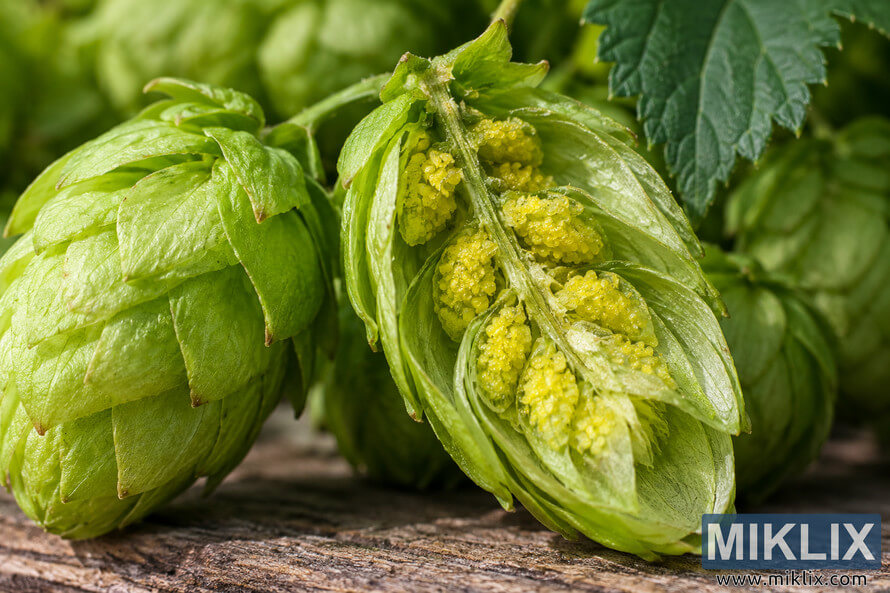
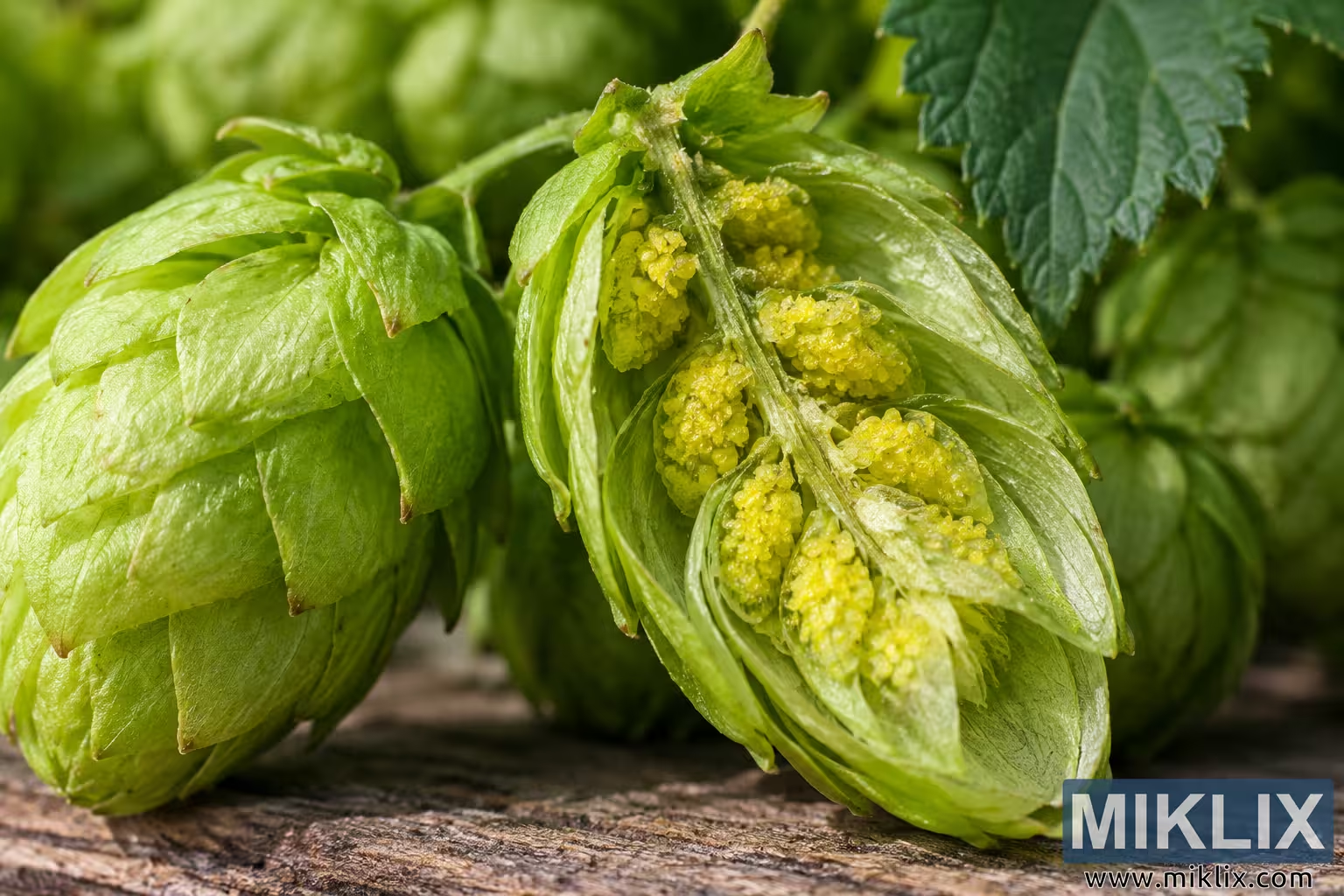
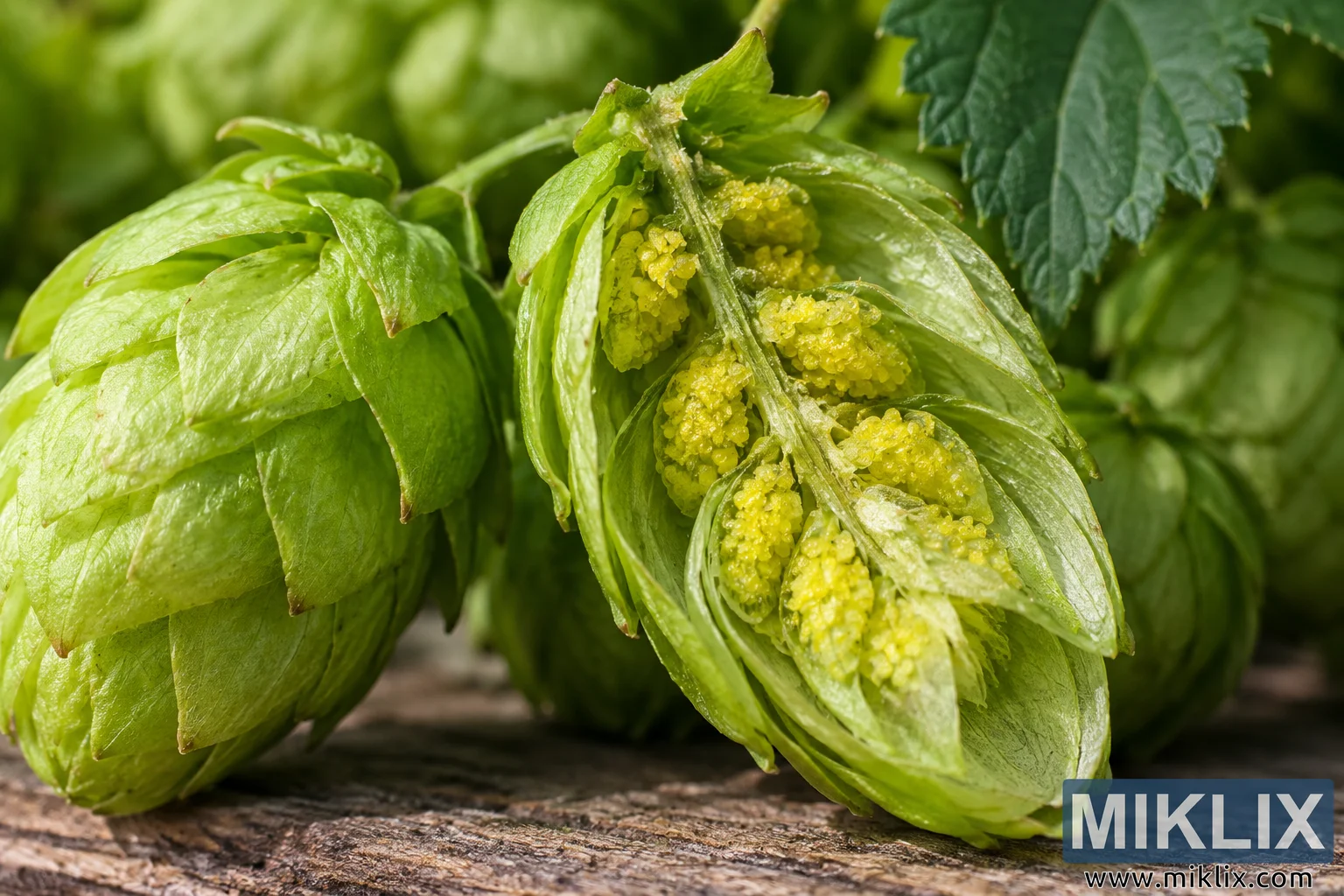
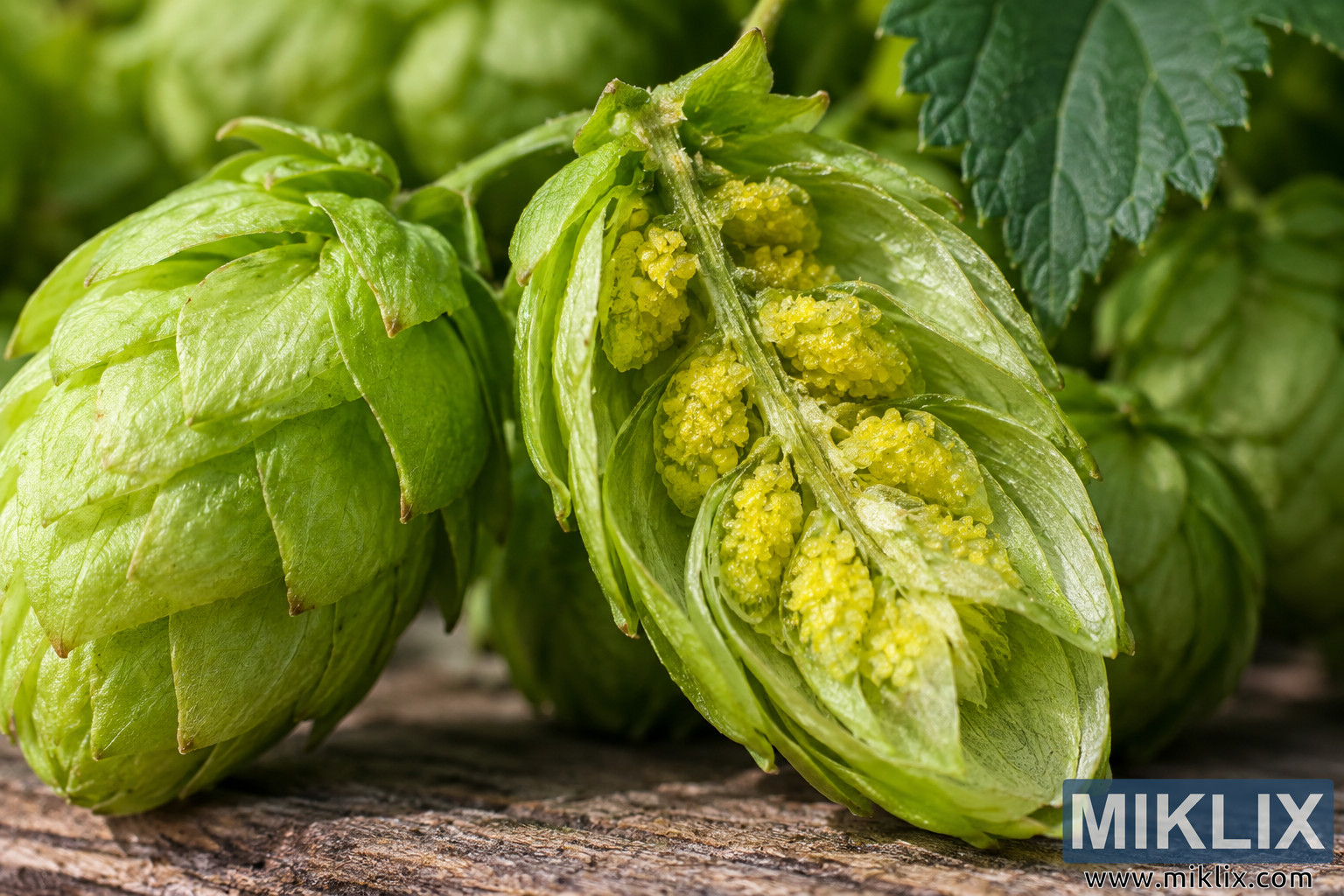
Image: Fresh Green Hop Cones with Exposed Lupulin Glands
Published: September 22, 2026 at 3:49:16 PM UTC
Detailed macro photograph of fresh green hop cones with an opened cone exposing bright yellow-green lupulin glands, photographed on rustic wood.
Available versions of this image
The image files available for download below are less compressed and higher resolution - and as a result of that, higher quality - than the images embedded in articles and pages on this website, which are more optimized for file size in order to reduce bandwidth consumption.
Regular size (1,536 x 1,024)
Large size (3,072 x 2,048)
Very large size (4,608 x 3,072)
Extra large size (6,144 x 4,096)
Comically large size (1,048,576 x 699,051)
- Still uploading... ;-)
Image description
A highly detailed, landscape-oriented macro photograph presents a cluster of fresh green hop cones at extremely close range, with the composition centered on one partially opened cone that reveals its vivid yellow-green lupulin glands. The image has a natural botanical character and emphasizes the intricate structure, freshness, texture, and resinous interior of the hops. In the foreground, several mature hop cones rest against a weathered wooden surface. Their overlapping bracts form tightly layered, scale-like patterns, with each individual bract showing delicate veins, subtle wrinkles, gently curled edges, and slight variations in green coloration. The cones range from bright yellow-green in the strongest areas of illumination to deeper, richer green in the shaded portions, giving the photograph considerable depth and dimensionality.
The principal hop cone occupies the center-right portion of the frame and has been opened sufficiently to expose the interior. Along the central stem and between the surrounding green bracts are numerous conspicuous lupulin glands. These appear as dense clusters of tiny golden-yellow to yellow-green resinous structures, providing a strong color and texture contrast with the smooth leafy surfaces around them. The glands look fresh, moist, and slightly glossy under the directional light. Their granular, clustered appearance is captured with exceptional close-up detail, making them the main visual point of interest. The macro perspective allows the viewer to examine the lupulin at a scale that would normally require physically opening and closely inspecting a fresh hop cone. The glands appear concentrated around the inner axis of the cone, nestled beneath the protective bracts and distributed in several distinct patches from the upper central area toward the lower foreground.
Immediately to the left of the opened cone is a large intact hop cone. It is positioned prominently in the foreground and fills much of the left side of the photograph. Its tightly overlapping bracts create a compact, rounded form, while the edges of individual bracts cast small shadows onto the layers below. The surface is illuminated strongly enough to reveal fine botanical details, including translucent areas, natural creases, faint veins, and tiny imperfections along some of the tips. A few bract edges display subtle brownish or reddish-brown accents, suggesting the natural variation found on freshly harvested plant material rather than an artificially uniform appearance. Behind these two dominant cones, additional hops form a softer green background. Because of the shallow depth of field, these background cones are progressively blurred, keeping attention firmly on the opened specimen and its exposed lupulin.
A dark green hop leaf enters the composition from the upper-right corner. Its serrated edge and pronounced vein structure are clearly recognizable, although it is less brightly illuminated than the cones in the foreground. The leaf provides botanical context and introduces a deeper shade of green that contrasts with the luminous lime and yellow-green tones of the hop flowers. Additional foliage and hop forms dissolve into soft focus across the upper and rear areas of the frame, creating a naturally textured background without distracting from the central subject. There are no labels, packages, logos, trademarks, typography, containers, or other branding elements anywhere in the scene. The photograph focuses exclusively on the plant material and the rustic surface beneath it.
The hops rest on an aged wooden tabletop or plank with a strongly textured grain. The wood is brown and gray-brown, with visible grooves, cracks, irregular fibers, and signs of weathering. Its rough, earthy appearance contrasts with the fresh, supple surfaces of the hop cones and helps establish an agricultural, harvest-oriented atmosphere. The foreground wood is reasonably sharp, particularly around the bases of the cones, while the surface gradually becomes less distinct toward the background. This combination of organic plant material and rustic timber gives the photograph a natural, tactile quality associated with freshly harvested hops and traditional ingredient photography.
Lighting plays an important role in the image. Strong but warm naturalistic illumination comes primarily from the upper-left and front areas, producing bright highlights on the green bracts and making the exposed lupulin glands appear especially luminous. The light reveals subtle translucency in some of the thinner hop bracts and creates small reflective highlights on their slightly glossy surfaces. Shadows between overlapping layers increase the perception of depth and clearly separate the individual botanical structures. The central opened cone receives enough light for its interior to remain highly legible, while the surrounding darker greens frame the golden lupulin and intensify its visual prominence. The overall tonal range moves from brilliant yellow-green highlights through saturated leafy greens to deep shadowed greens and earthy brown wood.
The photographic style is realistic and highly detailed, with the characteristics of professional macro or close-up botanical photography. A shallow depth of field isolates the principal cones from the background while preserving extensive fine detail across the most important foreground areas. The viewpoint is low and intimate, almost level with the hops, rather than looking down from above. This makes the cones appear substantial within the frame and brings the viewer directly into the texture of the plant. The landscape composition spreads the cluster horizontally, with the intact cone anchoring the left side and the opened, lupulin-rich cone forming the primary focal point near the center-right. The surrounding foliage and additional cones provide visual continuity across the background.
Overall, the image is a close, vivid study of fresh hops at harvest-like freshness, specifically emphasizing the yellow-green lupulin glands concealed inside the cone. The combination of crisp botanical detail, exposed resinous glands, layered green bracts, softly blurred foliage, warm directional light, and weathered wood creates an informative yet visually rich photograph. The scene communicates freshness, natural texture, aromatic plant character, and the internal anatomy of a hop cone without relying on any text or commercial identifiers. Its strongest visual feature is the contrast between the familiar leafy exterior of the hop cones and the concentrated clusters of bright lupulin visible inside the opened specimen, making the photograph particularly suitable for illustrating fresh hops, hop anatomy, lupulin, brewing ingredients, botanical cultivation, harvesting, or close-up agricultural imagery.
The image is related to: Hops in Beer Brewing: Defender