
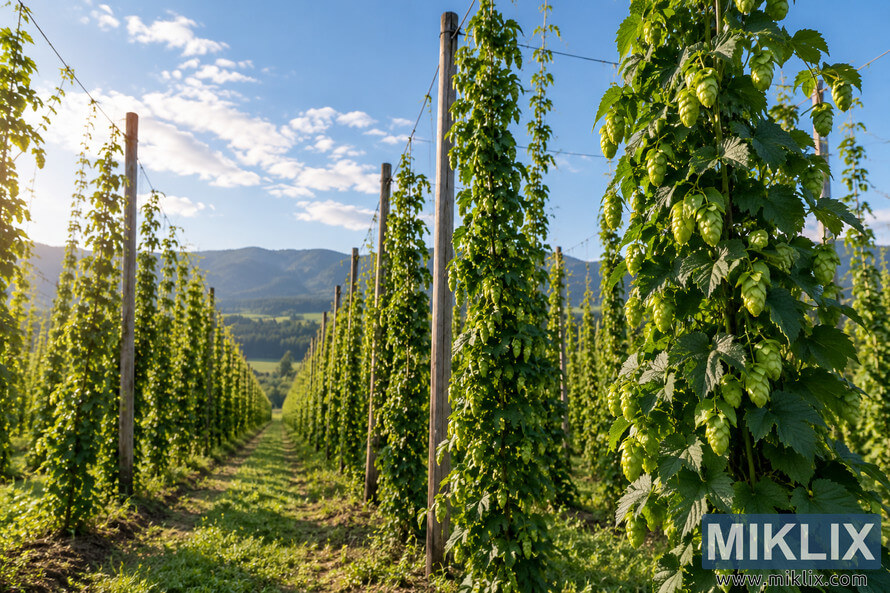
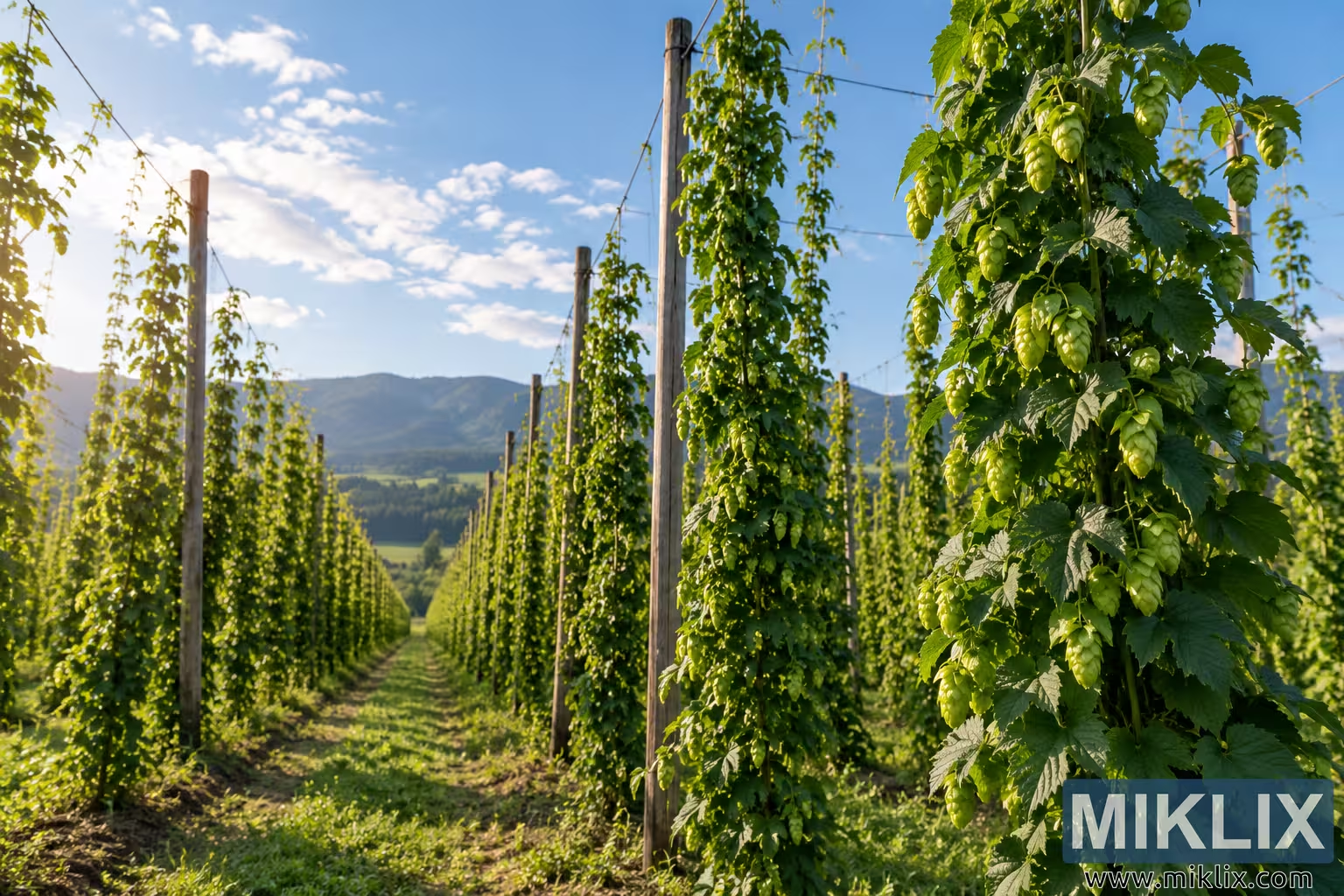
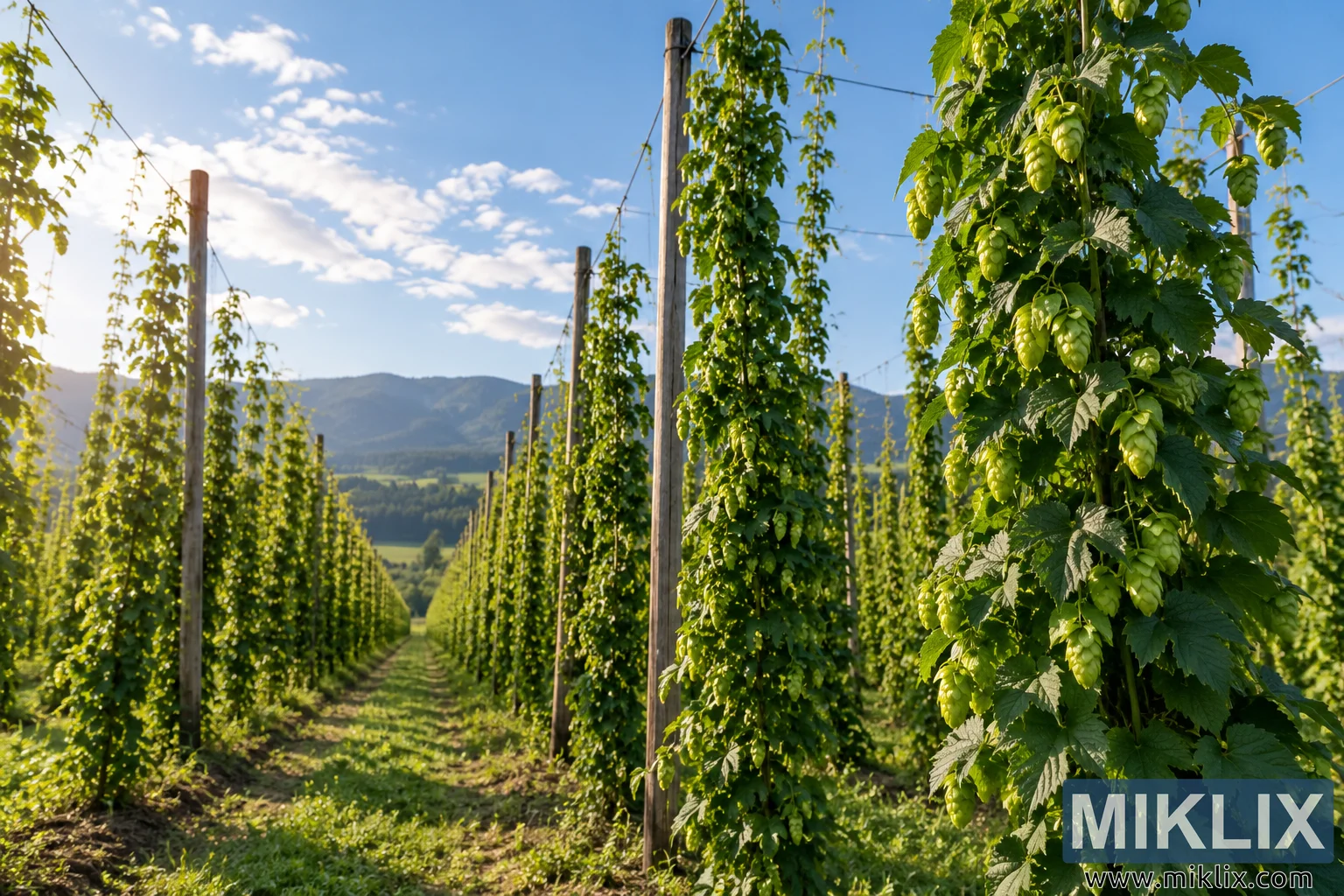
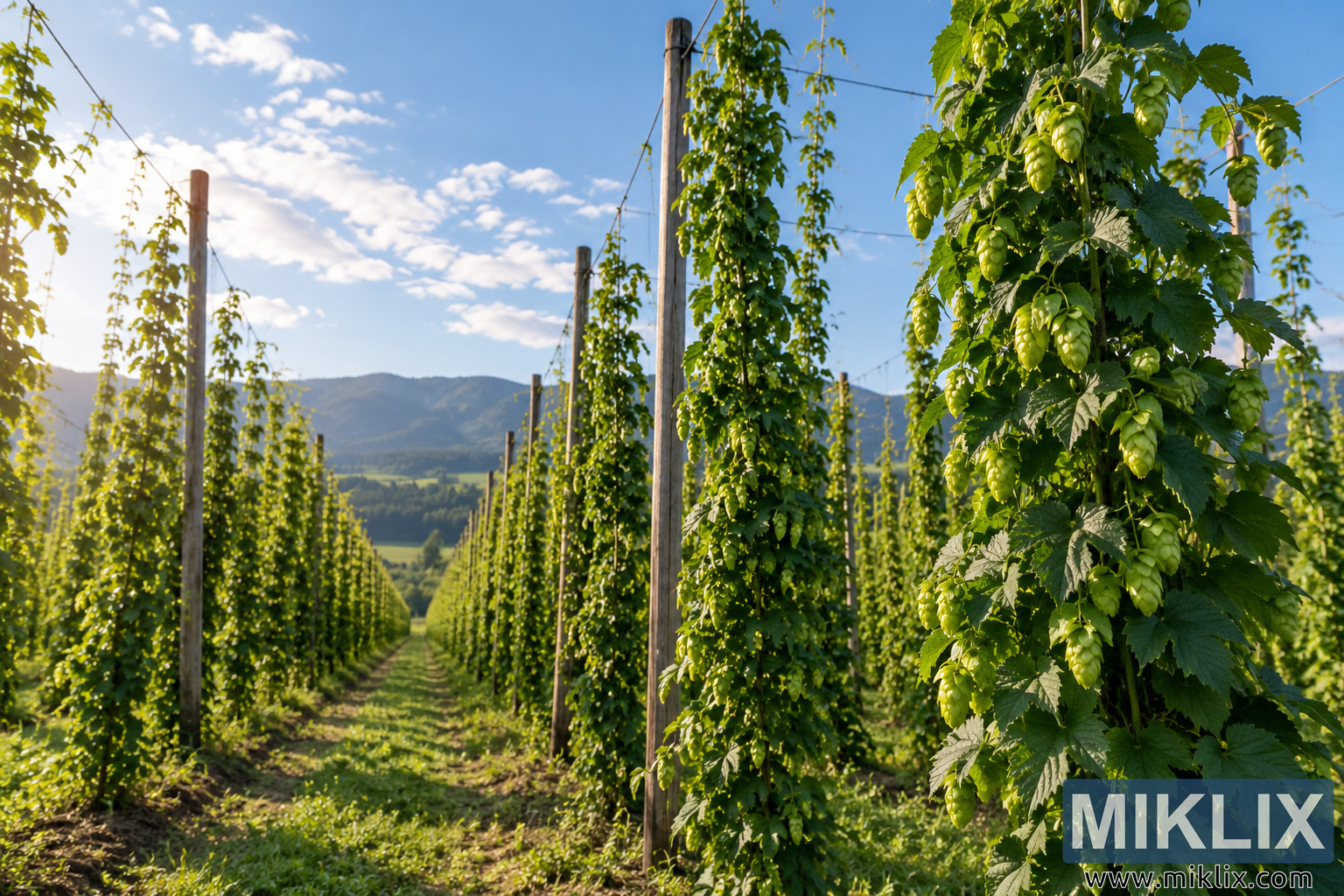
Image: Hop Plants Growing on Traditional Hop Yard Poles
Published: September 22, 2026 at 3:49:16 PM UTC
Photorealistic landscape of mature hop plants growing on traditional wooden hop yard poles and trellises, with green hop cones, sunny rows, and distant hills.
Available versions of this image
The image files available for download below are less compressed and higher resolution - and as a result of that, higher quality - than the images embedded in articles and pages on this website, which are more optimized for file size in order to reduce bandwidth consumption.
Regular size (1,536 x 1,024)
Large size (3,072 x 2,048)
Very large size (4,608 x 3,072)
Extra large size (6,144 x 4,096)
Comically large size (1,048,576 x 699,051)
- Still uploading... ;-)
Image description
A wide, photorealistic landscape photograph depicts a thriving hop yard on a bright, clear day, with vigorous green hop plants climbing a traditional system of tall wooden poles, suspended wires, and vertical supports. The composition looks down several long, orderly rows of hops that extend from the foreground toward the center of the image and gradually converge in the distance. This strong linear perspective gives the scene a pronounced sense of depth and emphasizes the organized agricultural structure of the hop yard. The most prominent plant occupies the right side of the foreground. Its dense foliage is rendered in crisp detail, revealing broad, serrated, deep-green leaves and numerous mature clusters of pale green hop cones. The cones hang naturally among the leaves in groups of varying sizes, their overlapping papery bracts clearly visible and illuminated by warm sunlight. The plant wraps densely around its vertical support and reaches upward toward the overhead trellis system, illustrating the characteristic climbing growth habit of hops. Additional hop plants rise in parallel rows throughout the middle ground, each forming a tall, narrow column of foliage around its support. The plants vary subtly in density and height, creating a natural appearance while retaining the carefully managed geometry of a cultivated hop field. Weathered wooden poles stand at regular intervals between and alongside the plants. Their muted brown and gray surfaces contrast with the vivid greens of the vegetation, and their simple, functional appearance reinforces the traditional character of the hop yard. Thin wires stretch between the poles overhead and diagonally across portions of the sky, providing the framework from which the climbing plants are trained. These wires are visible without dominating the scene and help communicate the considerable height of the growing system. Between the rows is a narrow grassy track that begins near the lower center-left of the image and continues into the distance. Alternating areas of grass, exposed earth, and soft shadow give this pathway an authentic working-farm appearance. Sunlight falls across the field from the left, producing warm highlights on the leaves, hop cones, poles, and ground. The foreground foliage on the right receives particularly attractive directional light, causing the hop cones to stand out against the darker leaves behind them. Individual leaf surfaces show variations in brightness and texture, while overlapping foliage creates rich areas of shadow. On the far left, bright sunlight enters the scene close to the edge of the frame, creating a gentle luminous quality and slightly softer contrast in that part of the image. The sky fills much of the upper portion of the photograph and is a clear, saturated blue with scattered small white clouds. The open sky provides visual breathing room above the tall plants and makes the green foliage appear especially fresh and vibrant. In the background, beyond the hop yard, a broad range of softly rendered forested hills or low mountains stretches across the horizon. Their subdued blue-green tones are affected by atmospheric perspective, distinguishing them from the sharply detailed plants in the foreground. Lower areas of the distant landscape contain patches of fields, trees, and countryside, suggesting that the hop yard forms part of a larger rural agricultural region. The transition from sharply defined foreground vegetation to softer distant hills contributes additional depth to the photograph. The overall mood is calm, productive, fertile, and summery. The plants appear healthy and abundant, with many visible hop cones suggesting a crop approaching or at harvest maturity. There are no people, vehicles, buildings, signs, labels, logos, packaging, or recognizable commercial branding anywhere in the scene. The visual emphasis remains entirely on the crop, the traditional wooden-pole growing system, and the surrounding rural landscape. The image combines documentary agricultural realism with an appealing, polished photographic quality. Fine botanical details in the foreground, repeating vertical columns of hop plants, receding rows, natural ground cover, and distant countryside all contribute to a convincing representation of a traditional hop yard. The landscape orientation allows the viewer to appreciate both the close detail of the hop cones and the large scale of the cultivation system. The right foreground serves as the primary visual anchor because of its especially dense hop foliage and numerous clearly visible cones, while the rows and pathway guide the eye inward toward the center of the field. Vertical poles counterbalance these horizontal and diagonal perspective lines, giving the composition a stable rhythm. The combination of warm sunlight, fresh green vegetation, blue sky, wooden agricultural infrastructure, and distant hills creates an inviting impression of a well-established hop-growing landscape during favorable summer weather. The photograph communicates the distinctive appearance of hops grown vertically on traditional tall supports, showing both the botanical character of the plants and the practical architecture required to cultivate them at scale.
The image is related to: Hops in Beer Brewing: Defender