
Image: Defender Hops Flavor and Aroma Sensory Wheel
Published: September 22, 2026 at 3:49:16 PM UTC
Explore a detailed Defender hops flavor and aroma sensory wheel featuring floral, citrus, fruity, spicy, earthy, resinous, herbal, and vegetal tasting notes.
Available versions of this image
The image files available for download below are less compressed and higher resolution - and as a result of that, higher quality - than the images embedded in articles and pages on this website, which are more optimized for file size in order to reduce bandwidth consumption.
Regular size (1,536 x 1,024)
Large size (3,072 x 2,048)
Very large size (4,608 x 3,072)
Extra large size (6,144 x 4,096)
Comically large size (1,048,576 x 699,051)
- Still uploading... ;-)
Image description
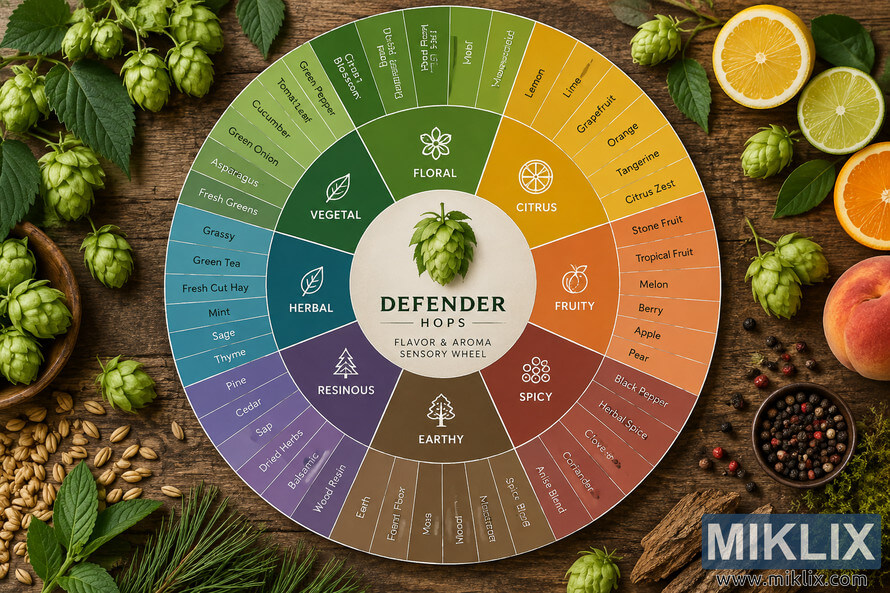
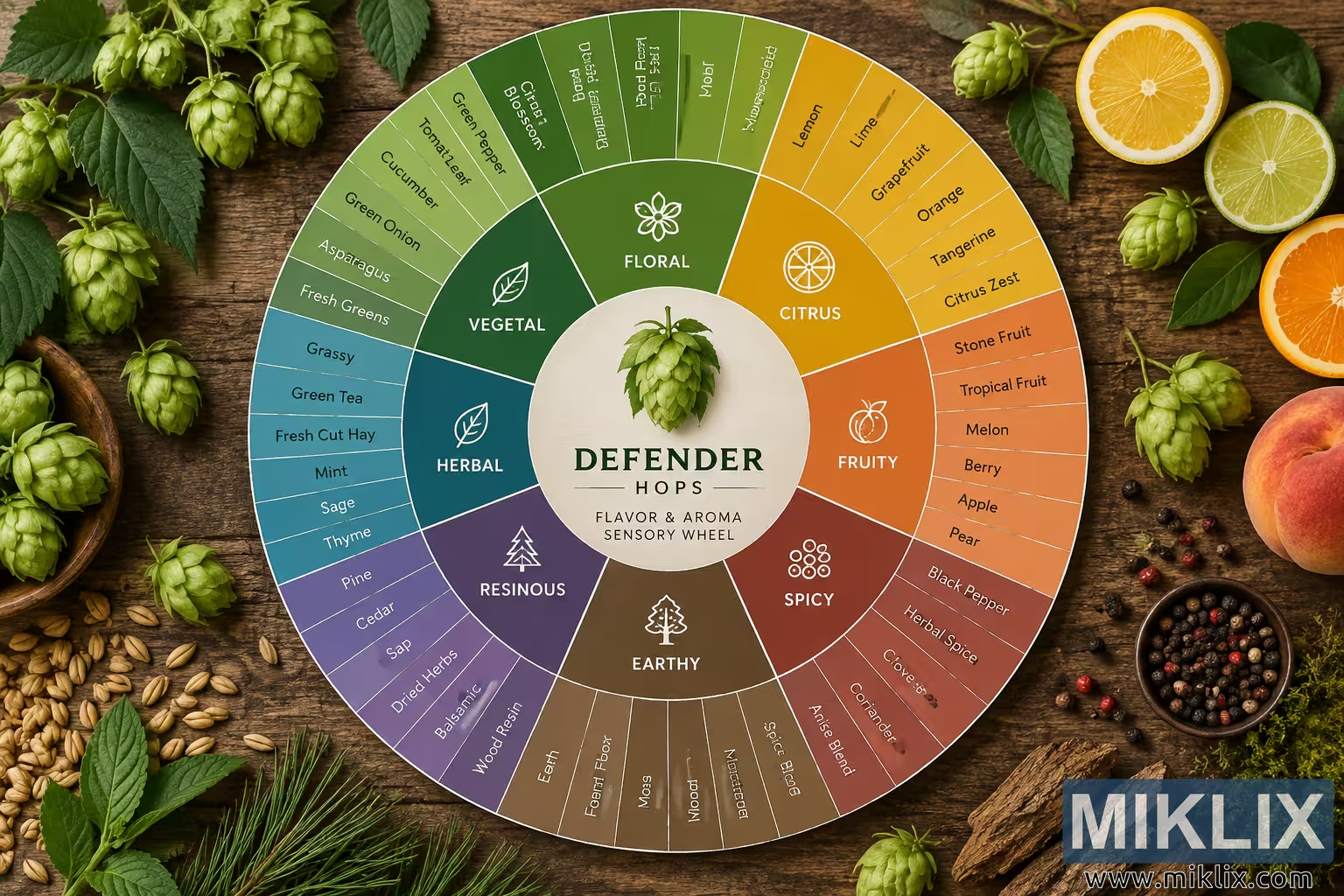
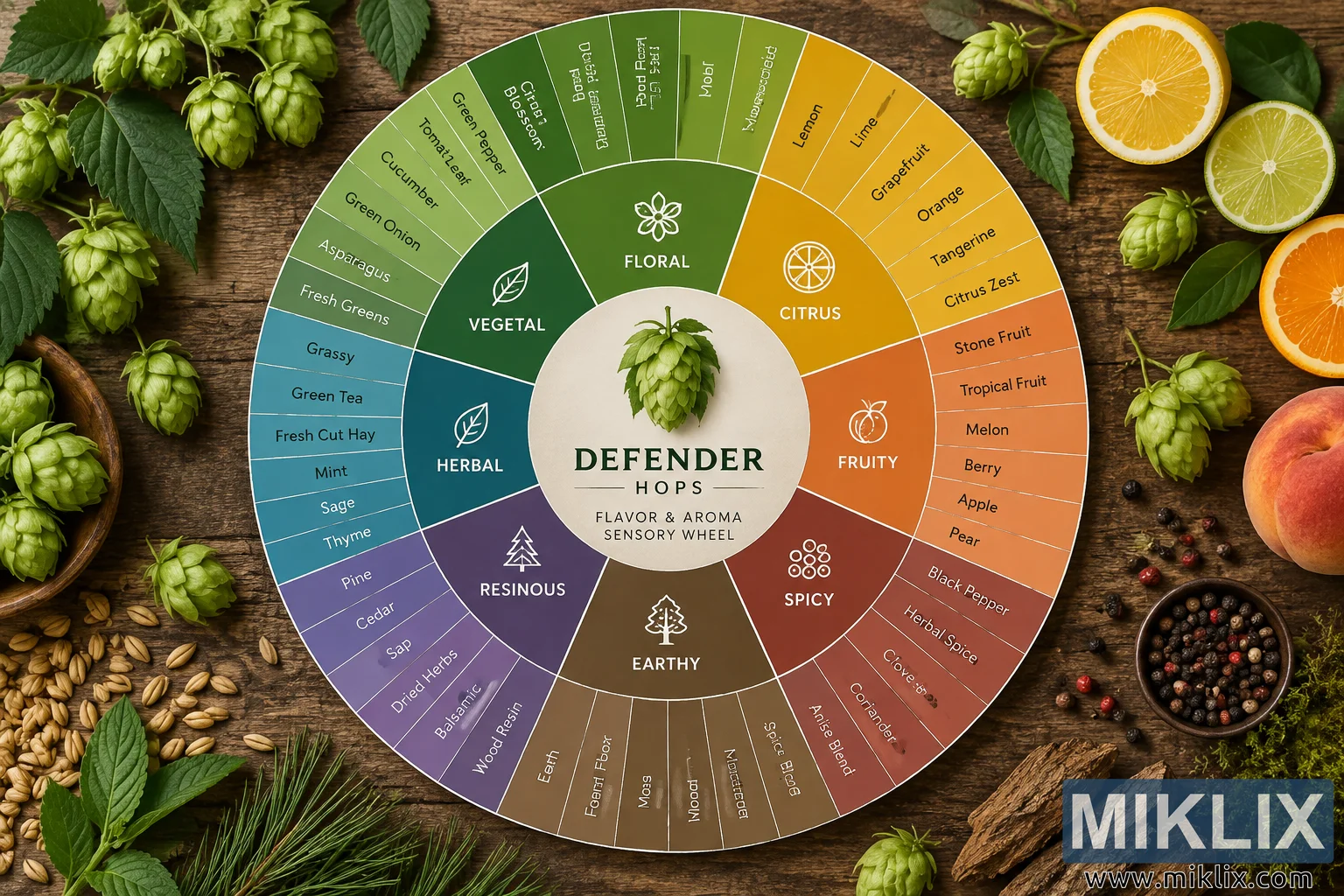
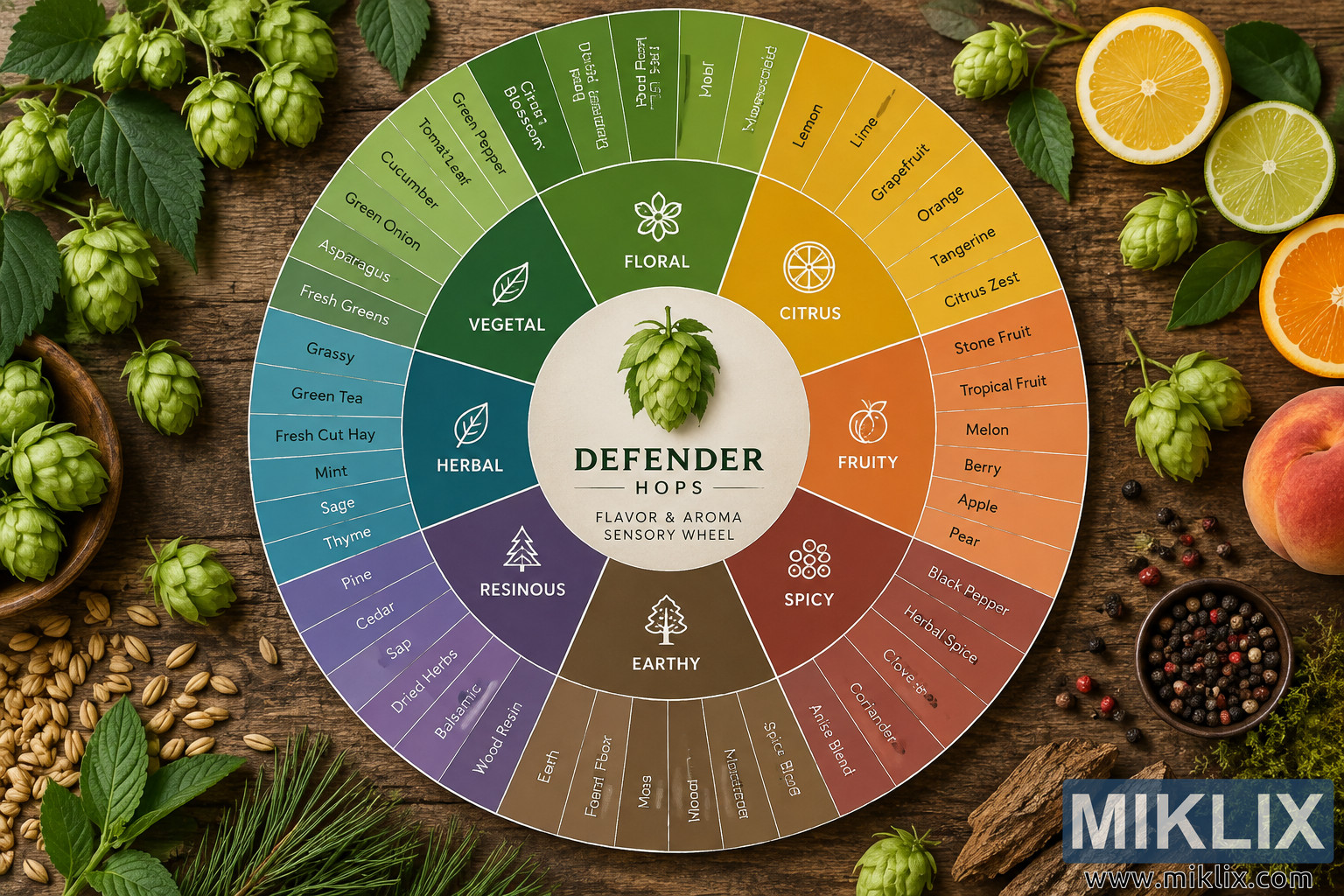
A landscape-format, high-resolution flat-lay photograph presents a detailed sensory wheel for Defender hops, designed to communicate a broad spectrum of possible flavor and aroma characteristics. The composition is viewed directly from above, with a large circular wheel occupying most of the center of the frame. It rests on a warm, rustic wooden tabletop whose visible grain, knots, scratches, and natural variations create an earthy, tactile background. Around the wheel is a carefully arranged selection of botanical and culinary ingredients that visually reinforce the sensory vocabulary represented in the diagram.
At the center of the wheel is a pale cream circular area featuring a realistic green hop cone with overlapping papery bracts and a short stem with leaves. Beneath the hop illustration appears the prominent word “DEFENDER,” followed by the smaller word “HOPS.” Additional text identifies the graphic as a “FLAVOR & AROMA SENSORY WHEEL.” The central neutral area provides a visual anchor and contrasts with the saturated colors used throughout the surrounding sensory categories.
The wheel is divided radially into eight major sensory families: Floral, Citrus, Fruity, Spicy, Earthy, Resinous, Herbal, and Vegetal. Each family has its own color range and a simple white line icon. The Floral area is rendered in rich greens and includes a stylized flower symbol. The Citrus section transitions into golden yellow and orange hues and is accompanied by a citrus-slice icon. The Fruity section uses warm orange tones and includes a fruit icon. The Spicy section shifts toward brick red and reddish brown, with a cluster-like spice symbol. Earthy uses natural brown shades and a tree-like icon, while Resinous is represented by muted purple tones and a conifer symbol. Herbal appears in blue-green and teal shades with a leaf icon, and Vegetal returns to green shades with another botanical leaf symbol.
Outside the broad category ring, the wheel expands into numerous narrower segments containing individual sensory descriptors. In the Citrus region, readable notes include lemon, lime, grapefruit, orange, tangerine, and citrus zest. The Fruity region includes descriptors such as stone fruit, tropical fruit, melon, berry, apple, and pear. The Spicy region contains notes including black pepper and other spice-associated descriptors. Earthy characteristics include references such as earth, forest floor, moss, and mushroom-like qualities. The Resinous area includes pine, cedar, sap, dried herbs, balsamic, and wood-resin associations. Herbal notes include grassy, green tea, fresh-cut hay, mint, sage, and thyme. The Vegetal area includes fresh greens, asparagus, green onion, cucumber, tomato leaf, and green pepper. The Floral section contains green-toned botanical and blossom-related descriptors. Together, these radial subdivisions create the appearance of a professional tasting reference tool intended to help identify and communicate hop aromas and flavors.
The surrounding still-life ingredients echo the wheel’s categories. Fresh green hop cones and hop leaves are distributed prominently around the upper left, upper right, right edge, and lower portions of the photograph. Their vivid green color and layered textures establish hops as the central botanical subject. At the upper right are halved citrus fruits, including bright yellow lemon-like and green lime-like slices, with an orange-colored citrus half nearby. Their juicy interiors and clearly defined segments reinforce the wheel’s citrus category. A ripe peach or similar stone fruit appears along the right edge, supporting the fruity notes.
Near the lower right is a small dark bowl filled with mixed peppercorns, surrounded by a few scattered individual peppercorns, visually representing spicy and peppery aromas. Beside them are rough pieces of brown bark or resinous wood and a patch of green moss, linking the still life to earthy, woody, forest-floor, and resinous characteristics. At the bottom and lower left, conifer needles and leafy herbs contribute pine, herbal, and fresh-green associations. Scattered grains are visible toward the lower left, adding another natural brewing-related texture and reinforcing the agricultural character of the scene. A small wooden vessel containing additional hop cones is partially visible along the left edge.
The photograph uses warm, natural-looking illumination that produces gentle shadows beneath the wheel, hop cones, leaves, fruit, spices, and pieces of wood. The lighting emphasizes the dimensionality of the ingredients while keeping the sensory wheel clear and visually dominant. The wheel itself is crisp and graphic, contrasting with the photorealistic organic materials around it. Its concentric structure guides the eye from the central hop cone and title outward through the broad sensory families and finally into the more specific descriptors along the perimeter.
The overall visual style combines a craft-beverage tasting chart, botanical still life, and educational infographic. Natural ingredients are deliberately positioned to correspond with the concepts displayed on the wheel without overwhelming the information. Green dominates the botanical portions of the composition, while yellow citrus, orange fruit, reddish spices, brown wood, purple resinous sections, and teal herbal segments provide a balanced range of colors. The rustic timber background unifies these elements and evokes agriculture, brewing ingredients, sensory evaluation, and traditional craft production.
Although the central wording identifies the subject as Defender hops, the scene does not display recognizable commercial logos, packaging, manufacturer marks, or other actual brand identities. The name functions as the subject label of the sensory wheel rather than as depicted branded merchandise. The resulting image is an informative and visually rich representation of hop sensory analysis, showing how floral, citrus, fruit, spice, earth, resin, herb, and vegetable-like impressions can be organized into an accessible circular flavor-and-aroma vocabulary.
The image is related to: Hops in Beer Brewing: Defender