
Image: Hop Additions Timing Chart for Brewing
Published: September 22, 2026 at 3:49:16 PM UTC
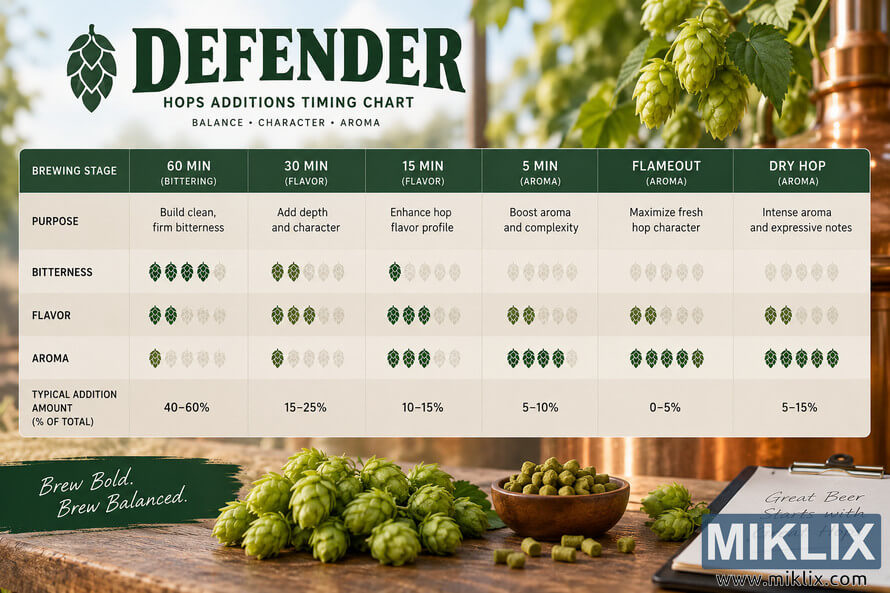
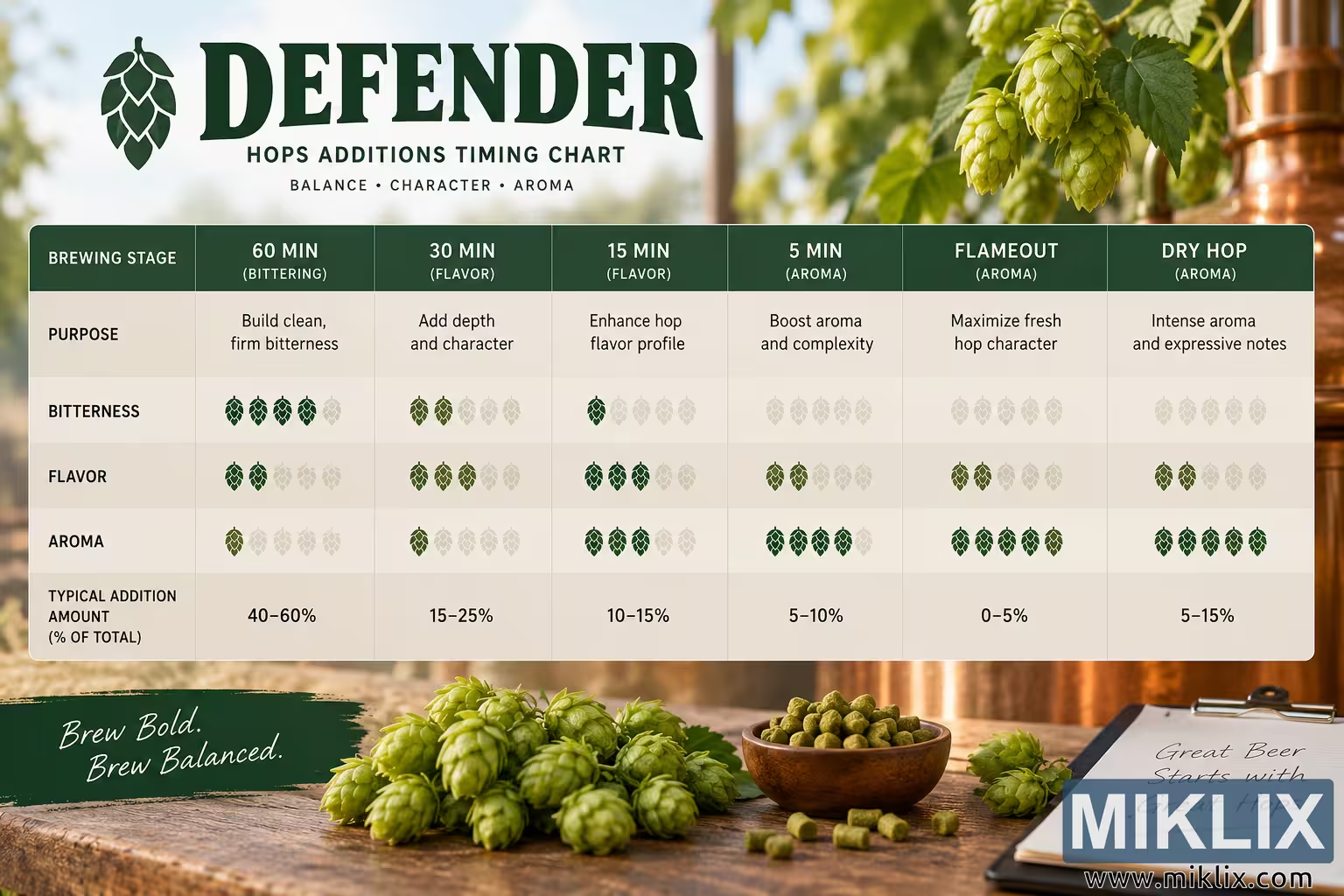
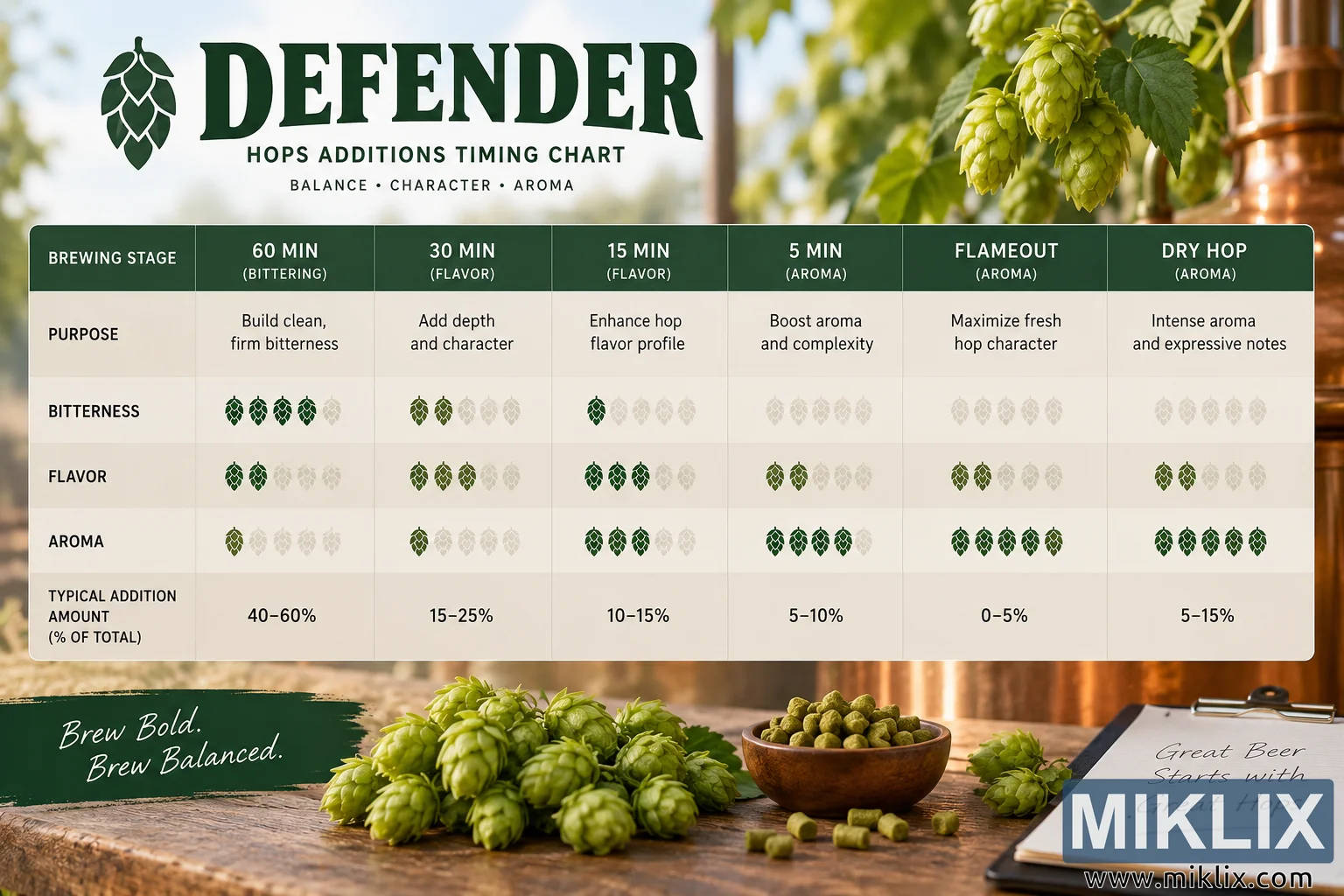
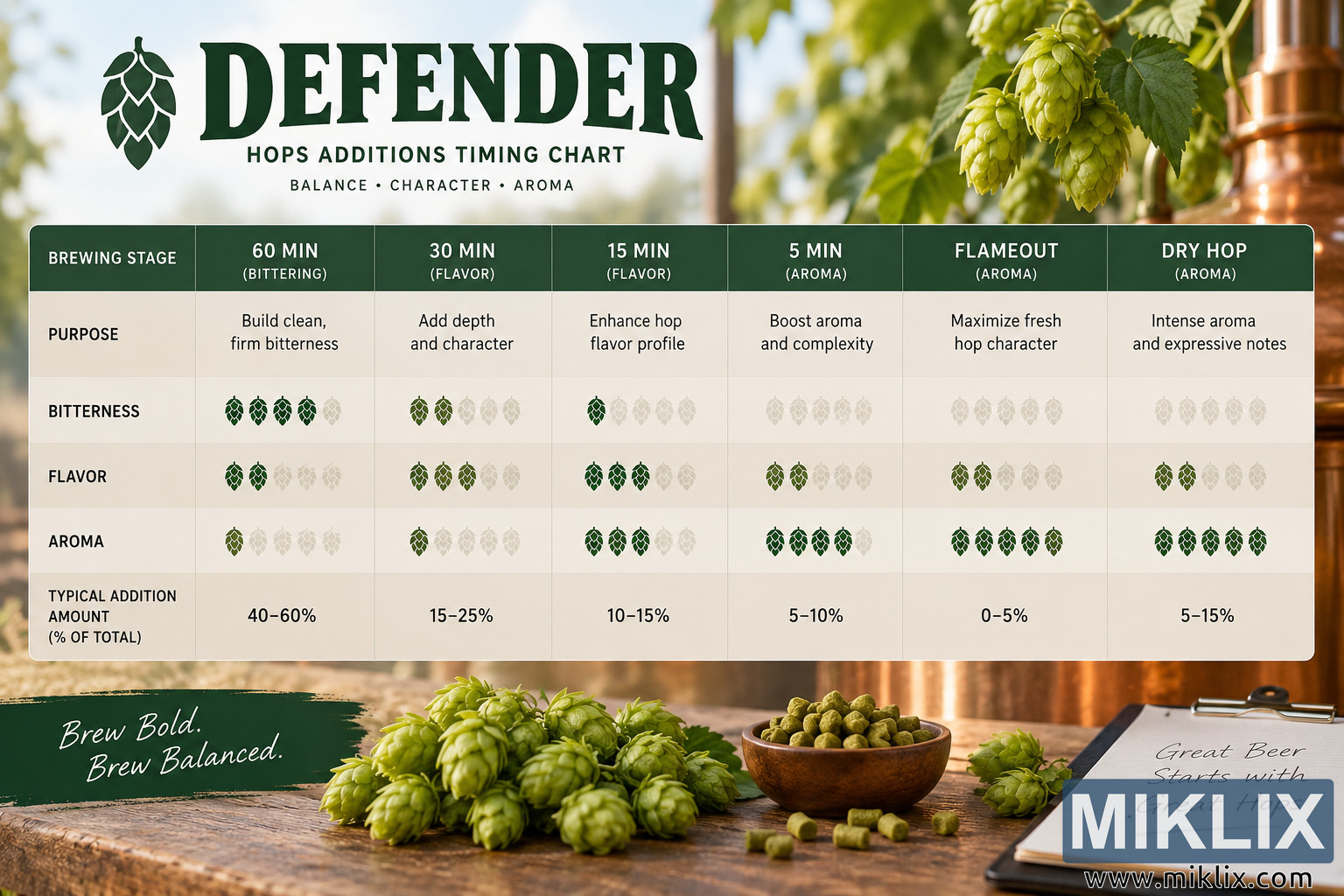
Brewing infographic illustrating hop-addition timing from 60-minute bittering to dry hopping, comparing bitterness, flavor, aroma, purpose, and typical addition amounts.
Available versions of this image
The image files available for download below are less compressed and higher resolution - and as a result of that, higher quality - than the images embedded in articles and pages on this website, which are more optimized for file size in order to reduce bandwidth consumption.
Regular size (1,536 x 1,024)
Large size (3,072 x 2,048)
Very large size (4,608 x 3,072)
Extra large size (6,144 x 4,096)
Comically large size (1,048,576 x 699,051)
- Still uploading... ;-)
Image description
A wide, landscape-format brewing infographic presents a hop-addition timing chart in a warm, rustic brewhouse setting. The composition combines a clean educational chart with photographic elements associated with hop growing and small-scale brewing. Across the upper left and center of the image is a large dark-green heading reading “DEFENDER,” accompanied by a stylized hop-cone symbol. Directly beneath it is the subtitle “HOPS ADDITIONS TIMING CHART,” followed by the smaller phrase “BALANCE • CHARACTER • AROMA.” The background is softly focused and sunlit, with green hop vines and leaves visible around the scene. Several fresh hop cones hang prominently from a vine in the upper-right area, while polished copper brewing equipment occupies the far-right background. The overall palette is dominated by natural greens, warm copper, cream, beige, and weathered wood tones.
The central feature is a large rectangular timing table with rounded corners and a translucent cream-colored body. Its dark-green header divides the brewing process into six hop-addition stages: “60 MIN (BITTERING),” “30 MIN (FLAVOR),” “15 MIN (FLAVOR),” “5 MIN (AROMA),” “FLAMEOUT (AROMA),” and “DRY HOP (AROMA).” A left-hand column labels the chart categories as “BREWING STAGE,” “PURPOSE,” “BITTERNESS,” “FLAVOR,” “AROMA,” and “TYPICAL ADDITION AMOUNT (% OF TOTAL).” The chart is designed to show how adding hops at progressively later stages of brewing shifts their contribution away from bitterness and toward fresh hop flavor and aroma.
In the “PURPOSE” row, the 60-minute addition is described as building clean, firm bitterness. The 30-minute addition is described as adding depth and character. The 15-minute addition is intended to enhance the hop flavor profile. The 5-minute addition is shown as boosting aroma and complexity. The flameout addition is described as maximizing fresh hop character, while dry hopping is associated with intense aroma and expressive notes. These descriptions create a visual progression from early-boil bittering additions to late and post-boil aromatic additions.
Three rows use small hop-cone icons as an intuitive intensity scale for bitterness, flavor, and aroma. Dark green or olive hop icons indicate stronger contributions, while pale cream or gray-green icons indicate lower contributions. The early 60-minute addition displays the strongest bitterness rating, with several dark hop symbols in the bitterness row, but comparatively fewer active icons for flavor and aroma. At 30 minutes, bitterness is reduced while flavor becomes more prominent. The 15-minute stage places greater visual emphasis on flavor and aroma with relatively little bitterness. At 5 minutes, the chart shows minimal bitterness, moderate flavor, and a strong aroma contribution. Flameout similarly emphasizes aroma, with multiple dark hop icons and essentially no meaningful bitterness contribution. Dry hopping displays the strongest aroma emphasis, represented by a full or nearly full row of dark-green hop symbols, while bitterness remains visually absent and flavor remains secondary.
The bottom row provides illustrative typical addition amounts as percentages of the total hop quantity. The chart shows 40–60% for the 60-minute bittering addition, 15–25% for the 30-minute addition, 10–15% for the 15-minute addition, 5–10% for the 5-minute addition, 0–5% for flameout, and 5–15% for dry hopping. These figures are presented as a simple visual planning guide within the infographic rather than as a detailed brewing formula.
Below the chart, the image transitions into a richly textured wooden worktable. A large pile of fresh, bright-green hop cones sits near the lower center-left, reinforcing the agricultural origin of the ingredient. Beside the fresh hops is a small wooden bowl filled with compact green hop pellets, with several pellets scattered naturally across the tabletop. Additional loose hop cones appear nearby. The tabletop has visible grain, scratches, and an aged finish, giving the image an artisanal craft-brewing atmosphere. Behind the table, warm sunlight reflects from copper brewing vessels and fittings, creating a golden glow and contrasting with the vivid green hops.
In the lower-left corner, a dark-green painted brushstroke panel carries the handwritten-style phrase “Brew Bold. Brew Balanced.” In the lower-right corner, a clipboard or brewing notebook rests at an angle on the table. Its cream paper contains the handwritten-style message “Great Beer Starts with Great Hops.” These decorative elements frame the educational chart and reinforce the image’s craft-brewing theme.
The infographic is intentionally people-free, focusing entirely on brewing ingredients, equipment, timing, and process. The combination of crisp typography, structured tabular information, hop-shaped rating icons, fresh botanical details, hop pellets, copper equipment, and rustic wood gives the image the appearance of a premium educational poster for brewers. The shallow depth of field in the photographic background keeps attention on the central timing chart while still providing recognizable brewing context. The landscape composition allows all six brewing stages to be compared from left to right in a single view, visually communicating the central concept that earlier hop additions primarily contribute bitterness, whereas later additions and dry hopping increasingly preserve hop flavor, freshness, and aroma.
The image is related to: Hops in Beer Brewing: Defender