
Image: Aromatic Compounds Visualization with Citrus and Pine
Published: September 24, 2026 at 2:44:22 PM UTC
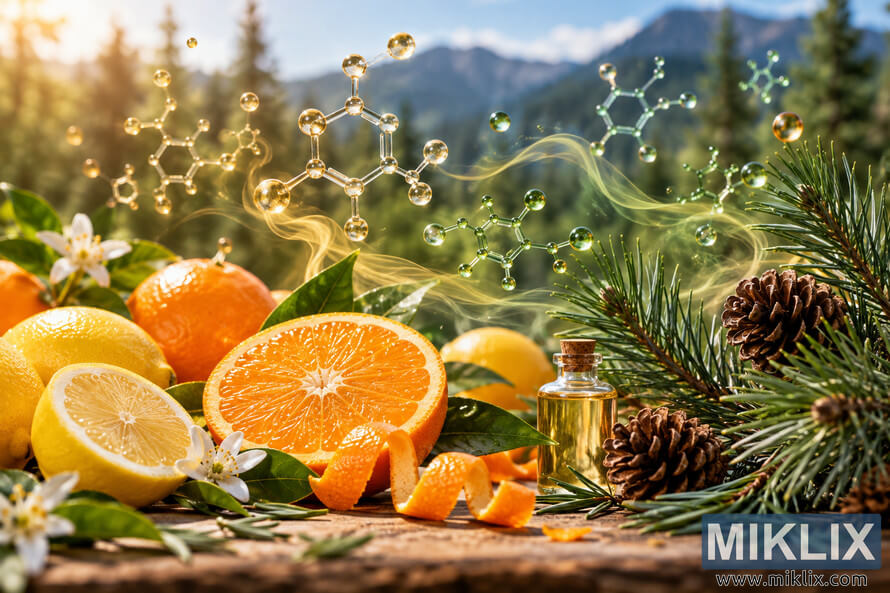
Photorealistic aromatic compounds visualization combining fresh citrus, pine branches, molecular structures, golden oil, and drifting fragrance vapor in a sunlit mountain forest.
Available versions of this image
The image files available for download below are less compressed and higher resolution - and as a result of that, higher quality - than the images embedded in articles and pages on this website, which are more optimized for file size in order to reduce bandwidth consumption.
Regular size (1,536 x 1,024)
Large size (3,072 x 2,048)
Very large size (4,608 x 3,072)
Extra large size (6,144 x 4,096)
Comically large size (1,048,576 x 699,051)
- Still uploading... ;-)
Image description
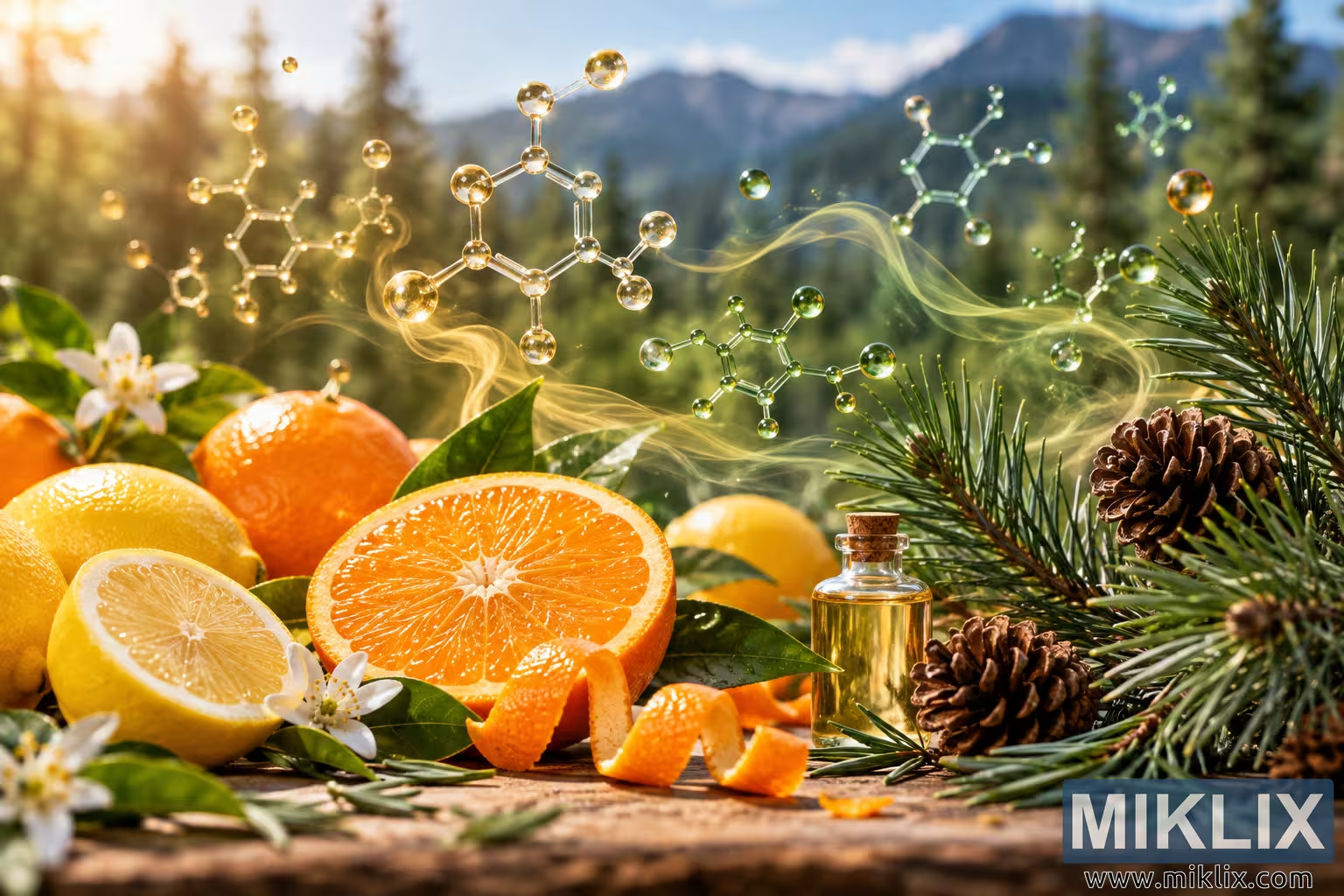
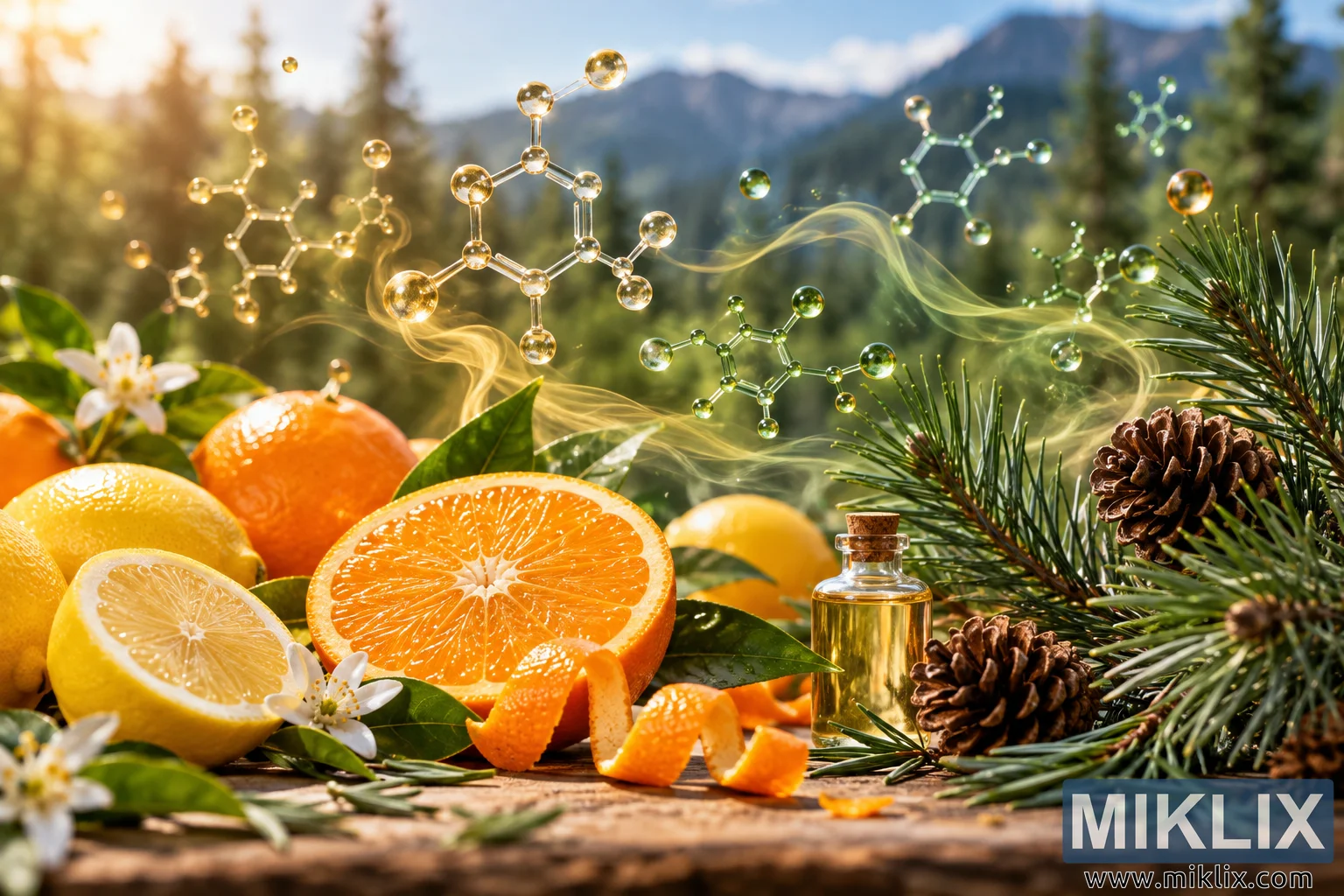
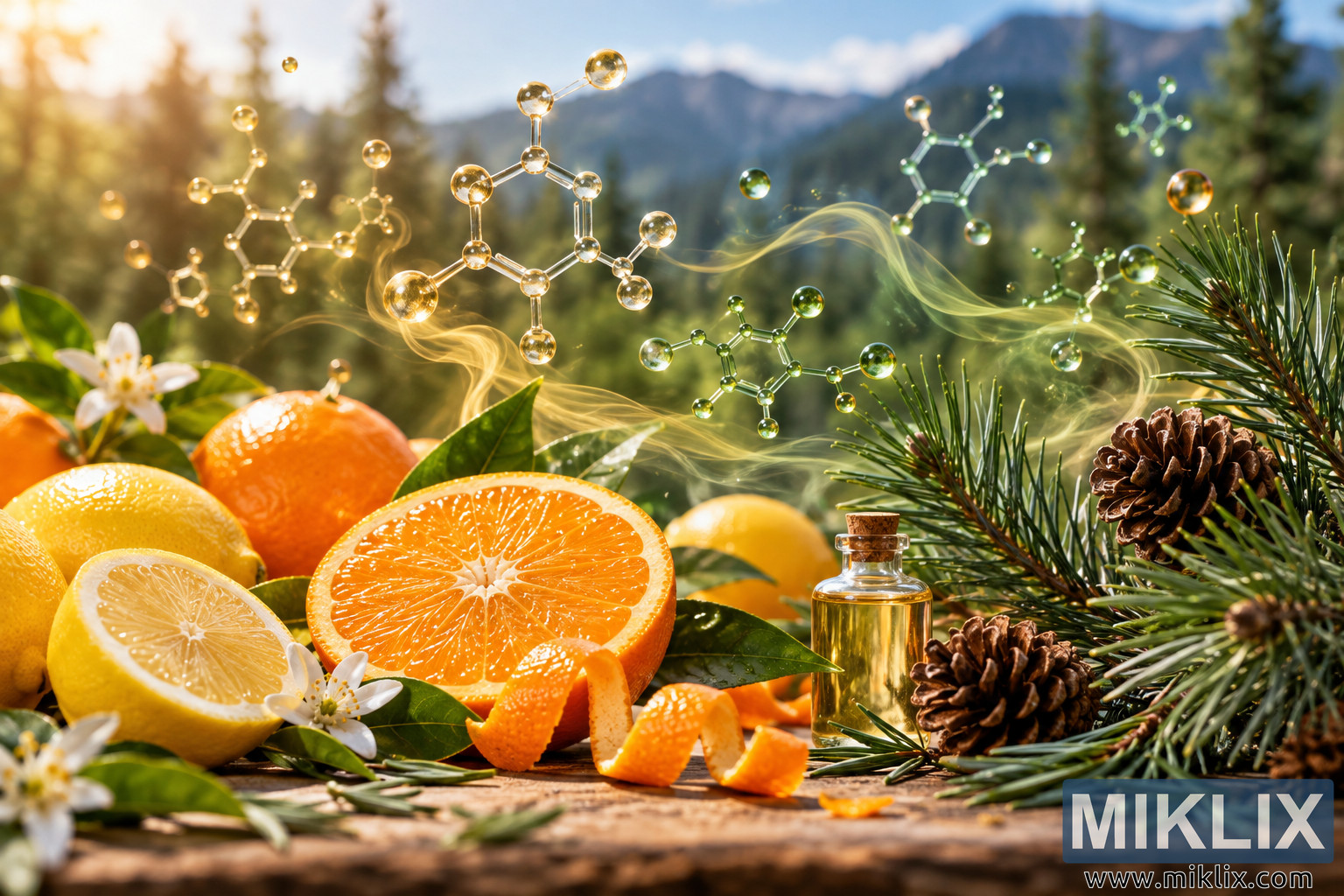
A vivid, high-resolution landscape-oriented image presents an imaginative visualization of aromatic compounds inspired by citrus fruits and pine forests. The composition combines photorealistic natural ingredients with translucent molecular structures and flowing, vapor-like forms, creating a visual connection between recognizable botanical sources and the invisible aromatic molecules associated with their fragrances. The foreground is arranged as a richly detailed still life on a rustic wooden surface. On the left and center, an abundant collection of citrus fruits dominates the scene. Bright yellow lemons and intensely orange citrus fruits are grouped among glossy green leaves, small white blossoms, and pieces of freshly curled citrus peel. A large orange half occupies a prominent central position. Its cut surface faces the viewer, revealing clearly defined segments filled with glistening juice vesicles. The moist, translucent flesh catches the warm sunlight and gives the fruit a fresh, juicy appearance. Nearby, a lemon has also been cut open, exposing pale yellow flesh and a textured rind. Whole fruits positioned behind the cut citrus add depth and reinforce the impression of a generous assortment of freshly harvested ingredients. Several spiraling strips of orange peel extend across the wooden surface, suggesting the release of fragrant oils from the rind.
The right side of the composition transitions from citrus vegetation into a dense arrangement of evergreen pine branches. Long, slender green needles extend diagonally into the frame and surround several mature brown pine cones. The cones display sharply rendered overlapping scales and a dry, woody texture that contrasts with the smooth, glossy citrus leaves and juicy fruit surfaces. The pine branches appear fresh and vibrant, with individual needles catching points of sunlight. This juxtaposition of citrus and pine visually represents two distinct aromatic families: bright, fresh, zesty citrus notes and cool, resinous, woody evergreen notes. Between these botanical elements sits a small transparent glass bottle filled with golden amber liquid. The bottle is sealed with a natural cork stopper and has no label, logo, writing, or recognizable branding. Warm light passes through the liquid and glass, producing luminous golden reflections. Its placement among the fruits and pine branches suggests a concentrated aromatic extract or essential oil derived from natural materials without referring to any specific commercial product.
Above the still life, the image introduces a scientific and conceptual layer through a collection of floating molecular structures. These molecules are represented as elegant three-dimensional ball-and-stick forms made from translucent, glass-like spheres connected by slender rods. Some structures glow with warm amber and golden tones above the citrus, while others take on fresh green hues closer to the pine branches. Their ring-shaped and branching configurations evoke organic aromatic compounds without presenting the scene as a strict textbook diagram. The molecules vary in size and distance, with larger structures appearing nearer the viewer and smaller forms receding into the background. This creates a sense that aromatic chemistry is suspended throughout the air above the natural ingredients. Small spherical droplets and luminous particles are scattered around the molecular forms, adding movement and suggesting volatile compounds being released into the atmosphere.
Flowing through and around the molecular structures are delicate ribbons of translucent golden-green vapor. These soft, curling streams move horizontally across the middle of the image, visually connecting the citrus on the left with the pine elements on the right. Their shape resembles fragrance drifting through warm air rather than heavy smoke. The vapor catches the surrounding light and becomes brighter along its edges, giving it an ethereal, almost weightless quality. Golden vapor is especially visible around the citrus-associated molecular structures, while greener tones become more prominent toward the evergreen side. The transition is gradual rather than sharply divided, reinforcing the idea that the two aromatic profiles are blending into a unified fragrance composition. Tiny glowing particles suspended within and around these ribbons contribute to the impression of active aromatic molecules dispersing from the botanical materials.
The background depicts a sunlit mountain forest rendered with a shallow depth of field. Tall evergreen trees rise behind the still life, but their details are softly blurred so that they do not compete with the sharply focused foreground. Beyond the trees, rugged mountain peaks stretch across the horizon beneath a clear blue sky with soft patches of white cloud. Warm sunlight enters from the upper left corner, producing a golden glow and atmospheric flare. The lighting suggests either early morning or late afternoon, when sunlight is low enough to create long highlights and a warm, inviting atmosphere. This natural illumination gives the citrus rinds a glossy sheen, outlines the pine needles, illuminates the amber liquid in the bottle, and makes the floating molecular forms appear almost jewel-like. The distant forest and mountains establish a strong connection to nature and reinforce the evergreen theme without distracting from the central aromatic visualization.
The overall color palette balances saturated orange and lemon yellow with deep evergreen, fresh leaf green, warm amber, natural brown, and clear sky blue. Strong complementary relationships between the orange fruits and green vegetation make the foreground energetic and visually appealing. Fine surface textures are emphasized throughout: pores in the citrus rind, individual juice-filled cells in the cut fruit, reflective moisture on leaves, rough grain in the wooden tabletop, layered scales on pine cones, slender pine needles, smooth glass, and translucent molecular spheres. The photographic realism of these materials contrasts with the more conceptual floating chemistry elements, allowing the image to communicate both natural freshness and scientific abstraction at the same time.
The composition is carefully balanced across its wide landscape format. The citrus cluster provides substantial visual weight on the left, while the pine branches and cones create an equally strong structure on the right. The small glass bottle forms a visual bridge near the lower center-right, and the floating molecules extend across the upper half of the frame, connecting both sides. The sweeping vapor trails reinforce this horizontal movement and guide the viewer's eye from citrus to pine. Despite the abundance of details, the central area remains sufficiently open for the molecular visualization to be clearly visible against the softly blurred forest background. No people appear in the scene, and there are no labels, trademarks, logos, packages, or identifiable brands. The resulting image functions as a sophisticated visual metaphor for aroma chemistry: fresh citrus and evergreen botanicals serve as tangible fragrance sources, while floating molecular models, droplets, luminous particles, and delicate vapor trails represent the volatile aromatic compounds released from them. The scene conveys freshness, natural extraction, botanical fragrance, essential oils, terpene-like aromas, scientific exploration, and the sensory relationship between chemistry and scent, all within a bright, polished, photorealistic outdoor-inspired presentation.
The image is related to: Hops in Beer Brewing: Dr Rudi