
Image: Hops Added to Boiling Wort at Different Brewing Stages
Published: September 24, 2026 at 2:44:22 PM UTC
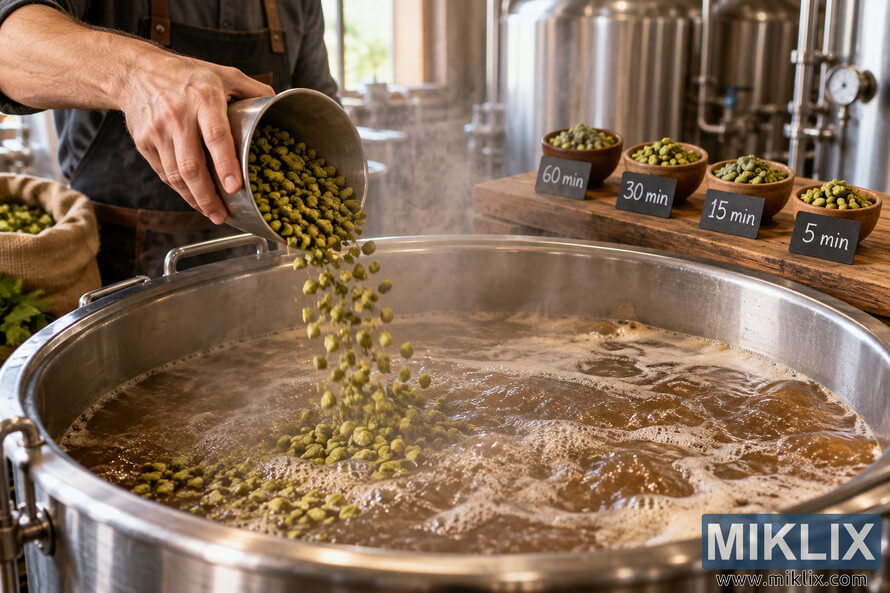
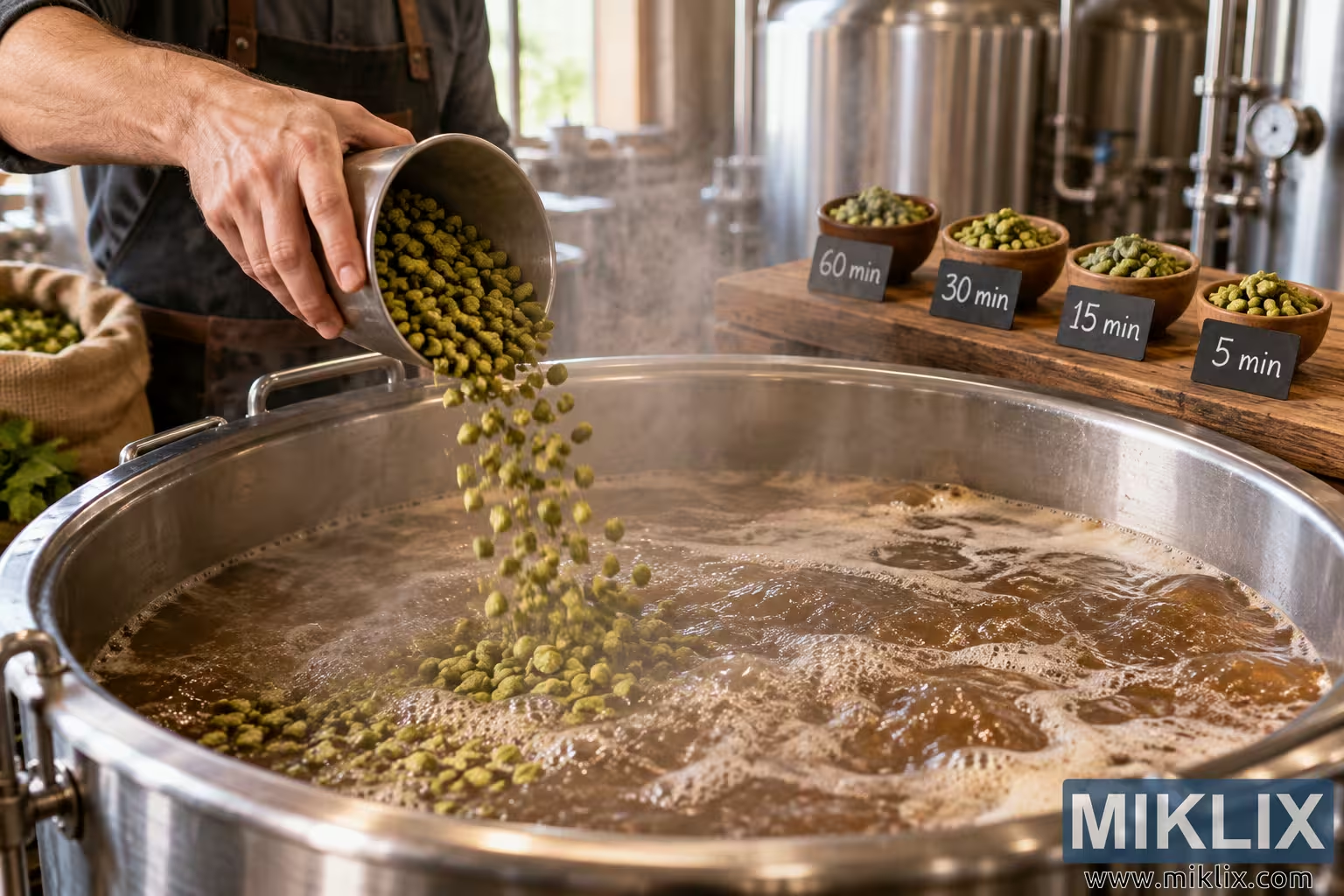
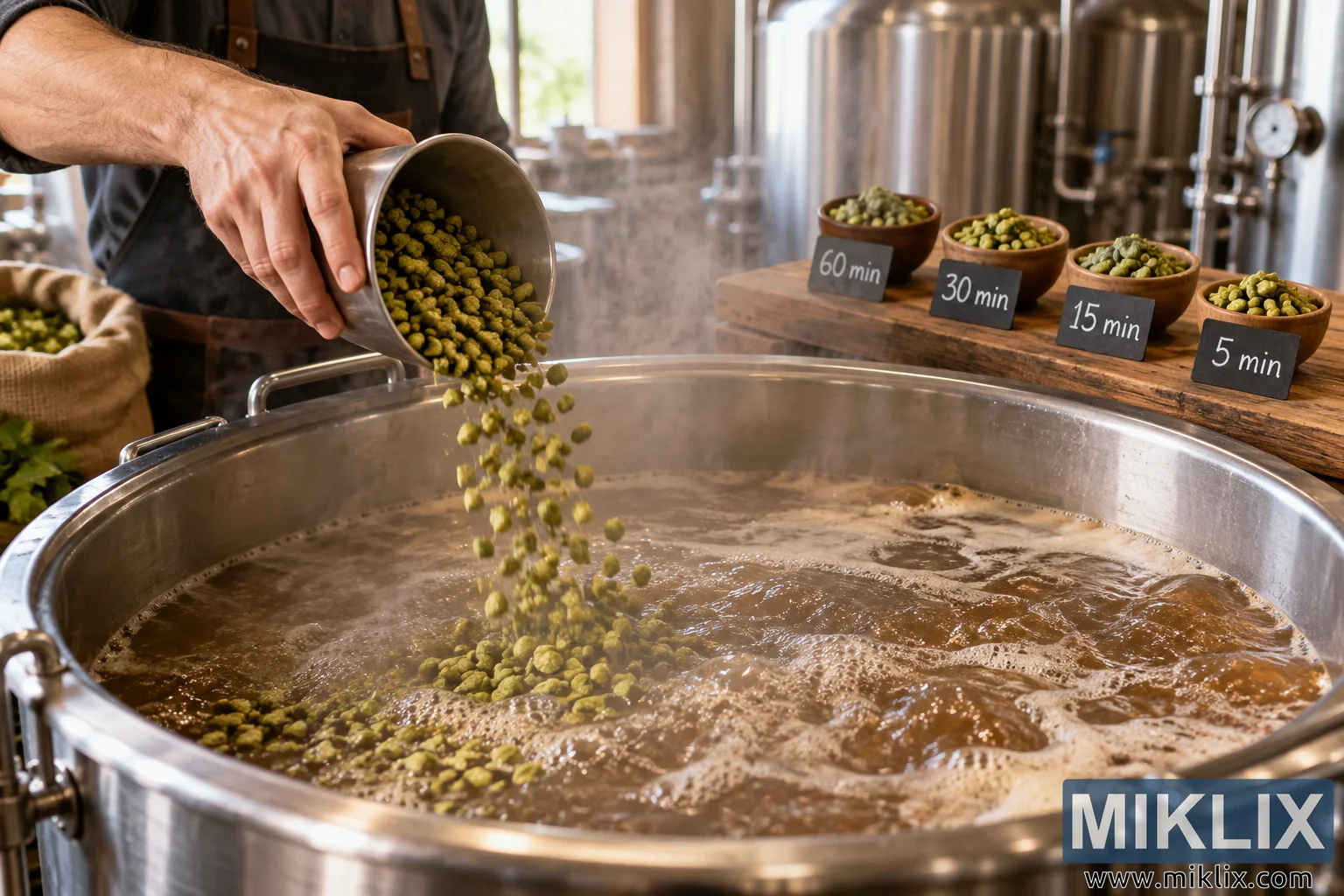
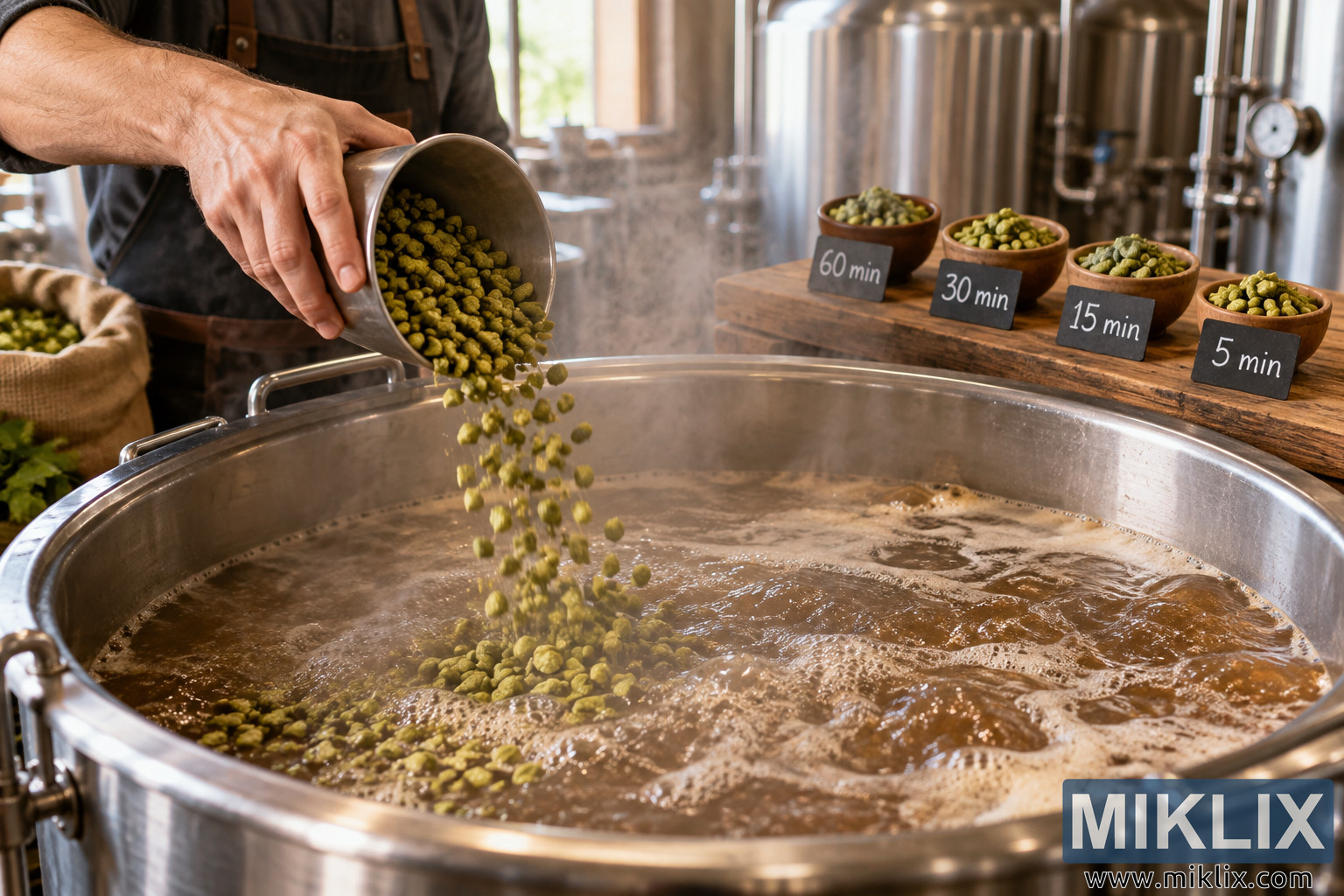
Realistic brewery scene showing hops added to vigorously boiling wort, with separate hop portions representing 60-, 30-, 15-, and 5-minute additions.
Available versions of this image
The image files available for download below are less compressed and higher resolution - and as a result of that, higher quality - than the images embedded in articles and pages on this website, which are more optimized for file size in order to reduce bandwidth consumption.
Regular size (1,536 x 1,024)
Large size (3,072 x 2,048)
Very large size (4,608 x 3,072)
Extra large size (6,144 x 4,096)
Comically large size (1,048,576 x 699,051)
- Still uploading... ;-)
Image description
A realistic, high-resolution landscape photograph depicts an active brewing scene inside a small professional or craft-style brewery. The composition focuses on a large, circular stainless-steel brewing kettle occupying most of the foreground. Inside the kettle, a substantial quantity of amber-brown wort is at a vigorous rolling boil. Large areas of the liquid surface are visibly turbulent, with swirling currents, rising bubbles, patches of pale tan foam, and irregular waves that communicate the heat and energy of the boiling process. Wisps of steam rise from the kettle and drift into the background, reinforcing the impression that the photograph captures an authentic moment during the brewing process.
At the upper left of the image, a brewer is partially visible from approximately the torso down to the hands. The brewer wears a dark shirt and a dark work apron with brown leather-like straps and trim. No face is visible, keeping the viewer's attention on the brewing action. One hand holds a plain stainless-steel container tilted downward over the open kettle. A stream of small green hop pellets is falling from the container into the boiling wort. Individual pellets can be seen suspended in midair at different points in their descent, while other pellets have already landed on the turbulent surface. A noticeable cluster of green hops floats near the center-left portion of the kettle, contrasting strongly with the warm brown and golden tones of the wort. The brewer's hand, the tilted metal cup, and the falling hops create a clear visual narrative of hops being added during the boil.
To the right and slightly behind the brewing kettle is a rustic wooden platform or work surface holding four small bowls filled with green hop material. Each bowl represents a different hop-addition stage during the boil. Small dark signs positioned in front of the bowls are marked with the times “60 min,” “30 min,” “15 min,” and “5 min.” The sequence visually illustrates how hops can be introduced at different points during wort boiling. The arrangement progresses clearly from left to right and helps communicate the concept of staged hop additions without requiring a separate diagram. The bowls contain similarly colored green hops, while their timing labels distinguish the different brewing stages. The timing display gives the scene an educational quality in addition to its photographic realism, suggesting that the image is intended to explain or demonstrate the process of adding hops throughout a boil.
On the far left side of the scene, behind the brewer's arm and beside the kettle, there is an open burlap sack containing additional green hops. The coarse woven texture of the sack introduces a rustic, natural element that contrasts with the smooth, polished stainless steel of the brewing equipment. Additional green plant material is visible around the opening of the sack. Together with the bowls and the pellets being poured into the kettle, this reinforces hops as the central ingredient being illustrated in the photograph.
The brewery environment continues into the softly focused background. Several tall cylindrical stainless-steel vessels and tanks are visible, along with polished pipes, fittings, and other brewing hardware. On the right side, a round analog gauge is mounted on a vertical section of metal piping. These details establish the location as a functioning brewery rather than a domestic kitchen. The background equipment is deliberately less sharp than the foreground action, producing a shallow depth-of-field effect that directs attention toward the kettle, the brewer's hand, and the falling hops. Despite being blurred, the metallic tanks remain recognizable and add depth and authenticity to the industrial brewing setting.
Natural-looking daylight enters through a bright window or opening in the rear portion of the brewery. This illumination combines with warm interior light to create an inviting atmosphere. Highlights reflect from the curved rim and exterior surfaces of the stainless-steel kettle, while softer reflections appear on the background tanks. The lighting emphasizes the contrast between the cool silver tones of the brewing equipment, the warm amber-brown wort, the earthy wood of the platform, and the vivid olive-green hops. Steam catches the light around the center of the image, creating a subtle haze and further enhancing the sense of heat rising from the kettle.
The photographic viewpoint is positioned close to the kettle and slightly above its rim, allowing the viewer to see both the boiling wort and the hops entering it. The kettle dominates the lower portion of the landscape frame, creating a strong foreground anchor. Its curved stainless-steel rim leads the eye around the composition, while the diagonal trajectory of the falling hops draws attention from the brewer's hand toward the liquid. From there, the eye naturally moves toward the four timed hop portions arranged across the wooden surface in the background. This visual structure effectively connects the immediate act of adding hops with the broader idea of making multiple additions at different stages of the boil.
The image has the polished appearance of professional food, beverage, or brewing photography while retaining enough physical detail to feel practical and authentic. Fine textures are visible in the brewer's hand, the hop pellets, the bubbling wort, the foam, the burlap sack, the grain of the wooden surface, and the brushed metal of the kettle. The suspended hop pellets provide a sense of motion, almost freezing the exact instant when an addition is made. Meanwhile, the vigorous boiling action gives the lower half of the photograph substantial visual energy.
Conceptually, the photograph illustrates staged hop additions during the wort-boiling phase of beer production. The visible timing markers suggest early, middle, and late additions, showing that hops are not necessarily added all at once. Rather than presenting the concept as an abstract brewing chart, the image embeds the timing information within a realistic working environment. The result is both instructional and atmospheric: viewers can immediately understand that hops are being added to boiling wort and that separate portions are associated with different points in the boil. There are no visible commercial logos, product packages, brewery names, or recognizable brand identifiers. All equipment, containers, clothing, labels, and ingredients appear generic, keeping the emphasis entirely on the brewing process and the staged addition of hops.
The image is related to: Hops in Beer Brewing: Dr Rudi