
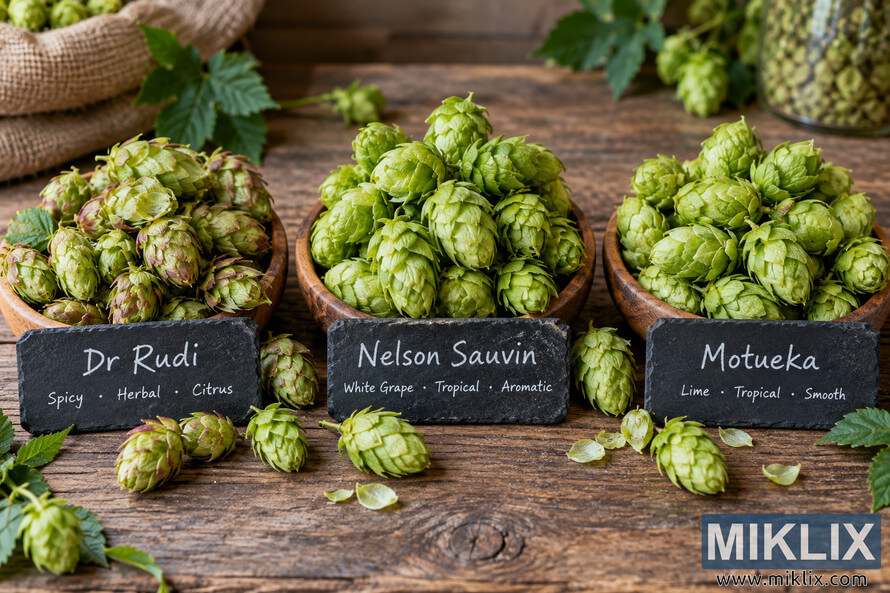
Image: Dr Rudi, Nelson Sauvin and Motueka Hop Varieties Side by Side
Published: September 24, 2026 at 2:44:22 PM UTC
Compare Dr Rudi, Nelson Sauvin and Motueka hops side by side in a rustic display highlighting their appearance and distinctive sensory characteristics.
Available versions of this image
The image files available for download below are less compressed and higher resolution - and as a result of that, higher quality - than the images embedded in articles and pages on this website, which are more optimized for file size in order to reduce bandwidth consumption.
Regular size (1,536 x 1,024)
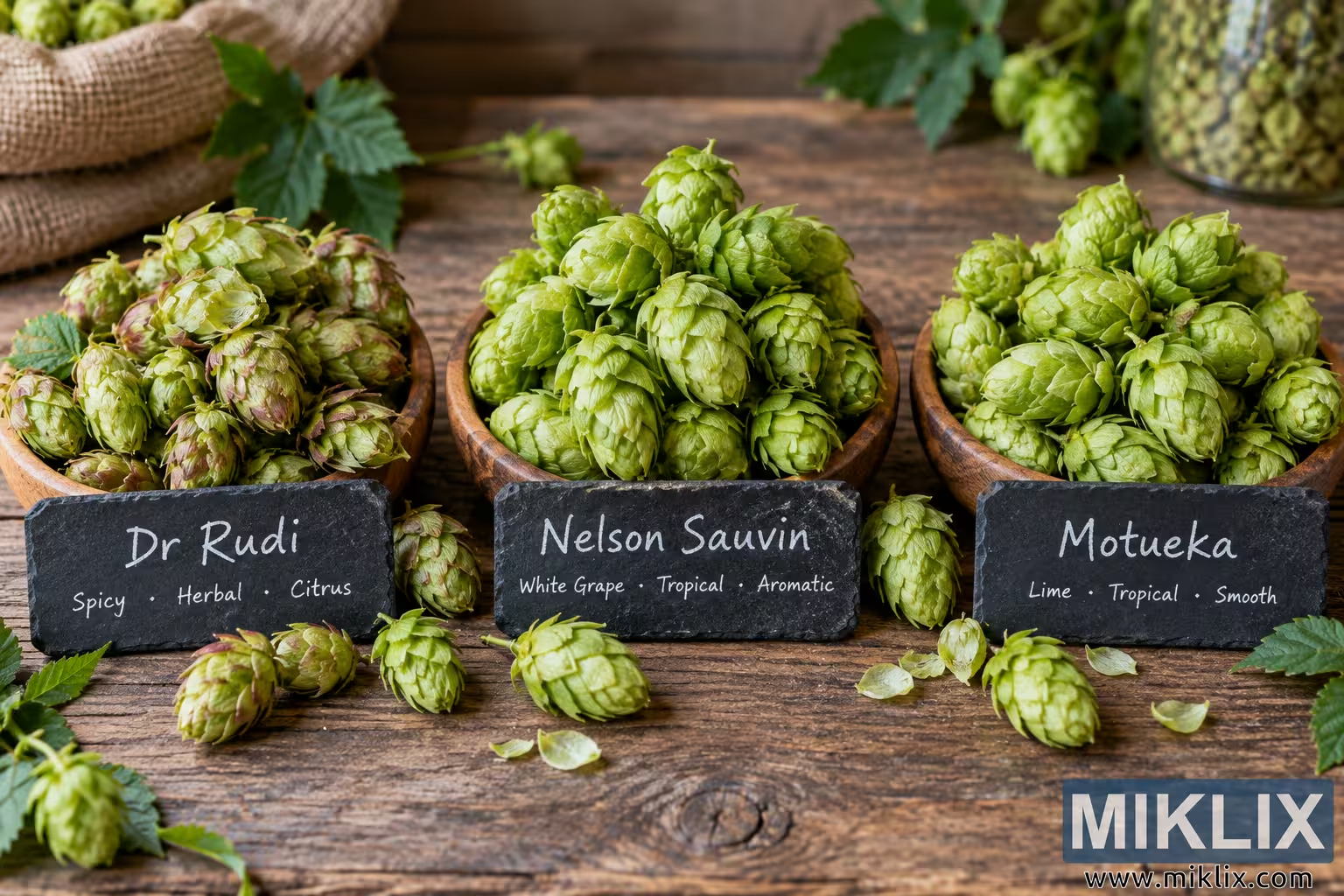
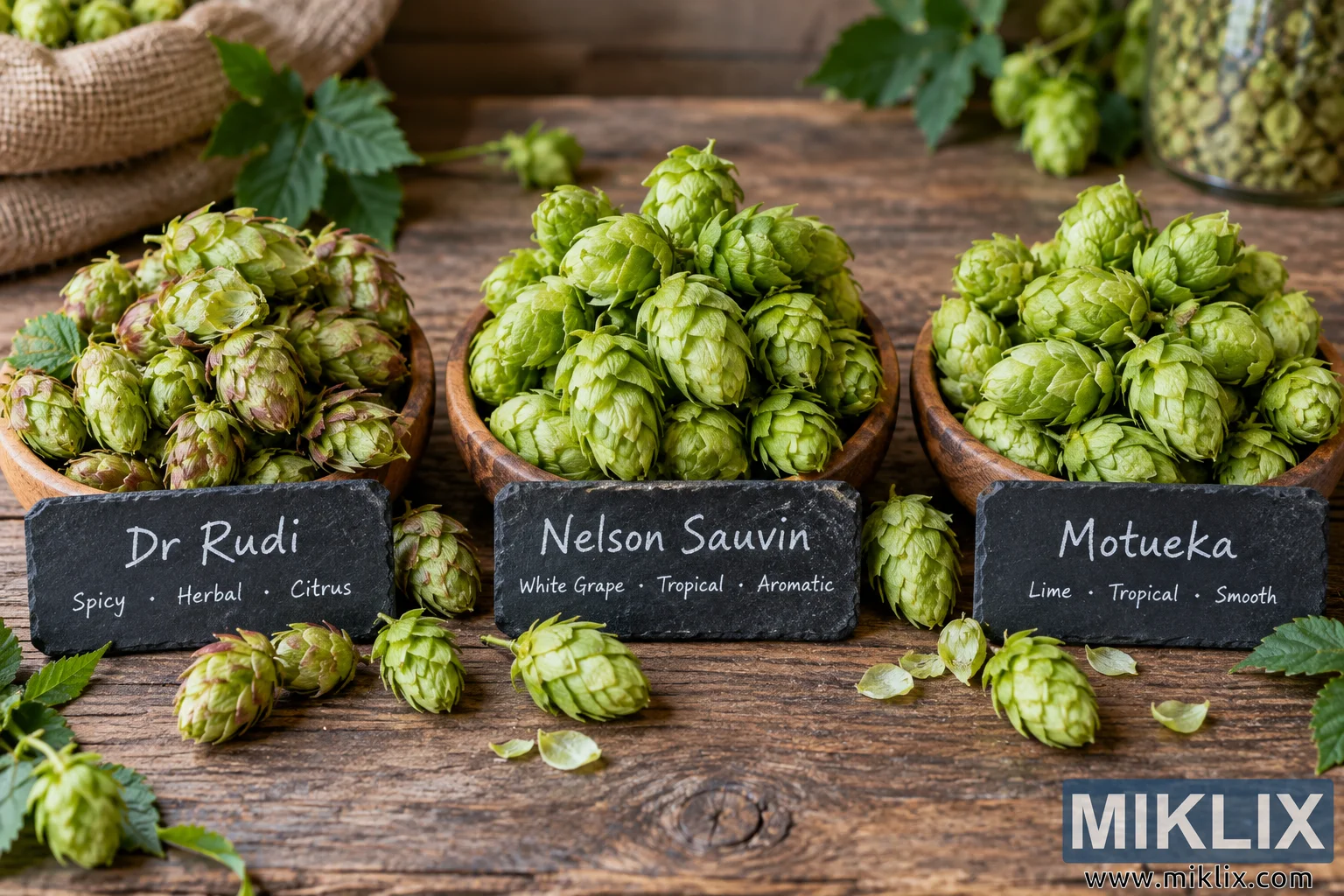
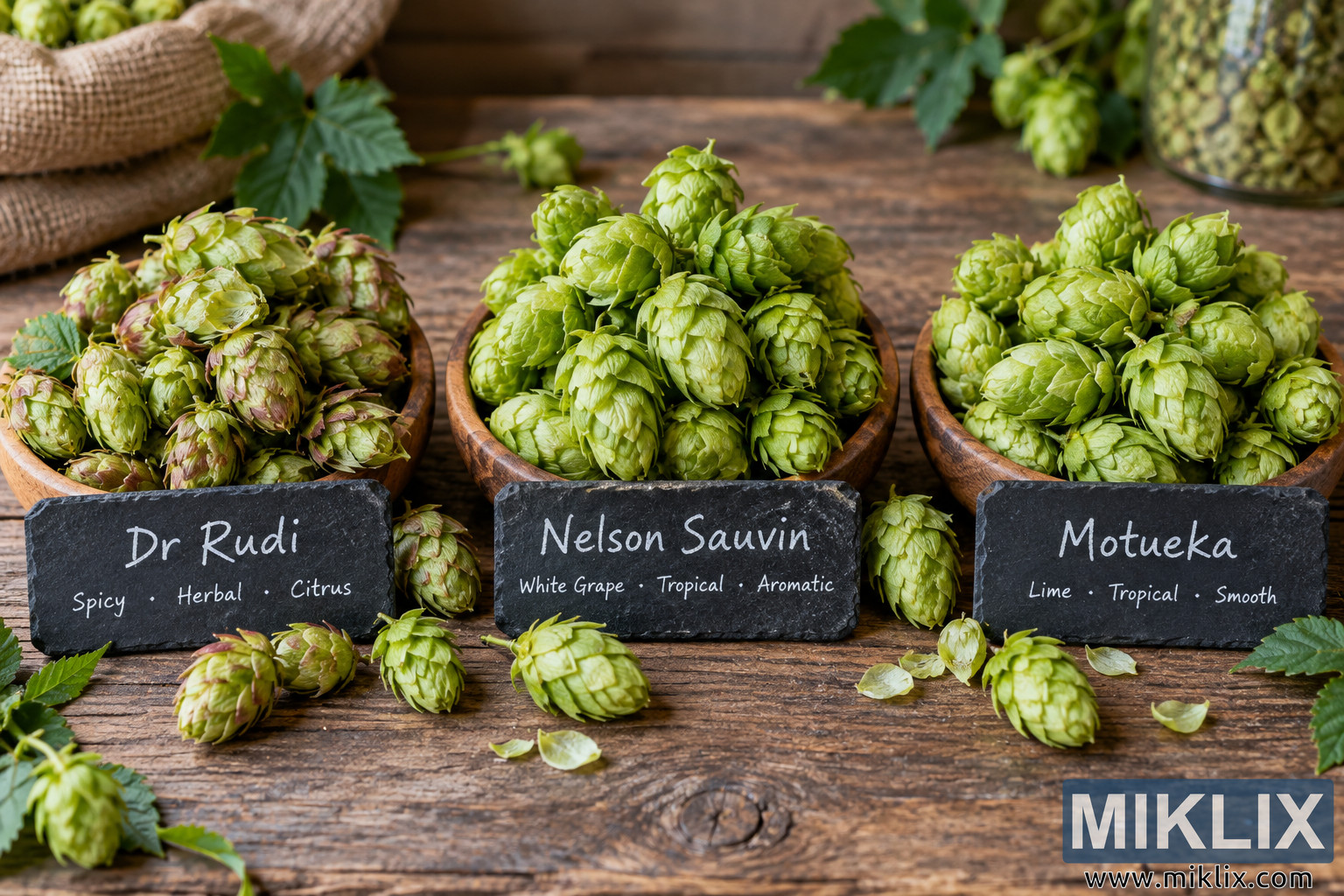
Large size (3,072 x 2,048)
Very large size (4,608 x 3,072)
Extra large size (6,144 x 4,096)
Comically large size (1,048,576 x 699,051)
- Still uploading... ;-)
Image description
A high-resolution landscape-oriented still-life photograph presents three different hop varieties arranged side by side for visual comparison on a rustic wooden tabletop. The composition has a warm, natural, artisanal atmosphere reminiscent of a hop farm, small brewery, or ingredient-tasting environment. Three shallow, round wooden bowls occupy the central portion of the image, each filled generously with fresh green hop cones. The bowls are positioned in a clear horizontal row, allowing the viewer to compare the appearance of the three hop varieties easily. In front of every bowl is a rectangular dark slate label with handwritten white lettering identifying the variety and summarizing several of its characteristic aromatic or flavor associations.
On the left, the first wooden bowl contains Dr Rudi hops. These hop cones display a somewhat varied coloration, with fresh yellow-green and olive-green tones as well as subtle reddish-purple or brownish accents around some of the overlapping bracts. The slight variation in color gives this group a distinctive appearance compared with the brighter green hops in the other two bowls. The cones are piled naturally rather than arranged with perfect symmetry, reinforcing the impression of freshly harvested agricultural ingredients. A black slate sign in front of the bowl reads “Dr Rudi” in large handwritten lettering. Beneath the name, smaller writing lists “Spicy · Herbal · Citrus,” providing a concise indication of the variety's represented sensory profile.
The center bowl contains Nelson Sauvin hops and forms the visual focal point of the composition. Its hop cones are vivid green, plump, and tightly layered, with clearly defined overlapping bracts and gently pointed ends. The pile rises higher than the rim of the wooden bowl, creating a generous mound of hops. Individual cones face in slightly different directions, making the texture of their layered leaves particularly visible. A dark slate label stands directly in front of the center bowl. The name “Nelson Sauvin” appears prominently in white handwritten lettering, while a smaller line below reads “White Grape · Tropical · Aromatic.” The central placement, substantial quantity of hops, and strong contrast between the bright green cones and dark sign make this variety especially noticeable.
On the right, a third wooden bowl contains Motueka hops. These cones are similarly fresh and green but form their own distinct cluster. Many are rounded and full, with crisp overlapping layers that catch the soft directional light. Their coloration ranges from yellow-green highlights to deeper green areas in the folds between the bracts. A matching black slate sign identifies the variety as “Motueka.” Underneath, smaller handwritten text reads “Lime · Tropical · Smooth.” The consistent label design helps establish the image as an intentional comparison of three hop varieties rather than simply a decorative arrangement of hop cones.
Several loose hop cones are scattered across the tabletop in front of and between the bowls. Some lie on their sides, while others point toward the camera, adding depth and a casual harvested quality to the scene. Small detached pale-green hop bracts are also visible on the wood near the foreground. The tabletop itself is made from broad, weathered wooden boards with pronounced grain, knots, scratches, and variations in warm brown color. Its rough texture contrasts with the delicate layered surfaces of the hop cones and contributes to the agricultural, handcrafted visual character of the photograph.
Additional hop plants and harvesting-related elements frame the main comparison without distracting from it. Along the left side and upper-left background, green hop leaves and stems extend into the composition. Behind them is a loosely folded piece of coarse natural burlap containing additional hop cones, suggesting freshly gathered produce. More hop leaves and cones appear around the upper-right portion of the scene. In the far right background, a partially visible transparent container appears to hold a larger quantity of hops. These background elements are softly out of focus, creating visual depth while keeping the three labeled bowls sharply emphasized.
The lighting is soft, warm, and directional, producing gentle highlights across the raised surfaces of the hop cones and subtle shadows beneath the bowls and signs. The hop cones' intricate textures are rendered clearly, from their overlapping papery bracts to the slight differences in shape and coloration among individual specimens. The warm brown tabletop and background balance the saturated natural greens, while the nearly black slate labels provide strong visual contrast. The shallow depth of field gradually softens objects toward the rear of the scene, giving the photograph a polished editorial quality while preserving the approachable character of a farm or craft-brewing setting.
The overall composition is symmetrical enough to communicate comparison clearly but remains intentionally organic. Dr Rudi occupies the left section, Nelson Sauvin the center, and Motueka the right, with approximately equal visual space dedicated to each variety. The labels make the comparison immediately understandable, while the differences in the hops' colors, shapes, and presentation encourage closer inspection. No people, commercial packaging, logos, brewery branding, or other recognizable brand marks are present. The emphasis remains entirely on the natural hop cones, their variety names, their represented sensory descriptors, and the rustic environment surrounding them. The result is an informative yet atmospheric ingredient photograph that visually communicates the diversity of hop varieties and evokes hop cultivation, brewing ingredients, sensory evaluation, and craft beer production without depicting a finished branded product.
The image is related to: Hops in Beer Brewing: Dr Rudi