
Image: Unbalanced Beer Recipe Components
Published: September 24, 2026 at 2:44:22 PM UTC
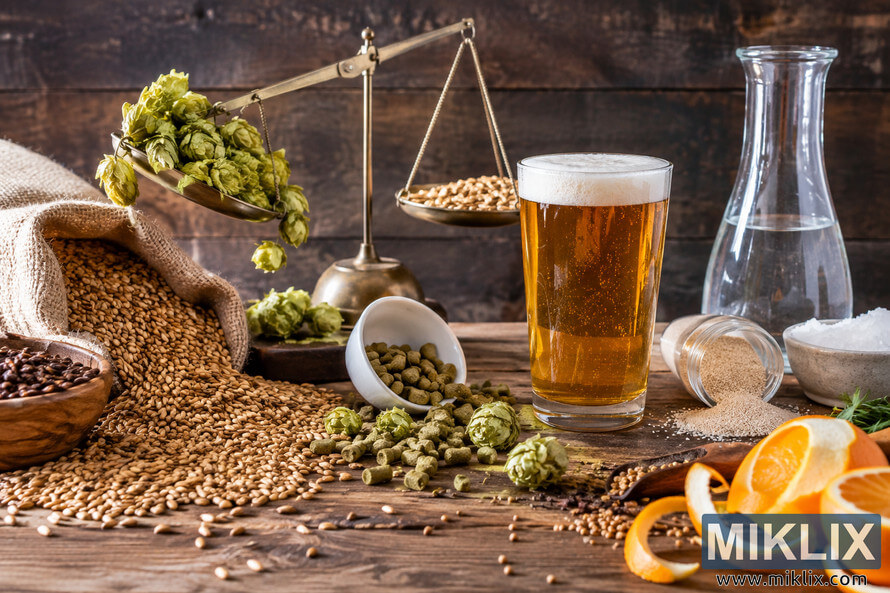
Photorealistic rustic still life illustrating an unbalanced beer recipe with amber beer, a tilted scale, excessive hops, malt grains, yeast, water, citrus, and spices.
Available versions of this image
The image files available for download below are less compressed and higher resolution - and as a result of that, higher quality - than the images embedded in articles and pages on this website, which are more optimized for file size in order to reduce bandwidth consumption.
Regular size (1,536 x 1,024)
Large size (3,072 x 2,048)
Very large size (4,608 x 3,072)
Extra large size (6,144 x 4,096)
Comically large size (1,048,576 x 699,051)
- Still uploading... ;-)
Image description
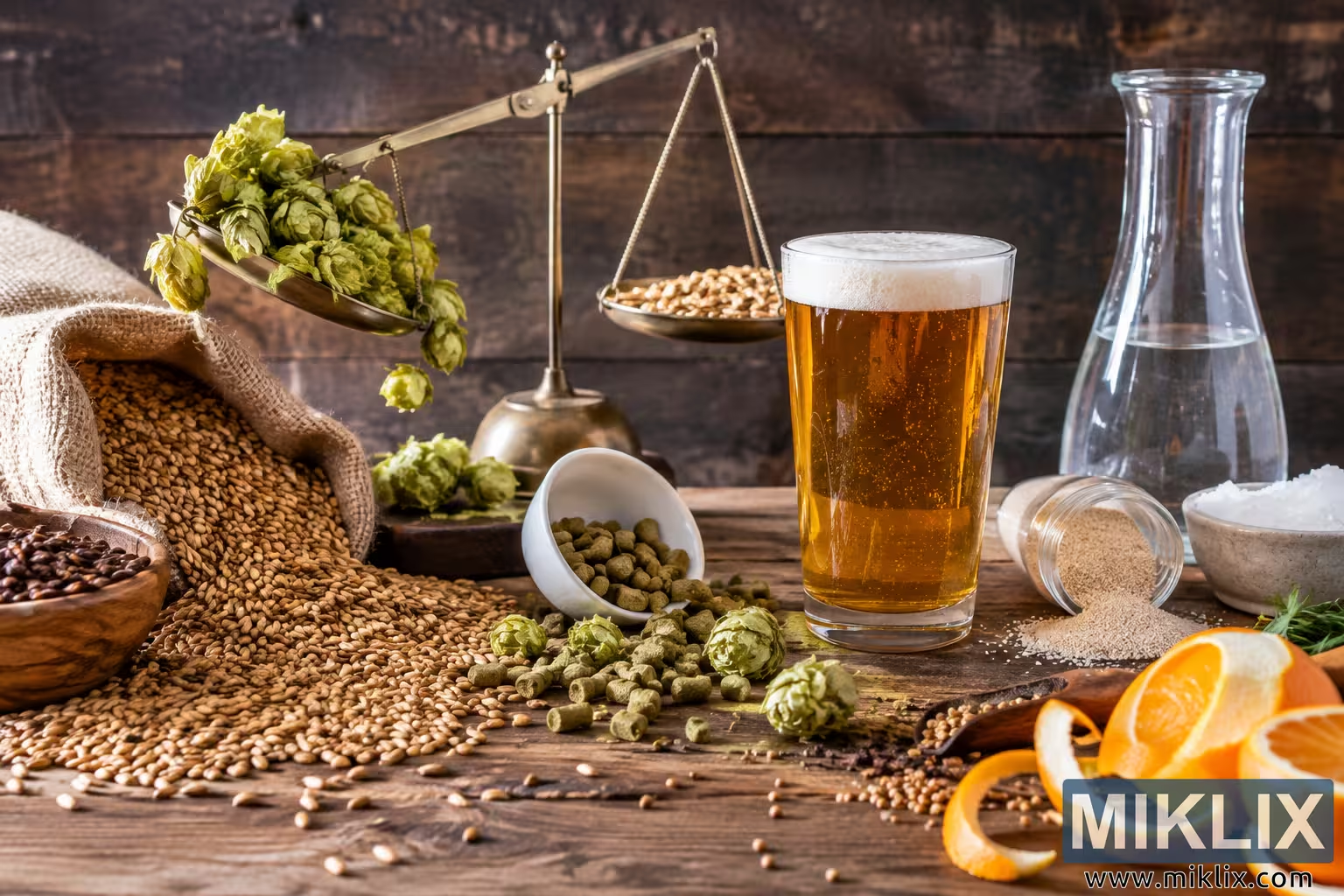
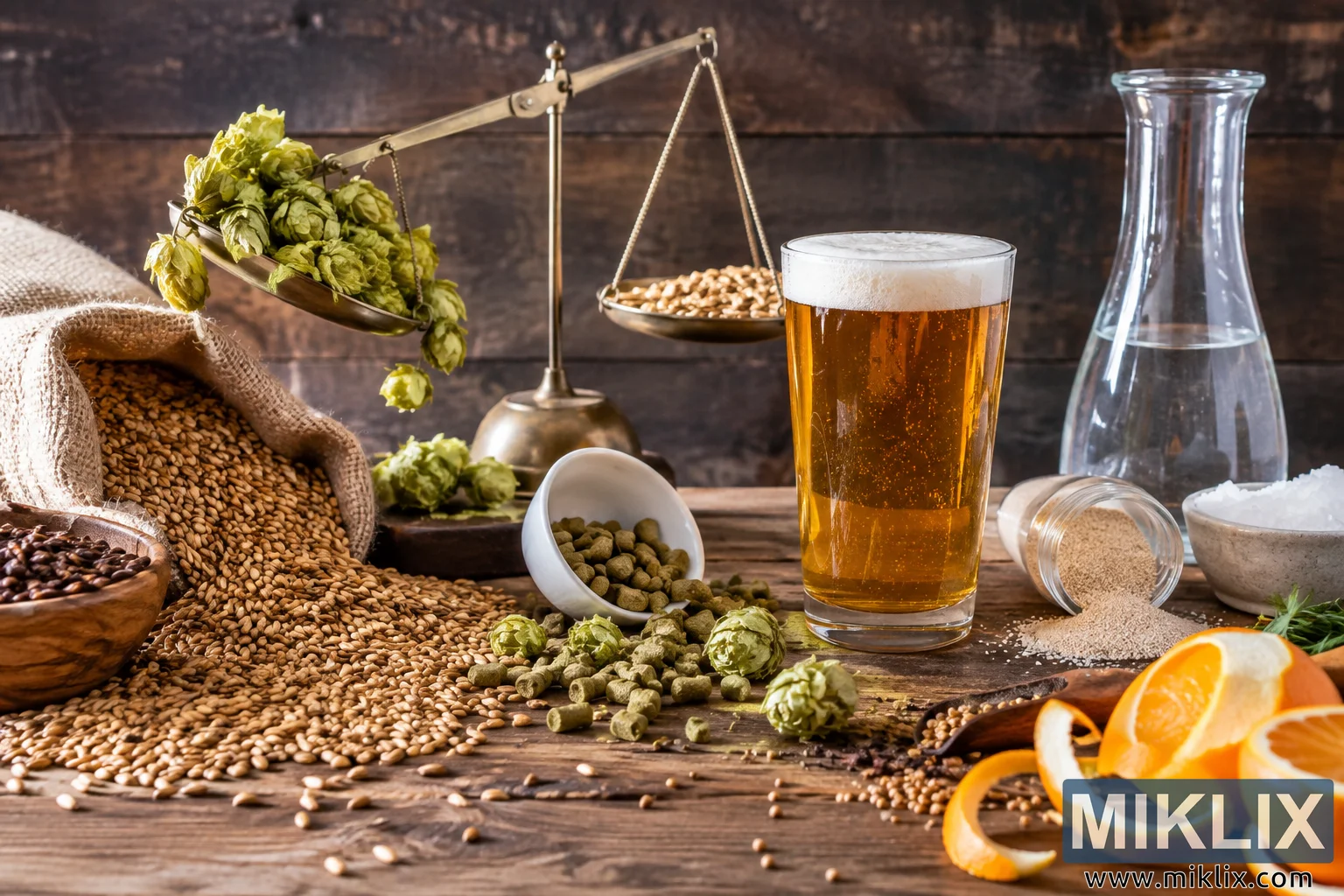
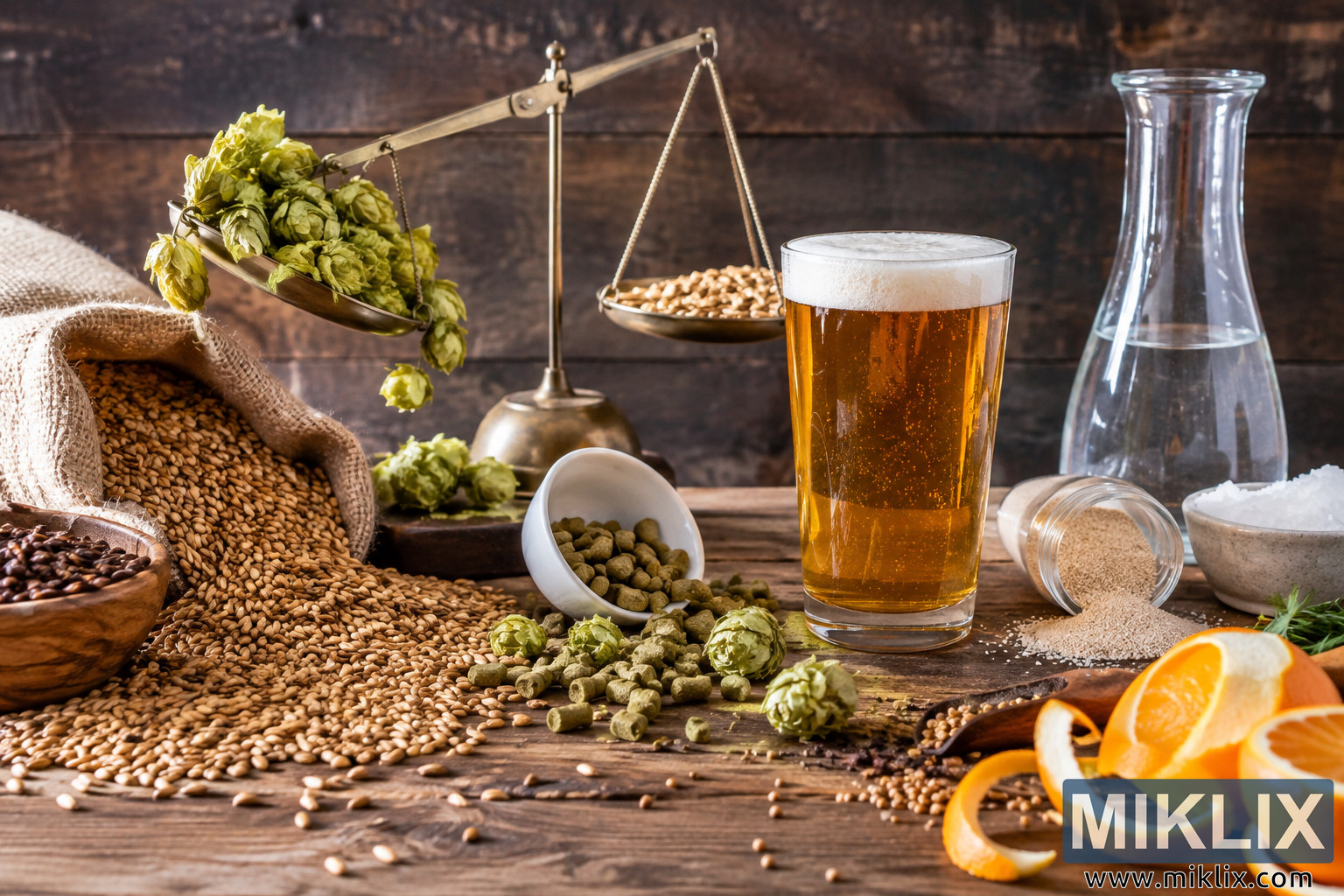
A detailed, photorealistic landscape-oriented still life depicts the concept of unbalanced beer recipe components through an intentionally uneven arrangement of brewing ingredients. The scene is set on a broad, rustic wooden tabletop made from weathered planks with visible grain, scratches, seams, and warm brown tones. Behind the table is a dark wooden plank wall that provides a subdued, natural backdrop. The lighting is warm and directional, reminiscent of soft daylight entering a traditional brewery, farmhouse kitchen, or craft workshop. Highlights catch the glass, metal, grain, and hops, while gentle shadows add depth and emphasize the textures of the individual ingredients.
Near the center-right of the composition stands a tall, clear glass filled with bright amber-golden beer. The beer is transparent enough for the warm light to pass through it, producing rich shades of gold, copper, and orange. Numerous tiny bubbles are visible inside the liquid, suggesting carbonation and freshness. A substantial layer of pale, creamy white foam rests on top of the beer and reaches close to the rim. The simple cylindrical glass carries no logo, label, text, or recognizable branding. Its clean appearance makes the beer itself one of the strongest visual focal points in the scene.
Behind and slightly to the left of the beer is an old-fashioned brass balance scale. Its central support rises vertically from a rounded metal base and holds a horizontal beam from which two shallow weighing pans are suspended by fine chains. The scale is conspicuously tilted rather than balanced, providing the clearest visual metaphor for an unbalanced beer recipe. The pan on the left is positioned lower and is dramatically overloaded with whole green hop cones. The hops form a generous mound, with several cones extending over the rim and hanging downward. One hop cone appears to have fallen below the pan, reinforcing the impression that this ingredient has been used excessively. The hops have layered, papery leaves in muted yellow-green and olive tones, with realistic variations in shape and texture.
The opposite scale pan, positioned higher on the right, contains a comparatively restrained quantity of pale tan cereal grains. This contrast between the overloaded hop side and the lighter grain side visually communicates an ingredient ratio that has moved far away from equilibrium. The brass scale has a gently aged surface with warm metallic reflections, complementing the golden colors of the beer and grain while adding a traditional, handcrafted brewing atmosphere.
The foreground is deliberately abundant and somewhat disorderly. On the left side, a large open burlap sack lies partly on its side and releases a substantial quantity of golden brewing grain across the tabletop. The coarse woven fibers of the sack contrast strongly with the smooth individual kernels. Hundreds of grains spill outward from the opening, covering a large portion of the foreground and creating an irregular organic pattern. A small wooden bowl at the far left contains darker roasted grains or malt, introducing deep brown and nearly black tones that suggest another possible component of the recipe.
Closer to the middle foreground is a small white ceramic container tipped onto its side. Greenish hop pellets have spilled from it onto the wooden surface, mixing visually with several loose whole hop cones. The pellets are compact, cylindrical, and noticeably different in texture from the fresh-looking hop flowers. Together, the whole hops and processed hop pellets emphasize the brewing theme while also contributing to the sense that the recipe contains too many competing or disproportionate ingredients.
To the right of the beer glass, a small clear jar has also fallen onto its side. Fine beige granules, suggestive of brewing yeast, pour from its opening and form a small mound on the table. Nearby is a simple ceramic bowl containing coarse white crystalline material. Behind these ingredients stands a tall, transparent glass carafe partly filled with clear water. The carafe has a narrow neck and wider lower body, catching bright reflections from the surrounding light. Like the beer glass, it is completely generic and contains no text, branding, logo, or identifying marks.
Additional ingredients are scattered across the right foreground, making the recipe appear increasingly complicated and poorly controlled. Bright orange citrus fruit and curling strips of orange peel occupy the lower-right corner. Their saturated color contrasts strongly with the subdued greens and browns of the brewing ingredients. Small quantities of seeds, spices, herbs, and other botanical elements are distributed around wooden utensils and across the tabletop. These supplementary ingredients suggest flavor additions that might be appropriate in moderation but, when combined with the overloaded scale and extensive ingredient spread, reinforce the overall theme of imbalance and excessive complexity.
The composition is visually dense without becoming completely chaotic. The beer glass serves as the primary finished-product reference, while the tilted scale acts as the conceptual centerpiece. The abundant grains, hops, pellets, yeast-like granules, water, citrus, spices, and herbs create a visual narrative about recipe formulation. Rather than depicting a carefully measured brewing process, the image suggests proportions that have become distorted: some ingredients appear excessive, others comparatively underrepresented, and numerous flavor additions compete for attention. The strongly lowered hop pan is particularly effective in communicating that one component may dominate the recipe.
The overall aesthetic combines rustic food photography with a subtle conceptual illustration. Natural materials such as wood, burlap, grain, hops, citrus peel, ceramic, glass, and aged brass give the scene a tactile quality. Warm highlights and rich amber tones make the beer inviting, while the visibly uneven scale introduces tension and communicates that the underlying formulation is not harmonious. There are no people in the image and no commercial packaging, trademarks, brand names, logos, labels, or other identifiable brand elements. The result is a realistic, atmospheric representation of unbalanced beer recipe components, using physical ingredients and an uneven balance scale to transform an abstract brewing problem into an immediately understandable visual metaphor.
The image is related to: Hops in Beer Brewing: Dr Rudi