
Image: Macro Close-Up of Hop Cone with Visible Lupulin Glands
Published: September 27, 2026 at 8:50:10 AM UTC
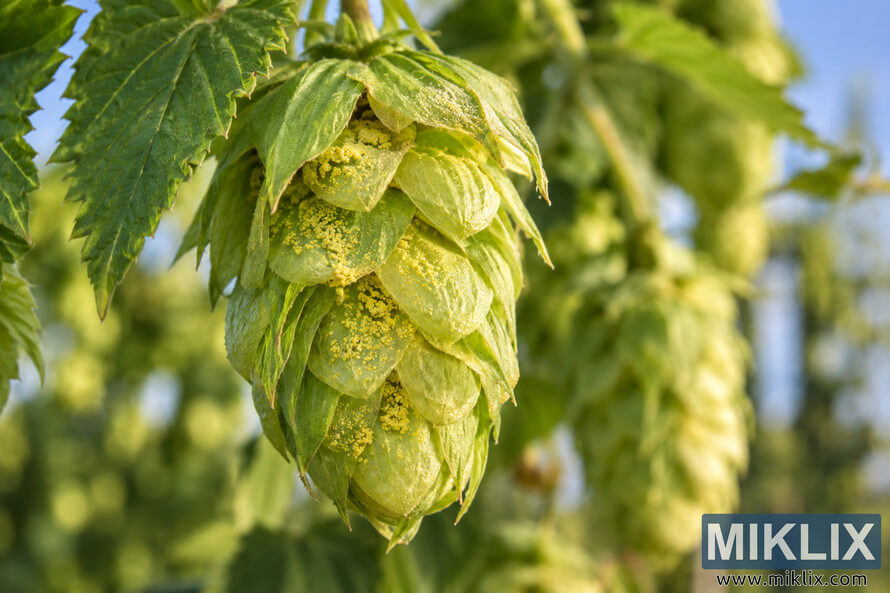
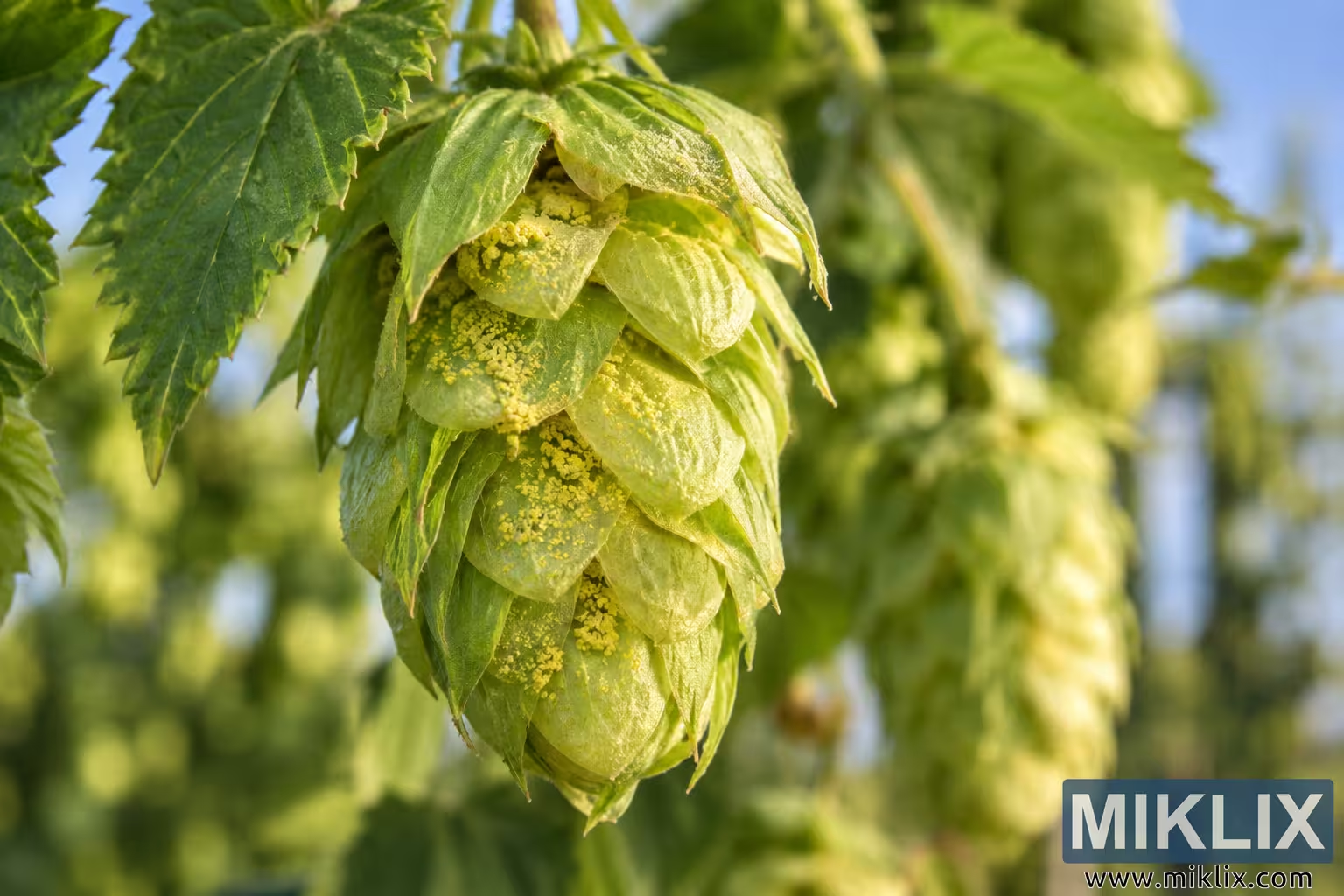
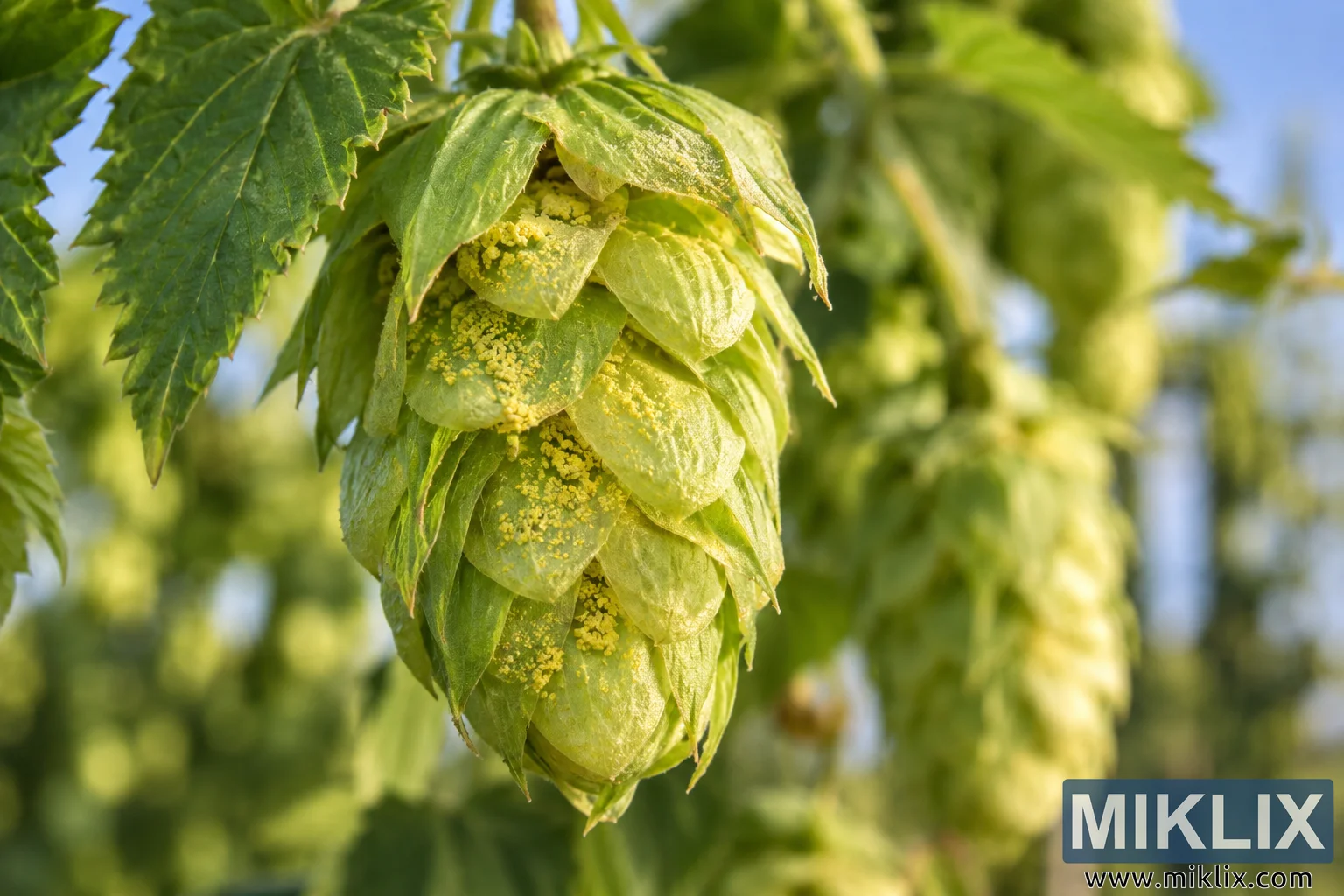
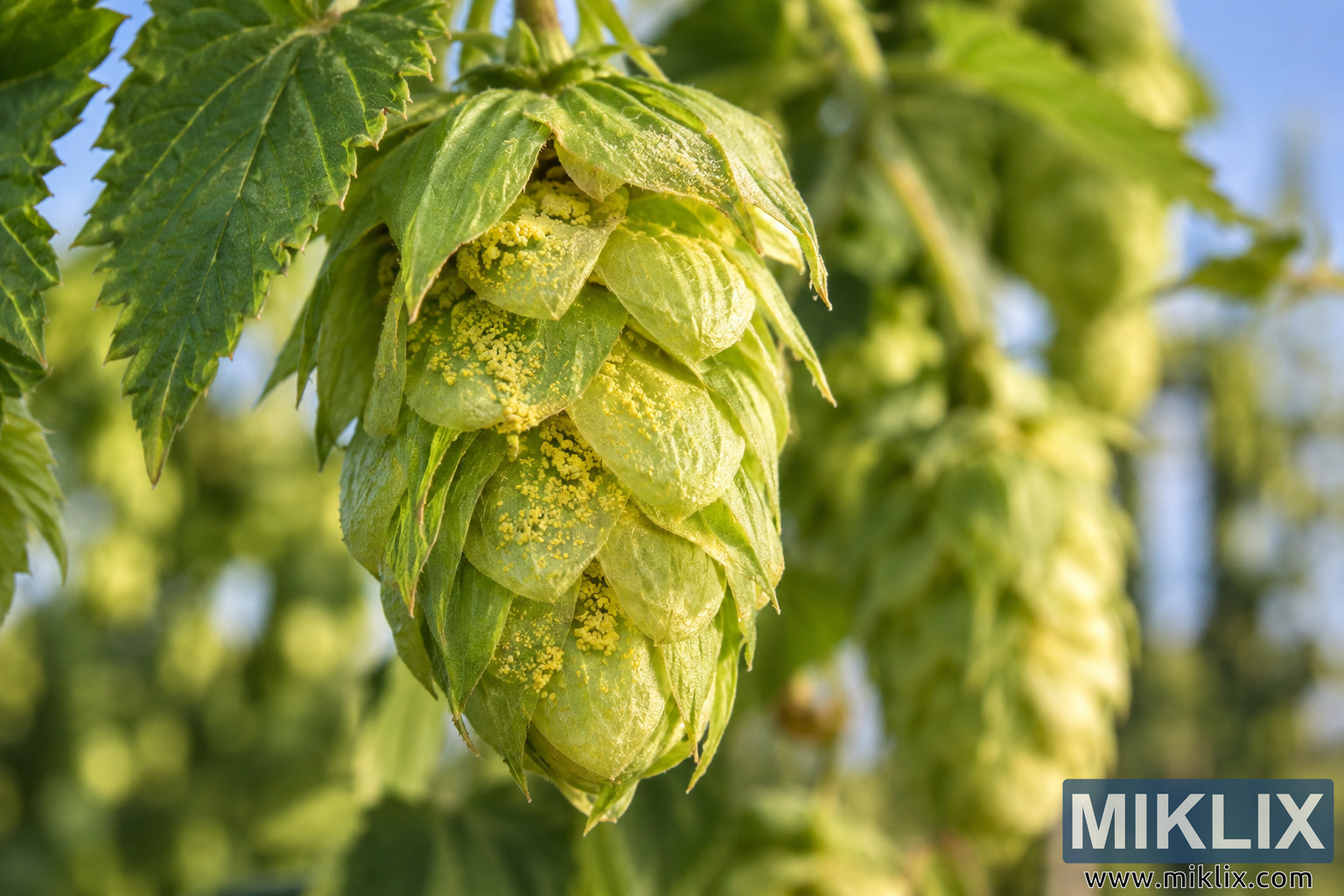
Detailed macro photograph of a green hop cone with visible golden-yellow lupulin glands, layered bracts, natural foliage, warm sunlight, and a softly blurred hop-yard background.
Available versions of this image
The image files available for download below are less compressed and higher resolution - and as a result of that, higher quality - than the images embedded in articles and pages on this website, which are more optimized for file size in order to reduce bandwidth consumption.
Regular size (1,536 x 1,024)
Large size (3,072 x 2,048)
Very large size (4,608 x 3,072)
Extra large size (6,144 x 4,096)
Comically large size (1,048,576 x 699,051)
- Still uploading... ;-)
Image description
A highly detailed, photorealistic landscape-format macro photograph presents a mature hop cone growing naturally on the plant in bright outdoor daylight. The main hop cone dominates the left-center portion of the composition and hangs vertically from its stem, allowing its layered botanical structure to be examined at very close range. Numerous overlapping green bracts form the characteristic compact, tapered shape of the cone. Each bract has a slightly different orientation, curvature, and degree of illumination, giving the cone a convincing sense of depth and natural irregularity. The surfaces of the bracts reveal delicate veins, subtle wrinkles, fine textural variations, and gently curled or pointed edges. Their coloration ranges from fresh medium green in the shaded areas to pale yellow-green where direct sunlight passes across the plant tissue.
One of the most prominent details in the photograph is the visible concentration of lupulin material distributed among and across the overlapping bracts. The lupulin appears as numerous tiny yellow to golden-yellow granular glands, especially noticeable in the upper and central sections of the cone. These minute particles form irregular clusters along the protected areas where the bracts overlap, while smaller individual specks are scattered across some of the exposed green surfaces. Their warm yellow coloration contrasts clearly with the surrounding green plant tissue. The close perspective makes these glands an important visual feature rather than an indistinct botanical detail, emphasizing the resinous structures associated with a mature hop cone. The granular appearance is especially clear where sunlight catches the yellow particles, creating small variations in brightness and texture without making them look artificially uniform.
The hop cone itself is sharply focused. Individual bracts can be distinguished from one another from the upper portion of the cone down to its pointed lower end. The upper bracts spread outward slightly and partly overlap neighboring foliage, while those toward the middle create dense, repeating layers. Near the bottom, the structure gradually narrows and terminates in several pointed green tips. This progression gives the cone a natural elongated, roughly oval silhouette. The combination of crisp botanical detail and shallow depth of field directs attention immediately toward the cone and, more specifically, toward the exposed lupulin glands.
Several hop leaves surround the main subject. In the upper-left corner and along the left edge of the frame, broad green leaves extend into the photograph. Their serrated margins are clearly recognizable, with pointed teeth creating an irregular outline against the brighter background. The leaves display branching veins and variations in surface texture, and some areas are illuminated strongly enough to reveal lighter green highlights. Other sections remain in softer shade, producing a broad range of green tones. A smaller leaf or bract-like section arches over the upper portion of the cone, partially framing the yellow lupulin deposits beneath it.
The background depicts additional hop growth but is intentionally rendered out of focus by the shallow depth of field. To the right of the principal cone, another hop cone hangs farther away and appears as a soft, elongated yellow-green form. Additional blurred leaves, stems, and vertical plant structures extend through the background, suggesting a cultivated hop garden or hop yard with plants trained upward. These background elements provide environmental context while remaining sufficiently indistinct that they do not compete with the main subject. Patches of pale blue sky are visible between the foliage, particularly toward the upper-right side of the image, reinforcing the impression of an outdoor agricultural setting on a clear or mostly clear day.
Warm natural sunlight enters the scene strongly and gives the image a fresh, late-summer agricultural character. The light strikes the main cone from the front and side, creating luminous highlights along several bracts while leaving narrow shadowed areas between the overlapping layers. These small shadows are particularly effective at defining the three-dimensional construction of the cone. The yellow lupulin glands respond differently to the light than the smooth green bracts, appearing granular and slightly brighter. The resulting tonal contrast makes their distribution easy to perceive. The sunlight also creates bright green and yellow-green areas in the background, where the out-of-focus foliage produces soft circular and organic bokeh shapes.
Compositionally, the image uses asymmetry and negative space effectively. The principal hop cone occupies much of the left half of the landscape frame, while the right half contains softer, more distant vegetation and glimpses of sky. This arrangement gives the photograph room to breathe and prevents the macro subject from feeling visually cramped. The strong focus transition from the extremely detailed foreground cone to the creamy, blurred background creates a pronounced sense of depth. Although the photograph is a close-up botanical study, the distant hop cones and vertical growth patterns communicate that the subject remains attached to a living plant rather than being photographed as an isolated specimen.
The overall palette is dominated by natural greens, ranging from dark leaf green to bright lime and yellow-green, complemented by the distinctive golden-yellow lupulin and small areas of clear blue sky. There are no artificial objects, people, labels, logos, packaging elements, text, or recognizable commercial branding anywhere in the scene. The image concentrates entirely on the physical characteristics of the hop plant. Its combination of macro detail, visible lupulin glands, natural sunlight, shallow depth of field, and softly rendered hop-yard background gives it the appearance of a high-resolution agricultural or botanical photograph intended to communicate both the beauty and the fine structural details of a mature hop cone.
The image is related to: Hops in Beer Brewing: Ella