
Image: Ella Hops: Alpha Acid Content, Essential Oil Composition and Sensory Profile
Published: September 27, 2026 at 8:50:10 AM UTC
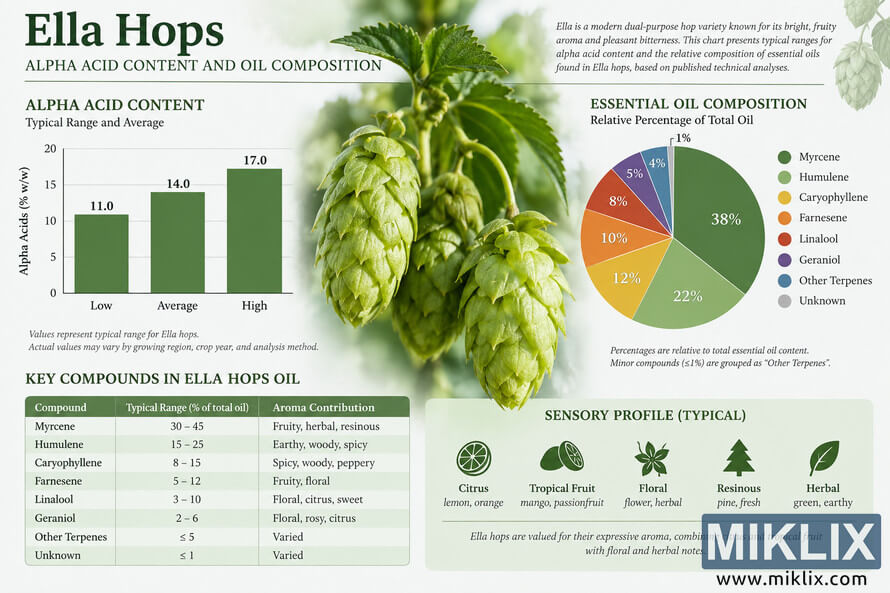
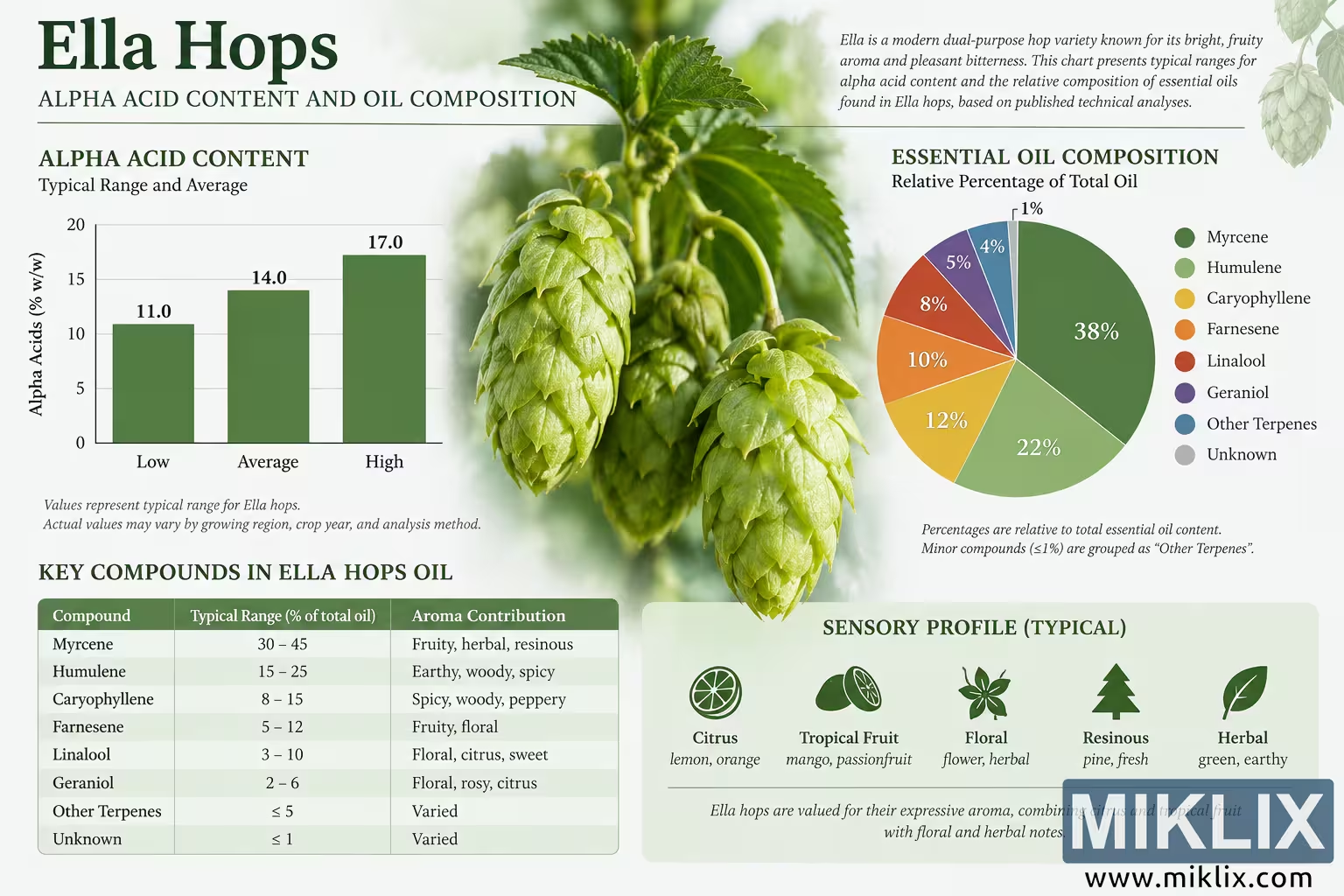
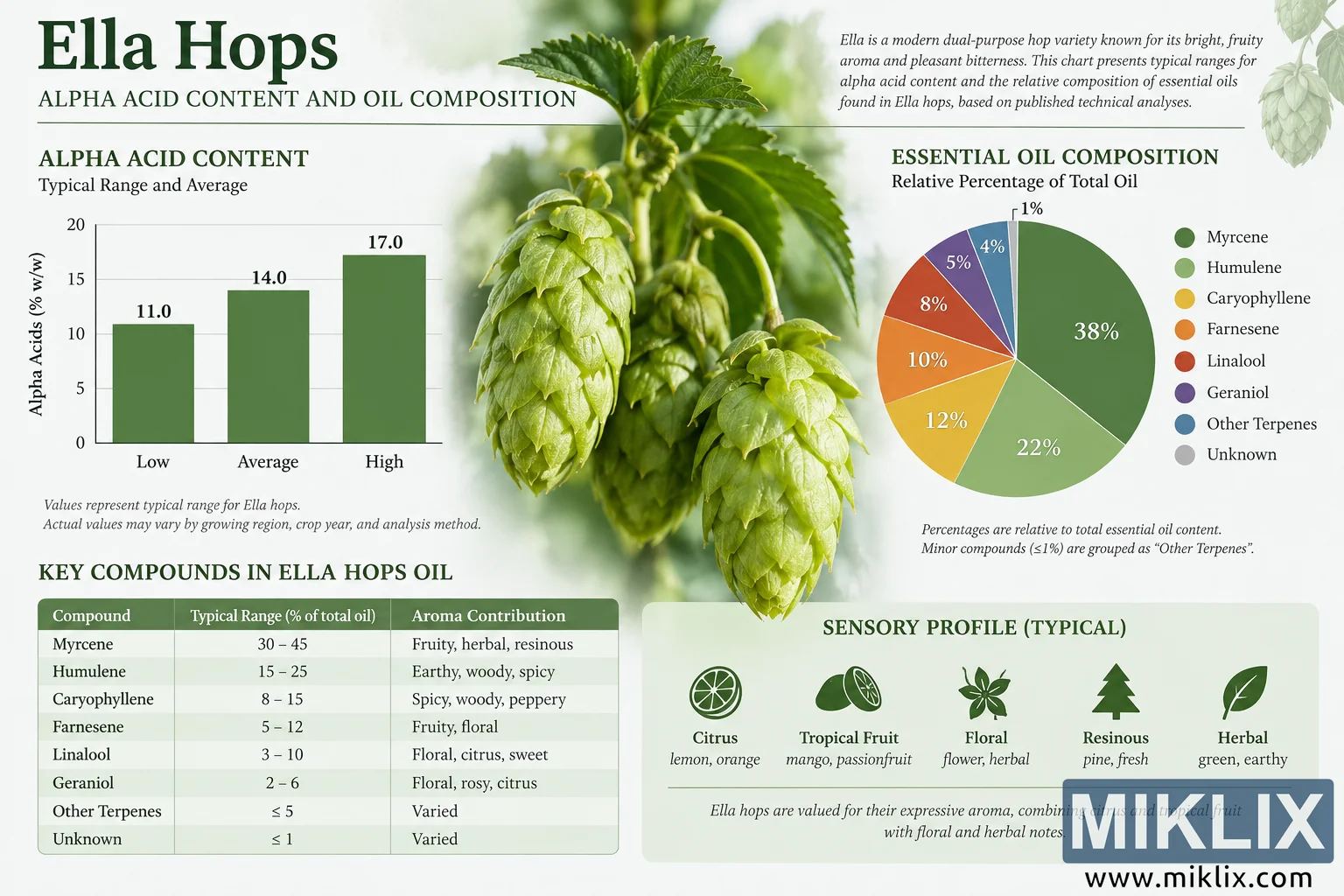
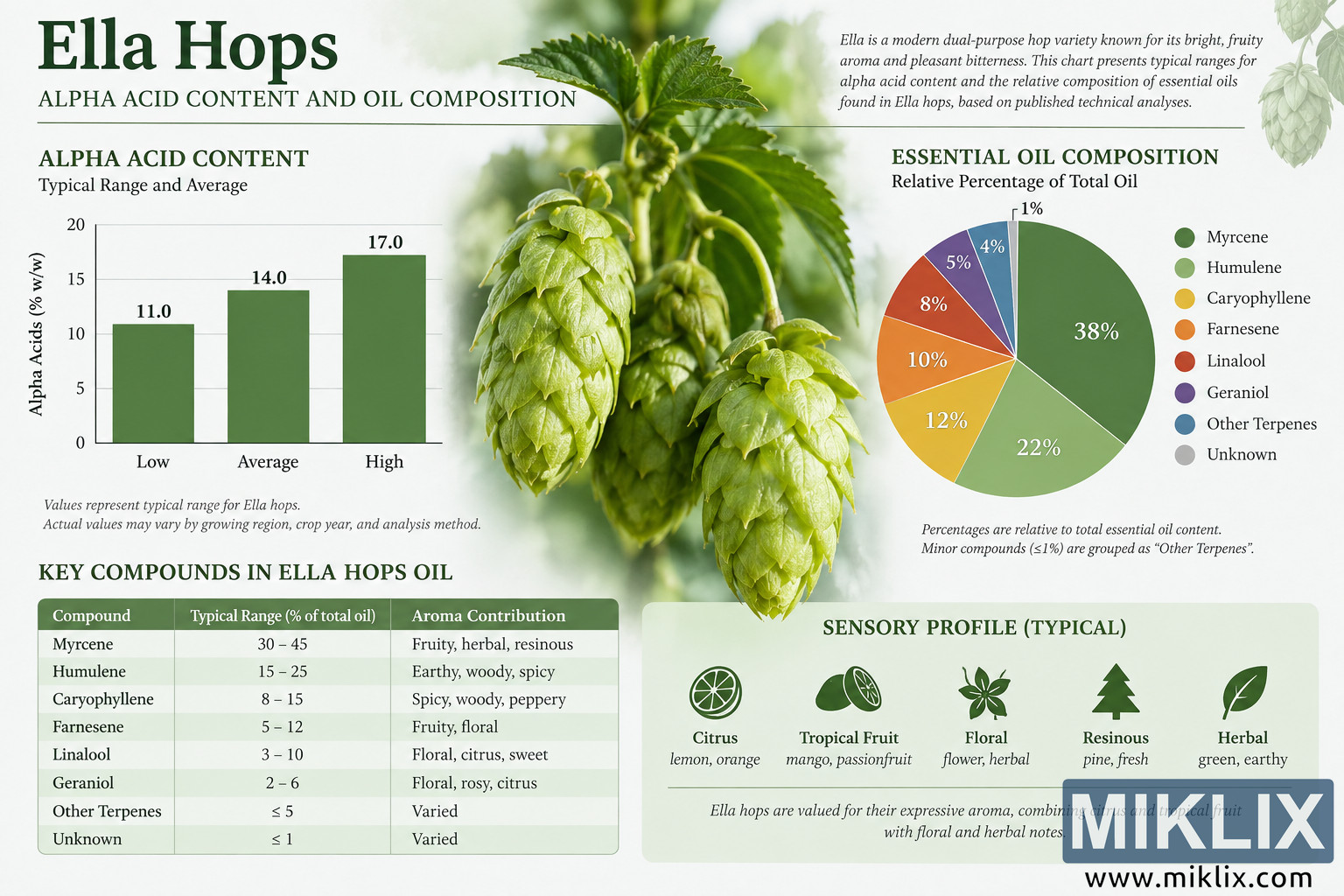
Scientific infographic about Ella hops showing typical alpha acid content, essential oil composition, key hop-oil compounds and citrus, tropical fruit, floral, resinous and herbal sensory characteristics.
Available versions of this image
The image files available for download below are less compressed and higher resolution - and as a result of that, higher quality - than the images embedded in articles and pages on this website, which are more optimized for file size in order to reduce bandwidth consumption.
Regular size (1,536 x 1,024)
Large size (3,072 x 2,048)
Very large size (4,608 x 3,072)
Extra large size (6,144 x 4,096)
Comically large size (1,048,576 x 699,051)
- Still uploading... ;-)
Image description
A wide, landscape-format scientific infographic titled “Ella Hops” presents information about the alpha acid content, essential oil composition, key aromatic compounds, and typical sensory characteristics of Ella hops. The overall design uses a clean white to very pale green background, dark forest-green typography, muted natural accent colors, and a large photographic botanical image of fresh green hop cones and leaves as the central visual element. The composition is divided into several clearly defined informational areas, giving the image the appearance of a polished horticultural or brewing-science reference chart.
Across the upper left is the large serif heading “Ella Hops,” rendered in dark green. Immediately beneath it appears the subtitle “ALPHA ACID CONTENT AND OIL COMPOSITION” in uppercase letters. A thin horizontal green rule extends across most of the infographic below this introductory area. In the upper-right portion, an italic introductory paragraph explains that Ella is a modern dual-purpose hop variety known for a bright, fruity aroma and pleasant bitterness, and states that the chart presents typical alpha acid ranges and the relative composition of essential oils found in Ella hops. Pale decorative botanical hop illustrations appear near the far upper-right edge.
The upper-left analytical section is headed “ALPHA ACID CONTENT,” followed by the subtitle “Typical Range and Average.” A vertical bar chart displays alpha acids as a percentage by weight. The vertical axis is labeled “Alpha Acids (% w/w)” and ranges visually from zero to twenty. Three dark green bars are labeled Low, Average, and High. The values printed above the bars are 11.0 for Low, 14.0 for Average, and 17.0 for High. Horizontal guide lines make the values easy to compare. Beneath the chart, a short italic note says that the values represent a typical range for Ella hops and that actual values may vary according to growing region, crop year, and analysis method.
Dominating the center of the infographic is a detailed photographic close-up of a living hop plant. Several mature, light-green hop cones hang downward from leafy stems. The cones consist of overlapping papery bracts with yellow-green highlights and deeper green shadows, giving them a fresh, dimensional appearance. Serrated hop leaves surround the cones, while the softly blurred background suggests foliage and natural daylight. The central botanical photograph visually connects the scientific charts with the agricultural plant being described and provides an organic contrast to the structured data panels.
The upper-right section is headed “ESSENTIAL OIL COMPOSITION,” with the subtitle “Relative Percentage of Total Oil.” A large circular pie chart breaks the oil profile into multiple colored segments. The largest dark green segment is labeled 38 percent and represents Myrcene. A lighter green segment marked 22 percent represents Humulene. A yellow-gold segment marked 12 percent represents Caryophyllene. An orange segment marked 10 percent represents Farnesene. A reddish-orange segment marked 8 percent represents Linalool. A purple segment marked 5 percent represents Geraniol. A blue segment marked 4 percent represents Other Terpenes, while a very small gray segment marked 1 percent represents Unknown. To the right of the chart, a vertically arranged legend pairs colored circular markers with the compound names Myrcene, Humulene, Caryophyllene, Farnesene, Linalool, Geraniol, Other Terpenes, and Unknown. An italic note below the chart explains that percentages are relative to total essential oil content and that minor compounds at or below approximately one percent are grouped as other terpenes.
The lower-left portion contains a structured table under the heading “KEY COMPOUNDS IN ELLA HOPS OIL.” The table has three columns labeled Compound, Typical Range (% of total oil), and Aroma Contribution. Alternating pale green and white rows improve readability. Myrcene is shown with a typical range of 30–45 percent and an aroma contribution described as fruity, herbal, and resinous. Humulene is listed at 15–25 percent with earthy, woody, and spicy characteristics. Caryophyllene appears at 8–15 percent with spicy, woody, and peppery characteristics. Farnesene is shown at 5–12 percent with fruity and floral qualities. Linalool is listed at 3–10 percent with floral, citrus, and sweet characteristics. Geraniol appears at 2–6 percent with floral, rosy, and citrus notes. Other Terpenes are listed at 5 percent or less with varied aroma contributions, and Unknown compounds are shown at 1 percent or less with varied contributions.
The lower-right section is contained within a softly tinted pale-green rounded rectangle and is titled “SENSORY PROFILE (TYPICAL).” Five stylized dark-green botanical or flavor icons are arranged horizontally. The first depicts a sliced citrus fruit and is labeled Citrus, with the descriptors “lemon, orange.” The second uses tropical-fruit imagery and is labeled Tropical Fruit, with “mango, passionfruit” underneath. The third is a flower-like icon labeled Floral, accompanied by “flower, herbal.” The fourth resembles an evergreen tree and is labeled Resinous, with the descriptors “pine, fresh.” The fifth is a leaf icon labeled Herbal, accompanied by “green, earthy.” A thin horizontal line separates these icons from a centered italic statement at the bottom of the panel explaining that Ella hops are valued for an expressive aroma combining citrus and tropical fruit with floral and herbal notes.
The visual hierarchy is carefully organized: the large title identifies the hop variety, the central photograph provides immediate botanical recognition, the bar and pie charts communicate quantitative information, the table gives more detailed chemical ranges, and the sensory panel translates the chemistry into recognizable aroma impressions. Serif typography and restrained green tones give the chart a scholarly, botanical character, while the high-resolution hop photograph makes the design approachable and visually engaging. No commercial branding, company logos, product packaging, or other brand identifiers are present. The finished image functions as an educational scientific-style reference graphic about Ella hops, combining quantitative brewing data, essential-oil chemistry, botanical imagery, and sensory descriptors in a single landscape composition.
The image is related to: Hops in Beer Brewing: Ella