
Image: Ella Hop Recipe Calculations in Brewing Software
Published: September 27, 2026 at 8:50:10 AM UTC
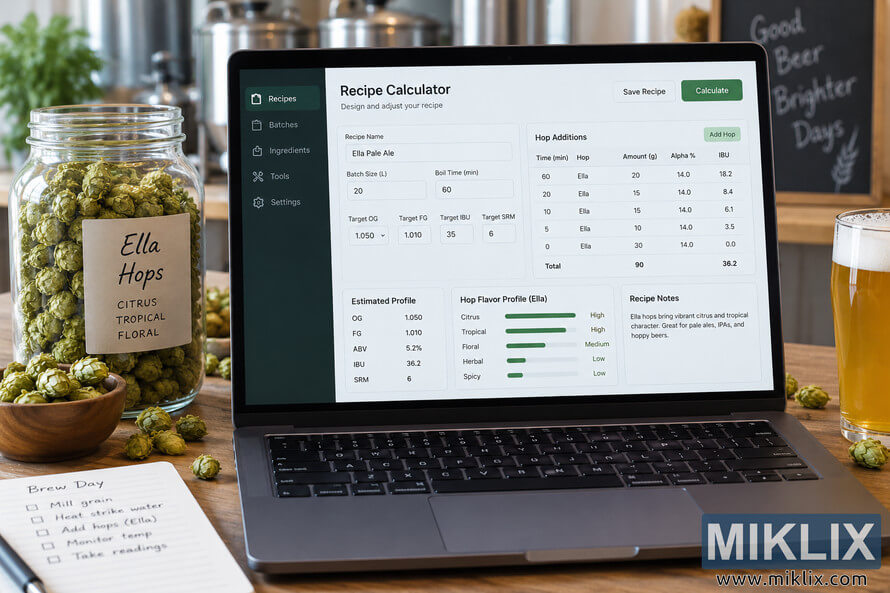
Brewing software interface displaying Ella hop recipe calculations, hop additions, bitterness estimates, flavor profiles, and brew-day details in a realistic homebrewing workspace.
Available versions of this image
The image files available for download below are less compressed and higher resolution - and as a result of that, higher quality - than the images embedded in articles and pages on this website, which are more optimized for file size in order to reduce bandwidth consumption.
Regular size (1,536 x 1,024)
Large size (3,072 x 2,048)
Very large size (4,608 x 3,072)
Extra large size (6,144 x 4,096)
Comically large size (1,048,576 x 699,051)
- Still uploading... ;-)
Image description
A realistic, warmly lit landscape photograph depicts a homebrewing workspace centered on an open dark gray laptop resting on a wooden work surface. The laptop screen displays a clean, modern brewing software interface devoted to recipe calculations for a beer using Ella hops. The computer is positioned almost directly toward the viewer, making the software interface the primary focal point of the composition, while brewing ingredients, equipment, and a finished glass of beer provide visual context around it. The interface has a restrained white, pale gray, dark teal, and green visual design. A dark vertical navigation panel appears along the left side of the screen with menu items labeled Recipes, Batches, Ingredients, Tools, and Settings. The Recipes section is highlighted, indicating that it is currently active. The main heading at the top of the application reads Recipe Calculator, followed by the smaller phrase Design and adjust your recipe. Buttons for Save Recipe and Calculate appear toward the upper-right corner, with the Calculate button emphasized in green. The main recipe form identifies the recipe as Ella Pale Ale. Fields beneath the recipe name show a batch size of 20 liters and a boil time of 60 minutes. Additional target values include an original gravity of 1.050, final gravity of 1.010, target bitterness of 35 IBU, and target color of 6 SRM. To the right is a prominent Hop Additions table with columns for time, hop variety, amount, alpha percentage, and IBU contribution. Every listed addition uses Ella hops. The schedule includes hop additions at 60, 20, 10, 5, and 0 minutes, with quantities and calculated bitterness contributions displayed for each stage. The table totals 90 grams of hops and approximately 36.2 IBU, visually reinforcing the idea that the software is actively being used to calculate a brewing recipe. Below the main recipe fields are several analytical panels. An Estimated Profile section summarizes values such as OG, FG, ABV, IBU, and SRM, including an estimated alcohol level of 5.2 percent and bitterness of 36.2 IBU. Beside it, a Hop Flavor Profile panel for Ella presents horizontal indicator bars for citrus, tropical, floral, herbal, and spicy characteristics. Citrus and tropical are shown as the strongest attributes, floral is moderate, and herbal and spicy characteristics are comparatively low. A Recipe Notes panel explains that Ella hops contribute vibrant citrus and tropical character and are suitable for pale ales, IPAs, and other hop-forward beers. These interface elements make the software appear functional and data-oriented while remaining approachable and visually uncluttered. Surrounding the laptop are tangible brewing ingredients and tools that connect the digital calculations to the physical brewing process. On the left side of the photograph is a large transparent glass jar densely packed with dried green hop cones. A simple kraft-paper label attached to the jar reads Ella Hops, with the descriptors Citrus, Tropical, and Floral written beneath the name. In front of the jar is a small wooden bowl overflowing with additional hop cones. Several loose hops are scattered naturally across the wooden tabletop, giving the scene a hands-on, working-brewery atmosphere rather than the appearance of a sterile product display. In the lower-left foreground, a partially visible notebook contains a handwritten Brew Day checklist. The visible tasks include milling grain, heating strike water, adding Ella hops, monitoring temperature, and taking readings. A dark pen lies close to the notebook near the edge of the frame. The notebook and scattered ingredients suggest that the brewer is actively planning or carrying out a batch while consulting the recipe software. On the right side of the image stands a clear pint glass filled with hazy golden beer. A pale, creamy foam head sits at the top of the beer, while warm amber and yellow tones catch the ambient light. More hop cones are scattered near the glass, visually connecting the finished beverage to the ingredient calculations shown on the laptop. The beer is partially cropped by the right edge of the composition, keeping the laptop screen dominant while still making the brewing context immediately recognizable. In the softly blurred background are stainless-steel brewing vessels and cylindrical equipment with reflective metallic surfaces. Their highlights and rounded shapes suggest a compact brewery or sophisticated homebrewing environment. Green plants and foliage add a natural accent to the left background. On the right, a dark chalkboard-style sign is visible out of focus with light handwritten lettering reading Good Beer Brighter Days and a small hop-like decorative drawing. The background has a shallow depth of field, ensuring that the laptop interface, hop jar, and nearby ingredients remain sharply emphasized. The overall lighting is soft and inviting, combining natural-looking illumination with warm indoor tones. Reflections on the glass jar, laptop, stainless-steel equipment, and beer glass add convincing photographic realism. The wooden tabletop contributes rustic warmth, contrasting effectively with the contemporary digital interface and industrial brewing vessels. The composition communicates a blend of traditional craft brewing and modern recipe-management technology. No recognizable commercial branding or corporate logos are visible. Instead, the scene uses generic brewing equipment, an unbranded laptop, a fictional or generic recipe application, and ingredient-focused labeling. The overall impression is that of a knowledgeable brewer using specialized software to calculate an Ella hop recipe, evaluate bitterness and flavor characteristics, organize hop additions, and translate digital recipe data into a practical brew-day workflow.
The image is related to: Hops in Beer Brewing: Ella