
Image: Ella Hops and Complementary Hop Varieties for Creative Blending
Published: September 27, 2026 at 8:50:10 AM UTC
Explore the blending potential of Ella hops alongside Citra, Mosaic, Amarillo, Simcoe, Cascade, and Centennial in a rustic hop-farm setting focused on aroma, flavor, and brewing creativity.
Available versions of this image
The image files available for download below are less compressed and higher resolution - and as a result of that, higher quality - than the images embedded in articles and pages on this website, which are more optimized for file size in order to reduce bandwidth consumption.
Regular size (1,536 x 1,024)
Large size (3,072 x 2,048)
Very large size (4,608 x 3,072)
Extra large size (6,144 x 4,096)
Comically large size (1,048,576 x 699,051)
- Still uploading... ;-)
Image description
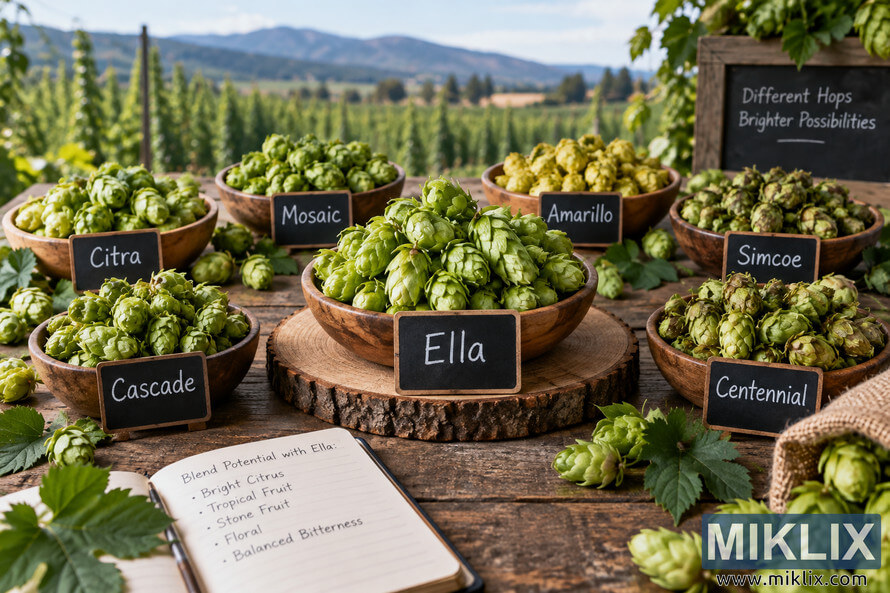
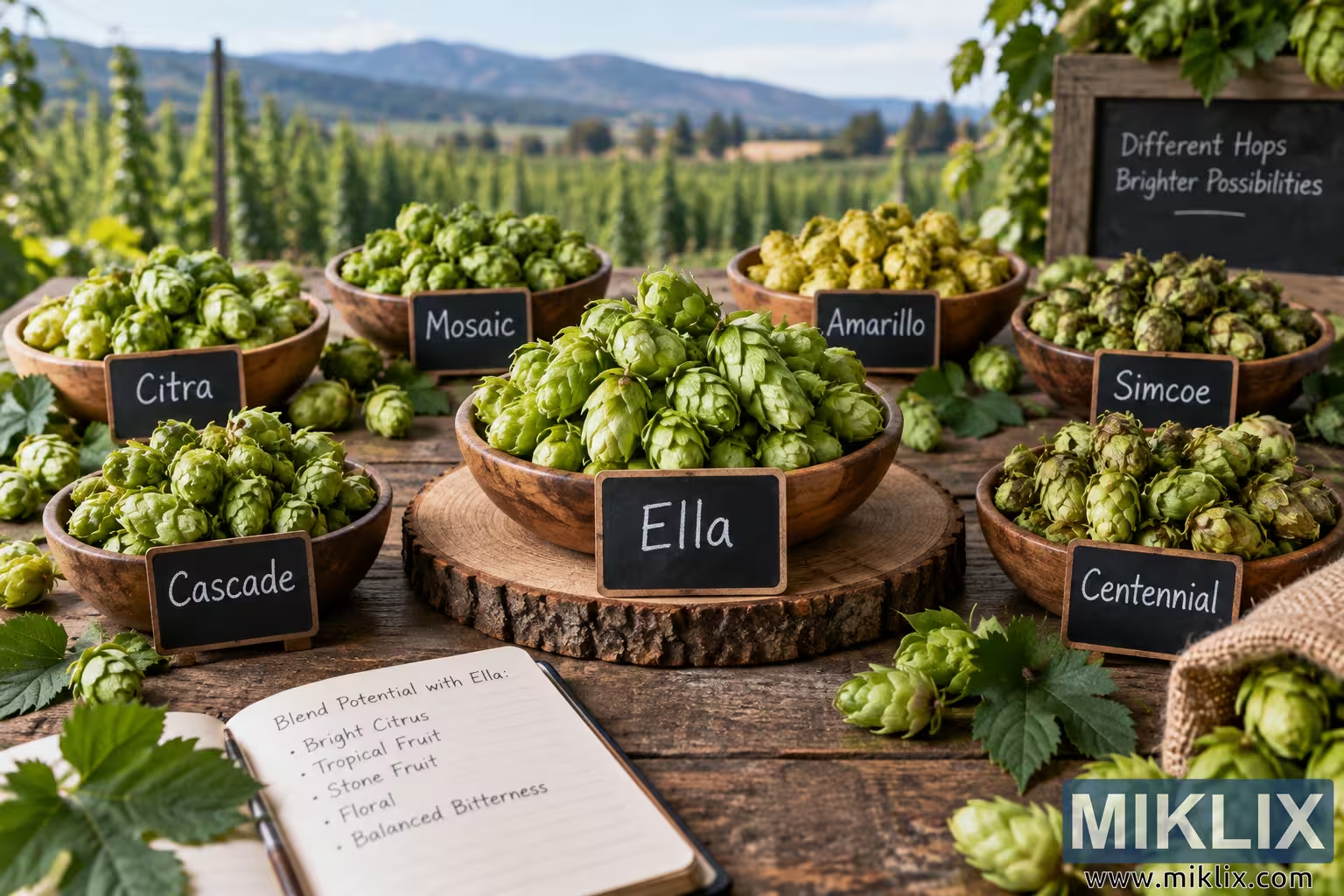
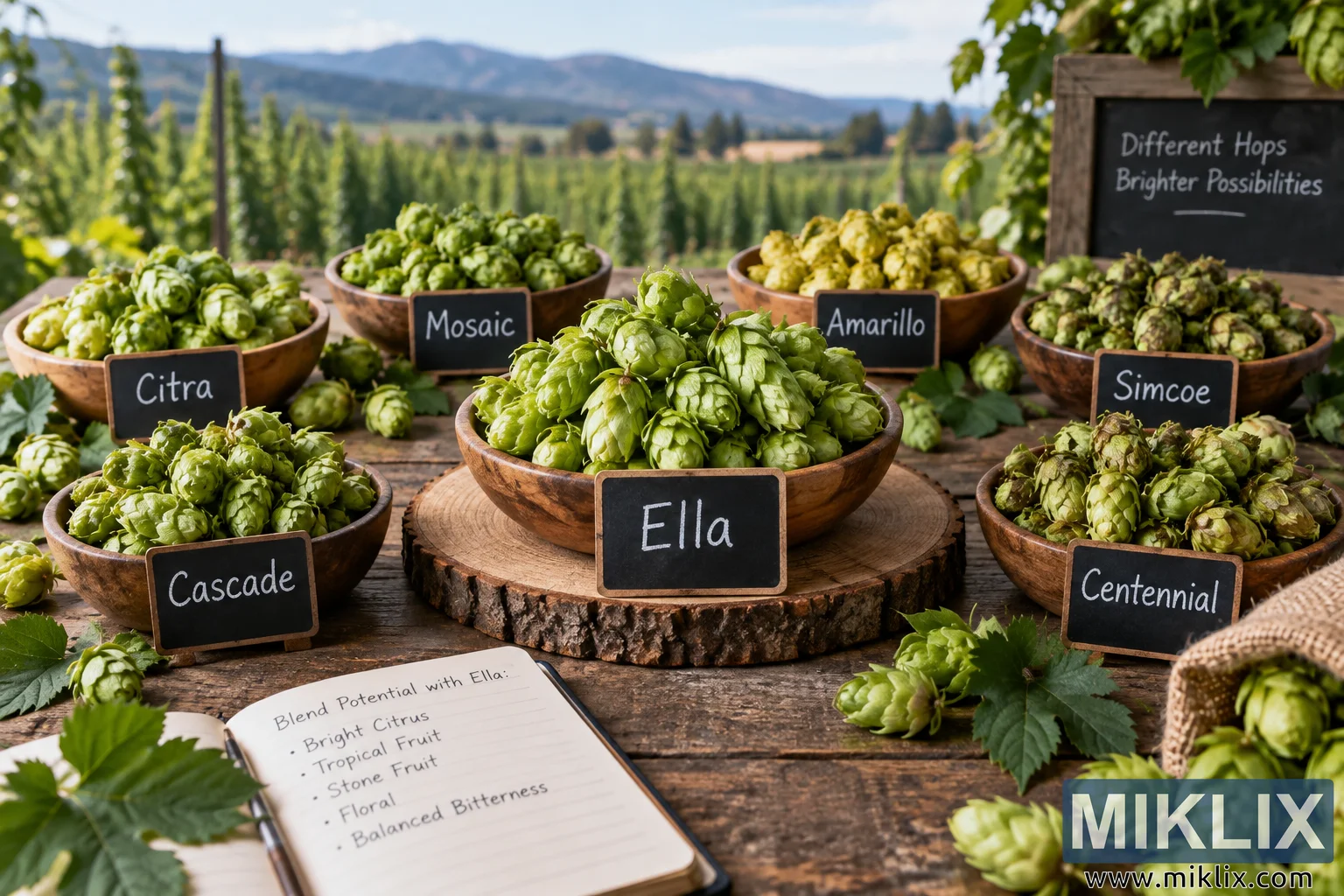
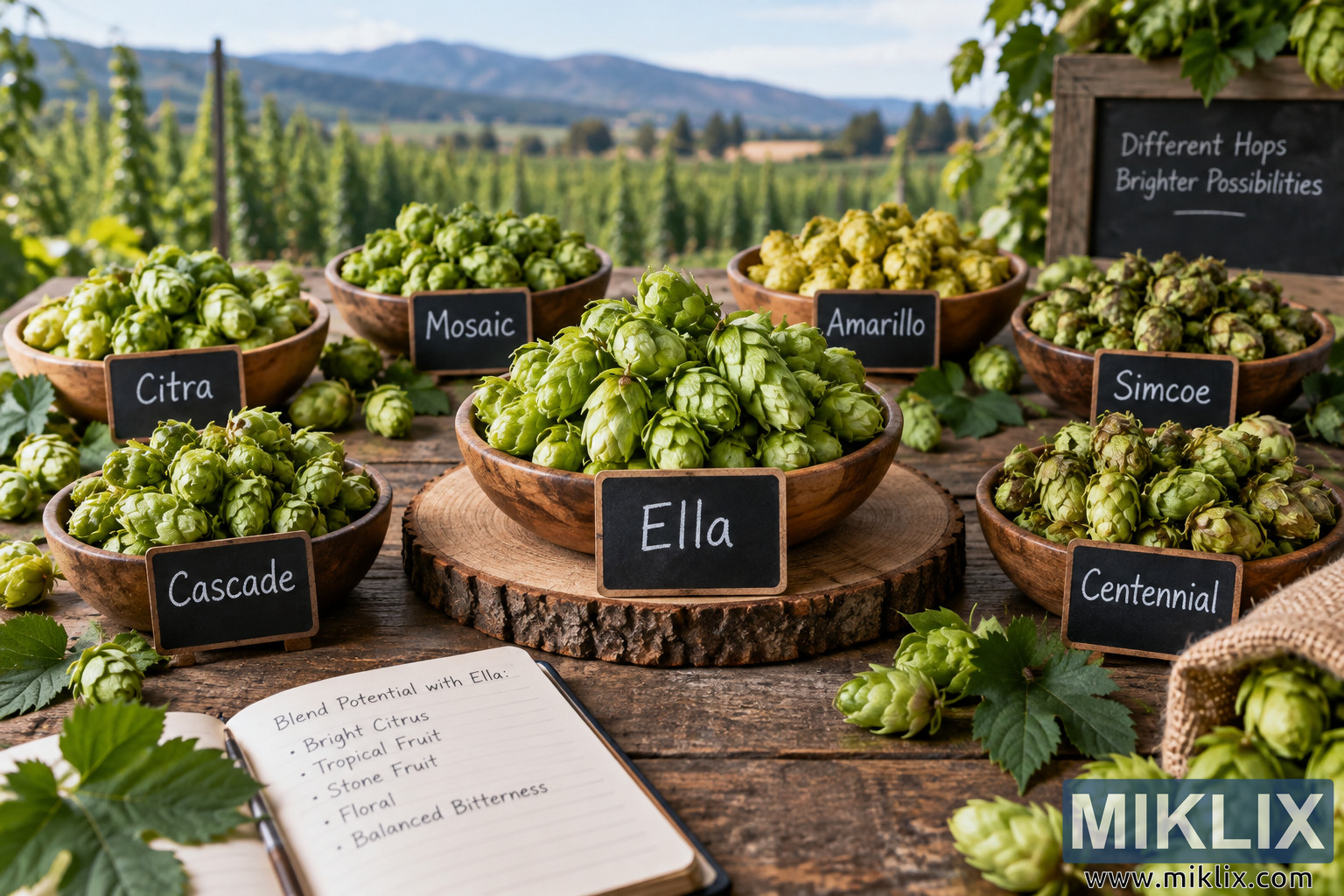
A wide, landscape-oriented photograph presents an abundant selection of fresh hop varieties arranged together on a rustic wooden table, visually communicating the potential for creating hop blends centered around Ella. The setting has the character of a hop farm, brewery garden, or outdoor tasting area, with natural sunlight illuminating the ingredients and creating a warm, agricultural atmosphere. In the center of the composition is a large wooden bowl filled generously with fresh green hop cones. This central variety is identified as Ella by a small rectangular black chalkboard sign positioned directly in front of the bowl. The handwritten white lettering makes the name easy to recognize while preserving the handcrafted, farm-to-brewery aesthetic of the scene. The Ella hops occupy the visual focal point and are elevated on a thick circular slice of natural wood, emphasizing their role as the foundation around which the other varieties can potentially be blended.
Surrounding the central Ella bowl are several additional wooden bowls containing hop cones with subtly different appearances, shades of green, and levels of maturity. Small chalkboard labels identify the surrounding varieties as Citra, Mosaic, Amarillo, Simcoe, Cascade, and Centennial. Citra appears toward the upper left, with a bowl of bright green cones positioned near the edge of the table. Mosaic is displayed slightly behind and closer to the center, also represented by fresh, tightly layered green hop cones. Amarillo occupies a bowl in the upper-right portion of the central grouping, where its hops appear somewhat more yellow-green in the sunlight. Farther to the right is Simcoe, represented by darker, slightly more muted cones. Cascade is positioned in the lower-left portion of the arrangement, while Centennial appears in the lower-right area. Together, these individually labeled bowls create a semicircular presentation around Ella and immediately suggest comparison, experimentation, and complementary blending possibilities.
The hop cones themselves are shown with substantial botanical detail. Their overlapping papery bracts, rounded conical forms, delicate stems, and variations in green coloration are clearly visible. Some cones appear vivid lime green, while others lean toward deeper olive or yellow-green tones. Loose hop cones have been scattered naturally across the tabletop between the bowls, preventing the display from feeling overly formal. Fresh hop leaves and trailing pieces of foliage are also placed around the arrangement. These leafy elements reinforce the impression that the hops have recently been harvested and connect the tabletop display visually with the cultivated plants visible in the background.
In the foreground, an open notebook rests diagonally across the wooden table. Its handwritten heading reads “Blend Potential with Ella:” followed by a short list of sensory and brewing concepts: “Bright Citrus,” “Tropical Fruit,” “Stone Fruit,” “Floral,” and “Balanced Bitterness.” The notebook introduces an educational and experimental dimension to the image. Rather than presenting the hop varieties simply as separate agricultural products, it suggests that a brewer might combine Ella with different complementary varieties to build layered aroma, flavor, and bitterness profiles. The handwritten notes also contribute to the artisanal character of the scene, evoking recipe development, brewing trials, sensory evaluation, or creative formulation in a small brewery environment.
The tabletop is made from heavily textured, weathered wooden planks. Knots, grain patterns, scratches, and irregular coloration give the surface a natural, well-used appearance. The wooden bowls echo these warm brown tones, while the circular tree-ring slab beneath the Ella bowl creates an additional organic texture. On the lower-right edge of the composition, part of a coarse burlap sack is visible with more fresh hops spilling outward. This detail strengthens the harvest theme and gives the arrangement a sense of abundance. The mixture of wood, burlap, chalkboard surfaces, paper, green foliage, and hop cones creates a tactile visual language associated with agriculture, craft brewing, and hands-on ingredient selection.
Behind the tabletop display stretches a softly focused hop field. Tall rows of hop plants climb vertical supports, forming repeated green columns that recede into the distance. The background is intentionally less sharp than the foreground, allowing the bowls and their labels to remain the primary subjects while still establishing the agricultural origin of the ingredients. Beyond the hop field, a broad mountain ridge extends across the horizon beneath a pale blue sky. The distant landscape gives the photograph an open, rural feeling and adds depth to the otherwise intimate ingredient presentation. Sunlight enters naturally across the scene, creating highlights on the hop cones and gentle shadows around the bowls and signs. The lighting emphasizes the freshness and texture of the plants without making the arrangement appear artificially staged.
At the upper-right side of the photograph, a larger framed chalkboard stands behind the bowls. In handwritten white lettering it reads “Different Hops Brighter Possibilities.” The phrase reinforces the visual message established by the multiple varieties: individual hops can contribute different characteristics, and thoughtful combinations can expand the range of possible brewing profiles. The sign is integrated into the rustic setting rather than presented as polished commercial advertising, maintaining the image's educational and craft-oriented tone.
The overall composition is balanced around the centrally positioned Ella hops. The surrounding bowls function almost like a palette of ingredients from which different combinations could be selected. Although each hop variety has its own labeled container, the proximity of the bowls, scattered cones, shared wooden surface, and handwritten blending notes visually connect them into a single concept. Ella remains the clear anchor, while Citra, Mosaic, Amarillo, Simcoe, Cascade, and Centennial illustrate possible directions for experimentation. Bright greens contrast with the warm browns of the bowls and table, while the distant field and mountains provide a calm natural backdrop. The resulting photograph conveys freshness, variety, craftsmanship, agricultural provenance, sensory exploration, and the creative potential of combining multiple hop varieties in brewing.
The image is related to: Hops in Beer Brewing: Ella