
Image: Advanced Homebrewing Setup for Hop-Forward Beer Production
Published: September 27, 2026 at 8:50:10 AM UTC
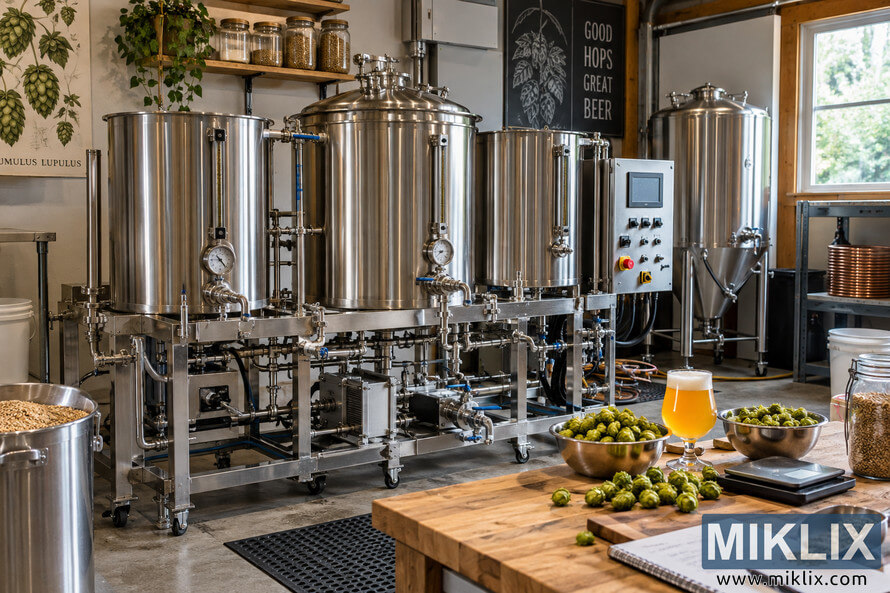
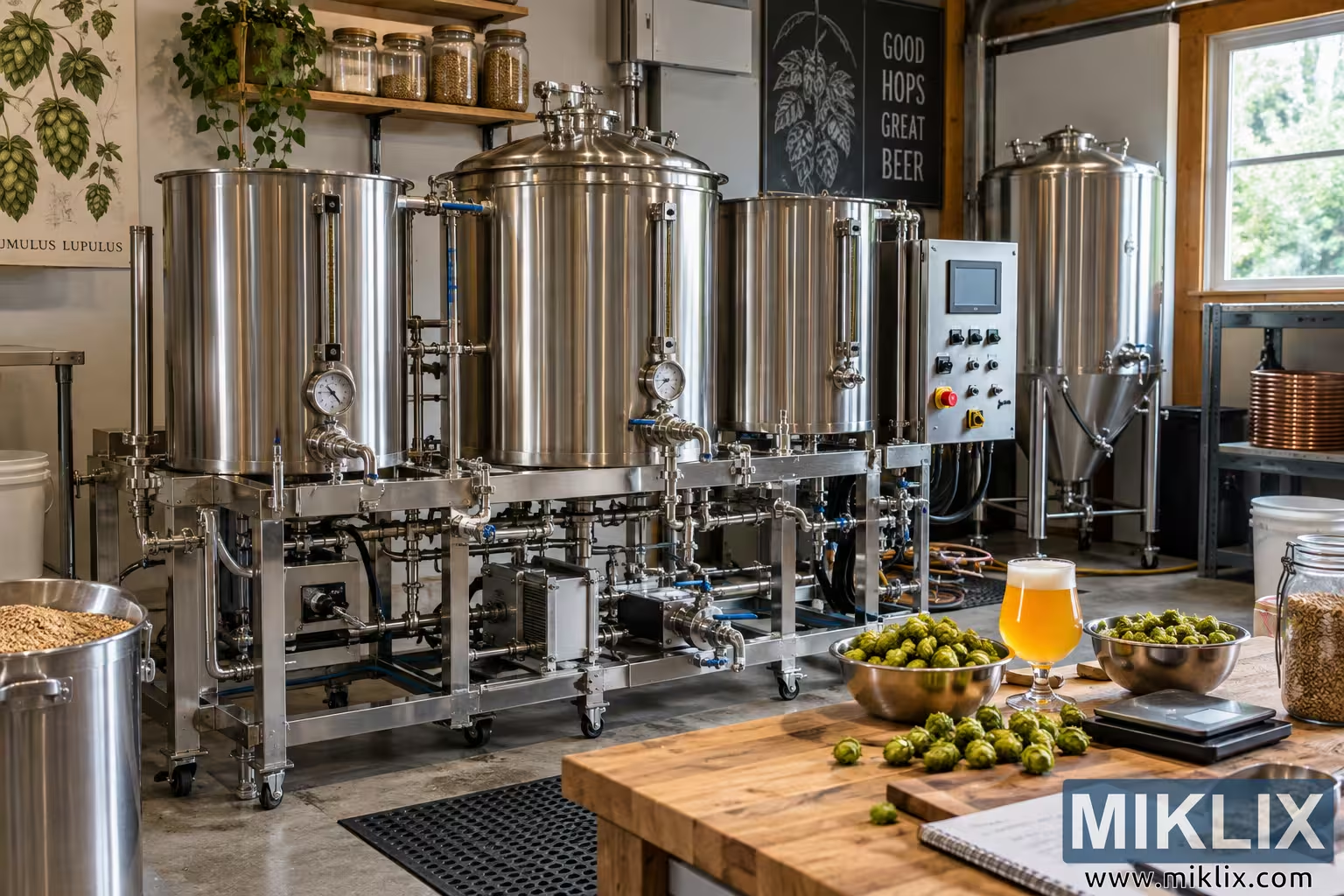
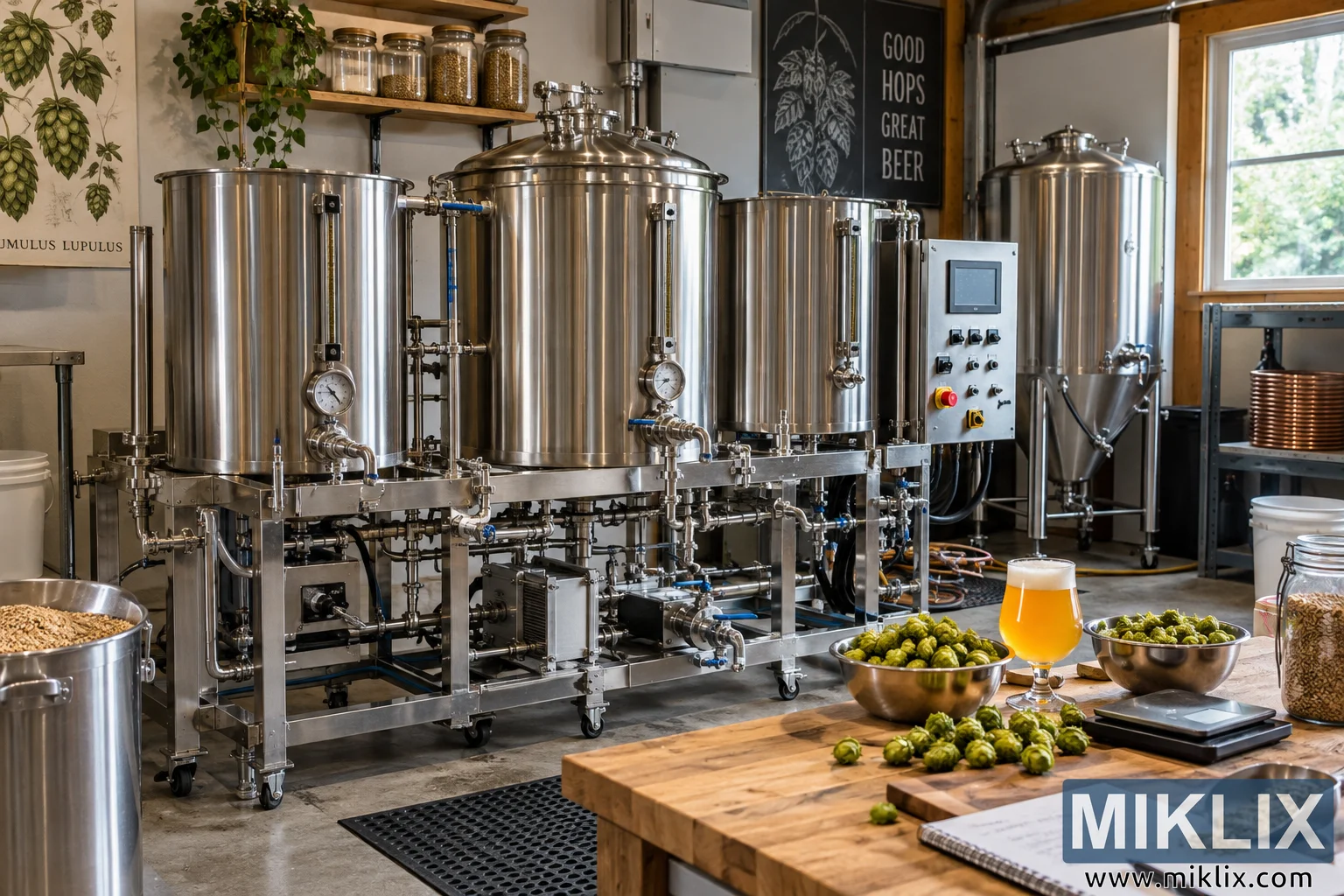
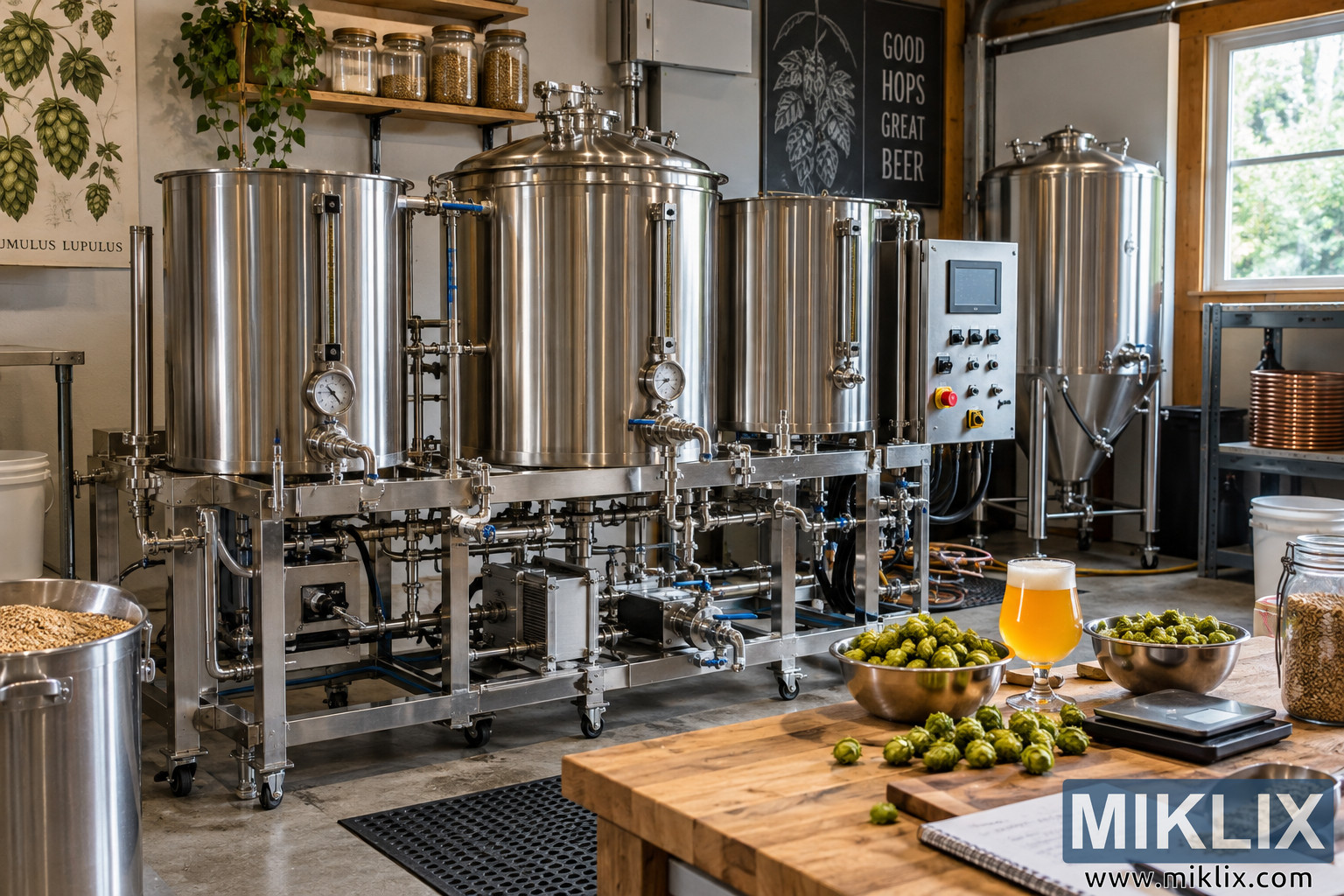
Advanced homebrewing setup for hop-forward beer production featuring stainless-steel brewing equipment, fresh hops, grain, process controls and hazy golden beer.
Available versions of this image
The image files available for download below are less compressed and higher resolution - and as a result of that, higher quality - than the images embedded in articles and pages on this website, which are more optimized for file size in order to reduce bandwidth consumption.
Regular size (1,536 x 1,024)
Large size (3,072 x 2,048)
Very large size (4,608 x 3,072)
Extra large size (6,144 x 4,096)
Comically large size (1,048,576 x 699,051)
- Still uploading... ;-)
Image description
A wide, landscape-oriented photograph shows an advanced homebrewing workspace designed for producing hop-forward beer. The room has the polished, technical appearance of a small craft brewery while remaining recognizably situated in a residential garage or dedicated home workshop. The central focus is an extensive stainless-steel brewing system consisting of several large cylindrical vessels mounted on a sturdy metal frame with caster wheels. The highly reflective tanks dominate the middle of the composition and are connected through an intricate network of stainless-steel pipes, valves, fittings, pumps, hoses, and other brewing hardware. Multiple analog gauges and vertical sight glasses are attached to the vessels, reinforcing the impression of a sophisticated system intended to give the brewer precise control over temperatures, liquid levels, and the movement of wort throughout the brewing process. To the right of the main vessels is a rectangular stainless-steel control panel. Its face contains a digital display, switches, rotary controls, indicator components, and prominent emergency-style controls, suggesting that heating, pumping, and other stages of the brewing process can be centrally managed. Beneath and between the vessels, additional pumps, plumbing connections, electrical cables, and compact pieces of processing equipment create a dense but carefully organized mechanical arrangement. Farther back on the right side of the room stands another tall stainless-steel tank, accompanied by a conical vessel that resembles equipment used for fermentation, conditioning, ingredient handling, or related brewing operations. A coil of copper-colored tubing is visible on a dark shelving unit nearby, adding another recognizable piece of brewing hardware to the workshop. The foreground introduces the ingredients that establish the hop-forward character of the intended beer. A substantial wooden workbench extends across the lower-right portion of the image. Several vivid green hop cones are scattered directly across its surface, while two stainless-steel bowls contain larger quantities of hops. Their textured, leafy cones provide a strong natural contrast to the smooth industrial surfaces of the brewing vessels. A clear stemmed glass of hazy golden-orange beer sits among the hops. The beer has a dense, pale foam head and a saturated color commonly associated visually with aromatic, hop-focused beer styles. Beside the glass is a compact digital scale, indicating the careful weighing of brewing ingredients. An open notebook lies across the front edge of the workbench with handwritten brewing notes visible on its pages, and a dark pen rests nearby. A metal scoop containing grain or crushed malt appears at the lower-right edge of the frame. A transparent jar filled with grain stands farther back on the bench, while another large metal container of grain occupies the lower-left foreground. Together, these details make the workspace feel active and functional rather than purely decorative, as though recipe development or preparation for a brewing session is underway. The background provides additional visual context for the homebrewing environment. Wooden shelves mounted high on the rear wall hold several clear jars filled with different grains or brewing ingredients. A green hop plant trails around the shelving area, visually linking the raw botanical ingredient with the finished brewing equipment. Botanical hop illustrations and hop-themed wall art decorate the walls, emphasizing the central role of hops in the brewing setup without relying on commercial product branding. The room combines white wall surfaces, exposed timber framing, dark storage furniture, and a gray concrete floor. A large window on the right allows bright natural daylight into the workshop and offers a softly focused view of green vegetation outdoors. This natural illumination mixes with warm interior light, producing attractive highlights and reflections across the polished stainless-steel equipment. Black anti-fatigue or drainage mats are placed on the concrete floor around the brewing system, suggesting a practical working area where spills and extended periods of standing are expected. Buckets, shelving, hoses, cables, containers, and other utility items are positioned around the edges of the scene but remain orderly enough that the main brewing system is visually dominant. The composition balances industrial precision with the tactile character of small-scale craft brewing. Stainless steel, glass, copper-colored tubing, unfinished wood, green hops, pale grain, and amber-gold beer create a varied material palette. The foreground ingredients provide depth and a human-scale point of reference, while the large vessels in the middle ground communicate the advanced nature of the equipment. Although no brewer is visible, the open notebook, measured ingredients, prepared hops, and poured beer imply experimentation, recipe refinement, and hands-on production. Overall, the image portrays a highly equipped homebrewing environment optimized for serious beer making, with particular visual emphasis on fresh hops, ingredient measurement, process control, fermentation equipment, and the production of aromatic hop-forward beer.
The image is related to: Hops in Beer Brewing: Ella