
Image: Laboratory Analysis of Falconer's Flight Hop Acids
Published: September 28, 2026 at 3:40:29 PM UTC
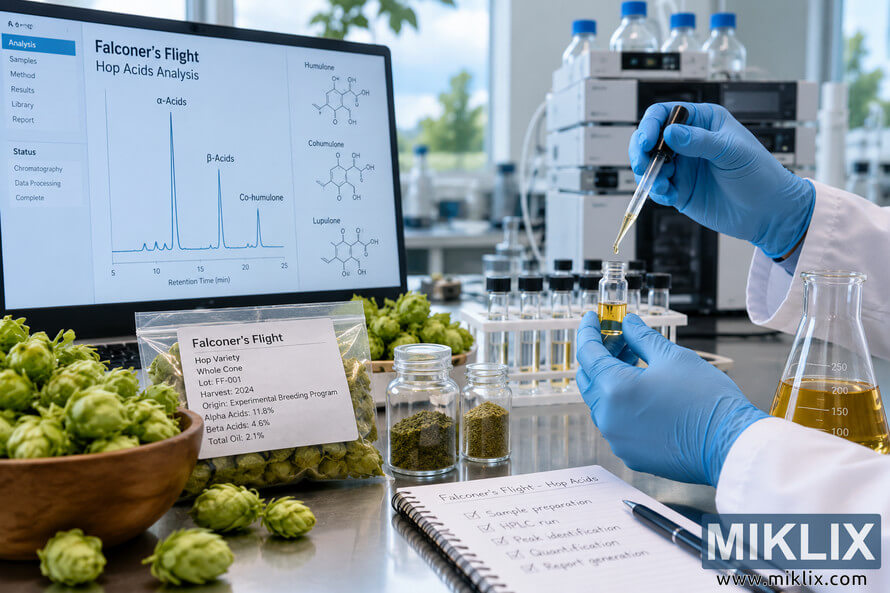
Laboratory analysis of Falconer's Flight hop acids with hop samples, liquid preparation, HPLC equipment, chromatogram results, and molecular structures.
Available versions of this image
The image files available for download below are less compressed and higher resolution - and as a result of that, higher quality - than the images embedded in articles and pages on this website, which are more optimized for file size in order to reduce bandwidth consumption.
Regular size (1,536 x 1,024)
Large size (3,072 x 2,048)
Very large size (4,608 x 3,072)
Extra large size (6,144 x 4,096)
Comically large size (1,048,576 x 699,051)
- Still uploading... ;-)
Image description
A wide, landscape-oriented photograph depicts a bright, modern analytical laboratory during a scientific investigation of hop acids. The composition centers on the laboratory analysis of a hop sample identified in the scene as Falconer's Flight. The setting is clean, orderly, and illuminated by abundant natural daylight entering through large windows in the background. Cool white and blue laboratory tones are balanced by the vivid green of the hop material and the warm golden-yellow color of liquid samples, creating a visually clear connection between the botanical raw material and the chemical analysis being performed.
On the right side of the image, a laboratory worker is partially visible from the shoulders and arms, wearing a white laboratory coat and bright blue disposable gloves. The person's face is outside the frame, keeping the viewer's attention on the analytical procedure. One gloved hand holds a small transparent sample vial containing a clear golden-yellow liquid, while the other hand holds a pipette or dropper directly above the vial. A small droplet of liquid is visible at the tip, capturing the precise moment before the sample is dispensed. This careful handling of a small liquid volume communicates controlled laboratory technique and suggests sample preparation, dilution, extraction, or transfer as part of the analytical workflow.
Behind the worker is a large piece of chromatography equipment resembling a high-performance liquid chromatography, or HPLC, system. Several solvent bottles with blue caps are positioned above the instrument, while tubing and stacked analytical modules reinforce the appearance of a professional chemistry laboratory. In front of the equipment is a rack containing multiple small sample tubes or vials. Some contain pale yellow or amber liquids, visually connecting them to the sample being handled by the scientist. The equipment is slightly softer in focus than the foreground, creating depth while still making its analytical purpose immediately recognizable.
The left side of the composition is dominated by a large computer monitor displaying analytical results. The screen is headed with the text “Falconer's Flight Hop Acids Analysis” and shows a chromatogram with several distinct peaks. Prominent peaks are labeled for alpha acids, beta acids, and co-humulone, while the horizontal axis indicates retention time in minutes. A navigation area on the left side of the interface contains analysis-related categories such as samples, method, results, library, and report, together with a status section referring to chromatography and data processing. On the right portion of the display are simplified chemical structural diagrams associated with hop-acid compounds, including labels for humulone, cohumulone, and lupulone. Together, the chromatographic graph and molecular structures visually communicate the identification and quantification of different bitter-acid components in hops.
Across the stainless-steel laboratory bench in the foreground are numerous hop cones and prepared hop samples. At the far left, a wooden bowl is filled with fresh-looking green hop cones. Additional cones are scattered naturally across the reflective work surface. Behind them are more green hop clusters, producing a strong botanical contrast with the highly technical laboratory apparatus. Near the center-left is a transparent sample bag containing dried hop material. Its white laboratory-style label identifies the sample as Falconer's Flight and includes several lines of specimen information and analytical values. Two small clear glass jars stand nearby, each containing finely ground or powdered green plant material, suggesting different stages of sample preparation before chemical extraction or instrumental analysis.
In the lower center and right foreground, an open spiral-bound laboratory notebook rests on the bench. The heading refers to Falconer's Flight hop acids, and beneath it is a handwritten checklist representing stages of the analytical process, including sample preparation, an HPLC run, peak identification, quantification, and report generation. A dark pen lies diagonally across the notebook. This detail gives the laboratory scene a practical, working quality by showing that observations and procedural steps are being documented alongside the instrumental measurements.
At the far right edge of the bench is a clear laboratory flask containing a larger volume of transparent amber-gold liquid. Measurement graduations are visible on the glass, further emphasizing the quantitative nature of the work. Smaller containers, sample vials, racks, glassware, and laboratory accessories extend into the middle and background of the scene. Reflections from the stainless-steel surface add brightness and reinforce the sterile, professional character of the environment.
The image uses selective depth of field while retaining substantial detail throughout the principal working area. The scientist's blue gloves, the golden sample vial, the green hop cones, and the chromatogram form the strongest visual anchors. The perspective guides the eye from the raw hops in the foreground, through the prepared botanical samples and liquid extracts, toward the chromatography equipment and finally to the analytical results on the monitor. This progression visually tells the story of laboratory analysis from agricultural material to chemical measurement and interpretation.
Overall, the photograph presents a polished scientific visualization of hop-acid analysis in a contemporary laboratory. It combines recognizable brewing-related botanical material with analytical chemistry techniques, including sample preparation, liquid handling, chromatography, molecular identification, quantitative results, and laboratory documentation. The scene conveys precision, cleanliness, scientific rigor, and controlled experimentation while retaining the organic visual character of hops. No visible commercial brand logos are used; the emphasis remains on the laboratory process, the hop sample, and the chemical analysis rather than on branded equipment or products.
The image is related to: Hops in Beer Brewing: Falconer's Flight