
Image: Hop Addition Schedule on Home Brew Day
Published: September 28, 2026 at 3:40:29 PM UTC
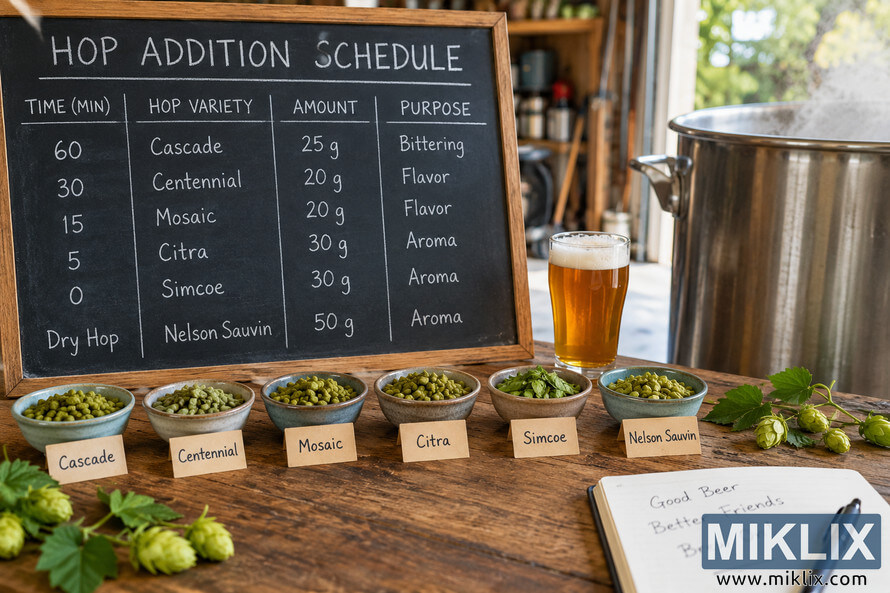
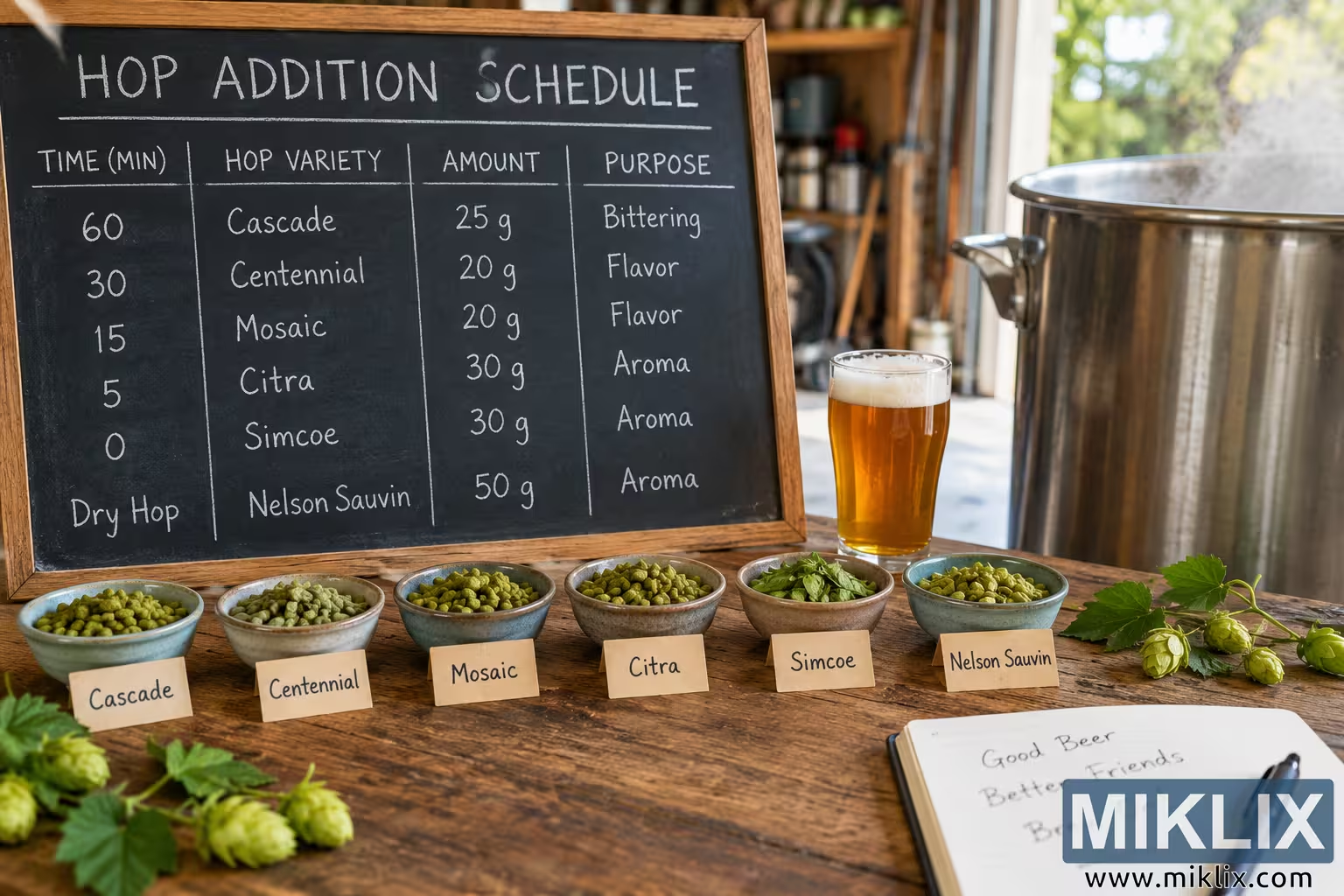
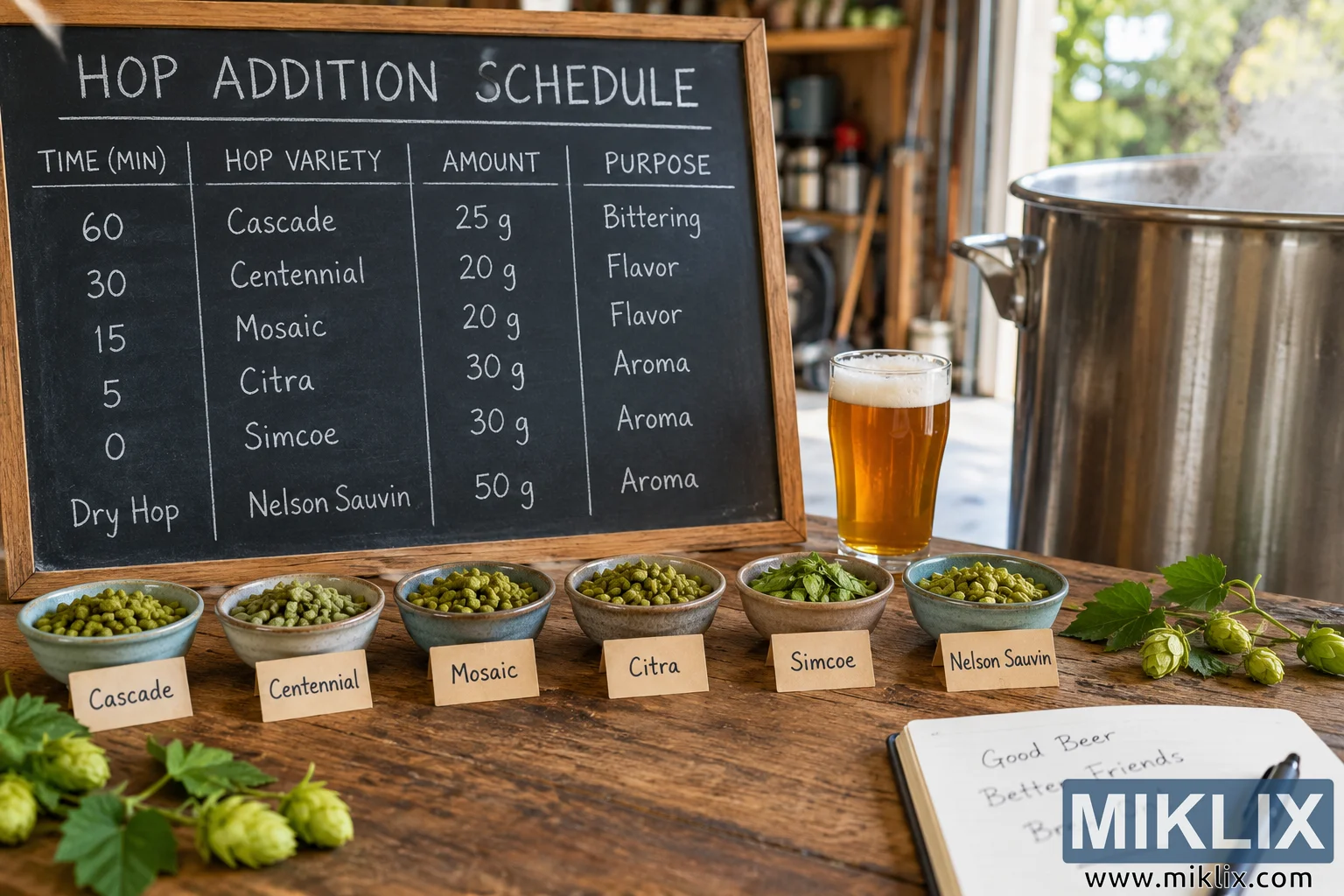
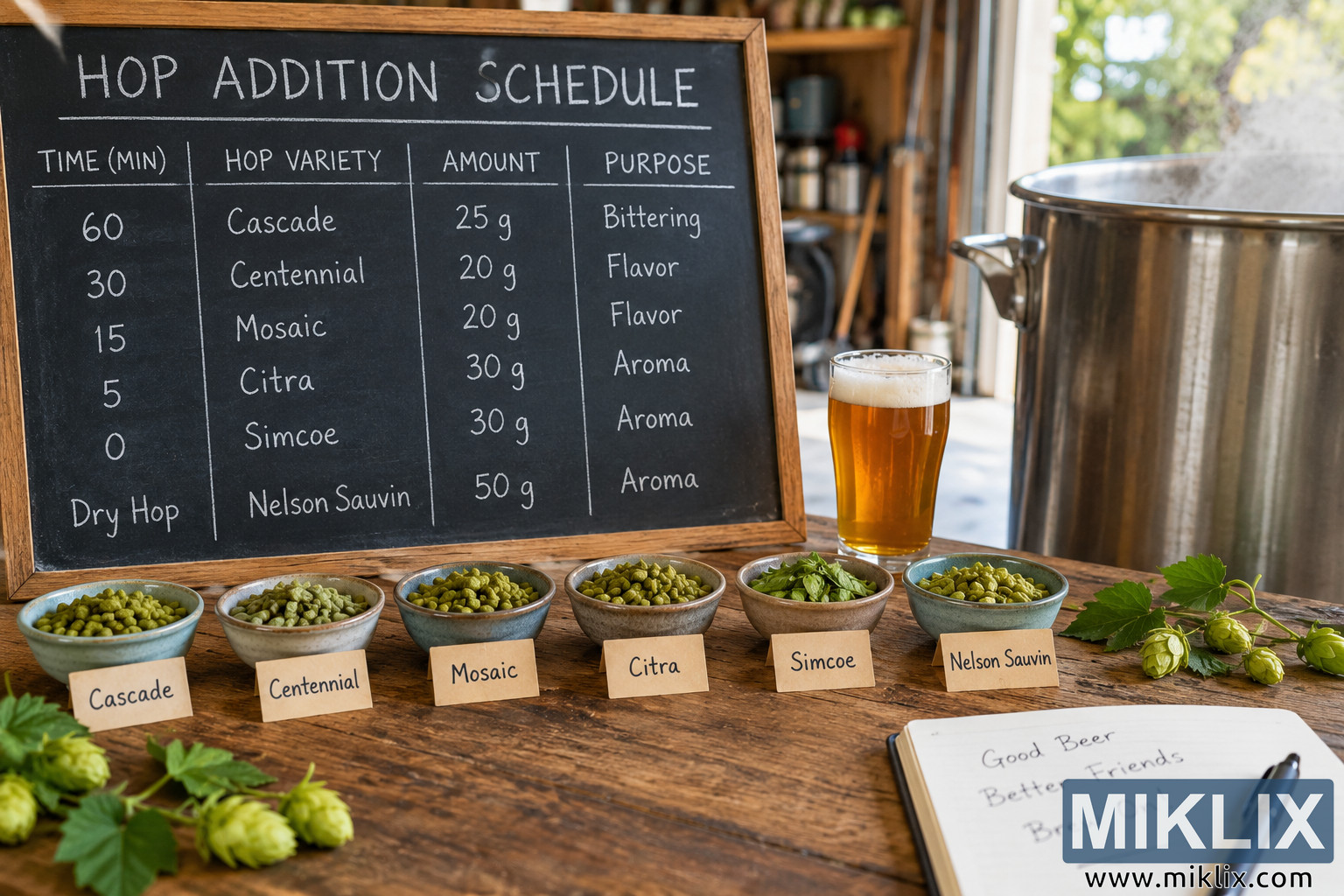
A rustic brew-day scene featuring a hop addition schedule, prepared hop varieties, fresh hops, amber beer, brewing notes, and a steaming kettle.
Available versions of this image
The image files available for download below are less compressed and higher resolution - and as a result of that, higher quality - than the images embedded in articles and pages on this website, which are more optimized for file size in order to reduce bandwidth consumption.
Regular size (1,536 x 1,024)
Large size (3,072 x 2,048)
Very large size (4,608 x 3,072)
Extra large size (6,144 x 4,096)
Comically large size (1,048,576 x 699,051)
- Still uploading... ;-)
Image description
A wide, landscape-oriented photograph depicts a warm, rustic home-brewing workspace arranged around the theme of a hop addition schedule on brew day. The setting resembles a small brewing shed, workshop, or cozy outbuilding, with natural wood surfaces, practical brewing equipment, and soft daylight entering from an opening on the right side of the scene. The composition is dominated by a large framed black chalkboard positioned on the left half of the image. Written across the top in large white chalk lettering is the heading “HOP ADDITION SCHEDULE.” Beneath the heading, the board is organized into a simple hand-drawn table with four columns labeled “TIME (MIN),” “HOP VARIETY,” “AMOUNT,” and “PURPOSE.” The chalk lettering and ruled lines have subtle irregularities that reinforce the handmade, small-batch brewing atmosphere. The schedule lists several stages of hop addition. A 60-minute addition specifies Cascade at 25 g for bittering. A 30-minute addition lists Centennial at 20 g for flavor, followed by Mosaic at 15 minutes and 20 g for flavor. Citra appears as a 5-minute addition at 30 g for aroma, while Simcoe is shown at 0 minutes with 30 g for aroma. A final dry-hop entry lists Nelson Sauvin at 50 g for aroma. The schedule makes the brewing concept immediately understandable and provides the image with a clear visual narrative: different hop varieties are prepared in advance so that they can be added to the brewing kettle at specific stages of the process. In front of the chalkboard is a substantial, weathered wooden worktable with visible grain, knots, scratches, and natural variations in tone. Six small ceramic bowls are arranged in a row across the table. Most contain green hop pellets, while one appears to contain fresh leafy hop material. Small kraft-paper cards stand in front of the bowls and identify the hop varieties as Cascade, Centennial, Mosaic, Citra, Simcoe, and Nelson Sauvin. The muted ceramic finishes, green hops, tan paper labels, and rich brown tabletop create an earthy palette appropriate to traditional craft brewing. Fresh hop vines are also scattered decoratively around the work surface. In the lower-left foreground, several vivid green hop cones and broad serrated leaves extend partially into the frame, creating a strong sense of depth. On the right side of the table, another hop vine carries several pale green cones attached to stems and leaves. These fresh botanical elements contrast with the compact processed hop pellets in the bowls and visually connect the brewing ingredients to the hop plant itself. Behind the ingredients, slightly right of center, stands a clear pint glass filled with bright amber-gold beer. A creamy off-white foam head rests on top of the beer. Light passing through the glass gives the liquid a luminous appearance and adds a warm golden highlight to the otherwise earthy scene. The glass is unbranded and contains no logos or commercial markings. To the far right is a large stainless-steel brewing kettle. Its reflective metallic surface catches the surrounding daylight and warm tones of the room. A sturdy handle projects from the side, and faint steam is visible rising from the open top, suggesting that wort is actively boiling or has recently reached brewing temperature. This steaming kettle establishes that the scene represents an active brew day rather than merely a static display of brewing ingredients. The background is softly out of focus, helping the chalkboard, hops, beer, and kettle remain visually prominent. Wooden shelves and workshop structures can be seen behind the board and kettle, together with indistinct brewing or storage equipment. The right side opens toward bright outdoor greenery, where sunlit foliage creates soft green and yellow bokeh. This natural illumination gives the photograph an inviting late-morning or afternoon character. In the lower-right foreground, an open notebook rests on the wooden table beside a dark pen. Handwritten words on the page read “Good Beer Better Friends Brew On!” with a short underline beneath them, adding an informal personal touch associated with hobby brewing and shared beer culture. The notebook also reinforces the planning aspect of the image, suggesting recipe notes, brew-day records, measurements, or observations. No people are visible. Instead, the brewing tools and carefully arranged ingredients tell the story of a brewer who has prepared everything before beginning the timed hop additions. The photograph uses a relatively low viewing angle close to tabletop height, making the hop bowls and labels feel tangible while allowing the chalkboard to remain large and legible in the background. The kettle balances the substantial visual weight of the chalkboard, while the amber beer forms a bright focal point between the two. Overall, the image communicates organization, preparation, craft, and enthusiasm for small-batch brewing. Its combination of a clearly displayed hop schedule, individually prepared hop varieties, fresh hop cones, steaming kettle, finished beer, handwritten notes, rustic wood, and natural daylight creates an educational yet atmospheric representation of hop additions during brew day. There are no visible commercial brands, logos, branded packages, or recognizable corporate identifiers anywhere in the scene.
The image is related to: Hops in Beer Brewing: Falconer's Flight