
Image: Hop Blending Chart with Brewer’s Notes and Flavor Profiles
Published: September 28, 2026 at 3:40:29 PM UTC
Detailed hop blending chart with flavor profiles, suggested blend ratios, brewer’s notes, fresh hops, malt grains, and beer arranged on a rustic wooden table.
Available versions of this image
The image files available for download below are less compressed and higher resolution - and as a result of that, higher quality - than the images embedded in articles and pages on this website, which are more optimized for file size in order to reduce bandwidth consumption.
Regular size (1,536 x 1,024)
Large size (3,072 x 2,048)
Very large size (4,608 x 3,072)
Extra large size (6,144 x 4,096)
Comically large size (1,048,576 x 699,051)
- Still uploading... ;-)
Image description
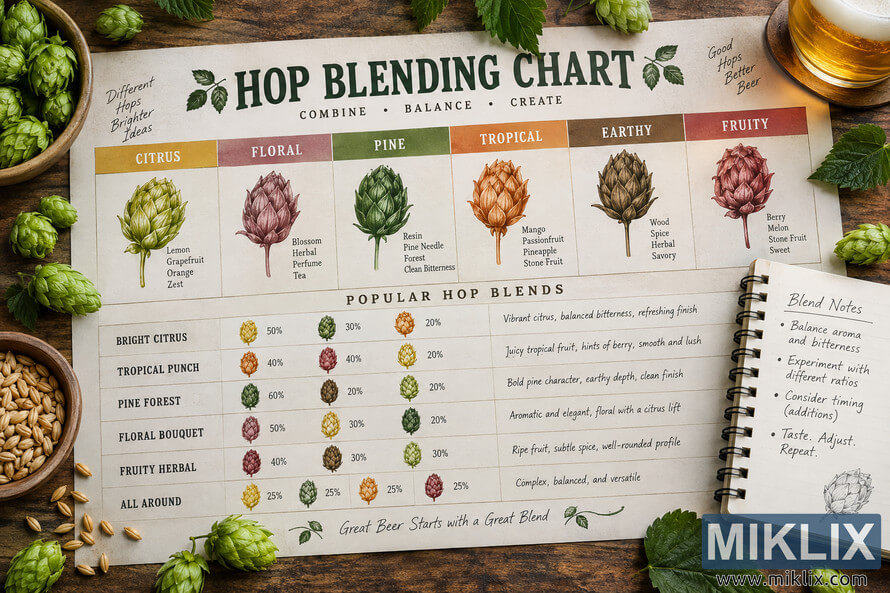
A high-resolution landscape-oriented still-life image presents a detailed hop blending chart arranged on a rustic dark wooden tabletop. The composition is photographed from a mostly top-down perspective with a slight natural angle, giving the scene the appearance of a carefully prepared brewer’s workspace. At the center is a large cream-colored printed sheet titled “HOP BLENDING CHART” in prominent dark green uppercase lettering. Small botanical hop illustrations flank the heading, while the words “COMBINE • BALANCE • CREATE” appear underneath. The overall design combines the visual language of a vintage botanical reference sheet, a practical brewing guide, and handwritten workshop notes. No recognizable commercial branding, company logos, product packaging, or trademarked visual identities are present.
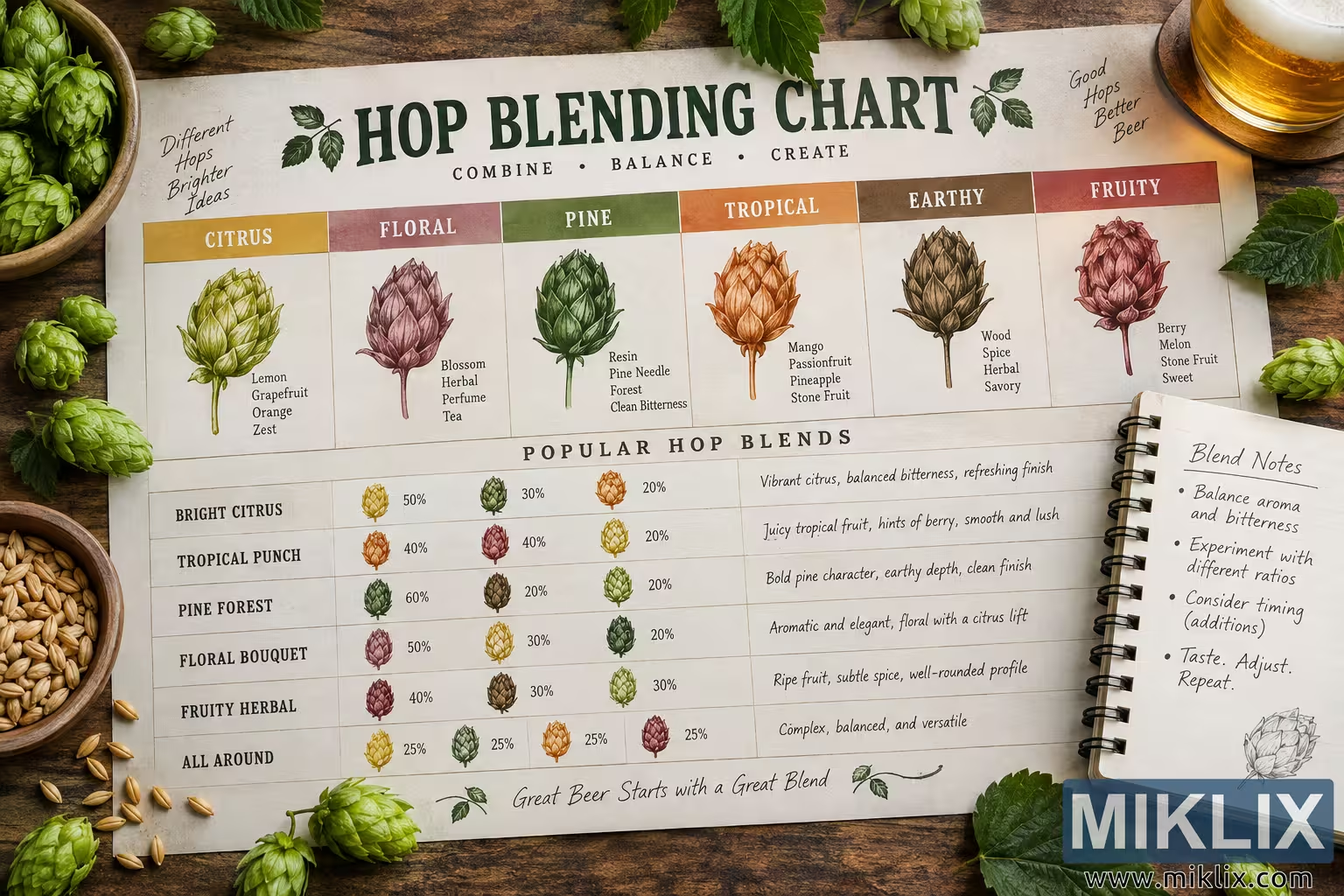
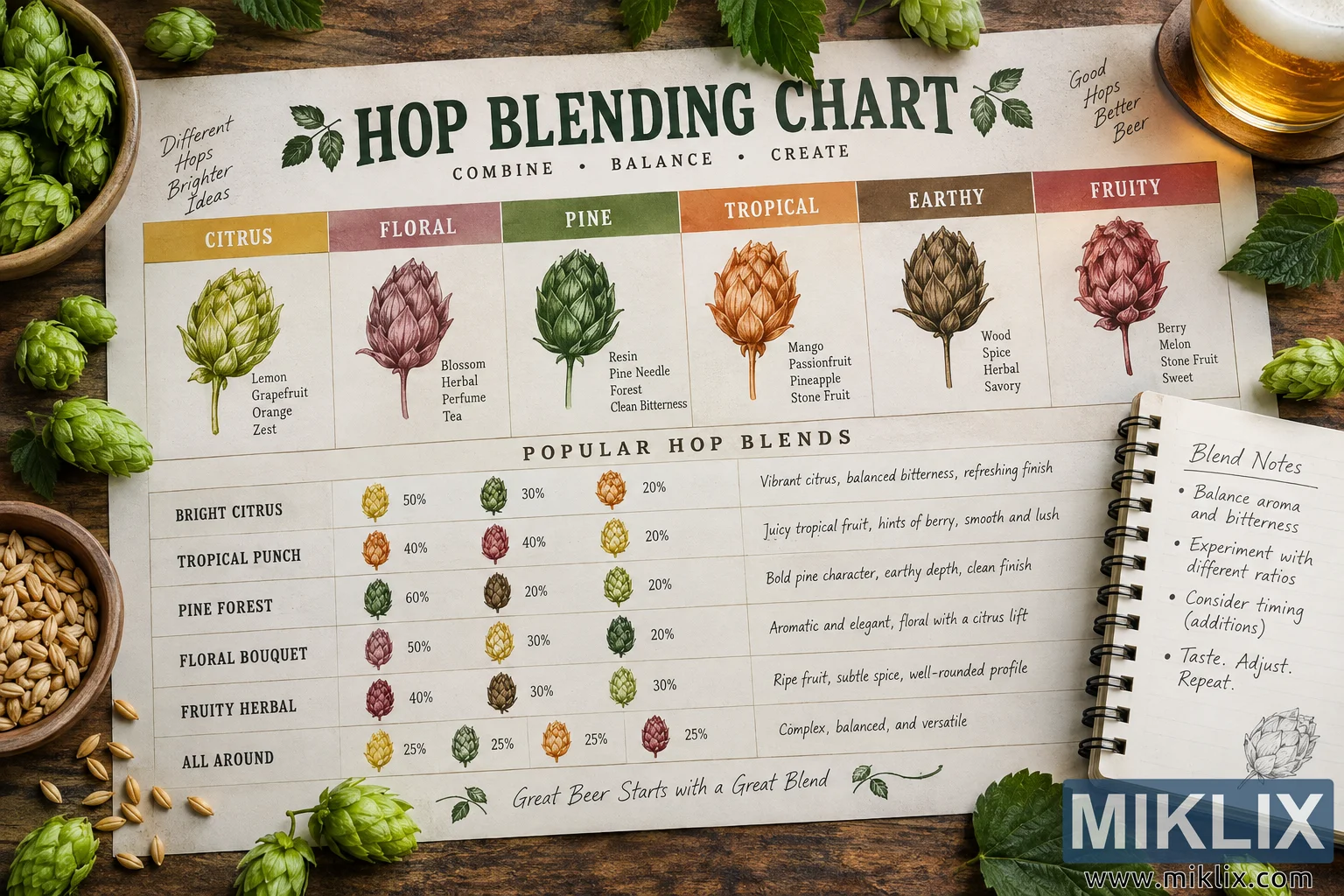
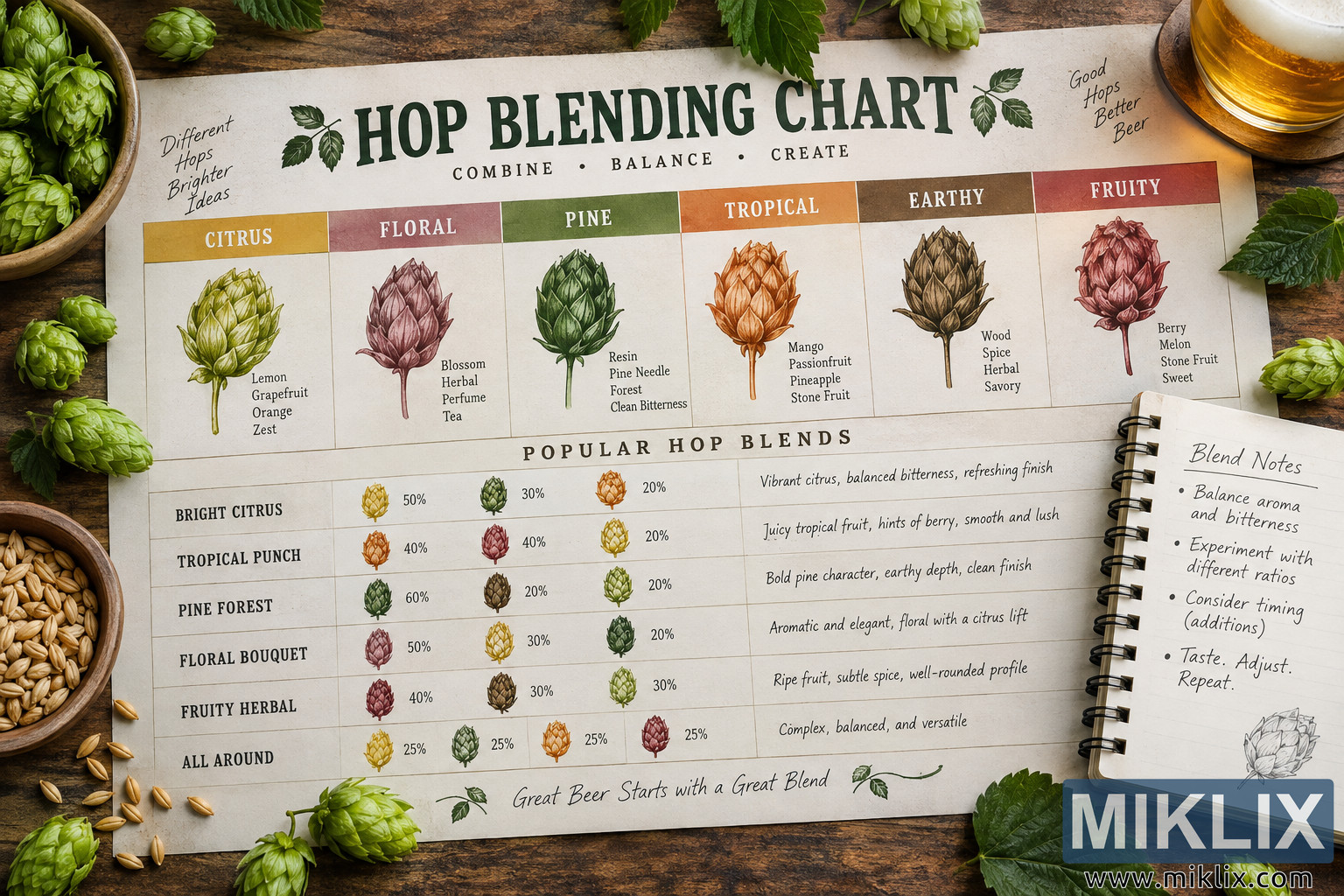
The upper half of the central chart is divided into six vertical flavor-profile sections. Each section has a colored header and a botanical-style illustration of a hop cone. The categories are Citrus, Floral, Pine, Tropical, Earthy, and Fruity. Beneath each illustrated hop are short sensory descriptors that suggest the aromas and flavors associated with that profile. The Citrus section includes references such as lemon, grapefruit, orange, and zest. Floral is associated with blossom, herbal, perfume, and tea characteristics. Pine includes resin, pine needle, forest, and clean bitterness. Tropical emphasizes mango, passionfruit, pineapple, and stone-fruit impressions. Earthy includes wood, spice, herbal, and savory qualities. Fruity references berry, melon, stone fruit, and sweetness. The hop illustrations are individually colored to make the categories easy to distinguish while preserving the muted, handcrafted character of the chart.
A horizontal divider introduces the lower section under the heading “POPULAR HOP BLENDS.” This area resembles a practical recipe matrix. Several blend concepts are arranged in rows, including Bright Citrus, Tropical Punch, Pine Forest, Floral Bouquet, Fruity Herbal, and All Around. Small colored hop symbols represent the different flavor families, with percentage values positioned beside them to indicate suggested proportions. The Bright Citrus blend, for example, visually emphasizes a citrus-oriented component while balancing it with smaller portions of contrasting hop profiles. Other rows use combinations of tropical, fruity, pine, earthy, floral, and citrus characteristics. Short tasting notes appear toward the right side of each row, describing intended outcomes such as vibrant citrus with balanced bitterness, juicy tropical fruit, bold pine character, aromatic floral qualities, ripe fruit with subtle spice, or a complex and versatile overall profile. These values and descriptions are presented as an illustrative blending reference rather than as branded product recommendations.
Along the bottom edge of the chart is a handwritten-style phrase reading “Great Beer Starts with a Great Blend,” accompanied by small decorative botanical marks. The typography throughout the main sheet mixes strong condensed serif headings with smaller printed labels and looser handwritten annotations. The paper has a warm, slightly aged ivory appearance, contributing to the impression of an established brewing notebook or traditional botanical field guide rather than a modern corporate infographic.
A spiral-bound notebook overlaps the chart along the right side. Its open page is headed “Blend Notes” in handwritten lettering. Several bullet points underneath summarize practical blending principles: balancing aroma and bitterness, experimenting with different ratios, considering the timing of additions, and tasting, adjusting, and repeating. A simple hand-drawn hop cone appears near the bottom of the notebook page. The notebook reinforces the experimental, workshop-like atmosphere and makes the scene feel as though a brewer is actively developing recipes rather than merely viewing a finished poster.
Additional handwritten notes appear directly around the main chart. In the upper-left area, a casual annotation refers to different hops and brighter ideas. Near the upper-right corner, another note reads like an informal reminder about good hops and better beer. These handwritten elements provide visual personality and contrast with the structured grid of the printed chart.
Fresh green hop cones and leafy hop foliage are distributed around the chart to connect the information on the page with the physical brewing ingredient. A wooden bowl filled with vivid green hop cones occupies the upper-left corner. More individual cones are scattered down the left side, across the lower edge, and near the right side of the composition. Their layered scales and natural green tones are rendered with substantial detail. Large dark green leaves frame parts of the upper and lower edges, while smaller stems and foliage appear between the paper and the surrounding tabletop. The irregular placement of the plant material keeps the composition organic despite the chart’s precise grid structure.
At the lower-left corner, a second wooden bowl contains pale golden malt grains. Several grains have spilled onto the tabletop, creating a loose trail beside the chart. The malt introduces another recognizable brewing ingredient and provides a warm beige-gold color contrast against the green hops and dark brown wood. At the upper-right corner, part of a clear drinking glass filled with golden beer is visible. The beverage has a bright amber-gold appearance and is topped with a dense pale foam head. Only part of the glass is shown, allowing it to function as contextual scenery without competing with the information sheet as the focal point.
Lighting is warm, soft, and directional, resembling natural window light or carefully diffused studio illumination. Subtle shadows beneath the hops, bowls, notebook, leaves, and paper create convincing depth while keeping the printed information legible. The wood grain of the table is strongly textured, with scratches, tonal variations, and rustic imperfections that contribute to the artisanal atmosphere. The cream paper, green botanical elements, golden malt and beer, and earthy brown background form a cohesive natural palette associated with brewing ingredients and traditional craft processes.
The image is composed in a wide landscape format. The central chart occupies most of the frame, while ingredients and tools create an informal border around it. The overall mood is educational, practical, handcrafted, and inviting. It visually communicates the idea of experimenting with hop combinations by aroma and flavor profile, recording observations, adjusting proportions, and developing balanced beer recipes. The combination of infographic-style information, botanical illustration, physical ingredients, handwritten notes, and brewing context makes the scene suitable for editorial material, educational brewing content, craft-beverage articles, recipe inspiration, or general visual storytelling about hop blending and beer formulation.
The image is related to: Hops in Beer Brewing: Falconer's Flight